What function does the falling shadow serve in an image, and why do artists sometimes include it while others consciously omit it?
CONCEPT
Casting a shadow has traditionally been seen as a sign of mastery: if it’s there, the artist understands optics; if it’s not, they haven’t mastered it yet. This gives rise to a familiar narrative where Antiquity nearly achieved verisimilitude, the Middle Ages lost it, and the Renaissance recovered it. This schema is convenient, but it forces us to view Medieval imagery as a failure and prevents us from asking why shadow is necessary at all.
I operate from the premise that a cast shadow always communicates something about the body—where it is, how it is lit, and what surface it rests upon. Therefore, both its presence and its absence are equally significant. A Roman mosaicist places a shadow beneath a fish bone to indicate the bone rests on the floor where guests walk. A Ravenna master leaves the emperor without a shadow because he is depicted in gold, not in the hall. Masaccio aligns the shadows of the apostles with the actual window of the chapel, and he makes Saint Peter heal the sick with his own shadow. In every case, the shadow fulfills its specific function, and comparing these functions is more compelling than arranging them in a queue toward realism.
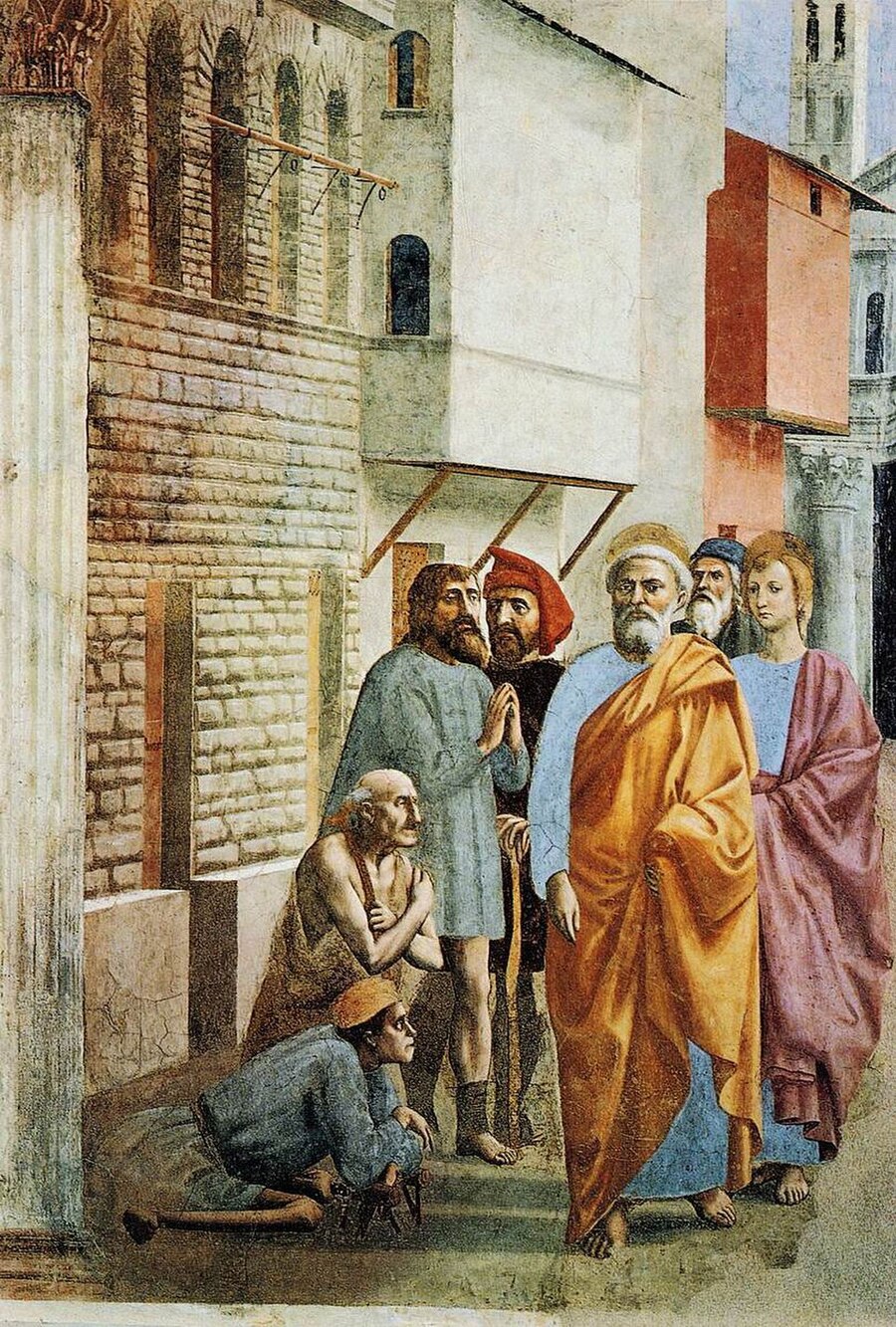
Mazaccio. Saint Peter is healed by his shadow. Fresco, circa 1425–1427. Brancacci Chapel, Santa Maria del Carmine Church, Florence
The subject of the study is images with and without cast shadows: Greek vase painting, Roman painting and mosaics, Byzantine mosaics and icons, and the frescoes of Giotto and Masaccio. This also includes the texts of Pliny the Elder, Plato, and Alberti, in which the shadow is connected to the origin of the image. The object of the study is the functions that the cast shadow performs within these artistic systems.
It is important to immediately separate the cast shadow from the chiaroscuro modeling that sculpts the figure’s volume. I am examining only the cast shadow. This distinction is one of the study’s main arguments: Byzantine masters knew how to model form with light, but they did not depict the cast shadow—meaning its absence was a deliberate choice.
The chronological scope spans from Archaic Greece to the Florentine frescoes of the 1420s. The sections are organized not by era, but by the function of shadow, although chronology is maintained within each section.
INDEX
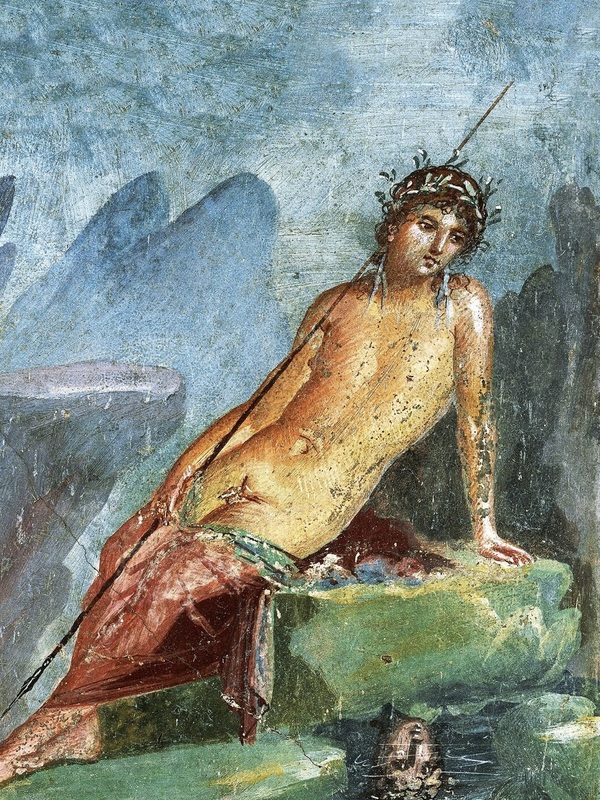
- Shadow-Trace — myths regarding the origin of the image from Pliny, Plato, and Alberti, Corinthian pinnacles, black-figure vase painting, and Pompeiian Narcissi
- Shadow-Evidence — Roman mosaics and frescoes where the shadow proves that the object is near the viewer
- Shadow-Negation — Ravenna mosaics and Sinai icons, where volume modeling exists, but there is no cast shadow
- Shadow-Threshold — Giotto and Masaccio, where the shadow connects the depicted space with the real light of the chapel
- Shadow-Wonder — «Saint Peter heals with his shadow, ” where the shadow becomes sacred once more Conclusions
Shadow Trace
Before examining how artists depicted cast shadows, it is crucial to understand what the ancient world thought about shadows in general. Ancient writers frequently connected shadows to the very origins of representation. The most famous legend regarding this originates in Archaic Corinth—a city of potters where painted clay plaques, or pinakes, were made in the 7th–6th centuries BCE.
Corinthian pinnacles from Penthesikopolis, 7th–6th centuries BCE. Ancient Collection, Berlin
Pinak themselves offer an interior view of a pottery workshop: a kiln with vessels, artisans overseeing the firing process. The figures are rendered in dark pigment against light clay, appearing almost like outlined shadows. The light in these scenes emanates from the kiln’s fire. One of the plaques retains an inscription naming Poseidon, to whom these were dedicated.
Exeky. Achilles and Ajax playing dice. Black-figure amphora, c. 540–530 BCE. Gregorian Etruscan Museum, Vatican Museums
In black-figure vase painting, the figure initially exists as a dark silhouette on light clay, and details are incised within it. This silhouette is not a cast shadow, and I do not attempt to derive one from the other, but the resemblance to a traced outline is difficult to ignore. We recognize Achilles and Ajax primarily by their contours.
Plato, who lived in the 4th century BCE, viewed shadows differently. In The Republic, he places shadows and reflections in water on the lowest rung of the visible spectrum—even below the objects themselves—and the prisoners in his cave mistake the shadows on the wall for reality their entire lives. For Plato, both shadows and reflections are equally deceptive because they lack substance.
Plato Academy. Mosaic from the Villa of T. Siminium Stephanus near Pompeii, 1st century BCE. National Archaeological Museum, Naples.
A Roman mosaicist depicted Plato with his students in the Academy garden. Shadows lie beneath a kiosk and a sphere box, while sundials top a column, indicating time by shadow. The shadow, which Plato considered the most deceptive visible form, lends verisimilitude to the scene in his own Academy and even serves as a means of measuring time. The artists did not argue with the philosopher; rather, they simply utilized the shadow where it served the illustration.
Several centuries later, the Roman writer Pliny the Elder recorded a legend specifically connected to Corinth. In his book on painting, he notes that everyone agrees on one point: painting began with tracing the human shadow. He then tells the story of the daughter of the Corinthian potter Butades. Before her lover departed, she traced his shadow on the wall by the light of a lamp, and her father filled in the outline with clay and fired it. According to Pliny, this relief was kept in Corinth until the Romans destroyed the city. In this story, the image appears as a memorial to a body that was in the room and was soon to leave it.
In the same years, Roman artists willingly depicted a different myth, one in which the image was born not from shadow, but from reflection.
Narcissus. Fresco from Pompeii, 1st Century AD. National Archaeological Museum, Naples
Narcissus sits on a stone by the spring, and below, in the dark water, his reflected face is visible. The image here arises from gazing into the water’s surface, not from touching a wall, and the artist shows us an image within an image. For the Roman viewer, both models coexisted nearby: the shadow drawn on the wall and the reflection in the water.
Nearly fourteen centuries after Pliny Alberti in his treatise «On Painting» (1435) returns to the question of the origin of the image. He names Narcissus, not the daughter of Butad, as the inventor of painting. For Alberti, painting resembles an attempt to embrace the surface of water in which Narcissus is reflected. As Victor Stoikita notes, where there is a shadow, there is instead a reflection—a colored likeness instead of a dark outline.
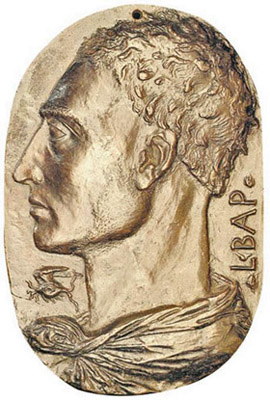
The bronze plaque, which is believed to be a self-portrait by Alberti, shows him in profile—a portrait form where the face is recognized by its outline, much like the silhouette of Butāda’s daughter’s beloved. This theorist, who placed reflection in the place of shadow, utilizes a shaded contour in his own depiction.
From the foregoing, two image models emerge: shadow relates to the contact and presence of the body, while reflection relates to likeness, color, and surface. The discussion will then move to how cast shadow functions within images, beginning with Roman mosaics and frescoes, where it proves that the subject is proximal to the viewer.
Shadow Clue
Pliny enthusiastically retells the dispute between two Greek painters. Zeuxis painted grapes so realistically that birds flocked to them, while Parrasios responded with a painting draped behind a curtain. Zeuxis asked for the curtain to be pulled aside and only then realized the curtain itself was painted. Roman viewers appreciated images that could be mistaken for reality, and a falling shadow served as one of the primary proofs of such illusion. It is fascinating to trace how this shadow, from one image to the next, draws the viewer closer.
Alexander Fighting Darias. Mosaic from the House of Faunus, Pompeii, c. 100 BCE. National Archaeological Museum, Naples
First, the shadow appears in a scene infinitely distant from the viewer—a battle that took place two and a half centuries before the mosaic was created. Shadows lie among the horses and warriors, and dozens of figures share the same ground under the same sun. The shadow transforms history into an event that happened, and the viewer watches the battle as if standing at the edge of the field.







