Table of Contents
1. Concept
2. The Use of Color in Kiklad Culture
3. Technical Analysis of The Metropolitan Museum
4. Color Reconstructions by Elizabeth Hendriks
5. Conclusion
1. Concept
Marble figurines of Cycladic sculpture, predominantly rendered as standing human figures with arms folded across the chest, are often perceived as works whose artistic expression is determined primarily by the material’s form. Their modern visual appearance—a light, almost monochromatic surface, minimal plastic detail, and strict symmetry—has largely shaped the perception of Cycladic sculpture as an art of formal simplification.
However, archaeological and technical research indicates that the original appearance of these objects was significantly more complex. Remnants of red, blue, and other pigments have been found on the surface of many figurines, as well as traces of lost painting. Color could have been used to denote eyes, hair, facial features, anatomical details, adornments, and ornamental motifs. Thus, the sculptural form did not exhaust the visual content of the work: the painting participated in the creation of the image and could have substantially influenced its perception.
The relevance of this research lies in the necessity of viewing the Cycladic figurine not merely as a marble form, but as a holistic work in which plastic and painted elements interacted with one another.
The research focuses on anthropomorphic marble figurines from the Early Cycladic period, specifically the Early Cycladic II period (approximately 2700–2300 BCE). The subject of the study is the interaction between polychrome painting and plastic form, as well as the visual functions of color motifs in depicting the human body.
The hypothesis is that polychromy was not merely a decorative supplement to a finished marble form. Instead, it served as an independent method of visually organizing the figure—highlighting individual body parts, refining anatomical features, forming graphic and ornamental compositions, and supplementing those characteristics of the human image not expressed through sculptural modeling.
The primary sources planned for use include studies of paintings from the Metropolitan Museum of Art collection, the catalog of Cycladic art from that museum, materials from the Cycladic Museum in Athens, and academic publications dedicated to the context and potential significance of painting on early Cycladic figurines. Museum catalogs and the results of technical analyses will provide factual data regarding the objects and pigments, while academic publications will form the basis for comparing existing interpretations and developing the study’s own theoretical position.
The goal of the research is to determine how drawing interacted with plastic form in early Cycladic sculpture and what role it played in shaping the anthropomorphic image.
Research Question: How did color painting relate to the plastic organization of the human figure, what visual functions did it perform, and how does its presence alter the interpretation of the artistic language of Cycladic sculpture?
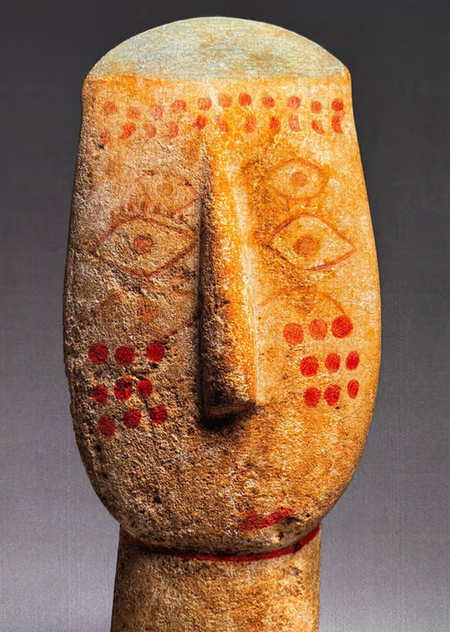
2. Drawing of a Cycladic figurine with colored accents, E. Hendrix
2. Color Use in Kikladic Culture
Pigments for paints were derived from natural minerals. The most common colors were red, sourced from iron oxide, cinnabar, and ochre, and blue from lapis lazuli. Green and black were used less often.
Blue and black were frequently used to outline body parts, while red was used to depict carved details, decorative elements, and facial paintings.
Palette with red pigment residue, 2700–2300 BCE.
Marble bowls with stone grog and fragments of red pigment, 2700–2300 BCE.
Vases and a piece of lazurite, 2800–2700 BCE
3. Metropolitan Museum Technical Analysis
In this chapter, we will examine figurines from the Metropolitan Museum of Art’s collection. Through technical analysis using ultraviolet light and spectroscopy, scientists found traces of pigment on numerous figurines.
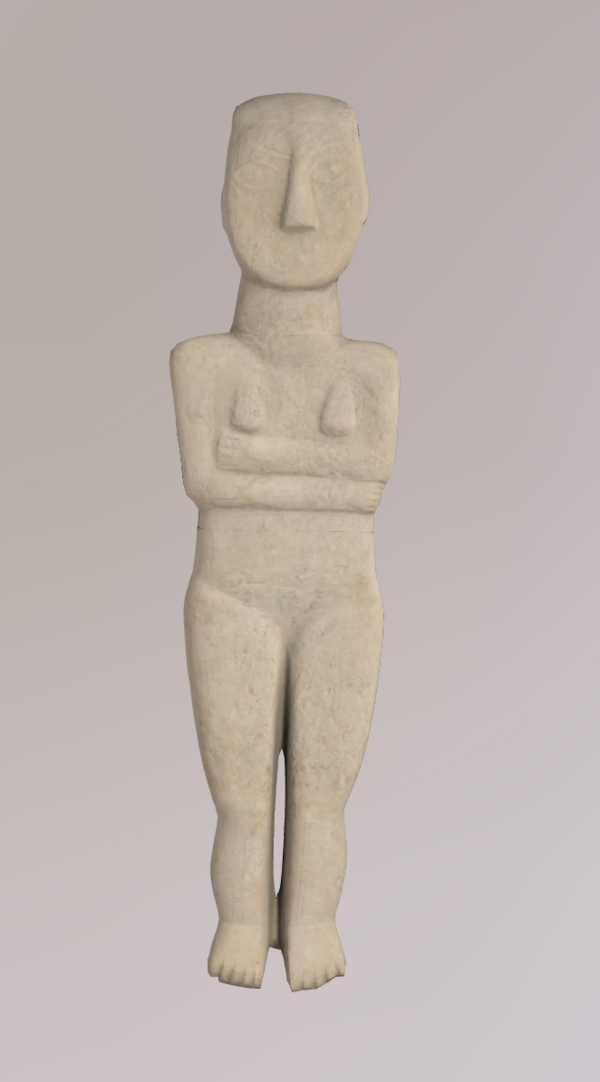
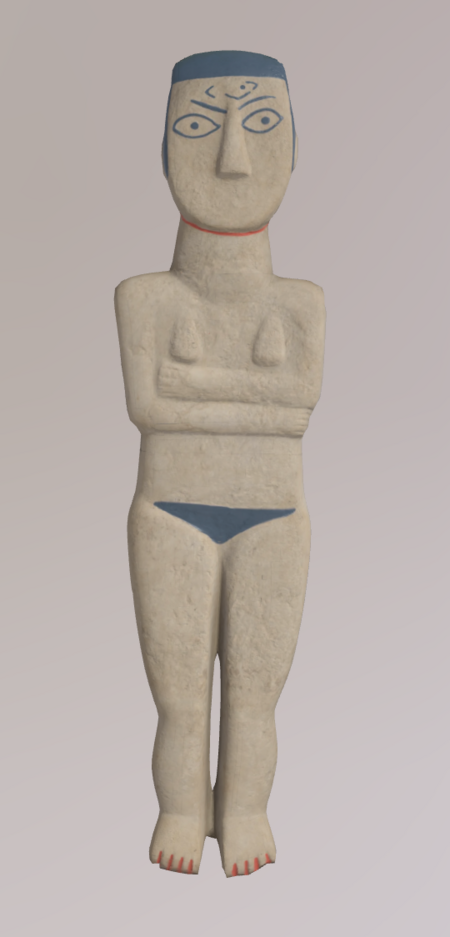
3–4. Marble female figure, 2700–2300 BCE. 3D scan
Remnants of cinnabar traces on the upper neck, hairline on the nape, and between the toes. «Paint ghosts» in the eyes and hair. An additional smooth area in the pubic region may indicate initial painting of this area.
«Paint ghost» refers to the smooth, protruding parts of a stone that indicate it was likely covered in paint. Thanks to this paint layer, the stone experienced significantly less erosion.
Smooth crotch area of several female figures (collage)
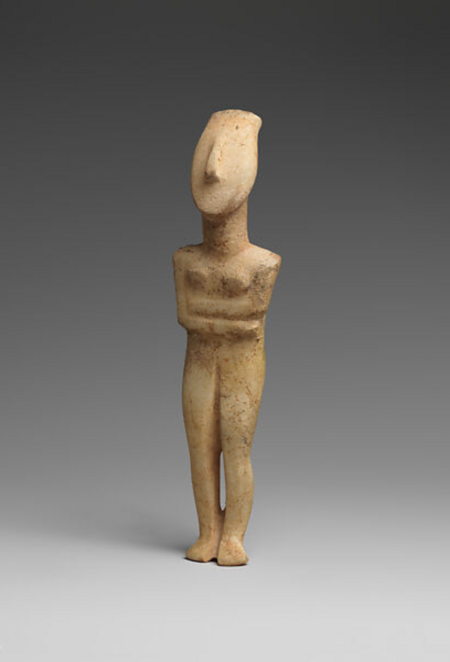
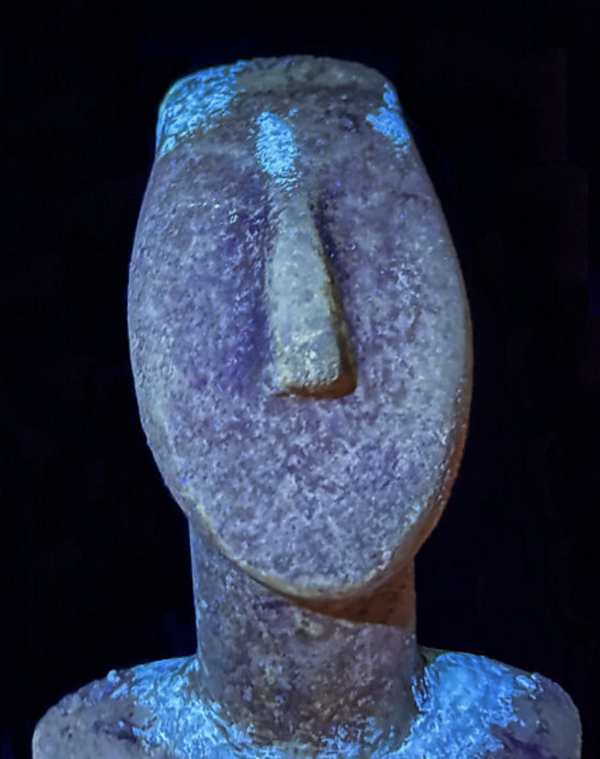
Marble female figure, c. 2700–2500 BCE (L.2022.38.120)
Red pigment on the forehead, chin, front and back of the neck, and under the left breast. A smooth stripe remains on the head, indicating the placement of a lost hairstyle or headdress. The eyes are marked as «paint ghosts.»
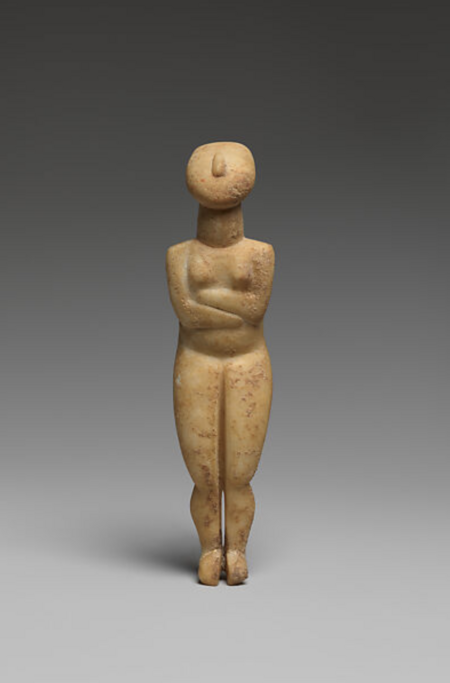
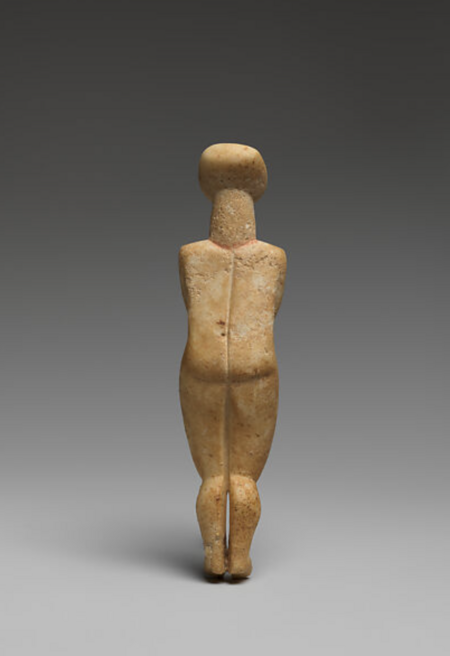
Marble female figure, 2700–2500 BCE (L.2022.38.64)
Red staining on the forehead, lower cheeks, and chin, as well as the upper and lower neck. Thicker remnants of pigment are preserved on the back of the neck. Possible traces of eyes.
4. Color Reconstructions by Elizabeth Hendrix
This chapter examines colored reconstructions of sculptures based on the research of Elizabeth Hendriks. Between 2003 and 2024, she published several works dedicated to Cycladic figurines, investigating them for the presence of residual color pigments on the surface. She put forth several significant hypotheses regarding the causality behind the appearance of certain ornaments and imagery.
Marble female figure, c. 2500–2300 BCE. Color reconstruction by E. Hendriks
The figure retains noticeable traces depicting the eyes and eyebrows. The hair is also preserved in traces of paint, most clearly visible as a side lock on the left side of the face, curving toward the nape of the neck.
Marble female figure, c. 2500–2300 BCE. Color restoration by E. Hendriks
The figure features eyes, and repetitions of eyes on the cheeks, legs, and abdomen. Additionally, there is a zigzag drawn on the chest, and fragments of faded vertical zigzags appear on the legs. A stripe on the upper head is visible as a «paint ghost, ” and an open almond shape is located in the mouth area.
According to Elizabeth Hendrix, the repetition of eye images might have indicated the figure’s involvement in rituals, after which additional eyes could have been erased.