[1] Introduction
In cinema, an object is usually noticed when it serves a function: a letter conveys news, a weapon presents a threat, and a musical instrument accompanies the protagonist. However, the screen allows us to perceive more in familiar objects than just their practical purpose. A camera close-up reveals texture, repetition alters the meaning of a gesture, and light transforms volume into a flat image.
French avant-garde cinema of the 1920s offers particularly suitable material for studying these shifts, as it features both non-narrative experiments and films that retain characters, conflict, and plot continuity.
Comparing such works allows us to determine what makes an object expressive and to what extent its meaning depends on the person who uses it. The study includes five films: Man Ray’s «Return to Reason,» Fernand Léger and Dudley Murphy’s «Mechanical Ballet,» Germaine Dulac’s «Le Chanteur de Sirenes,» and Jean Epstein’s «True Heart» and «The Fall of the Asher House.» Man Ray’s Dadaist experiment and Léger and Murphy’s non-narrative work are contrasted with the narrative explorations of French cinematic Impressionism. These classifications set the boundaries of the material, but they do not imply that all films within a single group are structured identically. Two of Epstein’s works allow us to test this distinction using material from a single director: the object environment of domestic melodrama is compared with the interior of a fantastic story. The selection is limited to French cinema of the 1920s, and the primary criterion for including a segment is the ability to demonstrate how a specific technique allows an object to assume an expressive role.
The key question of the research is how the functions of an object change in narrative experiments and Impressionist drama, and what connections with the human element remain.
The working hypothesis is as follows: the expressive function is determined not by the object itself, but by the manner in which it is incorporated into the image, montage, and action. Weakening the usual connection to the human gesture allows the object to be perceived as a material of rhythm or light form, whereas maintaining this connection makes it a means of revealing relationships and experiences. This distinction does not imply two impenetrable groups. One object can simultaneously organize the composition, participate in conflict, and create anticipation, and one technique can solve different problems across adjacent sequences.
By «subject matter,» we refer to the tangible objects that can be captured in the frame: tableware, mechanisms, printed publications, musical instruments, weaponry, paintings, and textiles.
Natural phenomena and architecture are considered only insofar as they help explain the behavior of these things. The human body is not equated with an object; comparing a person’s face, hand, or movement to an object serves to define the boundaries of such proximity. The primary unit of analysis chosen is an episode, not a single beautiful frame. For each example, the scale, light, movement, repetition, adjacency to other images, and the object’s participation in the action are taken into account. Sequences of still frames allow for the comparison of visible relationships, but conclusions about rhythm are based on the episode’s sequence because a static selection does not reproduce its duration.
The research sections are structured around methods of changing the subject image.
First, the focus is on isolating an object from its environment, followed by its participation in rhythm and transformation into a light pattern. Subsequent sections explore everyday relationships, the shifting meaning of familiar objects, and the creation of anxious anticipation. This structure allows readers to revisit a single film with different lines of inquiry and compare works within a shared thematic context. Visual pairs are curated based on perceived similarity or contrast: an object with and without a hand, a recurring form and a repetitive gesture, a static object and the evolving relationship to it. Preference is given to frames pulled directly from the films, as posters and staged photographs do not adequately demonstrate the specific characteristics of the on-screen composition.
The textual foundation comprises work on film theory and history, research articles, and materials from museum and archival institutions.
Epstein’s reflections on photogeny help raise the question of altering the familiar appearance of an object through film, but they are not used as a ready-made explanation for every frame [1, pp. 293–295]. Noam Elcott’s article clarifies Man Ray’s camera-less technique [6], while the studies by Germaine Dulac and Epstein’s market scene episodes allow us to relate visual observations to existing interpretations [2; 3; 9]. Catalogs from the Centre Pompidou and film archives are used to verify authorship, dates, and variations of versions [4; 8; 10]. The analysis is based on comparing this information with the imagery: the historical commentary outlines the context, and the specific conclusion must explain the visible organization of the chosen episode. Soundtracks from modern digital copies are excluded from the subject of this study.
[2] Close-up and object boundaries
An object without a familiar place
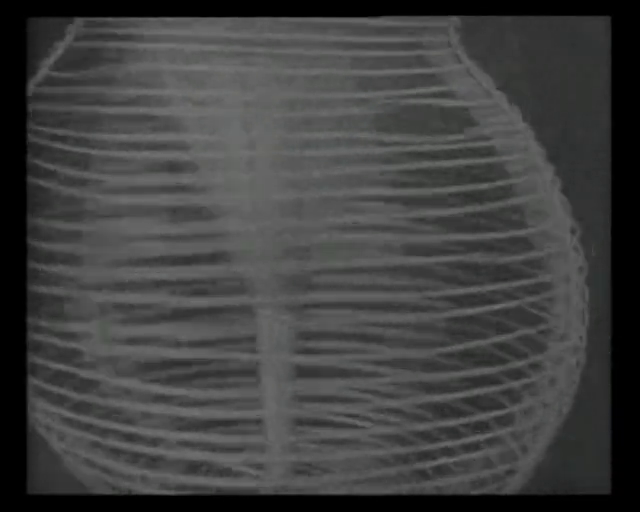
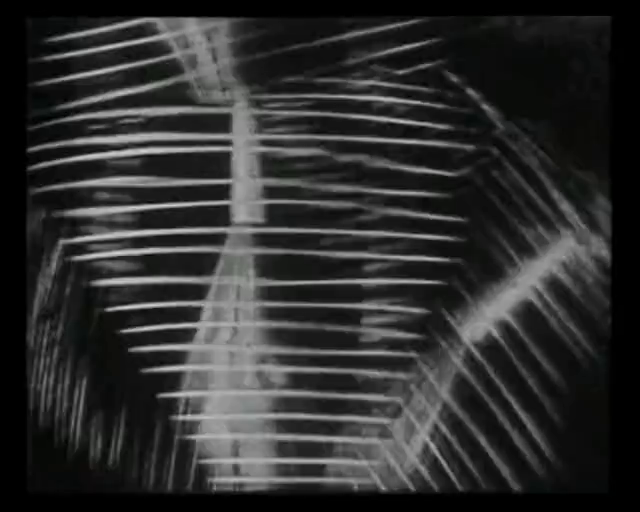
Fernand Léger, Dudley Murphy. «Mechanical Ballet.» 1924. Film stills.
In «Mechanical Ballet,» kitchen utensils appear so intimately framed that their usual environment vanishes. With the wire whisk, arcs, intersections, and open spaces are most discernible; the possibility of using it as intended takes a backseat. Beside the mechanical parts, this object joins the general procession of forms, even though the machine’s mechanism and the kitchen item’s function serve different purposes. The Centre Pompidou’s catalog and educational materials link this cinematic organization to montage, fragmentation, and the alteration of familiar scale [4; 5]. The close-up here is not significant in itself—rather, the absence of action that would explain the object through its use becomes crucial. The shot invites contemplation of the metal’s curves and luster, while adjacent images continue this focus on form. The object remains recognizable, yet its everyday function no longer dictates the viewing sequence.
An object without a familiar place
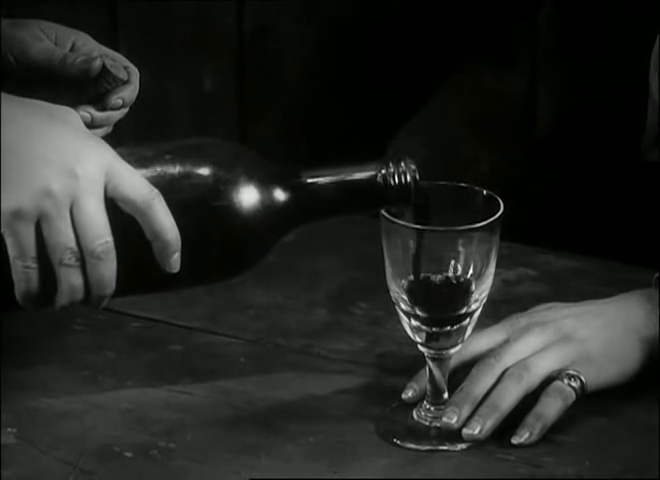
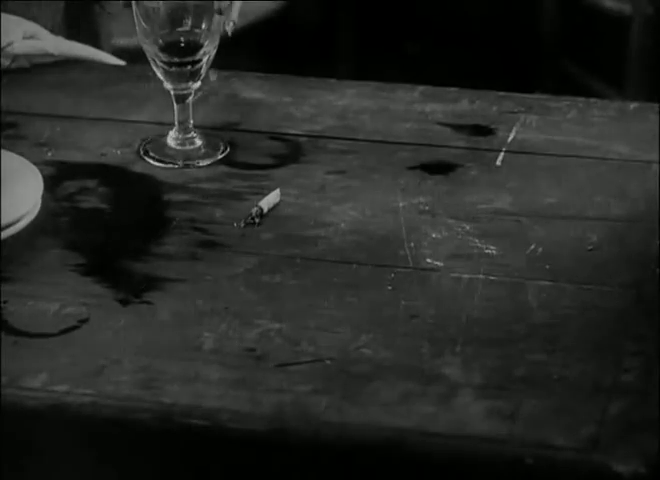
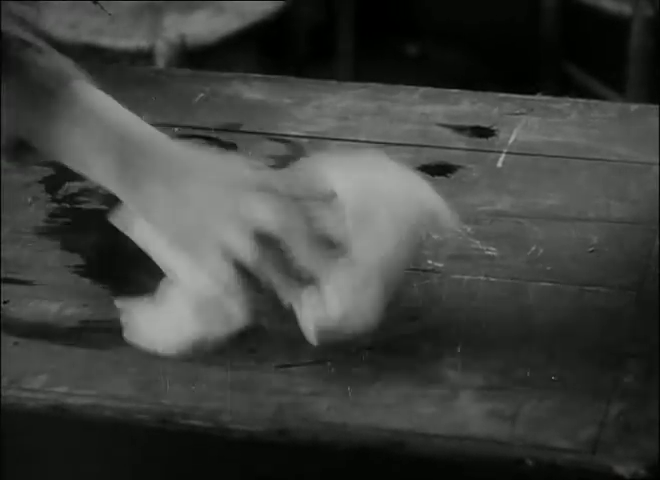
Jean Epstein. «The Right Heart.» 1923. Film stills.
The opening of «True Heart» also brings the camera closer to objects, but the outcome is different. Wet traces from dishes are visible on the table, and then a hand wipes the surface; bottles, a glass, and Mari’s face connect in a brief sequence. The image does not immediately convey a general impression of the café; instead, it reveals how the protagonist’s position in this space is built from repeated actions. Unlike the whisk in «Mechanical Ballet, ” the dishes are not separate from their use. The stains indicate that people have already been drinking here, the cloth continues someone else’s action by cleaning, and the filled glass links the object to serving the patrons. The close-up simultaneously enhances the texture of the surface while maintaining the social context. Therefore, the increased visibility of the object does not yet make it autonomous: in this episode, the table is important as a site of others' consumption and Mari’s labor.