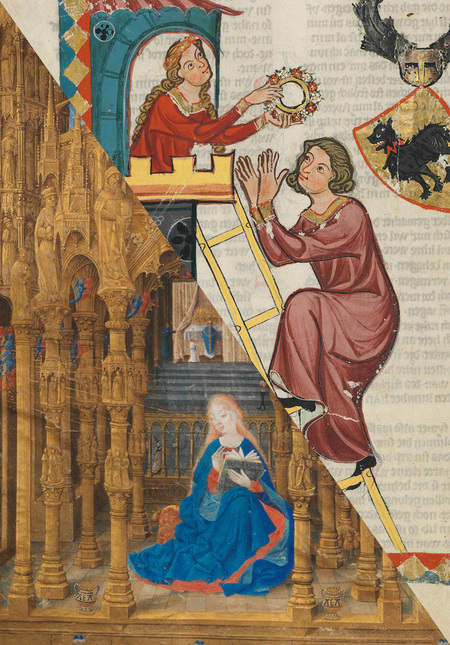
Medieval culture shaped a complex and contradictory perception of femininity. Woman could be viewed as the embodiment of spiritual purity and virtue, becoming an object of admiration and courtly adoration, or, conversely, associated with temptation, sin, and danger. These ideas were reflected not only in religious and literary texts but also in visual art. This study will examine book miniatures from the 13th–15th centuries as a link between the literature and painting of the era.
At the center of the study is the artistic embodiment of two models of femininity: the saintly woman (Mary and Margaret), and the temptress (Eve and the adulteresses).
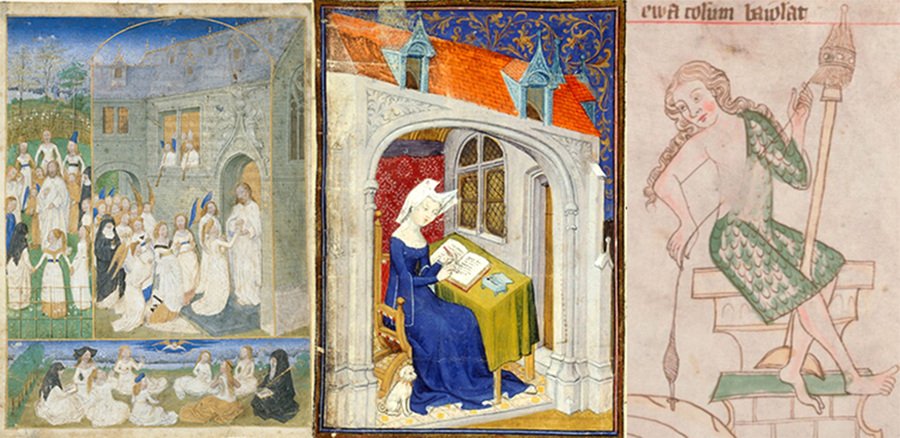
Fragments from miniatures depicting the encounter of the holy virgins with Christ at the gates of Paradise (Simone Marmion, 1467–1470), Christian Pisano studying in a royal manuscript (1410–1414), Eve in the Bible of Wenceslaus (1325–1349)
The image of the saint is connected with ideas of spiritual perfection, divine origin, chastity, and piety; the image of the temptress is linked to concepts of temptation, physicality, and the symbolic female participation in sin.
These models should not be viewed as exhaustive descriptions of the medieval woman, but rather as visual archetypes through which culture expressed specific ideas about femininity and a woman’s place in society.
The primary objective of this research is to identify the artistic devices medieval masters used to create and contrast these figures. Special attention is paid to the composition, postures, and gestures of the female figures, the direction of gazes, costume details, hairstyles, color schemes, attributes, and surrounding space. It is important to establish which visual indicators were employed to denote sanctity, beauty, purity, or peril, how consistently these indicators were used, and whether the same elements could take on different meanings depending on the subject matter and the image’s context.
The study material consists of book miniatures from Western European manuscripts dating from the 13th–15th centuries, which depict religious and often moralistic scenes featuring female characters.
Jane d'Évreux’s Clock, Queen of France, Jean Poussel, France, 1324–1328
By juxtaposing the two images, we can reveal how artistic devices shaped the boundaries between acceptable and condemned displays of female behavior, and how the idealization of feminine beauty coexisted with notions of female danger and sinfulness. Of particular significance is the study not only of the differences between the chosen models, but also their intersections—for instance, instances where external beauty served as a marker of both virtue and temptation.
Contents
CHAPTER 1. The Image of the Spiritual Ideal. I. The Virgin Mary with the Child. II. The Annunciation. III. Saint Margaret. CHAPTER 2. The Image of the Tempter. I. Eve. II. The Harlots. CHAPTER 3. Comparison and Conclusion.
CHAPTER 1. The Image of the Spiritual Ideal.
I. The Virgin Mary with the Infant.
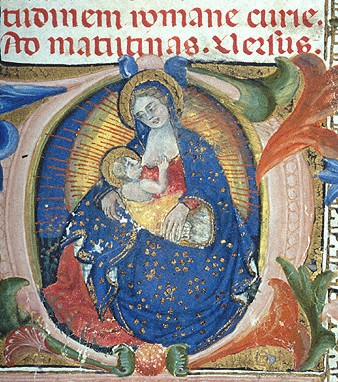
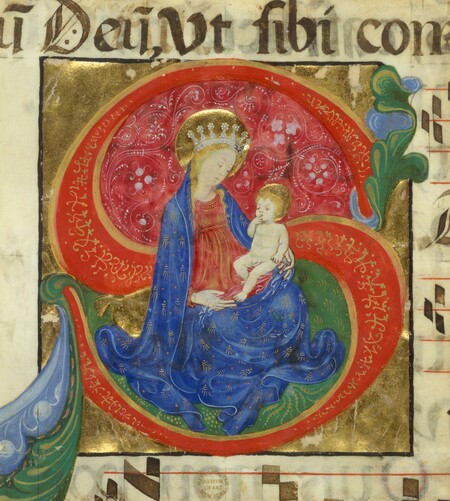
Choscolo, Italy, late 14th–early 15th century; miniature of the Madonna and Child, antiphonary, Franciscan Breviary Master, Italy, 1440–1460
Both miniatures depict the Virgin Mary with the infant Christ—the left one within the letter «O,» and the right one within the letter «S.» The artists place significant emphasis on botanical motifs, rendering vibrant green areas of intricate form. The author of the left miniature delves deeply into the ornamentation, incorporating Arabic symbols onto the letter itself, which frames the image of Mary.
1. Both Madonnas are depicted in a humble, seated posture, their gaze directed toward Jesus.
2. In both miniatures, Mary is clothed in blue garments, emphasizing her purity.
3. All the figures have halos above their heads, also signifying the divine nature of their origin.
II. The Annunciation.
«The Annunciation,» Charles Français’s Hours of the Divine Office, 1465
The two-panel composition «The Annunciation» is a diptych whose action unfolds in a complex space mimicking architectural and sculptural elements; the scene includes a procession of angels descending from the heavens to announce the miracle to Mary.
1. The miniature depicts Mary reading the Bible, demonstrating her sincere faith in God and humility.
2. The Madonna, like in the previous miniatures, is dressed in blue garments.
3. Her posture is humble and submissive, with her eyes directed toward the Bible.
The Clock of Jeanne d'Évre, Queen of France; Jean Poussel, France, 1324–1328
The miniature is executed in grisaille. The right side depicts the Annunciation with the figure of the Virgin Mary centered in the composition.
1. The Madonna pose differs from previous ones in that she is depicted standing. Nevertheless, Mary’s gestures remain humble and obedient.
2. The holy maiden holds a Bible in her hands as a symbol of faith, and her gaze is directed toward the angel.
3. Unlike the previous Annunciation miniature, Mary in this piece bears a halo that emphasizes the divine nature of her destiny.
III. Saint Margarita.
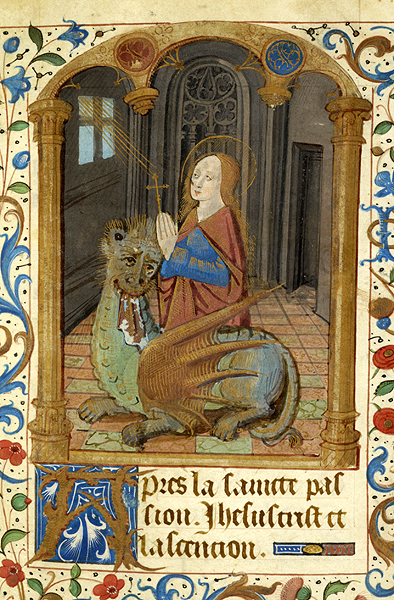
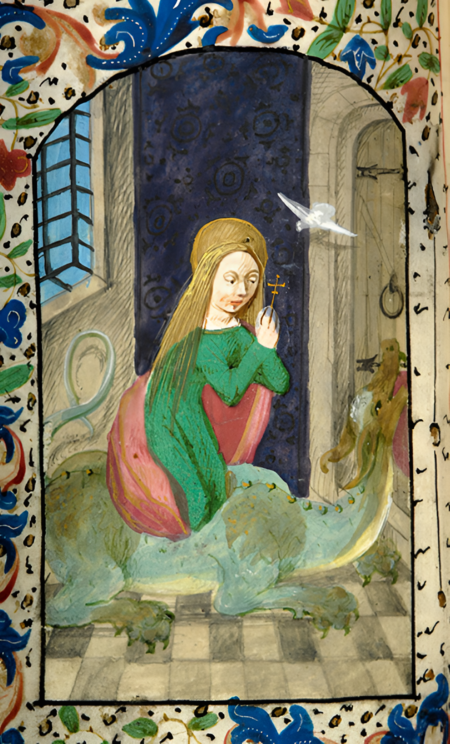
Life of Saint Margaret of Antioch, Northern France, 1460–1499; Horarium, Belgium, 1475
Both miniatures depict Saint Margarita of Antioch, who, according to her life story, was swallowed by the devil in the form of a dragon, but thanks to the power of the cross she held in her hands, she was able to tear open its womb unharmed and emerge.
1. Margarita, like Maria, is depicted in a modest pose. Her hands are clasped in a prayer gesture.
2. Margarita’s gaze is directed toward the rays of light on the left, while the saint’s gaze on the right is humbly cast downward.
3. Margarita has a halo above her head as a symbol of divinity.
CHAPTER 2. The Figure of the Sinful Woman.
I. Eva
The miniatures depict a scene of creation, Eve’s fall, and the expulsion of Eve and Adam from paradise. Next to the fountain made from Adam’s rib—a nude man reclining on the ground—Eve appears; she is also unclothed.







