Research Concept
Rationale for Topic Selection
The selection of this topic stems from my desire to understand how conceptions of love were reflected in the cultures of ancient peoples, particularly the Etruscans and Romans. Among the most fascinating goddesses for comparison are Turan and Venus, as they are both associated with love and beauty, even though their images developed within different cultures and societies. It is worth noting that the representations of these goddesses were modeled after Aphrodite, who was the goddess of love in Greek mythology. Given the close cultural exchange between the Romans and the Etruscans, it is possible to investigate how mythological images transformed when moving from one people to another. In this study, love is examined through the prism of culture and politics. Special attention is paid to how the images of the goddesses conveyed the Roman and Etruscan ideas about love, beauty, and femininity. Comparing Turan and Venus will help illuminate which aspects of their images were preserved during the transition between cultures and which changed due to historical transformations.
Material Selection Principle
The research will be visually grounded in Etruscan bronze mirrors and figurines depicting Turan. Roman sculptures and coins featuring the image of Venus will also be included. Special attention will be given to the Etruscan bronze mirrors adorned with mythological scenes, as they offer a unique opportunity to study mythological imagery on everyday objects. The characteristics of the body depiction, poses, gestures, and attributes will be examined using the figurines and sculptures. When selecting materials, the dating, origin, material, and intended use of each object will be considered. Preference will be given to works that have museum attribution and scholarly descriptions. A key criterion will be the object’s suitability for comparative analysis. Interpretations must be based on scientific data, as not every image of the female figure can be definitively identified as Turan or Venus.
The Principle of Research Categorization
The research will be structured by moving from the study of individual images to their comparative analysis. The first section will examine depictions of Turan in Etruscan art, predominantly on bronze mirrors and statuettes, as this is where she was most frequently represented. Initially, my focus will be on her appearance and the narratives in which Turan takes a direct role. The second section will investigate images of Venus in Roman art. Special attention will be paid to the nuances in conveying beauty and femininity. Equally important is the societal significance of her image—particularly its religious and political dimensions. The third section will address posture, gestures, attire, attributes, and composition, allowing for the identification of similarities and differences in the depiction of these goddesses, as well as tracing changes in their imagery and the perception of love. In the concluding section, I will synthesize the analysis results and determine the extent to which they align with the initial hypothesis.
The Principle of Selecting and Analyzing Textual Sources
The source material will comprise monographs, academic books, and articles concerning the history of the Etruscans and Romans, ancient mythology, religion, and art. The study will also incorporate descriptions of archaeological finds and museum catalogs. When selecting literature, scientific accuracy, relevance to the topic, and the availability of information about specific works will be considered. The resulting data will be cross-referenced with the visual characteristics of the objects. It is important to note that some studies contain authorial interpretations—these must be distinguished from historical facts—as image similarity does not directly prove a shift in the conception of love or a direct borrowing of an image.
Key Research Question
How did the images of Turan and Venus reflect Etruscan and Roman views on love, and what insights do the similarities and differences between these figures offer regarding the cultural exchange between the two peoples?
Research Hypothesis
I hypothesize that the similarity between the images of Turan and Venus is not so much related to common conceptions of love and beauty as it is to the cultural exchange between the Etruscans and the Romans. In Roman culture, the image of Venus evolved into something more than just an embodiment of love. It acquired new meanings tied to the ideology of the state. Comparing the works will allow us to determine how much the visual characteristics of Turan and Venus reflect the perspectives of these two cultures and confirm the hypothesis regarding the reinterpretation of the image of love by the Romans.
Research Objective
To identify the similarities and differences in the depiction of the love goddesses Turan and Venus as a means of reflecting the differing views of the Etruscans and Romans on love.
Research Objectives
1. To study the historical and cultural reasons for the veneration of Turan among the Etruscans and Venus among the Romans.
2. To identify the primary mythological meanings and functions of the goddesses.
3. To collect artifacts that reflect the images of Turan and Venus.
4. To analyze the characteristics of the goddesses' depictions.
5. To identify the similarities and differences in the visual representation of Turan and Venus.
6. To determine how the goddesses' images reflect the Etruscan and Roman conceptions of love.
7. To compare the analysis results with the research hypothesis and draw conclusions.
Geography and Chronological Scope of the Study
The territory of Ancient Rome and Ancient Etruria, which was located in Central Italy.
Etruscan art — 5th–3rd centuries BCE; Roman art — 2nd century BCE — 3rd century CE.
Introduction
Love, in the view of most, is the most profound emotion a person can experience; however, its understanding and perception have always differed across various cultures and throughout different eras. In different historical periods, love implied the manifestation of divine power, the foundation of procreation, a tool for shaping power, and social ideals. Society defined attitudes toward beauty and femininity based on its conceptions of love, which were reflected in religion, mythology, and art. Of particular interest in understanding love is the comparison between the Etruscan goddess Turan and the Roman Venus. Their images were shaped within distinct cultural contexts, yet both are intrinsically linked to love and beauty. Turan was an essential element of the Etruscan cultural system, a culture that interacted with Greek civilization. Roman Venus, in turn, was not only the goddess of love and beauty but also a significant figure in the political and religious life of Rome. Based on the importance of these two goddesses in societal life, one must ask: can a change in visual imagery signal a shift in societal values? Therefore, my visual research aims to identify the similarities and differences between the images of Turan and Venus. It is hypothesized that comparing the images of these goddesses will allow us to trace how Roman conceptions of love, succeeding the Etruscans, began to play a role in the culture and political life of society.
Turán
The name of the goddess Turan (Etruscan: Turansa) means «giver» or «mistress.» It is also believed that her name originates from the Etruscan verb tur, meaning «to run» or «to move.» The Etruscans viewed her as the ruler of all living things. The image of Turan was primarily shaped by the influence of the Greek world, where Aphrodite was the goddess of love. As a result of cultural exchange, the Etruscans adopted Greek mythology, adapting it to their own culture, and also incorporated new names for deities and artistic techniques. Notably, Turan and Aphrodite shared common attributes, such as the dove and the swan. In images dating before the 4th century BCE, Turan was depicted with wings, and she was also repeatedly shown holding a dove, a branch, or a rose. She is often seen in the form of a swan, symbolizing beauty and grace. The plants depicted near her illustrated blooming and vital force.
Etruscan bronze mirror depicting Turan (Aphrodite) with wings and two divine companions—Eros and Cymaea. (500–490 BCE) British Museum, London. Accession Number 1884,0614.56. Possible discovery site—Palestine.
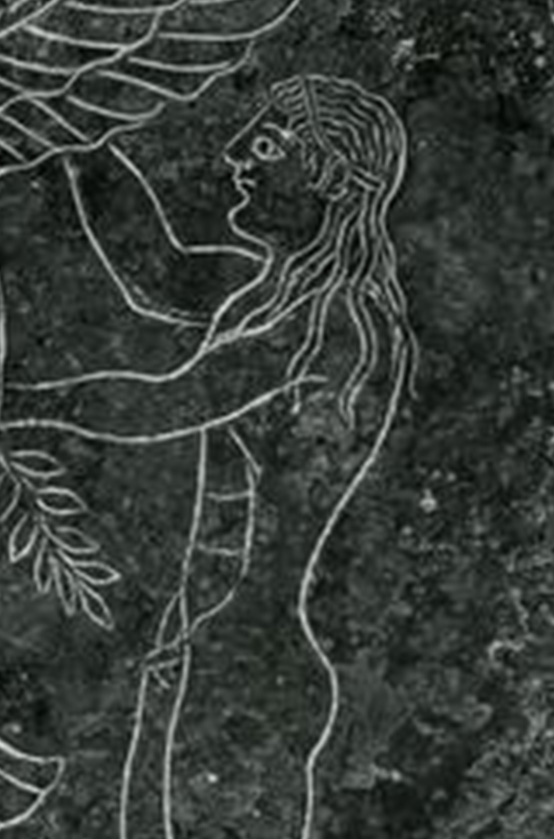
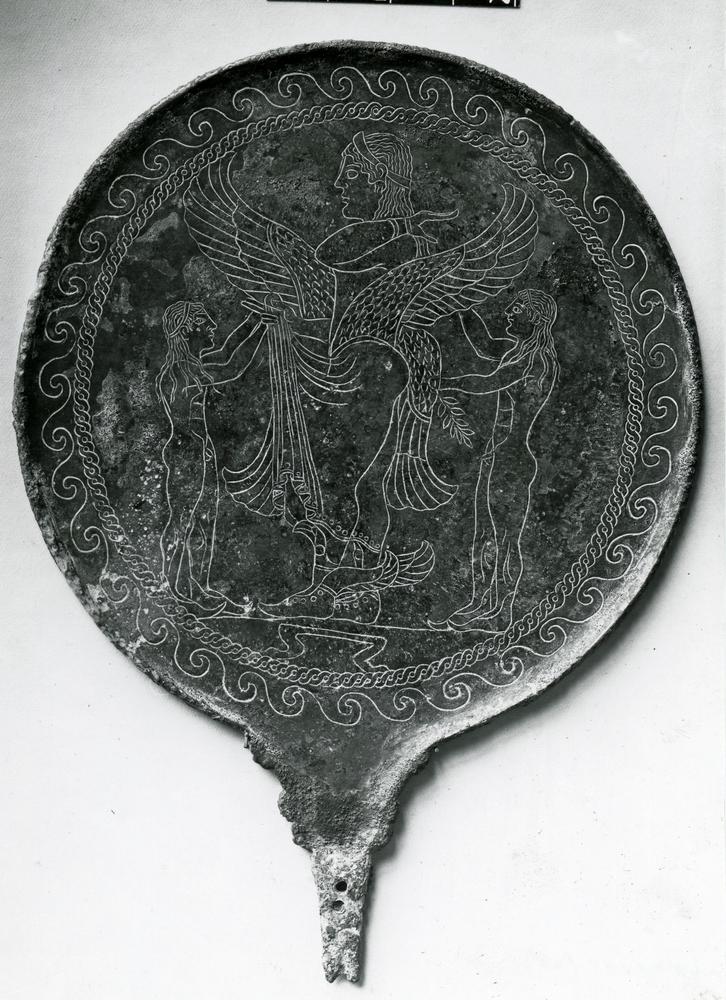
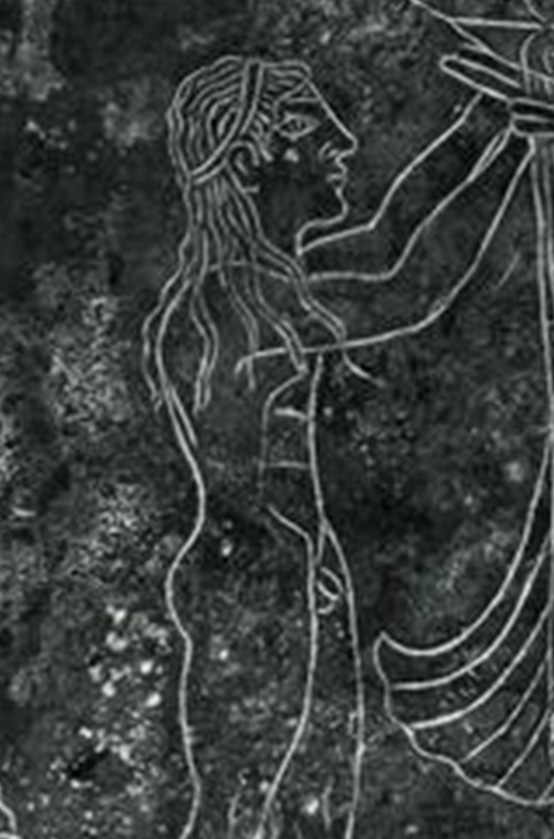
On the reverse side of the mirror, there is a depiction of a winged female figure identified as Turan (though some suggest it may be Aphrodite). Two smaller, nude figures are positioned on either side of her. The British Museum connects these figures to Eros, as well as Gymus or Anteros. The composition is built on the contrast between the central figure and her companions. Turan’s divine status is emphasized by her wings. According to the museum’s description, Turan is clad in a chiton—garment that, in antiquity, signified divine status—and she is distinguished from the other figures in the composition by her winged footwear. Thus, Turan’s attire plays a significant role in creating the image of the goddess of love. Also interesting is the possible connection between the two figures flanking Turan, who demonstrate various facets of love. Eros is the god of romantic desire, Gymus embodies desire—both passionate and painful—while Anteros is the god of reciprocal love. Based on the British Museum’s opinion regarding the identification of these gods, the mirror’s composition can be presented as a unification of the goddess’s image with the different manifestations of love. Consequently, this artifact helps us explore the Etruscans' conception of love through the composition, attributes, and interaction of mythical figures.
Bronze mirror depicting Turan and a swan. (325–300 BCE). Louvre, Paris. Accession Number: Cp 7177; Br 1720.
At the center of the image is Turan, depicted in profile, seated upon a swan. The goddess is once again draped in a chiton, and over it, a himation can be seen. This is a rectangular piece of fabric worn over the primary garment. Her earring and bracelet signify her status as a goddess. The swan is shown with a branch in its beak. Between the goddess’s face and the bird’s neck, an inscription in Etruscan is visible, which identifies her. The relationship between Turan and the bird holds special significance. The swan presents her as a mythological being. As mentioned earlier, this bird was frequently depicted alongside the goddess because it was one of her attributes. At times, Turan herself was even represented in the image of a swan. The very manner in which the swan is depicted is also important: it serves as her support. This underscores Turan’s authority—she is the focus of the composition, and the bird reveals her mythology. Turan’s placement on the animal can be interpreted as indicating her close connection to the natural world, thereby demonstrating her as the goddess who was the patroness of all living things. Therefore, this artifact allows us to analyze Turan’s connection to animals as one of the ways her role as a goddess of love was visually expressed.
Etruscan bronze mirror depicting Turan, Paris, Helen, and Ermania. (5th century BCE). National Etruscan Museum at Villa Giulia, Rome, Italy. Discovery site: Preneste (Palestrina), excavations of 1859.
The presented mirror offers a unique interpretation of the myth of Paris and Helen. The image depicts Helen holding her daughter Hermania, with Paris, Helen’s husband, positioned below and beside the box. Turan stands near the couple, holding a flower. In Roman culture, the union of Paris and Helen was often portrayed from a destructive perspective; however, this mirror focuses specifically on the characters' family life. It is important to note Turan’s appearance here: she wears a woven headdress and a necklace, details that emphasize her status. She is also draped in a long garment that covers her body. On this mirror, the goddess’s allure is revealed not through the display of nudity, as was often done in depictions of Venus, but through her clothing, jewelry, and her demeanor and placement relative to the other characters in the scene. Turan holds a flower—one of her attributes—which, as I mentioned earlier, aligns with Etruscan concepts of beauty and romantic affection. The goddess’s presence in this scene allows her to be analyzed as a patroness of love, motherhood, and family relations. A winged sphinx is also visible in the image. Researcher L.B. van der Meer interprets it as a harbinger of misfortune, thus conveying the destructive side of love. Consequently, the mirror’s depiction reveals Turan as a patroness of family and motherhood. Nevertheless, the sphinx also signifies the destructive aspect of love, encompassing conflict and ruin.