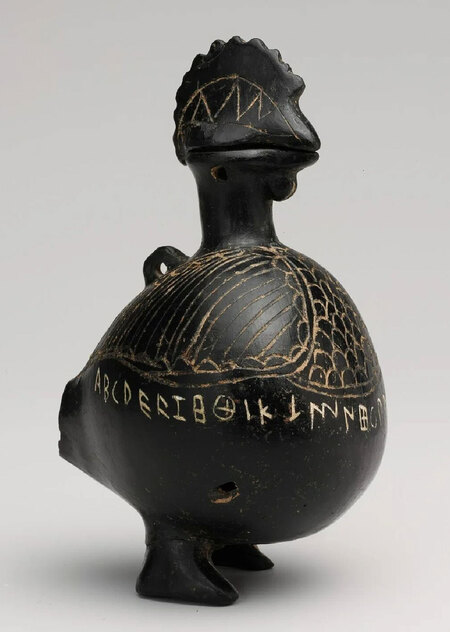
Early Etruscan Bucchero. A visual and semantic study of figurative vessels from the late 7th century BCE.
Navigator
1. Concept
2. Hypothesis
3. Research Object and Goal
4. Historical and Cultural Context
5. Methodology for Crafting a Thin Bookero
6. Alphabetical Inscriptions
7. Conclusion
8. Sources
Concept
I graduated from an art school and studied at the HSE distributed lyceum, where I took courses in art history. It was there that I became acquainted with Etruscan art. I believe the Etruscan civilization left behind an incredibly rich material culture, yet because there is an almost total absence of major literary monuments or chronicles written by them, we are forced to «decode» their mentality through archaeological finds.
The selection of the topic—figural vessels from the early Bucchero period of the late 7th century BCE—stems from the fact that this era is a turning point. It was during this time that the Etruscans experienced the so-called «orientalizing period, ” when their distinct local culture encountered a powerful influx of Eastern imports and Greek colonial influences. Potters achieved a technological breakthrough by imitating precious metal, merging utilitarian form with small-scale round sculpture and graphic design. The study of these objects allows us to understand how the visual image of an object functioned to represent the power, literacy, and prestige of the Etruscan nobility during feasts and funerary rituals.
I curated the material based on three criteria: chronological, geographical, and morphological. First, all artifacts are strictly dated to the last third of the 7th century BCE (the period of the emergence and flourishing of fine bucchero ware). Second, the geography of the finds is limited to the major craft centers of Southern Etruria (Caere, Veii, Vetulonia), where leading royal workshops operated. Third, only figurative objects were selected—pieces that demonstrate a departure from standard vessel geometry. Particular attention was paid to items bearing early alphabetic inscriptions (abecedaria), as these most vividly reflect the synthesis of plasticity and sign.
Research Relevance: A visual study of ancient ceramics is an excellent way to «read» the culture and daily life of a vanished people through their material traces. Etruscan buccheri is considered one of the most recognizable styles of ancient Italy. The early period of its development (late 7th century BCE) is particularly interesting because this is when the main artistic principles that would define the look of all Etruscan art of the Archaic period were established.
Classical works by art historians were selected as textual support for the research. The analysis of sources was built on comparing their conclusions with the actual visual display of museum exhibits.
Research Hypothesis
I hypothesize that the figured vessels of the early Bucchero were not created by the Etruscans merely as utilitarian wares or beautiful souvenirs, but rather as complex markers of elite status. In these objects, form, intricate plasticity (depictions of animals or humans), and decoration (including alphabets-abecedaries) were integrated into a unified system. This system simultaneously imitated expensive Eastern metalwork, demonstrated the owner’s familiarity with Greek literacy, and served a protective function within the funerary ritual.
Research Object and Goal
The object of study is early period Etruscan pottery from the late 7th century BCE. The subject encompasses the visual and stylistic characteristics and semantics of figurative vessels (primarily zoomorphic items and bowls with sculptural elements).
The research goal is to identify and describe the visual and semantic features of late 7th-century BCE Etruscan figurative vessels, and to demonstrate how the form, plastic decoration, and ritual function of these objects coalesce into a singular cultural code of the Etruscan elite.
Historical and Cultural Context
The late 7th century BCE in Etruria was an era of vigorous economic growth and the formation of a class of powerful, fantastically wealthy aristocracy. The Etruscans controlled rich metal deposits (iron, copper) in Tuscany and on the island of Elba, which made them key players in Mediterranean trade. This period in art history is called «orientalizing» (derived from the word Orient—East). Two crucial foreign policy factors influenced the development of fine sculpture directly:
• Contacts with the Near East: Through Phoenician and Syrian merchants, luxury goods—gold jewelry, bone boxes, and, most importantly, expensive silver and bronze tableware—began arriving in Etruria. Local potters started copying these Eastern metal jugs and bowls in more accessible, yet sophisticated, clay—thus giving rise to the black mirror bucero.
• Greek Colonization: Greek colonies were established in Southern Italy and Campania (very close to Etruria), such as Cumae and Pentapolis. The Etruscans engaged in intense cultural exchange with the Greeks. They adopted not only the alphabet, which we see on the abecedaria, but also the culture of wine consumption, mythological narratives, and vase shapes (such as the oinochoe).
Map of Ancient Italy, 7th–6th Centuries BCE
Phoenician silver chalice depicting a hunting scene, 8th–7th centuries BCE.
Phoenician silver bowl depicting a hunting scene
• Date and Origin: 8th–7th century BCE. Originates from the Eastern Mediterranean (Phoenicia); similar bowls were actively exported to Etruria.
• Museum: Walters Art Museum, Baltimore.
• Analysis: The piece is a shallow, round bowl made of chased silver with gilding. The entire interior surface is divided into concentric friezes featuring a dense relief narrative that radiates outward from a central medallion. The artisan combines Egyptian and Assyrian motifs: the scenes depicted include royal hunts, chariot processions, and mythical creatures. The finest engraving and relief chasing create a rich interplay of light on the metal surface.
What did the Etruscans borrow? • Metallic luster and thin walls. Seeking to reproduce expensive imported silverware in a more accessible material, craftsmen thinned the walls of the buccherro to 1–2 mm and achieved a deep black gloss through reduction firing and burnishing. • Concentric divisions and engraving. The fine carved ornamentation on early buccherri directly copies Phoenician metal engraving, and the composition of the cups is often structured around concentric zones—friezes depicting processions of animals and riders.
Silver ойнохойя from approximately 675–650 BCE
Silver Oinochoe (Phoenician-Cypriot Type Pitcher)
• Date and Origin: Mid-7th Century BCE (c. 675–650 BCE). Discovered in Etruscan «princely» tombs.
• Museum: Gregorian Etruscan Museum or National Museum of Villa Giulia, Rome
• Analysis: This vessel is a wine pitcher (oinochoe) featuring a silhouette characteristic of the Eastern Mediterranean: a wide, cylindrical or pear-shaped body that sharply transitions via a pronounced shoulder to a tall, narrowing neck with an elongated spout. A curved strap handle is attached to the lip of the rim and the lower part of the shoulder, its attachment points decorated with relief palmettes, scrolls, or cast zoomorphic details. Crisp, «chiseled» facets and form breaks emphasize the object’s metallic nature.
What did the Etruscans adopt? • The distinctive silhouette of the «Phoenician» ойнохоe. Etruscan potters directly copied this recognizable Eastern vessel shape—a pitcher with a conical neck, a sharp shoulder break, and a flat base—making it one of the most popular forms in early Bucchero ware. • Imitation of metal seams and rivets. In their ceramic copies, the masters reproduced even the construction details of forged metal: sharp ribs at the junction of the body and neck, flat handles, and relief palmette appliqués at the base of the handle, which originally concealed the soldering points.
Bronze tripod with a cauldron from the Bernardini Tomb, circa 650 BCE.
Bronze Tripod with Cauldron from the Bernardini Tomb
• Date and Provenance. Circa 650 BCE. Discovered in the Bernardini Tomb in ancient Palestrina (Preneste), Latium, Italy.
• Museum. National Etruscan Museum of Villa Giulia, Rome.
• Analysis. This ritual vessel is a hemispherical bronze cauldron supported by an intricate cast-iron and bronze stand. The sides of the basin are adorned with cast figures of people and animals, which appear to be peering into the vessel or climbing up its rim. The fine rods of the tripod create a complex structural support, lending a visual lightness to the massive metal object. Such an ensemble served as a prestigious element of the feasting and funerary inventory of Etruscan nobility.
What did the Etruscans borrow?
• Anthropomorphic and zoomorphic handles. Analogous to the figures on the walls and legs of the bronze tripod, Etruscan potters began molding sculptural figures of people and animals (caryatids, riders) directly onto the handles and supports of ceramic bowls and cups.
• Openwork structures. The desire to imitate light metal rods led to the creation of intricate pierced legs and tall stands for vessels in bucchero ware.
Politically, Etruria was not a unified state. It was a confederation of independent city-states (Cere, Veii, Tarquinii), each governed by a king (lucumon) or a noble council. Constant rivalry existed among the cities: whose aristocracy was wealthier, whose connections with the Greeks were more prestigious, and whose feasts were more magnificent. A finely crafted bucchero from Cerveteri or Veii was a vital «weapon» in this demonstration of status.
Map of Etruria, 7th–6th Centuries BCE
However, unlike the Greeks, for whom the symposion was exclusively a male gathering, the Etruscans possessed a unique characteristic: women held high status and participated in the feasts alongside men. They reclined on the dining couches (kline) with their husbands, drank wine, and engaged in conversation. The banquet in Etruscan society in the late 7th century BCE was not merely a meal—it was a crucial social ritual. Political alliances between aristocratic clans from different cities were forged during these feasts; the wealth of the household was displayed (set tables with dozens of bucchero pieces, which shone in the dim light by the glow of torches, mimicking silver); and cultural norms were solidified (the use of Greek wine, the ability to read inscriptions on the cups).
Fresco of a symposium from the Leopard Tomb, c. 480–450 BCE.
Fresco of a Banquet from the Leopard Tomb
• Date and Location: Approximately 480–450 BCE. Monterozzi Necropolis, Tarquinia, Italy.
• Museum: It remains in situ in the Monterozzi Necropolis in Tarquinia (a UNESCO World Heritage site).
• Analysis: The painting on the central wall of the burial chamber is a vibrant, multi-figure composition divided into two registers: an upper tympanum featuring heraldic leopards and the main field depicting a banquet. Wealthy couches (klinai) hold couples—men and women in elaborate garments—lying side-by-side, surrounded by young serving boys and winemakers. The fluid contour lines, expressive hand gestures, and warm ochre, combined with terracotta and olive accents, create a sense of lively, dynamic action.