The Representation of Greek and Roman Myths in Renaissance Painting Through the Lens of the Era
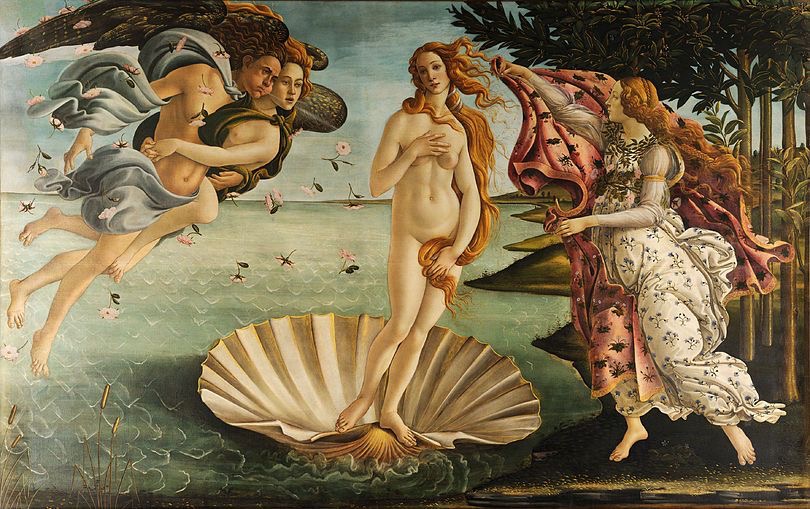
Sandro Botticelli «The Birth of Venus»
Navigation
[1] Concept [2] The Social, Cultural, and Economic Context of the Renaissance [3] Ancient Myths as a Medium for Transmitting the Spirit of the Renaissance [4] Conclusion [5] Textual Sources [6] Image Sources
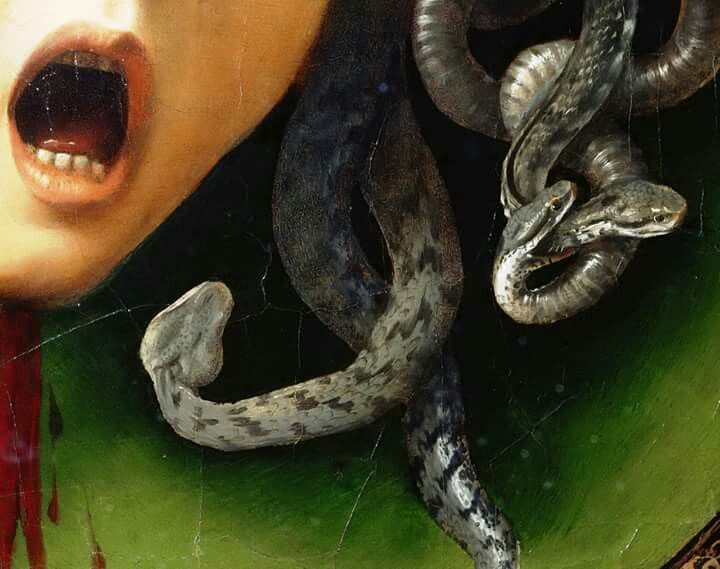
Caravaggio, Fragment «Medusa’s Head» 1597 Dimensions: 60 cm × 55 cm Uffizi, Florence
[1] Concept
Every era demands new symbols to represent its reality—symbols that reflect the social, economic, and cultural shifts, encompassing both the fears and hopes of society. Often, symbols are borrowed from the past, acquiring entirely new meanings, completely divorced from their original intent. The representation of previously forgotten symbols, meanings, and even beliefs becomes layered with new ideas, emotions, and contexts, allowing them to revive and attain new significance. They become a mirror of the people who use them—of society, time, policy, and economy—within which they exist.
Ancient mythology—specifically the myths of ancient Rome and Greece—often becomes this newly discovered symbol.
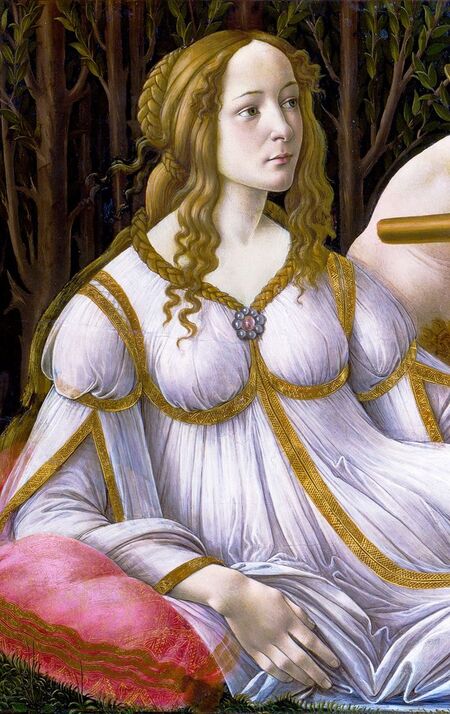
Fragment of Botticelli’s «Mars and Venus»
The legends of the past civilizations of Europe were an important part of Renaissance art, but it is essential to understand that Renaissance artists did not simply replicate what they saw in ancient works of art. Instead, they utilized classical imagery to represent the reality surrounding them—a reality shaped by the desires of influential patrons, political intrigue, their own perspectives, ideological motives, and the influences they felt around them.
It is also necessary to recognize the lost context of past myths, a context that was unavailable to Renaissance artists. They worked with a retold history, elements of which were partially lost, partially rewritten, and partially forgotten.
Both the imposition of lost context and the desire of the artists to augment it generated new meanings—meanings that, while not an exact representation of past myths, allow us, as people of the modern era, to grasp Renaissance individuals on a more intimate level.
Fragment from «Spring,» 1482 by Sandro Botticelli
The depiction of ancient Roman and Greek myths in Renaissance painting becomes a representation of the people of that era—their views on morality, corporeality, aesthetics, religion, nature, politics, and even intimate relationships. We can learn all of this by paying close attention to their retelling of distant legends and beliefs.
Sandro Botticelli, «Primavera.» Fragment: Flora 1482
[2] The Social, Cultural, and Economic Context of the Renaissance
Fragment from Botticelli’s «Mars and Venus»
Ancient mythology became a medium for conveying new ideas and phenomena that arose from emerging social and economic relationships, particularly in Southern Europe—especially in Italy—within the context of powerful city-states like Florence, Milan, and Venice, where the rigid norms of the preceding era, constrained by church law and powerful feudal lords, lacked authority. In these regions, a more liberated spirit flourished, supported by unique economic, political, and social conditions capable of sustaining the new artists of the Renaissance.
Artists were supported by the rulers of these city-states, merchants, and religious leaders—the creators themselves became more significant social figures.
Fragment of «Mars and Venus» by Botticelli
Among the individuals who patronized artists of that era and influenced how their various subjects were represented—often to their own political advantage—were the Medici family in Florence. Lorenzo the Magnificent, for example, sponsored Sandro Botticelli, Michelangelo, and Leonardo da Vinci. Various Popes, such as Julius II and Leo X, hired Michelangelo and Raphael for Vatican frescoes. Additionally, the Sforza Dynasty in Milan invited Leonardo da Vinci to work in their palaces, notably Duke Ludovico Sforza.
«The Violation of Europe» Titian 1560–1562
Similar wealthy patrons of the time favored mythological narratives because they allowed for the projection of intellectual sophistication, provided justifications for acquiring erotic art, and interestingly wove their lineage into heroic or divine figures, thereby giving greater moral validation to «their right to rule.»
Renaissance art became a visual platform for elite identity creation through the lens of myth, and it also leveraged these myths for propaganda.
Botticelli, «Primavera» (fragment — nymph Chloris and Zephyrus), 1482
It is also worth noting the emergence of new philosophical ideas in Europe during that period—a noticeable trend toward the idealization of nature and the human body, something previously taboo within the context of Catholic Christianity. This became a crucial element in motivating inspiration from antiquity. We can observe a synthesis of medieval European ideas and the classical antiquity during the Renaissance.
Jumpietrino «Leda with her children on her lap»
Thus, Christianity and paganism took on new meanings: Venus became an analogue of the Virgin Mary, while the «Descent of Orpheus» into the underworld symbolized the «Descent of Christ into Hell, ” and the „Judgment of Paris“ was compared to moral temptation and the fall of humankind—a theme that is so relevant in Christianity.
This type of syncretism allowed classic myths to survive and even flourish within a Christian context, adding depth to the works of that era.
Sandro Botticelli, «Athena Palladium and the Centaur»
[3] Myths of Antiquity as a Vehicle for Conveying the Spirit of the Renaissance
Botticelli, «Primavera» (Fragment) 1482