Semiotics of the False Door in Ancient Egyptian Funerary Canon: Visual Transformation as a Reflection of the Periods of Rise and Decline of Ancient Egypt
Rubrics:
1. Concept
2. The Cult of Ka in Ancient Egypt and Its Significance
3. The Evolution of the False Door
3.1. The Old Kingdom
3.2. The Middle Kingdom
3.3. The New Kingdom
4. Spatial Semantics of the Threshold and the Meaning of False Door Elements in Egyptian Culture
5. Iconography and Texts on False Doors
6. Systematization and Conclusions
Concept
Justification for Topic Selection
The culture of Ancient Egypt is replete with mystical symbols and signs. Its visual code is unique yet remarkably decipherable. This topic deeply interests me because many symbols and objects from Egyptian culture have endured to our time, transforming into visual elements that are more accessible to us. The theme of a closed door appearing at a pivotal moment in a person’s life is also present in contemporary visual art. This door takes on various forms, colors, and contexts, but one thing remains constant—it leads to some form of transformation, a meeting with the impossible. I believe the idea of passing through mystical doors into better worlds originated from Egyptian tombs. In this work, I aim to examine the false door not merely as a static architectural element, but as an idea conceived centuries ago, conveyed visually, and preserved into our modern era. I want to analyze the meanings ascribed to the false door by ancient builders, artists, and priests, and the significance of its various components. Furthermore, the false door is an excellent example of a visual concept that has undergone numerous transformations. I wish to explore how the false door, as a whole, evolved alongside Egyptian society. How did its visual code change, and why, despite all the obstacles and attempts to erase the world that the false doors of Ancient Egypt transport us to, did it nevertheless endure? In my view, this is a compelling element that vividly reflects the zenith of Egyptian civilization and its philosophy, as well as its eventual decline under the pressure of external civilizations.
Research Structure
To understand the concept of the false door and its transformation, one must analyze archaeological artifacts from the ancient world to the modern era. The false door has transformed significantly across different periods, and this will allow me to demonstrate the structure of that transformation. I will examine the most well-preserved artifacts from various time periods to identify trends in change and show the period when false doors dominated the structure of Ancient Egyptian tombs. Subsequently, I will analyze the most studied objects to better understand their construction, the significance of individual elements, and the symbols used. Following this, I can correlate the visual changes in my subject matter with the events occurring in Ancient Egyptian society to draw conclusions about the link between the changes in the false door and the historical events of Ancient Egypt. Thus—the core methodological principle of my research is a systemic approach.
Key Research Question
How the evolution of the false doors in Ancient Egyptian tombs reflects the change in the ancient Egyptians' worldview, what influence this transformation had on society, and what the goal was of pushing the semiotics of the world—in general, and the false doors in particular—out of the system of Ancient Egyptian tombs.
Hypothesis
The architectural element of ancient Egyptian tombs—the false door—served as a visual code characteristic of the civilization of Ancient Egypt and reflected a unique division of its philosophy: the world of Ka. This element transformed under the influence of political and social shifts within society. The evolution of the semantics and artistic design of the false doors reflects deep changes in the worldview of the Egyptians, documenting the transition from earthly socio-political priorities to new conceptions of the afterlife under the pressure of civilizations that conquered Egypt. The displacement of the world of Ka and the false door, as one of the central phenomena of this ancient Egyptian phenomenon, served as the final factor in the subjugation of the Ancient Egyptian civilization and its decline.
Research Objectives
1) Trace the evolution of the false door form—from early niches of the Old Kingdom to examples from the New Kingdom. 2) Analyze the spatial semantics of the threshold in Ancient Egypt and systematize the meanings of the false door’s elements. 3) Examine the iconography and texts on the false doors. 4) Trace the chronology of major historical events in Ancient Egypt that influenced the transformation of false doors and funerary cult practices in general. 5) Systematize the material according to the chronology of Ancient Egyptian civilization’s historical events and draw conclusions.
Timeline
Old Kingdom (c. 2778 — 2263 BCE / 3rd–6th Dynasties): A period considered the zenith of Ancient Egypt. It is when the great pyramids were built and the Pharaohs' power was at its strongest.
First Intermediate Period (c. 2263 — 2055 BCE / 7th–11th Dynasties): The state fragmented into nomes (autonomous regions), marked by civil wars, crises, and the decentralization of power.
Middle Kingdom (c. 2055 — 1650 BCE / 11th–13th Dynasties): The unification of Egypt under the rulers of Thebes. This era saw economic growth, a flourishing of science and art, and aggressive foreign expansion.
Second Intermediate Period (c. 1650 — 1550 BCE / 14th–17th Dynasties): Various foreign powers conquered Egypt, leading to the nation’s weakening.
New Kingdom (c. 1550 — 1069 BCE / 18th–20th Dynasties): The peak of Ancient Egyptian civilization’s might. This era featured the rule of great conquering Pharaohs (Thutmose III, Ramesses II the Great), the flourishing of sciences and arts, and the construction of many of the monuments known today.
Third Intermediate Period (c. 1069 — 664 BCE / 21st–25th Dynasties): Egypt was conquered by other civilizations, leading to the end of its independence and fragmentation.
Rationale for Selecting the Chronological Period
The period preceding the Old Kingdom does not contain a large number of artifacts associated with the false door. The Predynastic period mainly features purely archaeological sites that are difficult to interpret definitively. The period following the New Kingdom can be characterized as the decline of the Ka cult and the culture of false doors in tombs. Therefore, the monuments of the Old and Early Dynastic periods are of greatest interest to this study. It is from this period that we have inherited a vast quantity of architectural masterpieces, deciphered paintings, and papyri. The monuments of the 4th, 5th, and 6th Dynasties are particularly valuable to my research. There are many of them, and they are the best studied. In the Middle Kingdom, the significance of the Ka cult declines, resulting in the simplification of the false door. Therefore, I will also cover the origins of the false door and its transformation in the Middle and New Kingdoms, which will allow the visual presentation to be more complete.
Criteria for Selecting Research Subjects
As the main subjects, I selected objects for which there is the greatest amount of reliable information. For objects lacking extensive research or having a limited number of available images, I used them as auxiliary material to support my investigation. The ultimate goal of selecting these subjects was to create a clear visual sequence illustrating the transformation of false doors in ancient Egyptian tombs. Since I am studying objects directly related to funerary rites—I will be examining tombs and burials. It is logical to assume that the most striking examples will be the burials of pharaohs and nobility. However, for comparison and to understand the overall processes, I will also cover a range of objects belonging to less prominent members of Egyptian society.
Key Artifacts Examined in the Study
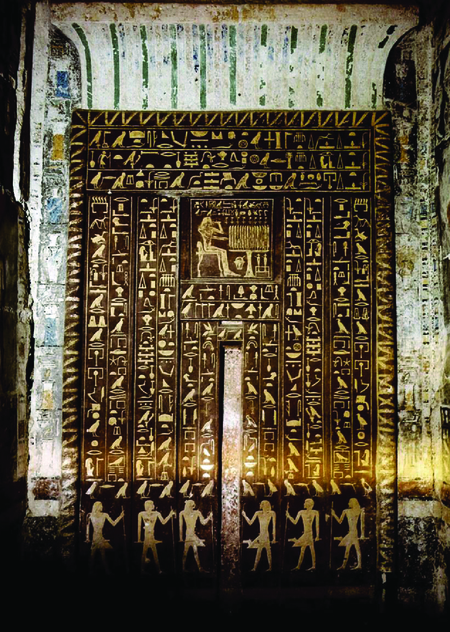
1 — False Door of Neferu (c. 2150–2010 BCE), 8th–11th Dynasties. The deceased is depicted in the central niche before the offering table. Metropolitan Museum of Art, New York. 2 — Tomb of Hem Min. (Late 5th — Early 6th Dynasty. Reign of Pharaoh Djet, approximately 2345–2323 BCE). Old Kingdom. El-Hawawish Necropolis (near modern Akhmim). 3 — False Door of Ika. (6th Dynasty — c. 2475–2355 BCE). Old Kingdom. Egyptian Museum, Cairo. 4 — Painted Limestone False Door of Tetyt Ankheris with a statue in the depth of the niche. 6th Dynasty (c. 2345–2181 BCE). Old Kingdom. Egyptian Museum, Cairo. 5 — Tomb Complex of Vizier Ka in Southern Abydos. 6th Dynasty (c. 2345–2181 BCE). Old Kingdom. Southern Abydos. 6 — False Door from the Tomb of Scribe and Astronomer Amenemhat (New Kingdom, 18th Dynasty, approximately 1401–1391 BCE). Metropolitan Museum of Art, New York. 7 — Statue of King Ka of Horus. (13th Dynasty — c. 1750 BCE). Middle Kingdom. Egyptian Museum, Cairo. 8 — False Door in Masabu Idu on the Giza Plateau. (6th Dynasty — c. 2345–2181 BCE). Old Kingdom. Giza Plateau. 9 — False Door of Herishefnat. Saqqara Necropolis (near the Pyramid of Tetty)—an ancient Egyptian limestone door-stela (5th–6th Dynasty). Old Kingdom. Museum of Mediterranean and Near Eastern Antiquities (Medelhavsmuseet). Stockholm, Sweden. 10 — Funerary Stela of Khoremhet. Limestone. (18th Dynasty — 1539–1500 BCE). New Kingdom. Druvert Collection (1824). Cat. 1611. Museo Egizio, Turin, Italy. 11 — False Door of Princess Ukhmenefret (or Wahmenefret) with a ritual offering table. (4th Dynasty, Old Kingdom period, c. 2543–2435 BCE). Museo Egizio, Turin, Italy. 12 — False Door on the Sarcophagus of Khnumnakht (Coffin of Khnumnakht / Nakhtkhnum). Approximately 1850–1750 BCE. Middle Kingdom, late 12th–mid 13th Dynasty. Metropolitan Museum of Art, New York. 13 — False Door of Royal Treasurer Neferu. Approximately 2150–2010 BCE (First Intermediate Period, 8th–11th Dynasties). Metropolitan Museum of Art, New York.
Introduction
Egyptian culture is built upon the tradition of burial. Every sphere of Egyptian society is connected in some way to the concept of an afterlife. This is not simply the burial of the dead; it is a vast and complex process spanning science, art, economics, education, and religion, upon which the Egyptian civilization was built. The entire social structure of ancient Egypt is intrinsically linked to the design of its tombs.
Funeral traditions have traditionally formed the foundation of any civilization. Almost every ancient culture developed its own rituals and possible scenarios for life after death. Like in other civilizations, the development of ancient Egyptian burial rites was closely tied to the country’s political movements. Reforms were conducted in real life as well as in preparation for the afterlife. The focus was often placed specifically on the afterlife, because fears and beliefs allowed rulers to manage their subjects more effectively, and it was easier to give hope and reduce tension among the living with grand promises about realms—good or bad—that could not be verified.
However, the tombs of the Egyptians are not solely about the afterlife. The funerary practices and beliefs of the ancient Egyptians are far more complex than they might seem. This complexity is precisely what makes Egyptian culture unique and fundamentally different from all others.
For thousands of years, Egyptian culture existed in relative isolation from other cultures, preserving and developing its singular identity. During this time, a vast number of ancient monuments remained, which modern scholars have managed to decipher. This has allowed for the creation of a sufficiently broad and reliable picture of the worldview of Ancient Egypt.
According to the worldview of the ancient Egyptians, a person was conceived as an indivisible entity composed of numerous parts. Each of these components holds significance for interpretation and function. In many ways, most of these parts were connected to funerary cults. For example, the Khat was the mummified physical body, which was essential for the continuation of afterlife existence. The Ba was the spiritual body, attained after funeral rites. The Ka was perhaps the component closest to the concept of the soul in other religions. There were also other parts of the human being that emerged during life or after death, playing a huge role in the complex system of Egyptian vital organization.Each part had its own role, its own narrative, and its own function in the afterlife, but for my research, the part called the Ka is the most interesting—it is the one linked to the architecture of false doors.
Statue of King Khafre. Egyptian Museum. Cairo. 13th Dynasty (c. 1750 BCE).
The Cult of Ka in Ancient Egypt and its Significance
It is challenging for us to fully grasp the diversity of post-mortem practices among the ancient Egyptians. However, for ancient societies, the focus on the afterlife is quite logical and easily explained. Life was hard and relatively short. The risks of illness, famine, and natural disasters were significant, and the human psyche naturally seeks anchors. Often, the dream of an easy and well-fed existence served as that solace. It was the rituals and structured beliefs that lent this dream density, visibility, and relative realism.I believe that the conventional coherence and variety of the Ancient Egyptian belief system provided stability and longevity to their beliefs. People believe in what they want to believe. And it was the belief in the Ka world that provided the greatest stability to their lives, thanks to its simplicity and uniqueness.There are certainly many rules in the world of the Ka. But all these rules are simple and comprehensible. The Ka is essentially a double of the person. It arises at the moment of birth, develops alongside the person, but continues to live after the double dies. It develops in a peculiar way—the more recognition a person receives, the more they are remembered, the stronger and happier their Ka becomes.
False Door of Neferu (c. 2150–2010 BCE), 8th–11th Dynasties. The deceased is depicted in the central niche before the offering table. Metropolitan Museum of Art, New York.
In our context, we can say that «Ka» is a kind of personal brand—it exists as an image, a description of a person and their actions; it is the reflection that the person creates themselves. And the world of the doppelgänger is filled with other reflections—relatives, servants, attendants, objects, and food. Furthermore, this system is perfectly ecological; for example, the reflections of relatives in the Ka world are not enslaved doppelgangers but individual images, reflections of reality specifically created for the world of that particular Ka.Yet, the primary element is not the person themselves, but rather their doppelgänger, the Ka. This is because the Ka constitutes their original essence, and it is the Ka that continues its eternal life after the person’s death.
The Creation of Man. Khnum sculpts the king in the image of Ka. Monument of Amenhotep III (1405–1370 BCE) from Luxor.