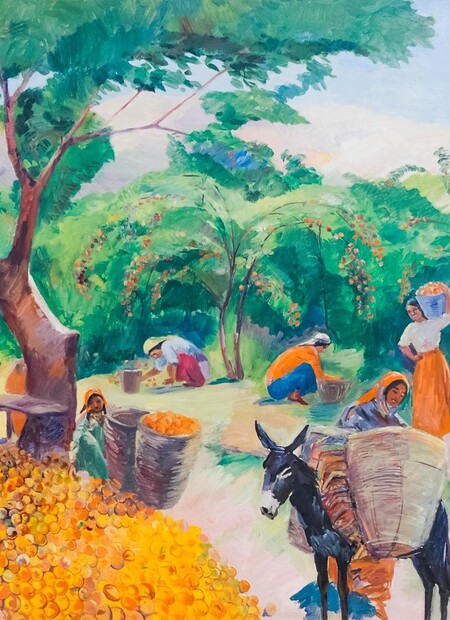
Plan:
- Concept2. Early Synthesis of East and WestTurkey: • «Street. Midday. Constantinople» (1910) • «Constantinople. Dogs» (1910) • «Lilac» (1910) (if time permits)Egypt: • «Date Palm. Egypt» (1911) • «Street in Cairo» (1911) • «Egyptian Night» (1911) (if time permits)Persia: • «Persia» (1913) • «In Persia» (1913) • «In Barfursheh. Persia» (1913) (if time permits)• «Bedouin with Camel. Fellah Village» (1911)? • «Sambek’s Flowers» (1914)? • «Red Horse» (1919)?3. Reinterpreted Synthesis of East and West«Alaverd Copper Smelter» (1929)? «Spring. Gardens» (1932) «Peach Harvest in the Armenian Kolkhoz» (1948)«Karyndzh Village Kolkhoz in Tumanyan Mountains» (1952) «Lalvar» (1952)4. Conclusion
Concept
His painting is characterized by great emotional depth. The individualism of his art is expressed in the distinctiveness of the paths he chose and the forms through which he conveyed his feelings and thoughts—forms that he discovered personally and which are utterly original. They draw sustenance equally from the wellsprings of national artistic traditions as they do from the impressionistic explorations of modern France. The Orientalism in his painting is organic and unpretentious. The blending of national characteristics in his works with a broader European culture creates a unique aroma in Saryan’s art.
«Martiros Sergeevich Saryan—an Armenian and later Soviet painter, graphic artist, illustrator, and scenographer, one of the founders of the national school of Armenian painting [1].» Born in Nakichevan-on-Don (which is now part of Rostov-on-Don), his heart, however, belonged to his roots and his historical homeland, a sentiment that profoundly influenced his art.«Saryan’s subject matter was diverse. He painted landscapes, cityscapes, portraits, and still lifes [2].» Yet, the depiction of Armenia, the land of his ancestors, naturally holds a special place in his work. His Armenian landscapes represent the final, most poignant note of his painting.However, attention should not be devoted only to the landscapes of his homeland. Since Martiros Saryan traveled extensively, he created landscapes and panoramas of various countries. It is in these works that we can see and feel how he captured the character of the local scenery through the lightness of his brushwork, the vibrancy of color, and the tonality of sunlight—especially in combination with color—all elements that convey the national identity and unique character of each nation.
Martiros Saryan. «Bedouin with a Camel. Fellah Village.» 1911
«Martiros Saryan’s artistic legacy is considered one of the most brilliant in the history of Armenian painting. The painter was distinguished by his unique style, in which color plays the primary role. His paintings are vivid and saturated—every shade plays an important role in the overall composition. Saryan skillfully combined expressiveness and the purity of color in his works with a deep and subtle understanding of light, which lent his pieces a unique charm and emotional depth [2].»
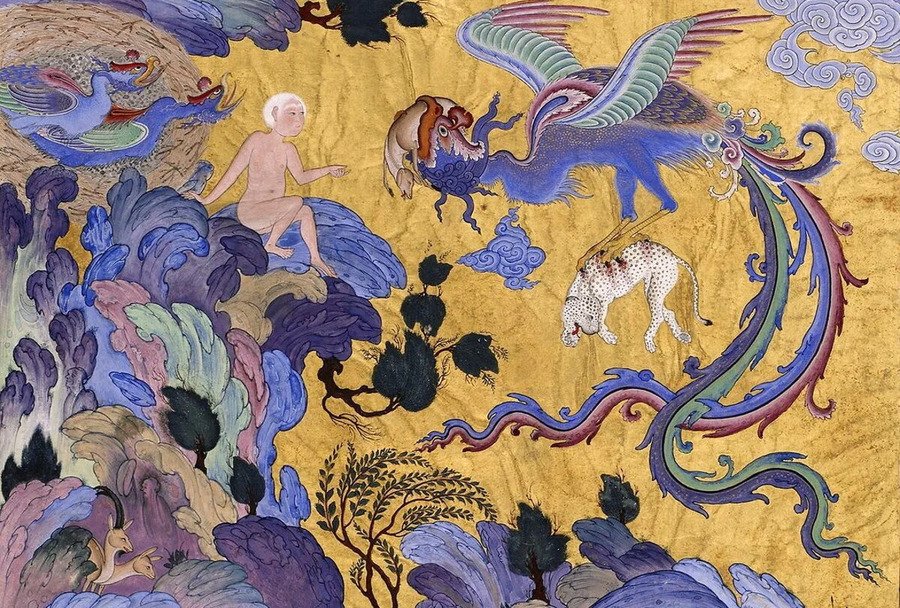
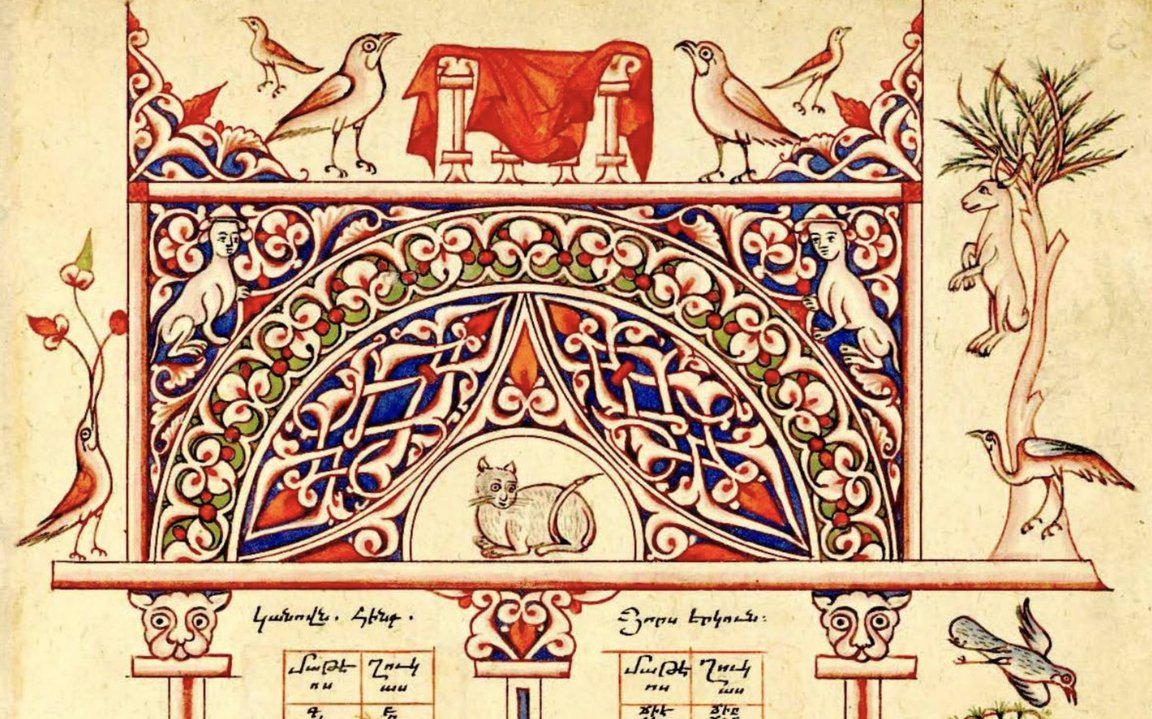
But the most compelling aspect of Martiros Saryan’s painting is not merely the harmony and expressiveness of the ethnicity, culture, and folklore from any region the artist visited, but rather how he depicted them. The truth is that Saryan and his work were profoundly influenced by artistic movements such as Impressionism, Fauvism, and Post-Impressionism. These movements provided him with the foundation for the brilliance and expressiveness of color, masterfully combined with the intensity of sunlight. Furthermore, he was greatly inspired by medieval Armenian miniature painting and the artistic output of the East, which included monuments from the ancient world. These historical artworks gave him an understanding of the key elements necessary for the basis of his landscapes—such as composition, space, the monumentality of form, and its generalization.
All of this created a unique synthesis of East and West. Essentially, Martiros Saryan reinterpreted the traditions of two nearly disparate global civilizations. Each of these civilizations possessed its own history, its unique developmental trajectory, culture, and independently formed way of life. On the surface, they seemed incapable of relating to one another or existing side-by-side. However, Saryan organically and harmoniously fused them. He unified the ancient cradles of civilizations with the innovations of European nations. The artist created a cohesive whole from disparate worlds. To substantiate this hypothesis, works from Martiros Saryan’s early career and pieces from when he rethought his style were selected and analyzed. This approach will best enable me to explore and reveal all facets of the synthesis between the techniques of Western masters and the elegance of Eastern cultures.
Early Synthesis of East and West
In 1897, Martiros Saryan enrolled at the Moscow School of Painting, Sculpture, and Architecture. At that time, the school was a leading educational institution where reforms to the education system were being implemented, and artists with progressive views were invited to teach [3].After completing his foundational studies, Saryan continued his training in the studios of Konstantin Korovin and Valentin Serov [3].
Trips to the Caucasus in the early 1900s proved to be an awakening for Saryan. Visiting his homeland strengthened his connection to his ancestors and transformed the palette and mood of his work [3].
During the 1900s, he participated in exhibitions of art associations such as «Blue Rose,» «Golden Fleece,» «Union of Russian Artists,» «World of Art,» and «Four Arts.» He also visited the homes and saw the collections of paintings belonging to Russian patrons and collectors like Sergei Shchukin and Ivan Morozov. It was during this period that the young artist encountered the canvases of European painters from the Fauvism and Post-Impressionism movements, such as Gauguin, Cézanne, Matisse, and Van Gogh.
Between 1910 and 1913, he traveled to Turkey, Egypt, and Iran [1], where he gained a deep familiarity with the nature, cultural monuments, and ancient art of the East.
It was then that Martiros Saryan began to form his extraordinary synthesis of the West and the East in his paintings.
Turkey
Martiros Saryan, the first from Eastern countries, visited Turkey.
One of the main works of the «Turkish period» is «Street. Noon. Constantinople» from 1910.
Martiros Saryan. «Street. Noon. Constantinople.» 1910
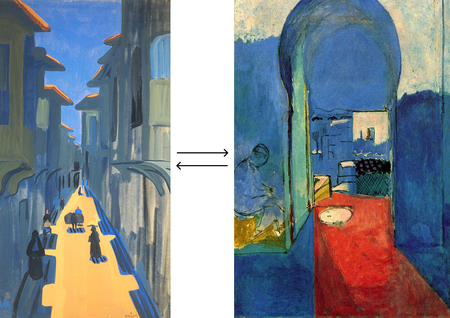
When viewed through the lens of Western artistic influences, Saryan’s «Street. Noon. Constantinople» bears a clear resemblance to Henri Matisse’s «Entrance to Casbah,» particularly concerning the color palette and brushwork. There is a distinct interplay between warm and cool tones, and both artists left these areas unmixed. The shadow is not rendered by mixing warm pigments with black; instead, it is conveyed through its own cool hue. This technique intensifies the feeling of heat and sweltering air, while simultaneously suggesting a coolness within the shadows during midday in a barren country. The broad brushstrokes and the lack of defined edges in the paintings evoke the idea that the mind—due to the high air temperature—begins to «blur» the boundaries and individual colors of all objects, merging them into a single whole.
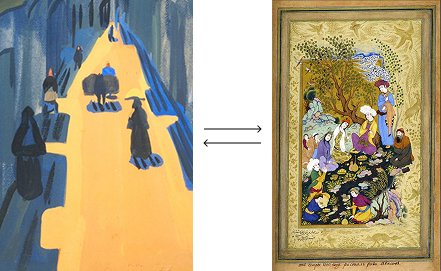
From the perspective of equating the painting with the East, one must look at the characters. They are virtually «faceless»; their silhouettes are generalized, and no individual person possesses a distinct «face, ” „character, ” or such.Here, the motif of medieval Eastern miniature painting is apparent, where in most cases, the face and the figure are one, simply rendered in different views and forms.
Martiros Saryan. «Constantinople. Dogs.» 1910
«Constantinople. Dogs, ” is perhaps one of the most colorful works of early synthesis. Known Soviet art critic Vladislav Zimenko said of it: „Although the animals depicted in close-up seem close to us, as a motif, they also go beyond the realm of the ordinary. The painting, in its entire artistic structure, speaks of something unusual. […] Strange, rhythmically placed creatures casting bright-blue shadows form what is like a clearly ordered, planar decorative relief, in which there are no straight paths“ [4]
To see how the influences of French artists shaped this work, one must look not only at the pieces of Henri Matisse but also those of Paul Gauguin.
In Gauguin’s painting «Areareare / A Prank» and in Matisse’s «Green Stripe,» the figures feature unnatural, unrealistic colors, yet they possess a expressiveness that allows you to discern the silhouette and understand the meaning—a quality Saryan conveys when depicting dogs. Combined with the broad, short brushstrokes, the images—though blurred—seem to come alive.
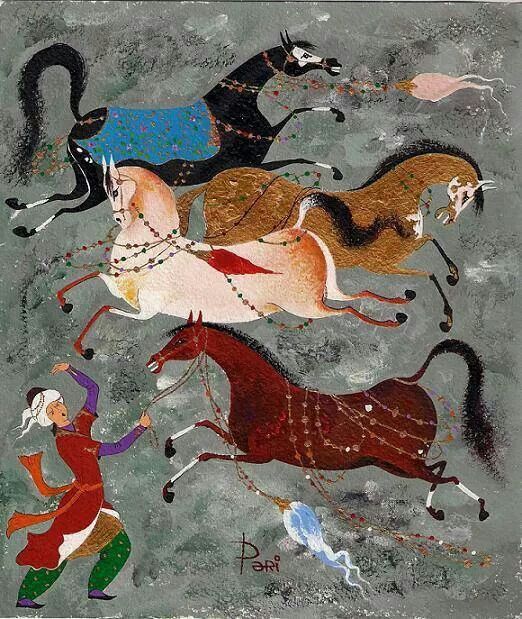
Egypt
In 1911, the artist visited Egypt, where he drew inspiration from the art of Ancient Egypt.
Martiros Saryan. «Date Palm. Egypt.» 1911
Martiros Saryan. «Street in Cairo.» 1911







