«СМОТРИТЕЛЬ ТИХОГО ЧАСА»
Магический реализм / подростковое фэнтези с элементами северного фольклора
Problem and Relevance
Relevance— Picture books account for 60% of children’s publishing, and the share of domestic authors has risen to 46%, meaning there is an open niche for author-illustrators.— Teens aged 12–18 are the demand driver, but they are strongly drawn to visuals.— Fantasy and mystery make up 28% of sales in the youth segment.— 62% of families are willing to purchase books, and 81% spend up to 3,000 RUB per month.
Reader: Teens aged 12–14 who have grown out of «little kid» books; parents searching for a meaningful gift.
Setting
Zavod City—a seaside town, once a bustling port, is now slowly sinking into slumber. The power plant on the hill runs on strange fuel: the citizens surrender their «excess”—forgotten grievances, superfluous tenderness, old fears. In return, the city receives light.
Every night between 3:00 and 4:00 AM, time in the city stops. It is neither a dream nor death—it is the Quiet Hour. People freeze where they are found: with a cup to their lips, with an unwritten text message, with an open window. None of the adults remember what happens during this hour. The children—they remember, but worse with each passing year.
During the Quiet Hour, the Overseer walks the streets—the only one capable of movement. He carries a list. On that list are the things that must be fixed before dawn.
Visuals
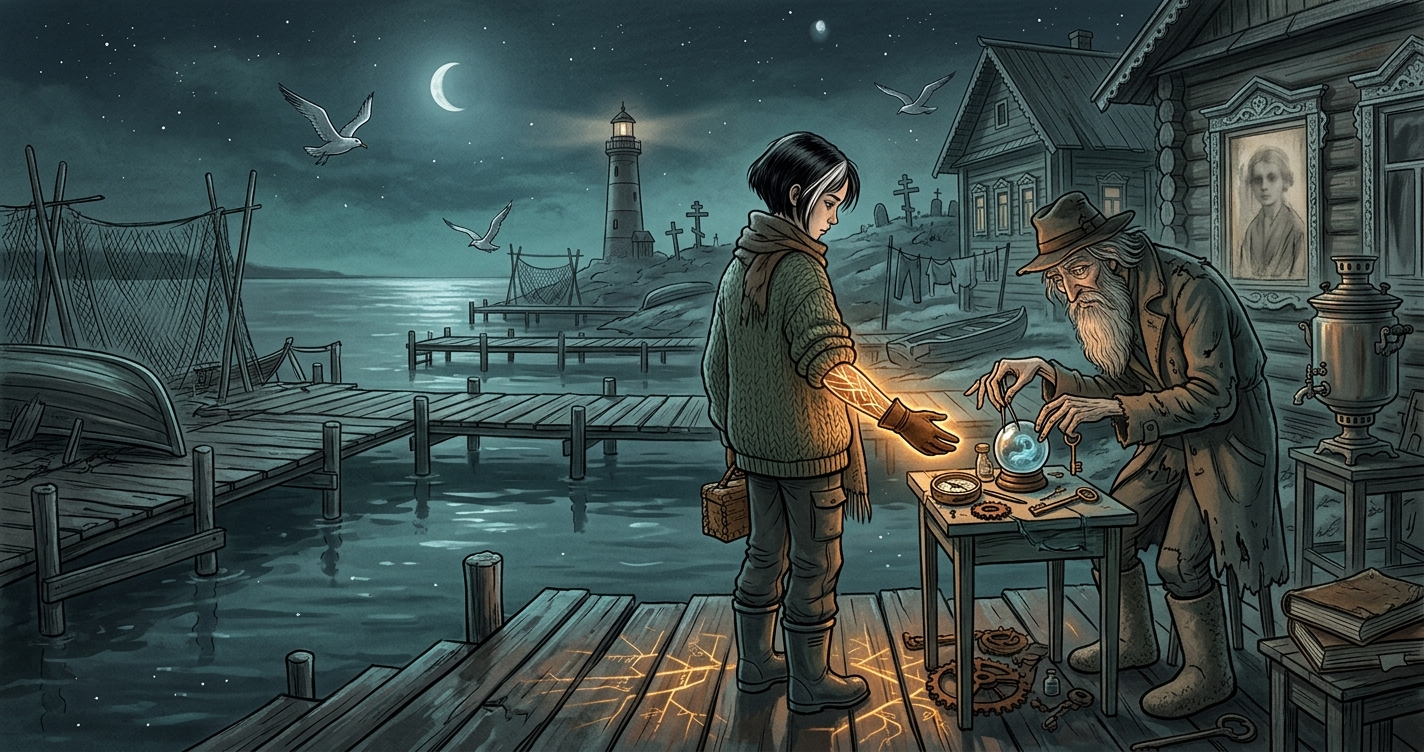
Palette: cool grayish-blue, dark turquoise, aged paper color, the only warm accent—Yasi’s glowing hand (warm yellow-orange).
Lighting: nocturnal, backlit, light sources—lanterns, shop windows, the glow from the hand. Lots of soft shadows.
Textures: wool, rust, wet asphalt, old paper, glass.
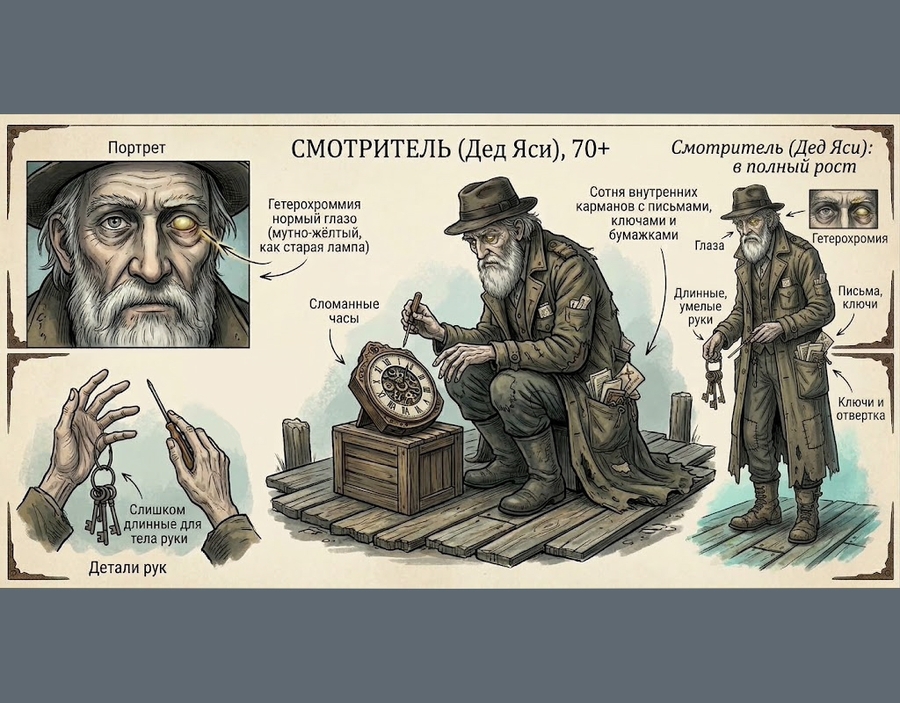
Style: a blend of book illustration and graphic novel—realistic proportions, but with grotesque elements (the grandfather’s overly long arms, Mrs. Pusto’s face, Toshi’s broad bone structure).
Characters
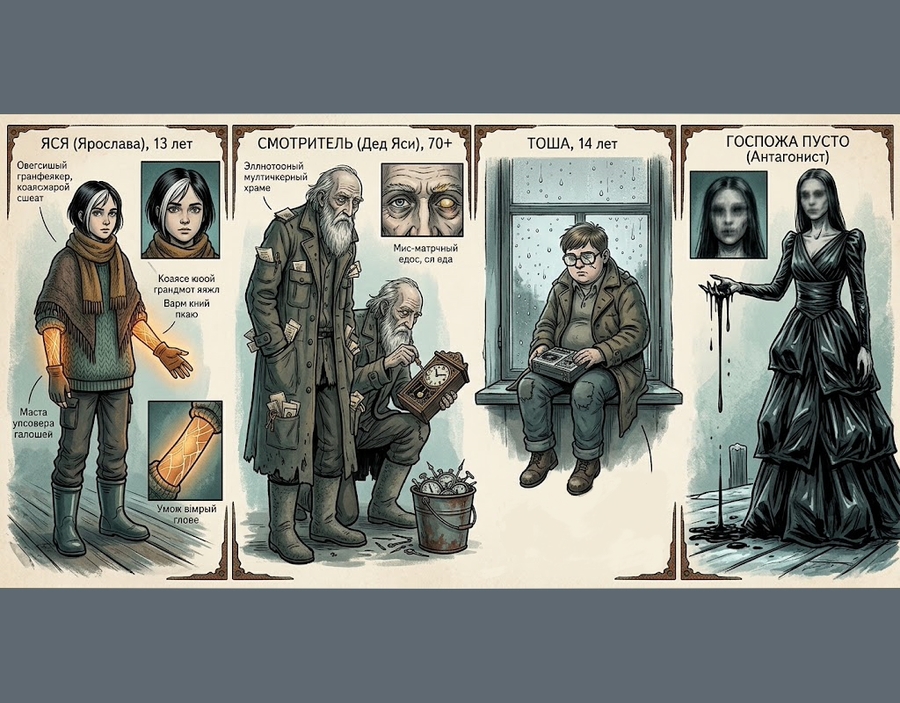
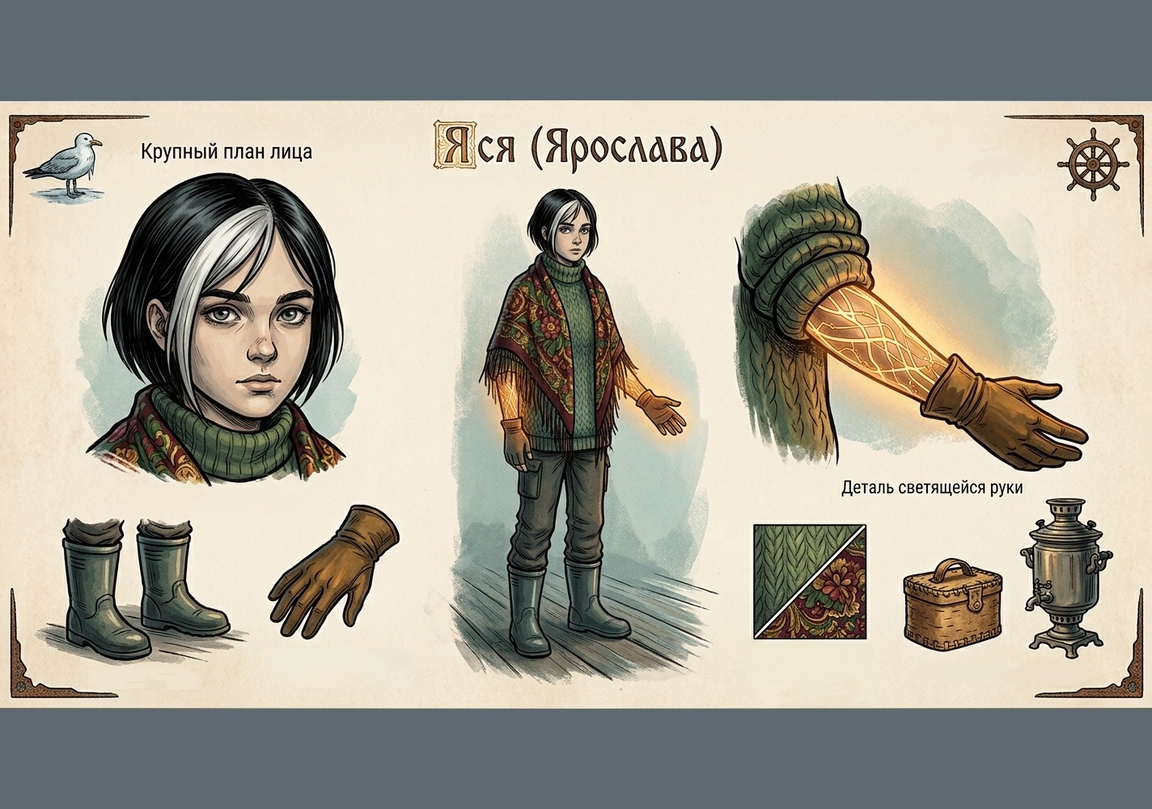
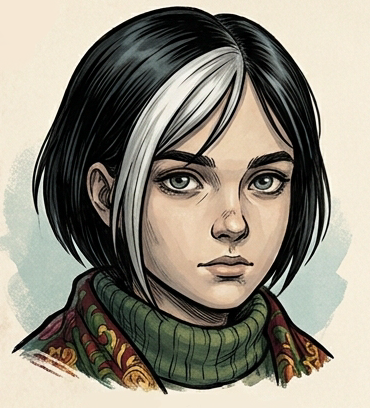
Yasya (Yaroslava), 13 years old Thin and petite, she is always wearing someone else’s clothes—her father’s sweater, her grandmother’s shawl. Her hair is dark and cut short, with a single gray streak (she has no idea where it came from). Her left arm is covered by a glove—not because it is injured, but because during the Quiet Hour it glows: thin lines, resembling a subway map, can be seen moving beneath her skin. Yasya hides this. She has just moved in with her grandfather, whom she hardly knows because her mother «went to work» (actually, she went to the hospital, and Yasya was never told).
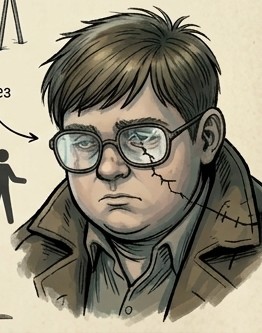
Tosha, 14 years old. His neighbor, Yasi, who «doesn’t sleep during Quiet Hours”—because he can’t. He’s chubby, wearing glasses with a cracked lens (the crack resembles a river). He carries an old tape recorder and records the sounds of a frozen city: ticking that shouldn’t be audible, the creak of swings that aren’t moving. He is in love with Yasi, but expresses it awkwardly and through constant arguments.
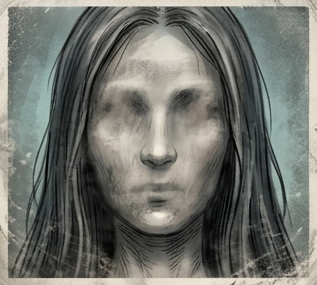
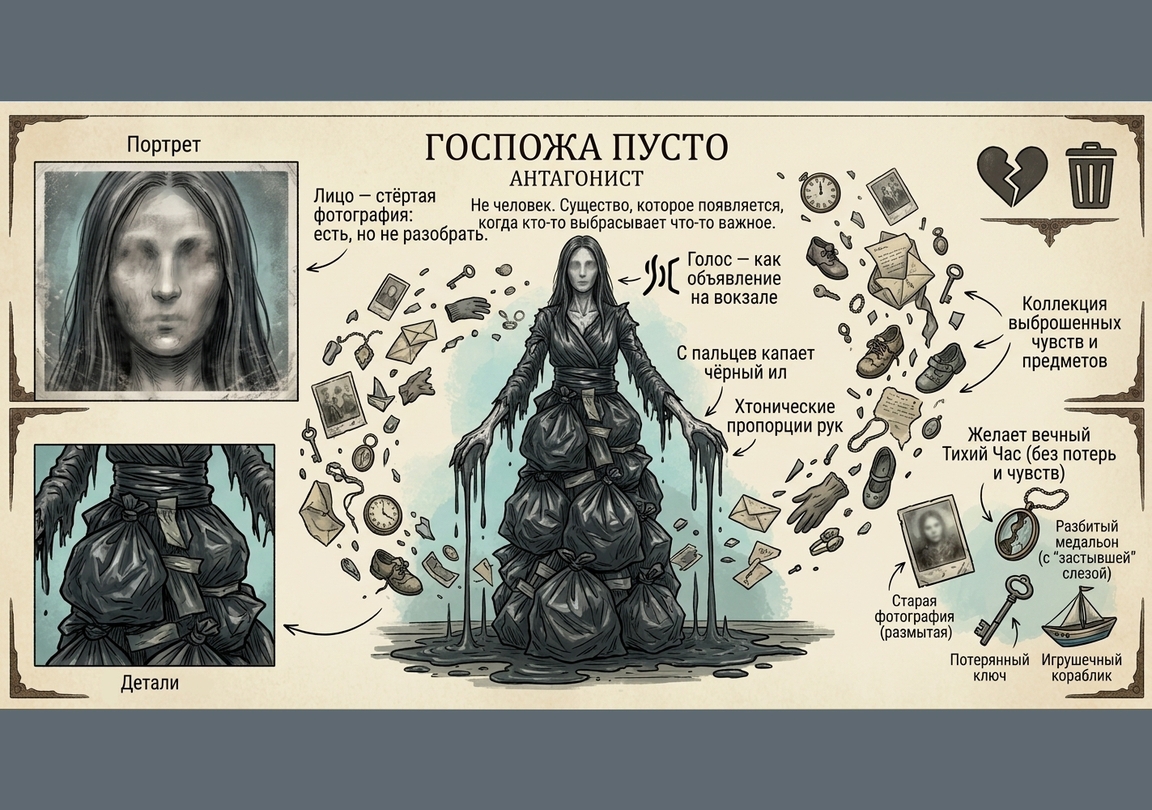
Ms. Pusto (Antagonist) Not human. A being that materializes when something important is discarded. She appears as a tall woman in a dress made of black garbage bags; her face is like a blurred photograph—present, but unreadable. Her voice is a creaking train station announcement. She collects discards: not objects, but emotions. She wants the Quiet Hour to last forever—then no one else will lose anything, because no one else will feel anything.
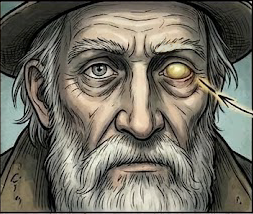
Caretaker (Grandpa Yasi), 70+ Tall, stooped, with hands that are too long for his body. He wears a long coat with a hundred internal pockets, spilling out papers, keys, and someone’s letters. His eyes are mismatched: one is gray, the other is murky yellow, like an old lamp. He speaks little and grumbles. He never looks someone in the eye—he looks slightly above their head, as if seeing something beyond the person.
Pipeline
— Creating a mood board, selecting references, and studying the characteristics of Northern settlements. — Sketches, storyboarding, iteration/culling — Coloring, rendering. AI neural networks are used where necessary. — Post-production
Positioning and Distribution
1. Illustrator’s Social Media Presence — Process documentation: sketches, storyboarding, «before/after» shots—shared on Instagram / VK / Telegram channels. — Showcasing characters and key scenes before book release—building anticipation.2. Illustrator Platforms — Behance, Dribbble, Pinterest—project portfolio. — Participation in challenges (Inktober, Mermay) featuring book characters.3. Publishing Contests and Pitching — Contests such as «Book Image, ” „Book Inside, ” and contests for emerging illustrators. — Pitching to publishers: „Samokat,“ „KompasGid,“ „Polyandria,“ „MIF. Childhood.“4. Literary and Local History Communities — Family reading clubs, libraries, and schools. — Pomeranian cultural centers, museums, and festivals (e.g., „Belomorsky Games“). — Partnerships with local history projects.5. Merchandise and Additional Formats — Prints, postcards, bookmarks, and posters featuring key scenes. — Digital version: animated spreads for social media. — Audio version with sea sounds and a „quiet hour.“
Print: cover
Cover Type: Hardcover (7BC — 7-bit cellulose coating, or integrated).
Why Hardcover: The book has 120 pages, is a gift format, and since it is intended for ages 12+, a soft cover would «cheapen» the product and wouldn’t withstand the weight of the block. The hardcover justifies the price and protects the illustrations.
Book Format: 225×300mm — suitable for maritime horizons and vertical lighthouse/boat imagery.
Print: internals
Paper:Type: Matte coated or high-density offset paper. Weight: 140–150 g/m². Any thinner, and the illustrations will show through; any thicker, and the booklet will become too heavy for 128 pages.Booklet Printing:Color Profile: 4+4 (full color on both sides) — because the spreads and illustrations span the entire booklet.
Your Calling