Concept:
The Gospel of Matthew tells the story of wise men from the East who came to worship the infant Christ and offer him gold, frankincense, and myrrh. However, their number, names, age, and appearance are not specified. The conventional image of the three kings developed gradually under the influence of Christian interpretations and artistic traditions. This makes the narrative of «The Adoration of the Magi» an interesting subject for visual exploration.
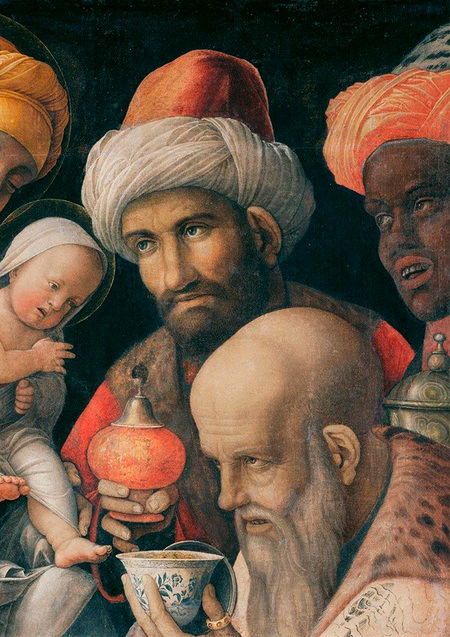
Artists differentiated characters by age, gesture, clothing, headwear, and gifts, and sometimes by skin color and facial features. These characteristics could denote status, presumed origin, or connection to different parts of the world. In my visual research, I want to trace how European painting represented the cultural «Other.»
The goal of my visual research is to explore ways of depicting the cultural «otherness» of the Magi and their connection to the iconography and artistic context of the Medieval and Renaissance periods.
Research Question: Why did artists depict the Magi differently when the Gospel barely describes their appearance, and what do these differences reveal about cultural perceptions?
As a hypothesis, I propose that the appearance of the Magi was influenced by religious traditions, artistic language, and perceptions of other lands. «Otherness» was conveyed through a combination of costume, attributes, appearance, and composition. Furthermore, age or a crown did not necessarily indicate origin, but could express status and symbolic meaning.
The visual materials consist of works from the thirteenth to the first half of the sixteenth century, primarily by Italian, Dutch, and German masters:
Guido da Siena, Duccio, Giotto, Gentile da Fabriano, Rogier van der Weyden, Mantegna, Bosch, Dürer, and Goias. The selection is built chronologically, by region, and by the variety of characteristics: paintings are compared both with and without pronounced cultural differences.
The main method I use in my visual research is the comparison of compositions and details—faces, costumes, headwear, attributes, and gestures. The style, patron, and function of the artwork are taken into account. The transition from the Middle Ages to the Renaissance is not interpreted as a straightforward movement from convention to realism; artistic approaches could coexist.
The research is divided into four thematic chapters, within which the works are compared chronologically.
First, I examine how the image of the Three Kings was constructed and the role played by their age and royal attributes. Then, I move on to the costumes, gifts, and other details that might indicate the characters' origin and status. The third chapter is dedicated to the variations in the appearance of the kings and the representations of different parts of the world. In the final chapter, I analyze their placement, gestures, and interaction within the composition. This structure allows for an examination of various ways of depicting cultural «otherness» and traces its evolution over time.
1. From Sages to Kings
Forming the image of the Magi
The image of the Three Wise Men, as we recognize it today, did not form instantly. Throughout the Middle Ages, artists referred to established religious traditions and gradually solidified recognizable character traits: crowns, age differences, and gestures of reverence. In this chapter, I will examine how these features were depicted in paintings from the 13th–15th centuries and the role the artistic language of that era played in conveying them.
Guido da Siena Workshop. «Adoration of the Magi.» c. 1270–1280. Lindenau Museum, Altenburg.
In 13th-century Sienese painting, the gold background, crowns, and gestures underscore the solemn nature of the adoration. The Magi are presented as rulers acknowledging the authority of the infant Christ.
In the Gospel of Matthew, the Magi are named sages from the East, but nothing is said about their royal lineage. The notion of the Magi as kings developed later under the influence of Christian interpretations.
Giotto. «Adoration of the Magi.» 1303–1305. Scrovegni Chapel, Padua.
Over time, artists began to distinguish the Magi by age, depicting them as elderly, mature, and young.
Compared to the Sienese painting of the 13th century, Giotto’s figures exhibit greater volume and interaction. The sequence of veneration becomes part of the drama of the sacred event. Gray hair, beard, and the kneeling posture highlight the elder prophet. The removed crown transforms a royal attribute into a sign of humility.
Duccio di Buoninsegna. «Adoration of the Magi.» 1308–1311. From the Sienese Cathedral Museum’s «Maestà.»
Duccio retains the decorative expressiveness of the lines and the solemn rhythm of the figures. The subject matter belongs to the grand altarpiece created for the main cathedral of Siena.
Lorenzo Monaco. «Adoration of the Magi.» c. 1420–1422. Uffizi Gallery, Florence.
In Late Gothic painting, solemn gestures are combined with the decorative nature of the costumes. The image of the tsar is created not only through the crown but also through the splendor of his attire.
Rogier van der Weyden. «Adoration of the Magi.» c. 1455. «Columba Altar, ” Alte Pinakothek, Munich.
In 15th-century Dutch painting, there is a notable focus on faces, fabric folds, and object textures. Despite this, the tradition of distinguishing the Magi by age and gestures is maintained.
These traits characterize the characters, but do not necessarily reveal their geographical origin.
2. The Image of Distant Lands
Costume, Attributes, and Status
In the Gospel, the Magi arrive from the East, but their precise place of origin is not specified. Consequently, artists were able to depict their clothing, headwear, gifts, and accompanying entourage in diverse ways. In this chapter, I will examine how such details were used to construct an image of distant lands and how representations of other cultures merged with the European fashion and artistic traditions of the Middle Ages and the Renaissance.