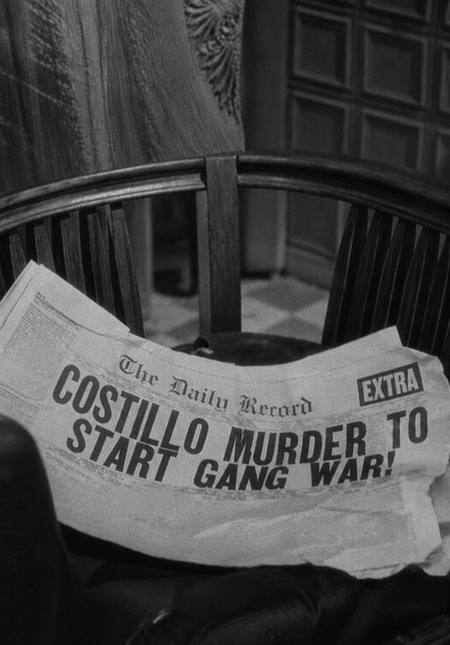
________________
Topics
— Concept
— Cinema’s attempts to conceptualize its young medium
— Print text and the collision of media
— Seven functions of newspaper imagery:
⠀⠀⠀⠀1. Informational
⠀⠀⠀⠀2. Political
⠀⠀⠀⠀3. Dramatic
⠀⠀⠀⠀4. Temporal
⠀⠀⠀⠀5. Media-related
⠀⠀⠀⠀6. Socio-ideological
— Conclusion
________________
Concept
Cinema, which emerged at the turn of the 19th and 20th centuries, was a relatively young medium that still needed to develop its own language, define the boundaries of artistic expression, and establish its place among existing methods of representing reality. The moving photographic image possessed a unique relationship with reality from the beginning: cinema’s capacity to capture the surrounding world created the impression that the image was a direct witness to what was happening. However, cinema could simultaneously depict reality and create fictional worlds, and distinguishing between the two was not always possible. In the artistic Hollywood films of the 1910s–1930s, this characteristic took on particular significance: the films strove to create a coherent on-screen reality where the viewer barely noticed the conventions of the cinematic image itself.
In this regard, of particular interest is the appearance of newspapers in American films from the 1910s through the 1930s. By this time, the print media had become a familiar and authoritative source of mass information, connected to the reporting and dissemination of real-world events. Therefore, the inclusion of a newspaper within a film allowed the on-screen action to connect with reality outside the frame. It could report on events not shown in the film, place a private story within a broader social and historical context, and create an additional sense of authenticity.
However, the interaction between the newspaper and cinema was not limited to leveraging the authority of the press. By existing inside a fictional work, the newspaper simultaneously maintained a link to the real world while becoming part of the invented narrative. It could serve as a witness to events, even though that testimony itself was created by cinematic means. Through this, cinema not only appealed to the trust afforded to the press but also demonstrated how unreliable newspaper reporting could be. False publications, manipulative headlines, erroneous accusations, and discrepancies between the actual event and its newspaper representation allowed the film to show that the printed publication does not merely report reality—it actively shapes a certain perception of it.
Thus, the newspaper within the frame reveals the ambivalent nature of cinematic imagery. On one hand, it strengthens the film’s connection to external reality by introducing recognizable forms of documentary and public information, acting as a kind of «reality tag.» On the other hand, it demonstrates that reality itself can be represented, distorted, or constructed by the means of another medium.
The Earl Hays Press — Hollywood’s oldest paper prop house, founded in 1915.
The result of this interaction is a contradiction: the newspaper image simultaneously references real reality while remaining part of the film’s fictional world. To examine this issue, one can refer to Jean Baudrillard’s concepts of simulation and hyperreality. Although the philosopher developed these ideas in the context of later mass media, particularly television, his arguments allow us to explore how media representation gradually loses a clear connection to reality and begins to exist independently. The newspaper within the film reproduces the form of a genuine print publication, yet the publication itself exists only within the framework of cinematic fiction. Meanwhile, it can not only create a sense of verisimilitude regarding the events but also illustrate how information is distorted, transformed into a false testimony, or utilized to form a specific perception of an event.
This study examines the function of newspaper imagery in American cinema from the 1910s to the 1930s through six interconnected aspects: informational, dramatic, political, temporal, media-related, and socio-ideological. Analyzing these aspects allows us to trace how printed text becomes part of the cinematic language, expands the possibilities of on-screen narrative, and helps film to comprehend its own relationship with reality and the ways it portrays it.
The historical period under investigation holds particular significance: it encompasses the rise of classic Hollywood cinema, the transition from silent to sound filmmaking, and the development of new methods of audiovisual communication. Examining newspaper imagery reveals how this nascent medium assimilated pre-existing forms of information transfer while simultaneously transforming them into material for its own artistic language. Thus, the hypothesis of this study is that the collision between the newspaper medium and the still young cinematic medium within the country’s most powerful mass communication and press industry constructs a specific aesthetic and visual pattern for printed text in 1910s–1930s Hollywood cinema—a pattern that can, in practice, function and integrate into a work in diverse ways.
Earl Hays Press
________________
Cinematic Attempts to Conceptualize Their Medium
One of cinema’s earliest capabilities was the capture of the surrounding world through moving photographic images. While photography allowed for the preservation of a single moment, film offered the ability to reproduce a sequence of events, the movement of objects, and changes in space over time. In its early stages, cinema largely referenced reality itself, striving to capture what was happening in front of the camera lens.As film developed its own artistic language, it gradually began to reference existing methods of recording and disseminating information. The print press held a particularly significant place among these methods, as it had already developed a system for documenting public events and preserving related information by that time. A notable example is the silent film The Red Kimono (1925), whose story begins with a scene where producer Dorothy Davenport opens a book containing a 1917 newspaper article dedicated to the real court case of Gabriel Darley. The newspaper material serves as the film’s starting point: even before the main narrative unfolds, the viewer is shown the printed source connected to the on-screen story. Thus, cinema engages with an existing document to establish the link between its own narrative and actual events.
The Red Kimono (1925) — Mrs. Wallace Reid
In the process of developing its narrative language, cinema faced the necessity of conveying increasingly complex information through visual imagery. One solution to this was the incorporation of written text directly within the frame. Unlike conventional intertitles, which paused the sequence of images to provide explanations or dialogue, a newspaper publication could exist within the boundaries of the screen itself, maintaining a connection with the depicted world.
The emergence of cinema coincided with the period of active development of mass printing. Newspapers had already established a familiar way of receiving information about public events—they reported on political campaigns, incidents, and the lives of notable figures, documenting them through text and illustration. Early cinema addressed a similar range of events, yet offered a different method of documentation: moving photographic imagery.In the article «McKinley at Home: How Early American Cinema Made News» (1999), Jonathan Auerbach examines early American cinema as a form of «visual newspaper.» As one example, the researcher analyzes William McKinley’s 1896 footage. The short film shows the presidential candidate on the porch of his home in Canton, Ohio, reading a telegram. A political event, previously accessible to the mass audience primarily through newspaper reports, was now subject to immediate on-screen documentation.⠀⠀⠀⠀«I aim to show how early film significantly changed the American understanding of the relationship between the public and the private.» ⠀⠀⠀⠀⠀⠀⠀⠀⠀⠀⠀⠀⠀⠀⠀⠀⠀⠀— Jonathan Auerbach
McKinley leaves his house to receive news from his secretary, George Cortely. After receiving the news, McKinley takes off his hat and wipes his forehead with a handkerchief. American Mutoscope and Biograph 68 mm (1896)
In the film about McKinley, the camera captures the presidential candidate on the veranda of his own home as he reads a telegram. The cinema records not only the political figure himself but also the moment he learns about the events unfolding. An ordinary moment from private life, thanks to the presence of a camera, becomes public and transforms into material intended for a wide audience. It is already here that we can see how the reception and transmission of information gradually become part of the cinematographic image.Subsequently, the interaction between the two media extends beyond the mere use of printed text within the film. The newspaper becomes a part of the screen space, and film, in turn, begins to appear in newspaper pages, becoming a subject of publication and discussion. It turns out that both media gradually turn to one another: cinema utilizes established methods of information presentation characteristic of the press, while the newspaper adopts film as a new subject for its own content. As a result, their interaction becomes not only a means of transmitting information but also an opportunity for each medium to utilize and recontextualize the forms of the other.
________________
Print Text and Media Collision
The interaction between print and cinematic imagery manifested not only in the appearance of newspaper pages within the screen space. At times, the structure of the printed publication formed the basis for the film’s visual organization. In the opening credits of Lewis Milestone’s The Front Page (1931), the actors' names and production details are presented in the form of newspaper pages containing photographs, headlines, and columns of text. Thus, the film references newspaper layout as a familiar method of information organization for the viewer. The printed page transforms into a form of cinematic representation here.
The Front Page (1931) — Lewis Milestone
The newspaper strip serves as a unique introduction to the depicted world, allowing the viewer to grasp its social environment even before the main narrative begins. In this way, information about the film and the fictional newspaper reports are unified within a single visual form. The boundary between information about the work and information within the work itself becomes less distinct. In fact, this is an example of an Opening Image, a technique used in early Hollywood to introduce the audience to the film’s world.
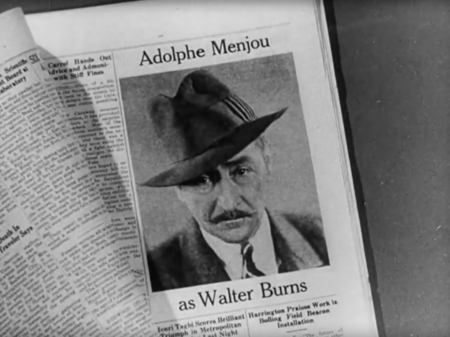
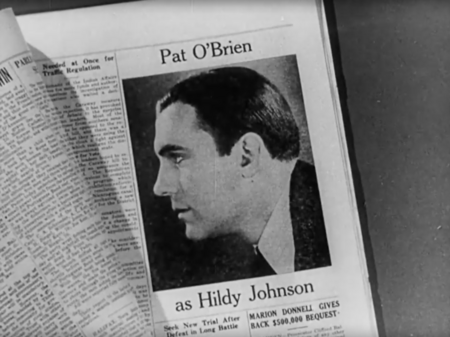
The Front Page (1931) — Lewis Milestone
In some early films, printed text acquires the significance of an independent narrative element. In Clarence Badger’s film It (1927), a newspaper publication becomes a result of a mistaken interpretation of events. A reporter writes a piece about a young woman whom he mistakenly assumes is an unmarried mother. The next day, this version of the events appears in the newspaper and begins to influence the story’s subsequent development. The discrepancy between the actual incident and its printed representation becomes crucial.
It (1927) — Clarence G. Badger
In this regard, such a discrepancy between an event and its representation in the newspaper also touches upon cinema itself. By incorporating printed text into its own image, film engages with another medium that, like itself, does not merely record reality but also shapes the way it is presented. The newspaper publication becomes a kind of reflection of the possibilities and limitations of the screen image itself. Both mediums select information, structure its sequence, and offer a specific interpretation of what is occurring. Therefore, the significance of the newspaper within the film is determined not only by its content but also by how cinema utilizes its properties. This allows us to distinguish several core functions of printed text within the visual work.
________________
Seven Functions of Newspaper Imagery
________________
Information
In the film «The Adventurer,» printed text is used to convey an event that does not necessarily require its own scene. An insert from a newspaper features a photograph of Charlie in prison attire and the headline, «Criminal Escapes: Inmate at Large.» The newspaper reports the hero’s escape while simultaneously linking his image to a wanted notice. The viewer does not need to see the escape itself or receive additional explanations; the headline and photograph are sufficient to understand what happened and the character’s current status. They work in tandem: the photograph identifies a specific person, and the text reports on his situation. Crucially, this information is presented not as an authorial clarification, but as a routine newspaper publication existing within the film’s world. The viewer learns what has happened through the very object that the characters encounter, making the newspaper clipping part of the on-screen reality. Of course, such an insert still resembles an intertitle because it performs a similar function—conveying necessary information to the viewer. However, there is a significant difference here: the text is no longer external to the action but exists within the film itself. This results in a unique type of intertitle that not only explains the events but is also a constituent part of the story’s world.
The Adventurer (1917) — Charlie Chaplin