Structure
- Concept
1. Concept
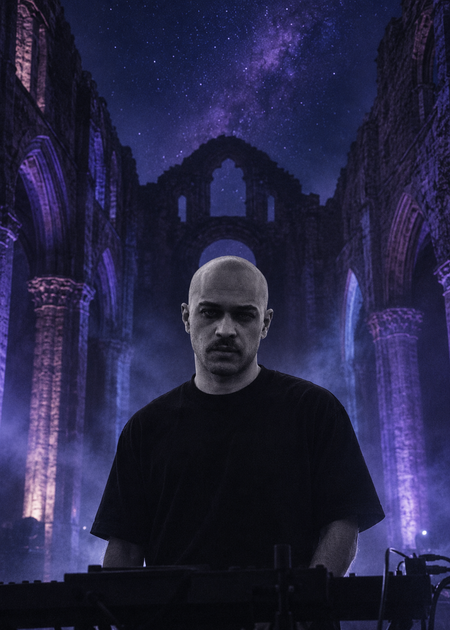
In this study, I examined the work of American musician and producer Aryan Ashtani and his solo electronic project, Mareux. I questioned how contemporary electronic music—built upon the fusion of romantic melancholy, synthetic soundscapes, and post-punk aesthetics—can interact with historical architectural spaces that have lost their original material integrity.
Research Objective: To develop a design concept for a prospective musical event.
We hypothesize how a Mareux concert at the Abbey of San Galgano can transform into a unique, living graphic score, where musical rhythm, architectural geometry, light, and the spectator’s movement form a single composition. In this context, the historical space does not serve merely as a backdrop for the concert; rather, it acts as an independent participant in the performance.
Aryan Ashtani’s creativity sits at the intersection of darkwave, post-punk, synth-pop, and electronic dance music. A key feature of Mareux is the combination of a melancholic, somewhat detached sound with a expressive romantic intonation. The music is perceived as simultaneously emotional and cool, nostalgic and contemporary, danceable and contemplative.The artist’s visual world is particularly compelling. Music videos, release covers, stage presence, and artistic choices are built around contrasts: cold metallic sheen versus human sensuality, artificial environments versus romantic experience, retro aesthetics versus contemporary electronic culture. Mareux’s visual language is largely cinematic—it utilizes the atmosphere of old cinema, the play of reflections, artificial lighting, blurred imagery, and unconventional interior spaces.
The Abbey of San Galgano, located in Tuscany, Italy, has been selected as the venue for the proposed performance. This monument of 13th-century Cistercian Gothic architecture presents a unique open-air space today: the walls, columns, pointed arches, and window openings remain intact, but most of the vaulting is missing. Instead of a ceiling, the sky is open above the visitor. This state of the building creates a distinct visual atmosphere where the architecture simultaneously exhibits its historical past and becomes integrated into the natural landscape.
The choice of this specific location is driven by the possibility of juxtaposing two different artistic languages. On one hand, medieval architecture—rooted in proportion, the repetition of structural elements, vertical lines, and the symbolic representation of space. On the other, the electronic music of Mareux, which utilizes cyclical rhythm, synthetic sounds, repeating musical motifs, and sonic layering. What connects them is the engagement with atmosphere, emotional state, and the sensation of space.
Yet, a significant contradiction exists between them: the abbey is a tangible testament to the past, while Mareux’s music constructs an artificial, largely intangible space. This juxtaposition is what forms the basis of the visual inquiry.
2. Mareux: A Musical Project and Its Visual Language
The project Mareux originated in Los Angeles in 2010. Aryan Ashtani’s interest in musical endeavors and his affinity for current genres inspired the debut album, TR/ST, in 2012.
His musical journey is rooted in an interest in electronic music, post-punk, and melancholic synthesizer soundscapes. A distinctive style gradually took shape in his early works: dense basslines, cold synthesizer arrangements, subdued vocals, and repeating rhythmic structures.
Mareux gained widespread recognition for the composition «The Perfect Girl"—his own interpretation of The Cure’s song of the same name from 1987. Although the track was recorded in 2015, it achieved mass popularity later, during 2021–2022. This success introduced a new audience to his work and the aesthetic of darkwave. [1]
In 2023, the debut album Lovers From The Past was released, featuring nine compositions dedicated to themes including unrequited love, disillusionment, and emotional distance. In 2025, the musician released the second album, Nonstop Romance. This album shows a notable expansion of the musical language: more danceable and experimental compositions, along with elements of disco and synth-pop, were introduced. The musician himself noted that he did not want to repeat the previous darkwave formula and aimed to make the album freer. [2; 3]
Here, we observe that Mareux cannot be viewed exclusively as a representative of dark Gothic aesthetics. His work is much broader, encompassing a blend of romance, danceability, nostalgia, irony, and a certain degree of unease.
Dada