Navigation
Concept, question, hypothesis, material selection principle
I. Spiritual Authority: pope, cardinal, abbot
II. Secular Authority: imperial power
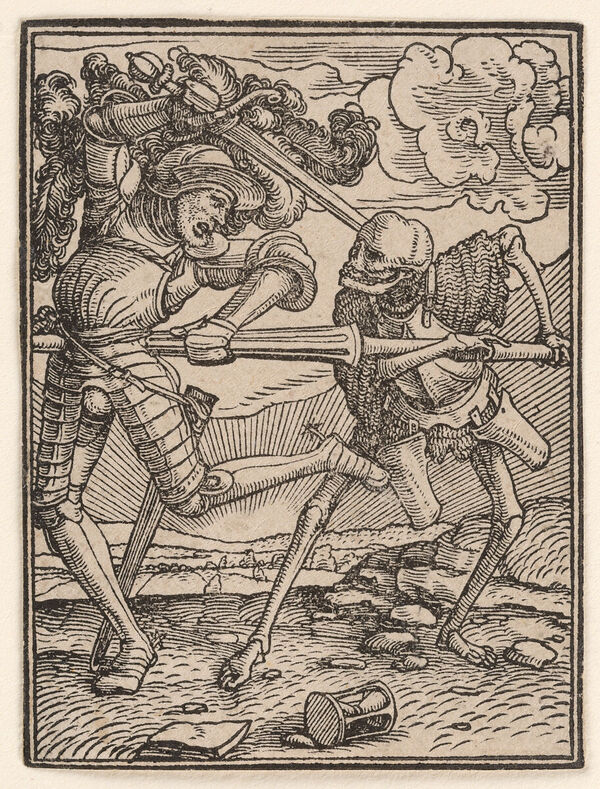
III. Military and Civic Life: knight, merchant, judge
IV. Labor and Daily Life: peasant
V. The «Dance of Death» in Monumental Painting
VI. Hypothesis Testing, Conclusion
Bibliography, Image Sources
Concept
«Dance of Death» (Danse macabre) — a theme in European art from the Late Middle Ages and Early Renaissance that centers on the allegorical encounter between living people and personified Death, regardless of social status. It was this theme that sparked my interest in writing a visual study on the connection between life and death in Late Medieval European art. The composition features representatives from various social groups, arranged in a specific sequence: from the highest spiritual and secular authorities down to people engaged in daily labor. Each character confronts Death, who invites them to the «final dance.»
The origins of this genre date back to the 14th century, where social inequality becomes the foundation of the visual narrative structure. The Pope is distinguished from the peasant not only by his societal position but also by his outward appearance—his status is indicated by the tiara, ecclesiastical vestments, and symbols of spiritual authority. The Emperor is recognizable by his crown, regalia, and formal attire; the knight is presented through armor and weaponry; the merchant is identified by his clothing and trade-related objects; and the plowman is depicted through his working posture, agricultural tools, and surrounding landscape. However, what unites all of them is the inevitability of death. These characteristics allow the viewer to quickly identify a character’s social role, yet Death is depicted as a figure that does not belong to the human hierarchy and does not recognize its boundaries.A key resource for this study will be Hans Holbein the Younger’s series of wooden engravings; his compositions allow for the analysis not only of the characters but also of how Death interacts with them. The research also examines two earlier monumental works: a surviving fragment of the Tallinn «Dance of Death, ” of which approximately 7.5 meters remains. Furthermore, I will utilize the fresco cycle in the Church of the Holy Trinity in Khrastovle, dated to 1490. These works enable a comparison between printmaking and wall painting, and allow us to see how a single narrative was adapted to different formats and spaces.
The primary method of visual research is comparative visual analysis. I examine each artifact using consistent parameters: the character’s social role, attire and attributes, body posture, interaction with Death, composition, and semantic effect. This allows for the comparison not only of individual images but of an entire system of visual signs. Thus, «The Dance of Death» is examined as a distinct visual language where social hierarchy first becomes visible and is subsequently subjected to symbolic deconstruction. The higher a character’s position in the earthly realm, the more evident the limitation of their power in the face of death becomes.
Hypothesis
In the European «Dance of Death» from the 15th–16th centuries, the visual emphasis on social distinctions serves as the primary method to convey the universality of death. Artists meticulously encode the characters' status through their clothing, attributes, poses, and surroundings, yet they simultaneously incorporate them into a unified compositional rhythm of encountering Death. Thus, the visual hierarchy is both demonstrated and challenged.
Research Question
How did artists of the 15th–16th centuries use visual markers of social status to depict the inevitability of death across different societal groups?
Material Selection Principle
- Principle of Thematic Precision. I include works where the theme of the «Dance of Death» is explicitly depicted, rather than merely featuring an isolated image of a skeleton or a symbol of death.
- Principle of Visual Legibility. The primary artifacts allow for character recognition based on costume, props, posture, and context. This is necessary for comparing works to substantiate a hypothesis.
- Principle of Comparability. All 12 engravings by Holbein are examined using the same parameters. This allows for a comparison of representatives from spiritual authority, secular authority, the military class, urban society, and peasantry.
- Principle of Reliability. The primary engravings are drawn from The Metropolitan Museum of Art’s collection, while the comparative works come from materials in the Niguliste Museum and the Istria Cultural Heritage catalog. Museum records provide verifiable information regarding authorship, dating, technique, and inventory numbers.
- Principle of Distinguishing Fact from Interpretation. The description separately specifies what is depicted, and only then does it offer an interpretation of the image’s meaning.
Chapter I. Spiritual Authority
Dad: supreme spiritual authority
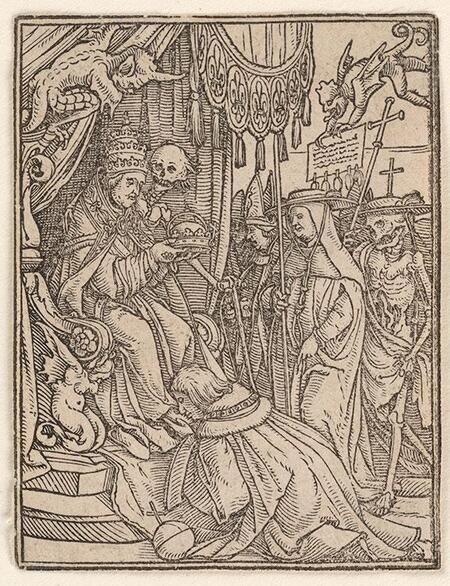
Hans Holbein the Younger, woodcut by Hans Lutzelburger. Father, from the series «Dance of Death.» Circa 1526, published in 1538. Woodcut. The Metropolitan Museum of Art, inventory no. 19.57.6. Museum Record. Public Domain.
The Pope holds the highest rank in the church hierarchy, and his status is immediately conveyed through his solemn vestments and papal tiara, thereby constructing an image of spiritual authority. However, the arrival of Death changes the meaning of this scene. The figure who occupies the pinnacle of the spiritual hierarchy in earthly life is incorporated into the same narrative as the other characters, because death requires no sanction from church authority and does not acknowledge its power. It is particularly significant to note that Holbein does not strip the Pope of his external symbols of status. They remain in the image and continue to denote his position, but it is against the backdrop of these symbols that it becomes apparent that a high religious status does not equate to immunity from death.
The father demonstrates the highest level of spiritual hierarchy, but even that does not lift a person beyond their common lot, which refers to the hypothesis of how the depiction of Death equates the social strata of European society, calling the hierarchy into question.
Cardinal: The Hierarchy within the Clergy
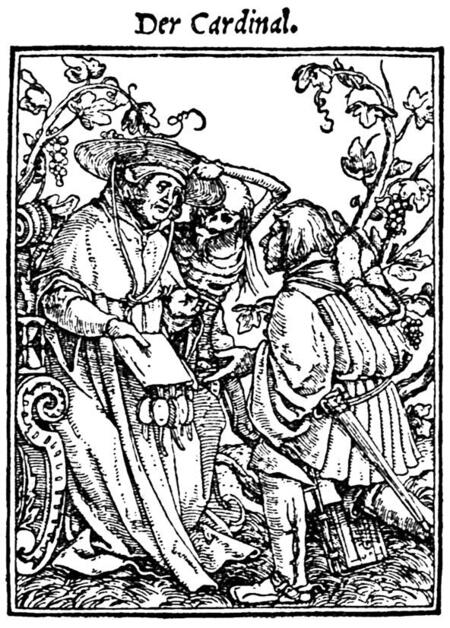
Holbein the Younger, woodcut by Hans Lutzelburger. Cardinal, from the series «Dance of Death.» Circa 1526, published in 1538. Woodcut. The Metropolitan Museum of Art, Inv. No. 19.57.9. Museum Record.
The image of the cardinal continues the theme of spiritual authority but allows for an examination of its internal structure. The cardinal and the Pope belong to the same religious governing system, yet they occupy different ranks within it. Holbein preserves the distinctions between the characters through their clothing and external attributes, allowing the viewer to recognize not just their affiliation with the clergy, but their specific position within the church hierarchy. Each remains a representative of their rank. However, the narrative places both within a single sequence where their differences cease to dictate the outcome of the encounter.
even within a single social group, visual differences persist, but they do not alter the overall participation of the characters, because death is near each of them.
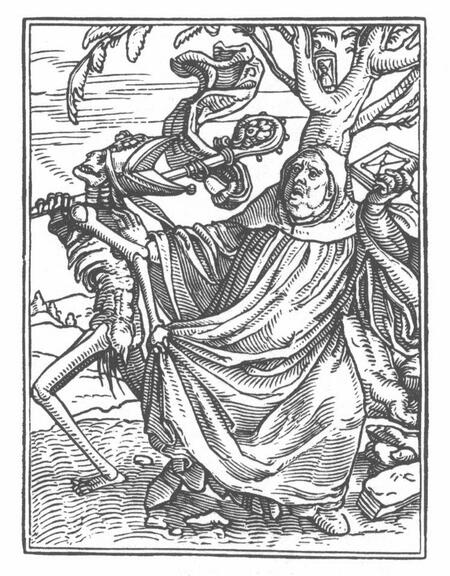
Holbein the Younger, woodcut by Hans Lutzelburg. The Abbot, from the «Dance of Death» series. Circa 1526, published in 1538. Woodcut. The Metropolitan Museum of Art, accession No. 19.57.14. Museum Record.
The abbot represents monastic authority. His status is conveyed through ecclesiastical vestments and the characteristic appearance of a spiritual figure, but unlike the Pope or a Cardinal, he is not connected to the governance of the entire Church, but rather to the leadership of the monastic community. The interaction between these two figures is especially significant. Death does not merely stand beside the abbot; it physically removes him from his familiar space. Furthermore, Death herself is depicted with a miter and episcopal staff—objects associated with clerical authority. This creates a visual irony: Death seems to be appropriating the attributes of the institution represented by the abbot.
The Metropolitan Museum of Art’s museum publication specifically notes this motif: Death is depicted wearing a bishop’s mitre and holding a crozier as he leads the abbot away.
The author points out how Death not only surpasses the spiritual status of humans but also visually co-opts their own symbols of power. In the artifacts I have previously described, we see how death «infiltrates» the human space, peering from behind or touching the garments. In these three images, these people represent spiritual authority at different levels of the hierarchy; however, this interaction with Death not only places them on equal footing but also demonstrates Death’s overarching supremacy over them.
Chapter II. Social Power and Aristocracy
Emperor: The Zenith of Earthly Power
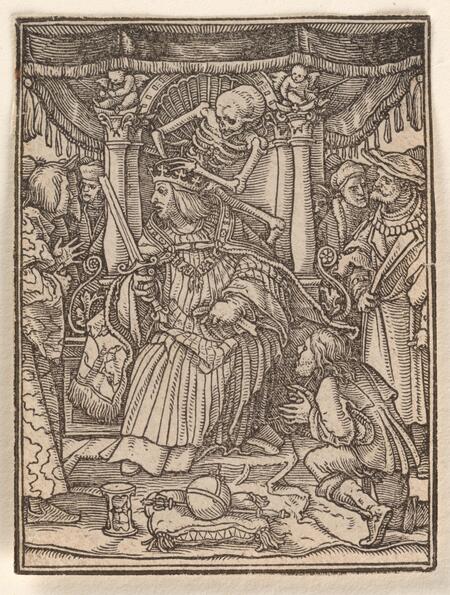
Holbein the Younger, woodcut by Hans Lutzelburger. Emperor, from the «Dance of Death» series. Circa 1526, published in 1538. Woodcut. The Metropolitan Museum of Art, Inv. No. 19.57.7. Museum Record.
The Emperor represents supreme secular power. The audience perceives his status through his crown, ceremonial attire, and regalia. Unlike spiritual figures, his authority is rooted in political governance and the power to dictate human destinies. The composition juxtaposes this image of authority with the figure of Death, where the Emperor retains the attributes of his rank, yet these attributes do not grant him the ability to control events. What serves as proof of his superiority in human society proves powerless against Death. It is important that the artist does not depict the Emperor as an ordinary person devoid of signs of his rank. On the contrary, his status is accentuated, making the contradiction between his grandeur and his helplessness in the face of Death particularly pronounced.
The higher an individual’s standing in the earthly hierarchy, the more pronounced the limit of their power becomes in the face of death. The representation of this new type of power—one no longer spiritual, but secular—now brings into conflict not only the tiers of hierarchy within specific social strata but also fundamentally different forces, where, in some way or another, all become equal before Death.







