Navigation
- Research Concept
- The Age of Handicraft: Uniqueness and Excess (Mid-18th to Early 19th Century)
- The Industrial Revolution: Machine, Mass Production, and Accessibility (Mid-19th Century)
- The Crisis of Form: Eclecticism and Craft Protest (Second Half of the 19th Century)
- The Birth of a New Aesthetic: Functionalism (1900–1920s)
- Conclusion and Sources
Concept
This visual study is dedicated to a pivotal moment in the history of the domestic environment—the transition from manual craftsmanship to factory furniture production during the Industrial Revolution. The choice of this topic stems from the need to understand a historical paradox: while the introduction of machinery and mass production made furniture accessible to broad segments of the population and democratized daily life, it radically simplified its plastic language and decorative program. The chronological scope covers the period from the mid-18th century (the flourishing of courtly craft in Baroque and Rococo styles) to the late 1920s (the establishment of industrial functionalism in the Bauhaus school). Geographically, the research focuses on the centers of industrial modernization in Western Europe (Great Britain, Austria-Hungary, Germany) and the United States, where the conflict between artisanal tradition and machine replication was most acutely manifest.
Research Objective—to analyze the transformation of furniture form, materials, and structural joints under the influence of industrial production, and to visually document the epoch’s dualism: mass production and cost reduction versus the loss of intricate decoration. The key question is: how did the shift to machine reproduction alter the constructive logic of furniture, and what aesthetic price did design pay for the democratization of the living environment? The hypothesis is that economic viability and the capabilities of early machinery inevitably led to a reduction of design—the displacement of handcrafted ornamentation in favor of standardized, pragmatic geometric forms.
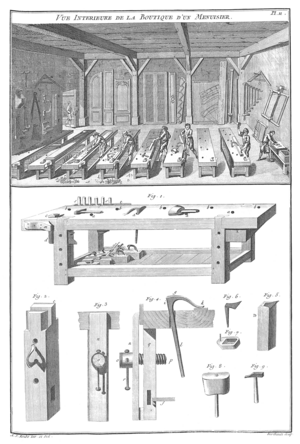
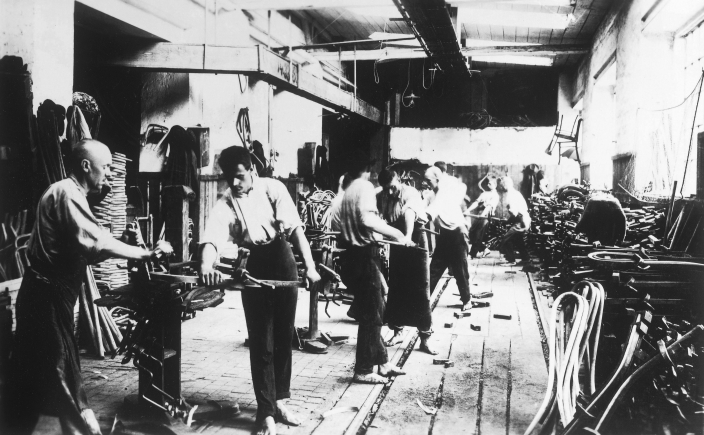
Woodworking shop, engraving by A.-Zh. Rubo «The Art of the Carpenter, ” 1769, France. / Steam bending workshop of the „Tonet Brothers“ factory, c. 1920.
For analysis, iconic furniture artifacts (chairs, armchairs, and case goods) were selected to clearly demonstrate the evolution of construction—from hidden solid wood joinery to steam-bent wood, stamped metal, and steel tubing. The selection is based on the principle of contrasting common silhouettes and large-scale details from hand and machine fabrication. The structure of this long-read is organized chronologically: elite craftsmanship, technological breakthroughs and mass production, the aesthetic crisis of Victorian eclecticism, and the birth of functionalism.
The theoretical foundation was built upon classical works concerning design history and material culture. Siegfried Gideon’s work, «Mechanization Takes Command» (1948), allows for the examination of furniture evolution through the lens of conveyor belt implementation and new comfort standards. Nicolaus Pevsner’s study, «Pioneers of the Modern Movement» (1936), offers a methodology for analyzing the conflict between 19th-century historicism, William Morris’s «Arts and Crafts» movement, and rationalism. The social aspect of losing the unique «aura» of an object through mass reproduction is addressed with reference to Walter Benjamin’s essay, «The Work of Art in the Age of Mechanical Reproduction» (1936).
The Era of Craftsmanship: Uniqueness and Redundancy