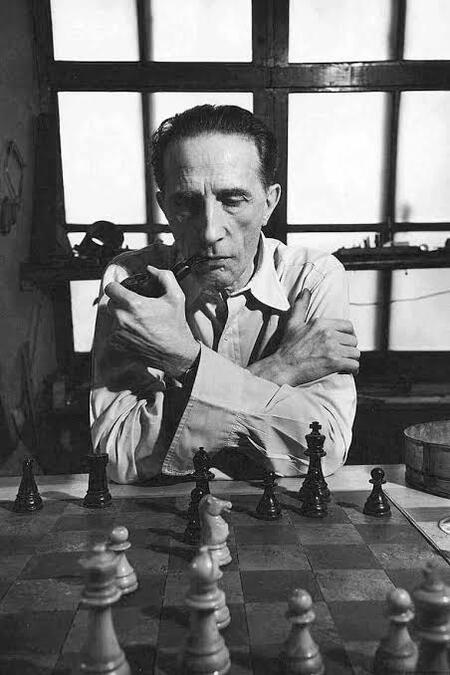
In 1924, Marcel Duchamp and Man Ray played chess on the roof of a Parisian theater. The game was featured in René Clair’s film Entr’acte, and it ended unexpectedly—a powerful stream of water washed all the pieces from the board.
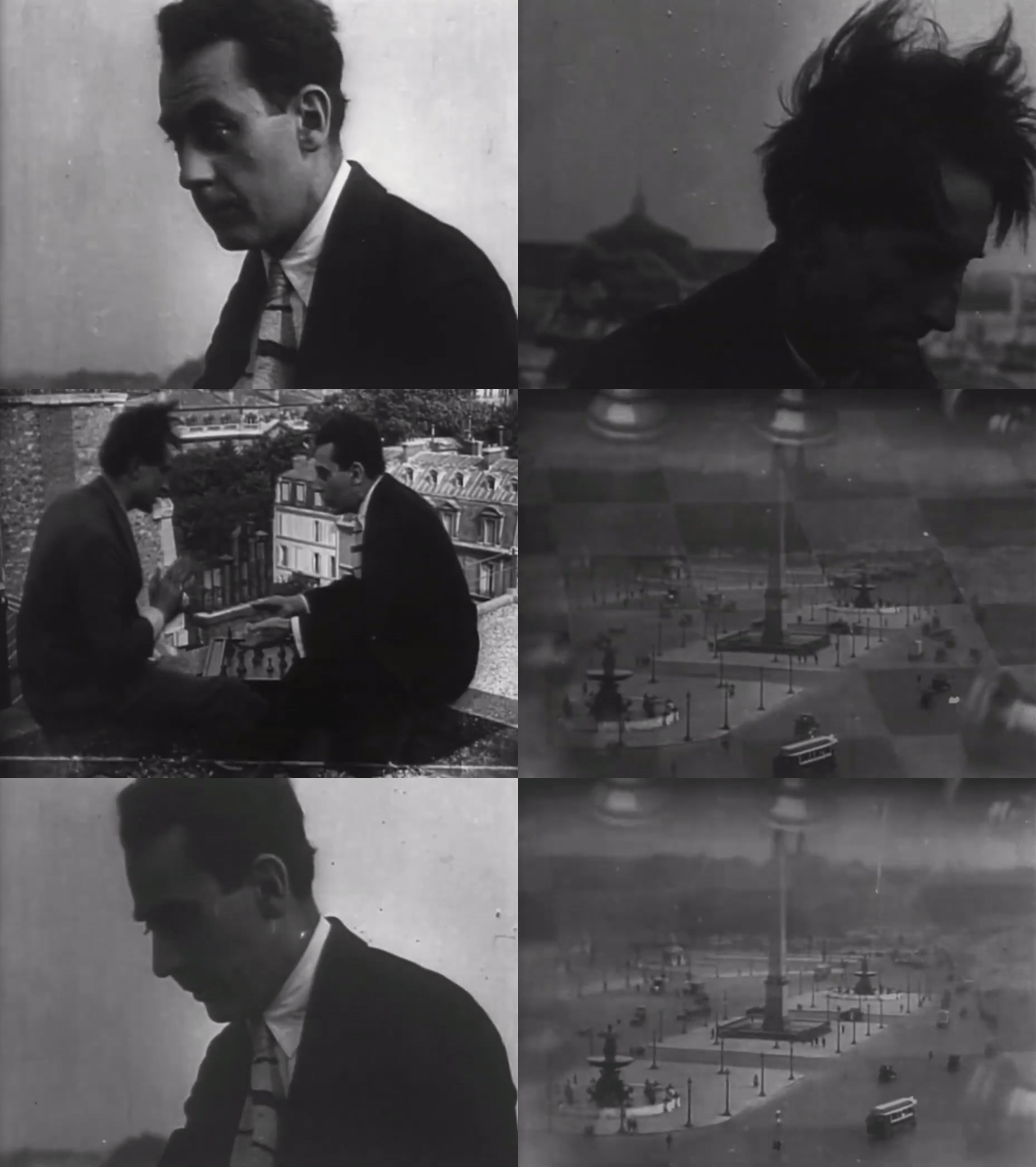
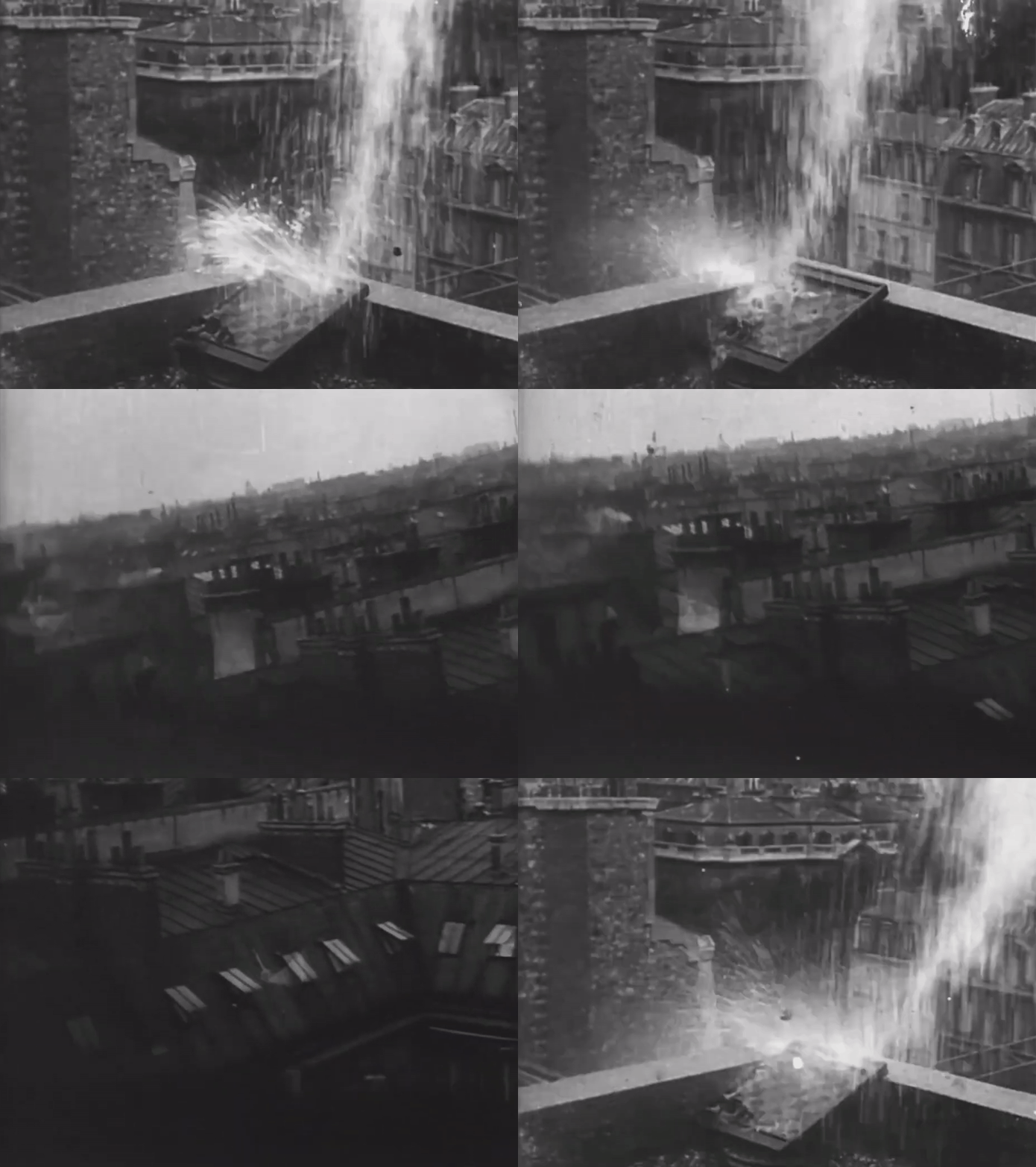
Marcel Duchamp and Man Ray playing a game of chess on the rooftop of the Théâtre des Champs-Élysées in Paris. Still from René Clair’s film Entr’acte (Intermission), 1924.
Duchamp wasn’t just a chess enthusiast; he was a serious tournament player. Man Ray even invented his own chess sets. In 1961, at an exhibition at the Moderna Museet in Stockholm, a chess game was contested where Duchamp moved the black pieces via telegram from New York, while three other participants took turns playing white on Man Ray’s chess set.
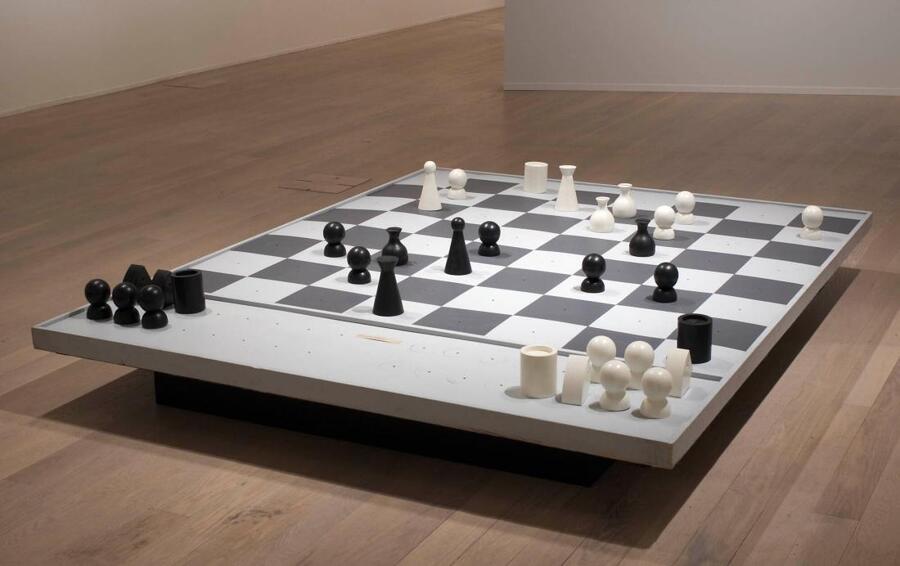
Perhaps the history of 20th-century art resembles a drawn-out game of chess. Artists continually devise new moves, challenge established rules, and compel viewers, critics, museums, and galleries to search for answers to the next «knight’s move.» But as soon as a defense is found against one threat, another immediately follows.
Round 1. Blind Play
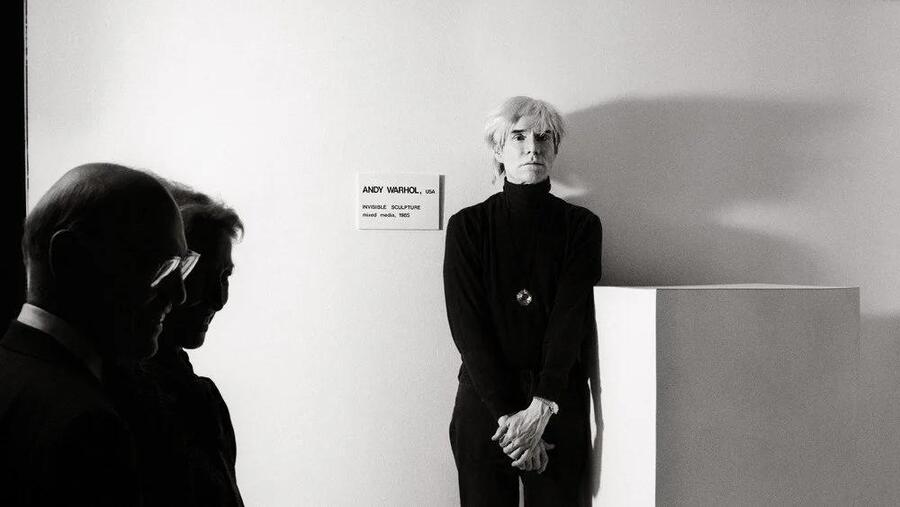
Andy Warhol. «Invisible Sculpture.» New York, 1985.
In May 1985, Andy Warhol presented «Invisible Sculpture» at the New York nightclub Area. For this performance, he climbed onto a white pedestal, posed for the photographer, and then stepped down. A placard remained beside him that read: «Andy Warhol, USA. Invisible Sculpture. Mixed Media. 1985.» But where was the sculpture itself? Did the space where the famous artist had just stood become the work of art? A very specific question arises: is the artist’s statement and the plaque bearing his name sufficient to transform an empty space into a piece of art? One can play chess blindfolded, without seeing the board or the pieces. But can a sculpture be perceived in the same way?
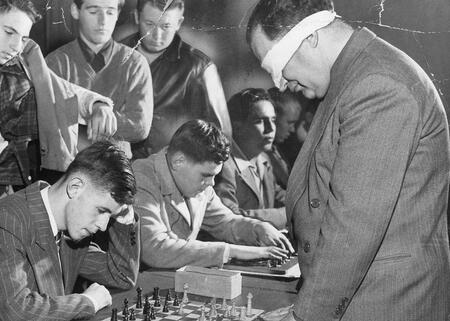
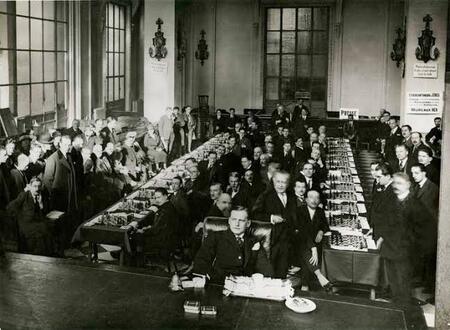
George Koltanovsky—Edinburgh, 1937 / Alexander Alekhine—Paris, February 1, 1925. Blindfold chess against multiple opponents
Step 2. Flip the board
Piero Manzoni. «Socle du monde» (Foundation of the World), 1961. Herning, Denmark.
In 1961, Italian artist Piero Manzoni installed a 82-centimeter metal pedestal in the Danish city of Herning. On its side was an inverted inscription: «Foundation of the world.» Why inverted? Because, according to Manzoni’s concept, the entire Earth—with all its cities, museums, people, and works of art—rested upon this pedestal. So, is the sculpture this small cube or the entire planet? And where should the viewer be positioned if they themselves have already become part of the artistic situation? If Warhol removed the sculpture from the pedestal, Manzoni flipped the pedestal and declared the entire world to be the sculpture.
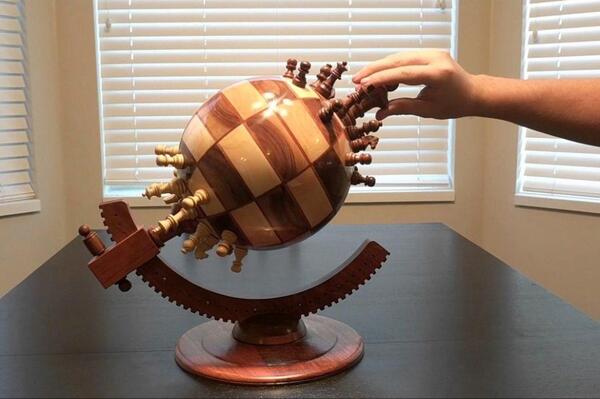
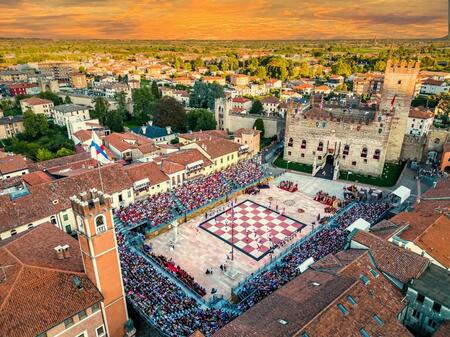
Ben Meyers. Spherical Chess, 2017 / Live Chess on Piazza delle Scacchi. Marostica, Italy.
What if we changed the size or even the shape of the chessboard? In 2017, American Ben Meyers created chess pieces shaped like a wooden globe. The pieces are held to the surface by magnets, and the playing area lacks traditional side borders. This alters the game itself—for instance, a bishop might move along a spiral around the sphere. But why limit ourselves to wooden pieces? In the Italian town of Marostica, a performance with human chess has been staged since 1923. In 1954, a massive marble board measuring 16 by 16 meters was erected in the central square. People in historical costumes move across it, including riders on real horses. It turns out that you don’t necessarily have to change the rules of chess. You can change the board’s shape, the figures' dimensions, or even replace them entirely with people. The familiar board game then transforms into a spatial experiment, and sometimes—into a genuine theatrical performance.
Live chess on Piazza dei Sacchi. Marostica, Italy.
Module 3. Edit Shapes
Takako Saito. «Spice Chess, ” c. 1977. Wood, cork, spices.
Who ever said that playing must be done the way we are used to? After all, there are Fischer Chess, three-dimensional chess, and so on. In Takako Saito’s Spice Chess (around 1977), all the pieces look identical. To distinguish a pawn from a bishop or a knight, you have to smell them—different spices are hidden inside the wooden pieces. Sight no longer provides the necessary information. The familiar game requires unfamiliar ways of perception.
Max Ernst. «Chess Figures, ” Great River, Long Island, 1944.
In 1944, Marcel Duchamp, Max Ernst, and gallery owner Julien Levy organized the exhibition «The Imagery of Chess» in New York. Thirty-two artists and other avant-garde figures were invited to participate—one for each chess piece. Among them were Alexander Calder, Man Ray, Isamu Noguchi, André Breton, Yves Tanguy, Dorothea Tanning, Arshile Gorky, and Robert Mazwell. Some created unusual chess sets, while others produced paintings, sculptures, and even musical compositions.
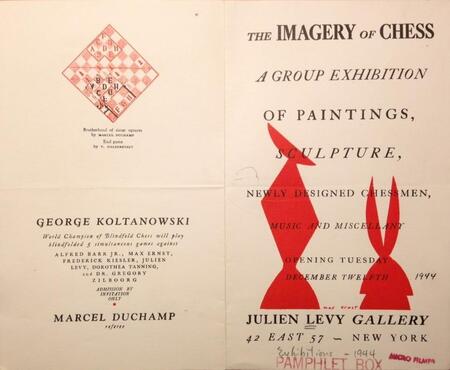
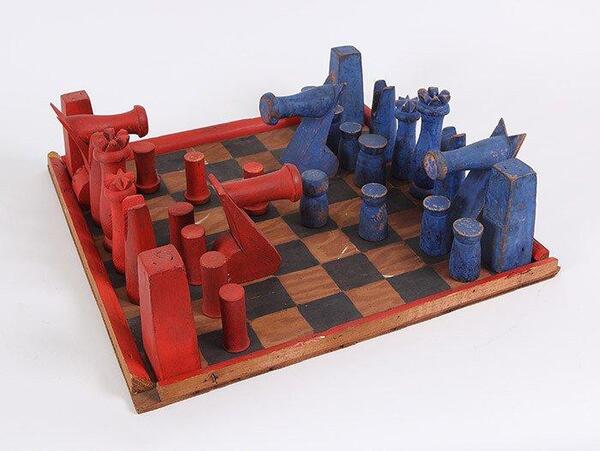
Marcel Duchamp. Invitation to the exhibition «The Imagery of Chess.» Julien Levy Gallery, New York, 1944 / Alexander Calder. Chess Set, 1944.
Module 4. The Piece as a Score
John Cage and Marcel Duchamp during the music-and-chess performance «Reunion.» Ryerson Theatre, Toronto, March 5, 1968.
Can a game of chess be transformed into a musical composition? On March 5, 1968, John Cage and Marcel Duchamp decided to test this. At the Ryerson Theatre in Toronto, they sat down at an unusual chessboard constructed by engineer Lowell Cross. Each square was equipped with light-sensitive sensors, and as the players moved the pieces, sound channels would turn on and off. Electronic music, performed by four composers, streamed into eight loudspeakers positioned around the audience.
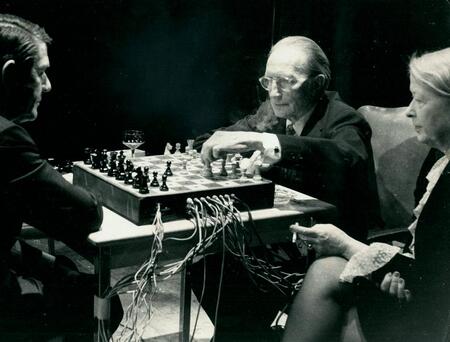
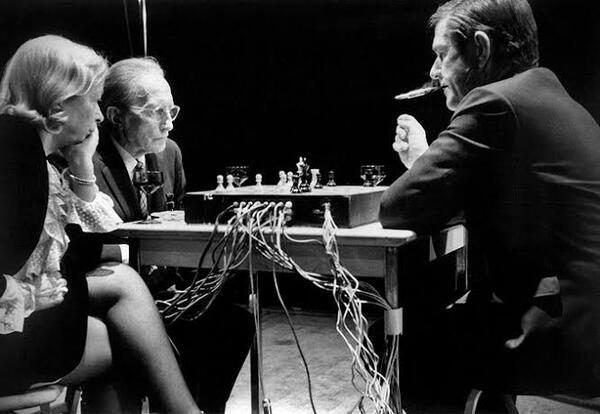
John Cage and Marcel Duchamp during the musical chess performance «Reunion.» Ryerson Theatre, Toronto, March 5, 1968.
Duchamp, who was 80 at the time, agreed to play without a knight to give Cage an advantage. It didn’t help—after 25 minutes, he won the game. But what was happening with the music during that time? Cage could not predict in advance what sounds the audience would hear; it all depended on the placement of the pieces and the players' decisions. It turned out that the chess players weren’t just competing—they were unconsciously conducting the musical composition. If Duchamp had made different moves, the audience would have heard a completely different piece.
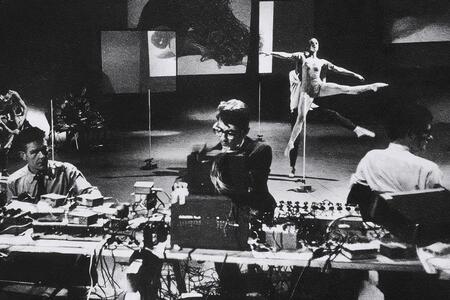
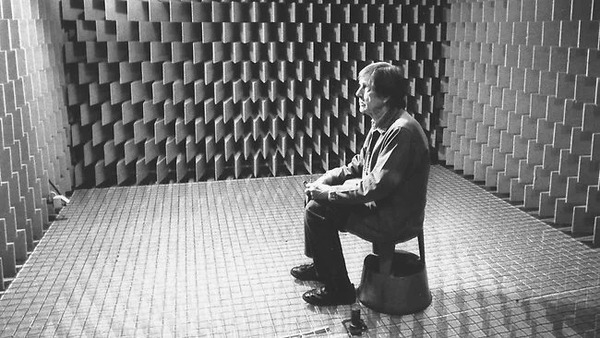
A joint multimedia performance, «Variations V,» created in 1965 by composer John Cage and choreographer Merce Cunningham in Harvard University’s anechoic chamber.
Cage’s experiments became an important part of the history of sound art—a contemporary art form in which sound is considered an independent artistic medium. Artists are now interested not only in composing music but also in how sound originates, propagates through space, and is altered by human influence.
Module 5. Psychological Attack
Barbara Krüger. «Untitled (Do You Feel Comfortable Losing?),» 2006. Chess set with built-in speakers.







