Upper Paleolithic: The Image of Woman in Primitive Art
Table of Contents:
- Concept 1.1 Rationale for Topic Selection 1.2 Material Selection Principles 1.3 Cataloging Principles 1.4 Key Question and Hypothesis
- Early Forms of Female Figure Representation Aurignacian Culture, approximately 40,000–30,000 years ago
- Development of Volume Sculpture and Proportion Changes Gravettian Culture: approximately 29,000–20,000 years ago
- Regional Characteristics of Female Body Depiction Gravettian Culture · approximately 25,000–18,000 years ago
- The Woman in Relief and Engraving Art Gravettian and Magdalenian Cultures · approximately 25,000–14,000 years ago
- Schematization and Changes in Representing the Female Figure Magdalenian Culture · approximately 17,000–12,000 years ago
- Conclusion
- Bibliography
- Image Sources
Concept
Rationale for Topic Selection
The art of the Upper Paleolithic era represents an early form of humans' visual apprehension of the surrounding world. Through imagery and works of artistic creation, primitive people conveyed their perceptions of nature, humanity, and life phenomena. A particularly significant place in this system was occupied by the female image, which was distinguished by the singularity of its artistic embodiment and the characteristic features of the human body’s depiction. Interest in this topic stems from the fact that the female figure in prehistoric art is represented not so much through individual facial features, but through generalized and intentionally highlighted aspects of the body. This approach suggests that the depiction of woman held a deeper meaning than a mere reproduction of the human form. This research is aimed at studying how the female image was formed in prehistoric art, what underlying concepts it might have represented, and why specific features of the female body became the foundation of artistic representation.
Material Selection Principles
When selecting materials, the age of creation, visual characteristics, methods of depicting the human body, and degree of detail will be considered. It is important to include images from different periods so they can be compared to track changes in the proportions, forms, and characterization of female figures. Visual material will include photographs of archaeological finds, museum images, and illustrations from scientific publications. Comparing these will allow for the identification of common traits in the female image, the observation of differences between images from various periods, and the tracing of the main features of its development.
Rubrication Principle
The research will be structured chronologically to trace the evolution of the female image throughout the Upper Paleolithic period. The structure will move from early manifestations of visual art to later, more developed forms of depicting the female figure. Initially, the first attempts at human representation and the characteristics of conveying the human body will be examined. Subsequently, attention will focus on the emergence of more recognizable female figures, their characteristic proportions, and the specific techniques used in their rendition. The final section will analyze the most recent depictions, allowing us to observe how artistic techniques and methods for representing the female figure changed. This approach will enable a tracking of the female image’s development over time, highlight its main features, and determine which traits remained constant while others gradually shifted.
Key Question and Hypothesis
Key research question: How did the portrayal of women in Upper Paleolithic art evolve, and what can the specific features of their depiction reveal about early humans' perceptions of the female body? The research hypothesis is that the image of women in Upper Paleolithic art was created not so much to realistically depict external appearance, but to convey specific ideas about female origins, motherhood, and fertility. It is suggested that the characteristics of the body depiction—the emphasis on certain parts and the alteration of proportions—were linked to the symbolic meaning of the female figure.
Early Forms of Depicting the Female Figure
Ориньякская культура: около 40 000–30 000 лет назад
Unknown master. «Venus of Hohle Fels.» Circa 40,000 years ago.
The figure is rendered in volumetric plasticity, emphasizing the representation of the chest and torso. The absence of a head in a conventional anatomical form and the simplification of the limbs draw focus to the central mass of the body.
Unknown master. «Venus of Galgenberg.» Circa 30,000 years ago.
Unlike massive female statuettes, this figure features elongated proportions and a dynamic silhouette. The sculpting is achieved through smooth transitions between body parts and limb positioning.
Unknown Artist. «Female Figurine from Vogelherd.» Approximately 35,000 years ago.
The image is executed in a small scale, employing a generalized rendering of anatomical details. The compactness of the form and the simplification of individual body parts make the overall silhouette the primary expressive element.
Unknown master. «Female Head.» Gravettian culture.
Unlike statuettes featuring a generalized full-body representation, the focus here is concentrated on the form of the head. The surface detailing and the emphasis on individual features create a distinct sculptural image.
Unknown master. «Lady of Brassempuis.» Circa 25,000 years ago.
The main technique involves detailed rendering of the head, conveying the hairstyle or headwear through intersecting lines. The face remains abstract, creating a contrast between detailed surface work and simplified features.
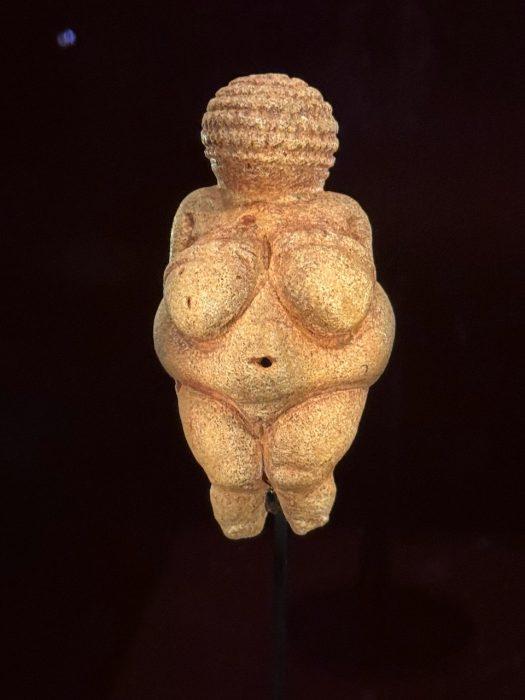
Unknown Master. «Venus of Willendorf.» Circa 29,500 years ago.
The volume of the figure is constructed by exaggerating the chest, abdomen, and hips. The head and limbs are rendered schematically, which directs the primary focus to the rounded plasticity of the torso.
Development of volumetric sculpture and changes in proportion
Граветтская культура · около 29 000–20 000 лет назад
Unknown master. «Venus of Dolní Věstonice.» Circa 29,000–25,000 years ago.
The figurine is crafted from fired clay, which lends the surface an uneven texture. The volume is formed through the rounded contours of the body and a simplified rendering of the limbs.
Unknown master. «Venus of Lespugue.» Approximately 25,000 years ago.
The figure is characterized by geometrization and a deliberate alteration of proportions. The enlarged hips and bust contrast with the narrow upper torso, creating a pronounced rhythm of rounded forms.
Unknown master. «Venus of Savignano.» Approximately 25,000 years ago.