|Concept|
Rationale for Topic Selection The elevated perspective seems the most objective of all possibilities. The camera is far away—the person is barely visible—the ground transforms into a schematic, and it seems that such a shot simply captures how everything is actually organized. I work as a graphic designer for an airline and regularly create route maps; essentially, I design this viewpoint for passengers. This is precisely why I wanted to understand where the reputation of the overhead view as a neutral image originates and whether that reputation is deserved. A photo book is better suited for this question than a single image. In a book, an aerial shot gains context from neighbors, a caption, space on a spread, and the publisher and client who paid for the edition. By observing how the image is assembled, captioned, and printed, one can see why it was made and what it is meant to communicate to the reader.Principle of Material Selection I selected five groups of publications from five countries, spanning from the mid-1920s to the end of the century. These include the travelogues of Swiss pilot Walter Mittelholzer, László Moholy-Nagy’s book «Painting, Photography, Film, ” photographs by Alexander Rodchenko, the Soviet album „Moscow is Being Reconstructed, ” Ed Ruscha’s book „Thirty-Four Photographs of Los Angeles, ” and Jan Artus-Bertrand’s album „Earth from Above.“The selection criterion is singular: the overhead view must be the underlying principle of the book, not merely an episode. Therefore, albums where an aerial photograph appears only once as a spectacular insert were excluded. No single book is analyzed as an author’s standalone monograph; rather, all are examined as a connected set and compared against one another.
Research Hypothesis A top-down view in a photo book was never neutral. The same technique changed its meaning five times over seventy years. In an expeditionary book, it functions as both a trophy and an advertisement for aviation. In the avant-garde, it’s a way to recalibrate vision and break the habit of viewing at eye level. In an official Soviet album, altitude signifies the power that plans the city. For conceptualists, the same perspective becomes a joke about bureaucracy, and by the end of the century, it transforms into a planetary warning sign. It is not so much the shooting technique that changes, but the book surrounding the image: the format, the layout of the spread, the caption, the typography, and the folded pages. The meaning of the high-angle view is set by the design of the publication—and that is the main point I want to convey.Principle of Material Structuring The sections are named by the type of view, not by decade: the trophy view, the construction view, the plan view, the ironic view, and the warning view. Chronology is maintained within each section, but it is not what organizes the material. This brings comparison to the forefront: in every section, the book answers the same fundamental question—to whom does height belong, and why did they ascend?Each section is structured similarly. First, the cover and an overall view of the publication, followed by spreads, then close-up individual images, and finally, a collage comparison with a book from a neighboring section. This allows the research to be read through the images alone: from one section to the next, the same perspective changes meaning right before your eyes.
Principles for Selecting and Analyzing Textual Sources
I require texts in three different capacities. The first group comprises the authors’ own words: Rodchenko’s articles on perspective (Rodchenko, 1982) and Moholy-Nagy’s book (Moholy-Nagy, 1927).
The second group consists of research: Alexander Lavrentyev’s work on Rodchenko’s perspectives (Lavrentyev, 1992), Andrey Fomenko’s article on how the avant-garde criticized conventional vision (Fomenko), Kasper Surber’s book on the colonial aspects of Mittelholzer’s flights (Surber, 2017), a collection on Moholy-Nagy’s connections to the Russian avant-garde (Miturich, Gerchuk, 2023), and Valery Stigneev’s essays on Soviet photography (Stigneev, 2009).
The third group is theoretical. Susan Sontag describes photography as a method of appropriating what has been captured (Sontag, 2021), and this concept helps in interpreting expeditionary books. Wilhelm Flusser discusses how the apparatus itself suggests a course of action to the photographer (Flusser, 2025). This is particularly relevant for aerial photography, where there are two devices: the camera and the aircraft. All sources are paraphrased in my own words; there are no direct quotes in this work.
View-Trophy: A pilot brings the country to life in a book
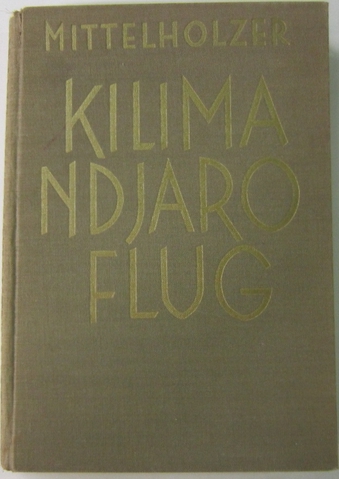
Swiss national Walter Mittelholzer was an aviator, photographer, and entrepreneur all at once. In the 1920s, he flew over Spitzbergen, Persia, across Africa, and over Kilimanjaro, publishing a book after each flight through the Zurich publisher Orell Füssli. Later, he became one of the founders of the Swissair airline.
His books sold two things simultaneously: a distant land and the journey itself. The airplane is constantly featured in the frame, and the caption indicates the altitude in meters. Historian Kaspar Surber notes that these photographs betray a colonial gaze: the airplane is presented as a sign of civilization set against a «backward» country (Surber, 2017). The altitude here functions as a conquest—the city is photographed in its entirety, taken with the photographer, and presented back home (Sontag, 2021).
← W. Mittelholzer. Kilimandjaro-Flug. Zurich: Orell Füssli, 1930. Cover
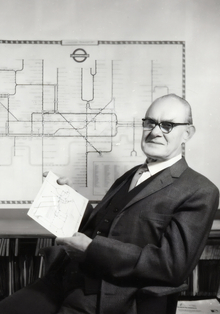
Walter Mittelholzer, c. 1918–1925
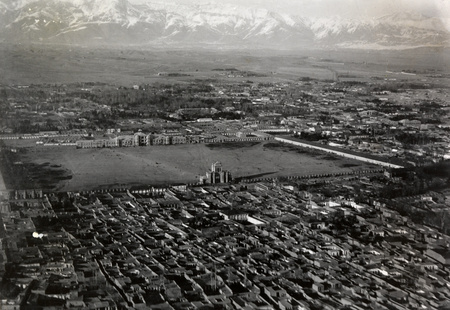
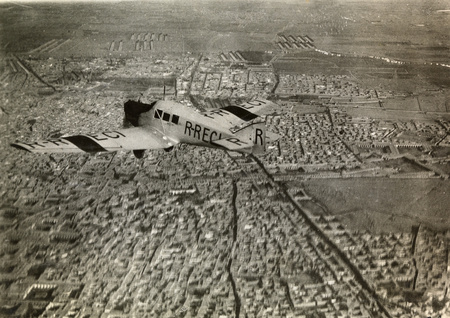
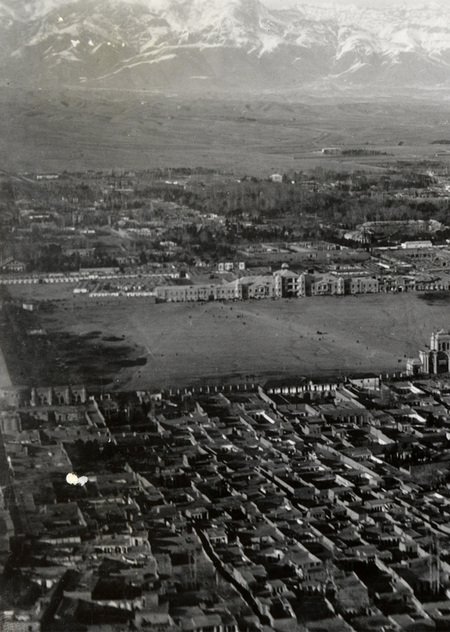
V. Mittelholzer. Tehran from 400 m altitude. 1925. Plate 43 in the book «Persienflug» (1926), V. Mittelholzer. Airplane over Tehran. 1925. Plate 60 in the book «Persienflug» (1926)
Mittelholzer doesn’t just photograph the land—he photographs his airplane over it. The old town below and the machine above appear in the same frame, and the hierarchy between them is readable without words. This is what Surber calls the colonial gaze (Surber, 2017).
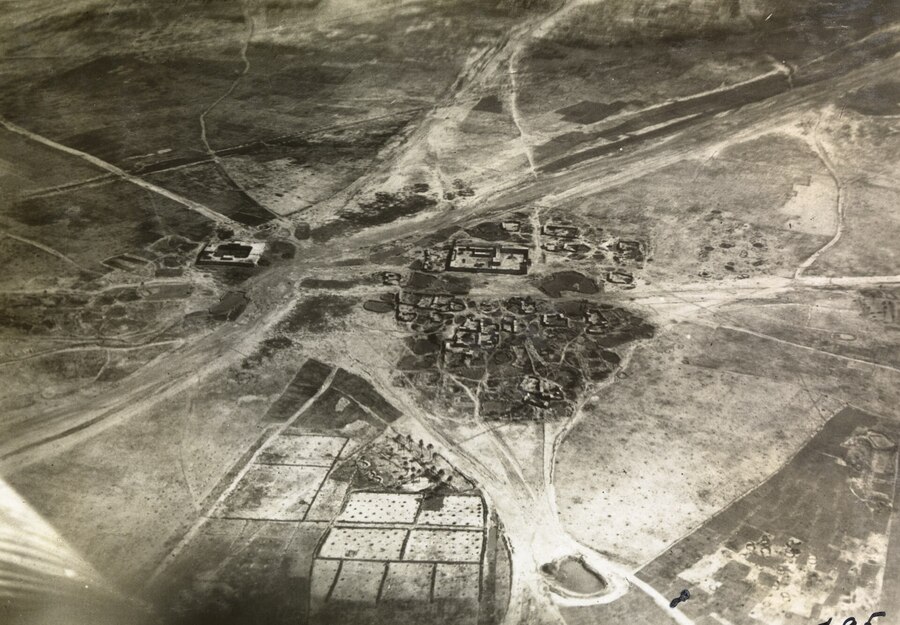
V. Mittleholzer. Kazvin from above. 1925. Illus. 59 in the book «Persienflug» (1926)
The captions in the book state the altitude of the flight. It is important for the reader to know not only what is depicted but also from where it was viewed. The number transforms the snapshot into evidence of an achievement.
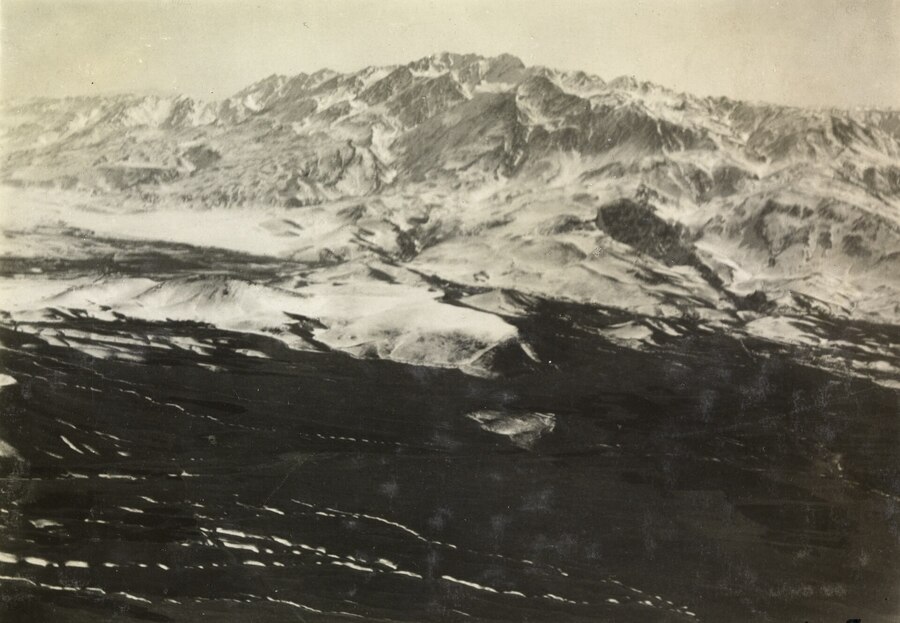
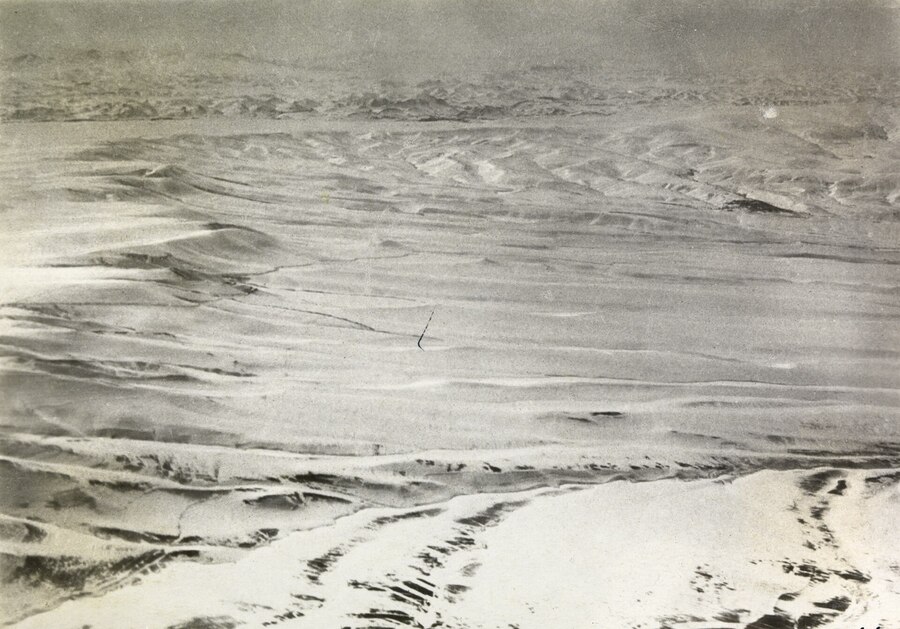
ETH Archive, LBS_MH02-02 series
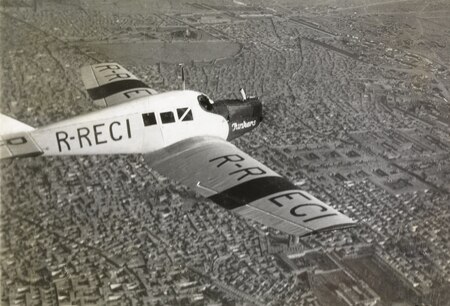
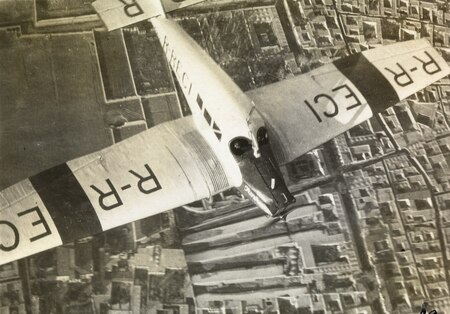
V. Mittelholzer. Photographs of Flights 1923–1930
V. Mittelholzer. 1926–1927. Published in the book «Afrikaflug»
V. Mittelholzer. 1926–1927. Published in the book «Afrikaflug»
V. Mittelholzer. Kilimanjaro. 1930
V. Mittelholzer. Swiss factory or set for sale to the owner. 1920s
The same practice served commerce at home: Mittelhoelzer photographed factories and hotels and sold the prints to their owners. The book about Switzerland from a bird’s-eye view was assembled from the same archive. Here, the top-down perspective is the commodity, and the photobook functions as its display window.
V. Mittelholzer. Switzerland from a bird’s-eye view. 1919–1926. From the collection for the book «Die Schweiz aus der Vogelschau» (1926).
Viewpoint Construction: The Avant-Garde Reassembles Vision
In the same years that Mittelholzer brought back views from expeditions, avant-garde artists raised their cameras toward towers and balconies for a different purpose. Their interest was not in the territory, but in vision itself. László Moholy-Nagy compiled images from the press, science, and his own experiments in the Bauhaus book «Painting, Photography, Film» to demonstrate that the camera sees differently than the eye (Moholy-Nagy, 1927).In late 1920s articles, Alexander Rodchenko argued against the habit of shooting at eye level. He considered it a legacy of painting and proposed looking at things from above and from below (Rodchenko, 1982). Alexander Lavrentyev describes the angle as a primary tool of the Rodchenko photographer (Lavrentyev, 1992). Andrey Fomenko adds an important observation: an extreme angle transforms depth into a flat pattern—that is, it transfers the logic of abstract painting into photography (Fomenko).
L. Mokhov-Nadzh. Painting, Photography, Film. Munich: Albert Langen, 1925. Cover
Moholy-Nagy’s book is structured as an argument in pictures. The images are sourced from newspapers and scientific publications; authorship is hardly important—the mode of vision is what matters. Overhead views are placed here alongside X-rays and macro photography: these are simply more ways to see what the eye cannot perceive on its own (Moholy-Nagy, 1927).
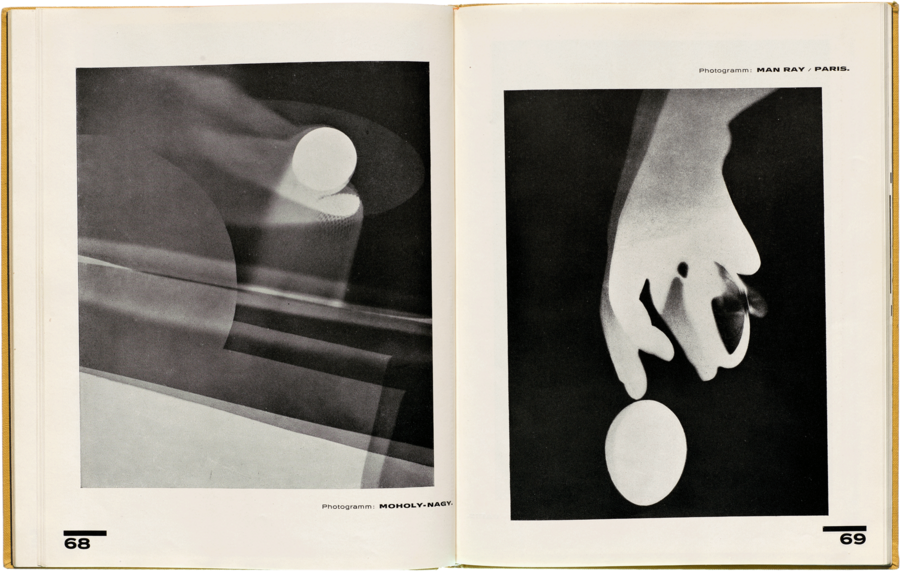
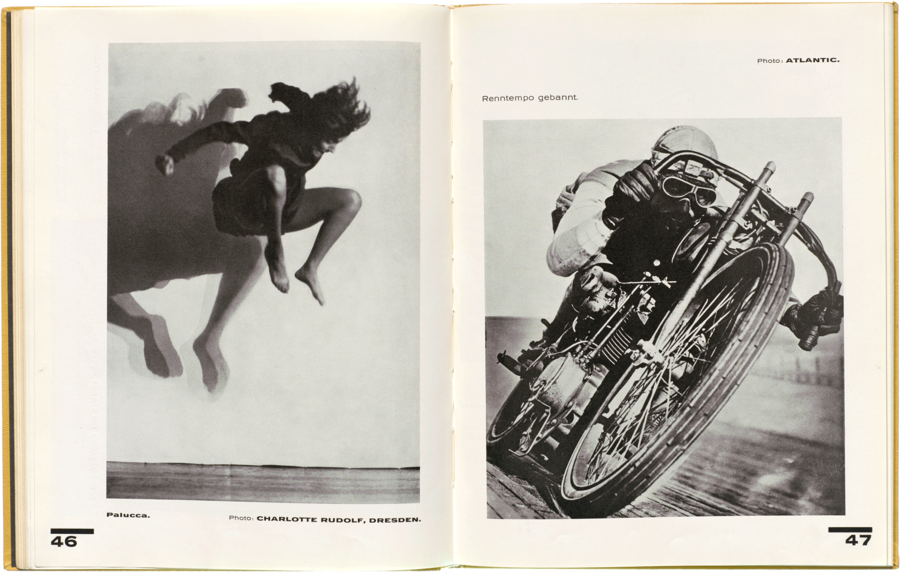
L. Mokhoi-Nadzh. Painting, Photography, Film. Munich: Albert Langen, 1925. Folios