Concept
Soviet animation, for nearly seven decades, served not only as entertainment but also as a tool for visually constructing social norms. The female figure holds a particularly significant place in this construction: it simultaneously reflected the ideological demands of the era while resisting them, giving rise to hybrid visual forms. The theme, «The Woman with the Oar and Vasilisa the Wise, ” was chosen because it allows us to observe the rupture between two visual paradigms—the functional „worker“ of the 1920s and the decorative „fairytale beauty“ of the 1950s—not as a simple stylistic shift, but as the result of a complex interplay between ideology, artistic tradition, and animation technique. This rupture remains insufficiently understood in visual terms: existing analyses tend to focus on plot or ideological subtext, while the formal parameters of the figure (proportion, line, color, plasticity) remain on the periphery of the research.
Seven films were selected for analysis, created between 1928 and 1984. The selection criteria were as follows: (1) the presence of a prominent female character whose visual presence is integral to the film’s meaning; (2) representation of various periods of Soviet animation (pre-war, Thaw, late Soviet); (3) genre diversity—ranging from poster-style short films to feature-length fairy tales and slice-of-life comedies; (4) availability of materials for frame-by-frame analysis. The selection included: «Grozny Vavila and Aunt Arina» (1928), «The Frog Princess» (1954), «Royal Rabbits» (1960), «Vovka in the Third Realm» (1965), «Vasilisa Mikulishna» (1975), «The Flying Ship» (1979), and «Beware, Monkeys» (1984). Films where the female character was incidental or lacked visual subjectivity, as well as works from the post-Soviet period outside these chronological bounds, were deliberately excluded.
The work is structured chronologically, but within each period, the analysis proceeds across four visual parameters: proportion and silhouette, line quality, color palette, and the plasticity of movement. This structure allows one, on one hand, to trace the evolution of the image over time, and on the other, to capture the internal logic of each visual decision. Comparisons are made not only between periods but also within a single period (for example, contrasting Vasilisa the Wise from 1954 and the capricious princess from 1960 as two poles of «fairy-tale» femininity).
Because the research is visual, priority is given to the direct analysis of the films. Textual sources are utilized in three areas: (1) academic works concerning gender representation in Soviet animation—primarily the monograph She Animates: Soviet Female Subjectivity in Russian Animation, which establishes the theoretical framework; (2) materials on the production history of specific films (data from Animator.ru and Kultura.RF) to account for the production context; and (3) critical and audience reviews that document the perceived visual qualities of the characters—for instance, evaluating Vasilisa’s dancing as «graceful and refined» in contrast to the «masculine» movements of other characters. Quotes from these sources are used sparingly, solely to support or complicate visual observations, rather than serving as standalone arguments.
Key research question: What visual devices construct the female image in Soviet animation, and how does their transformation correlate with the evolution of ideas about female subjectivity? Two hypotheses are proposed. The first hypothesis suggests that the transition from the «worker» to the «beauty» in the 1930s–1950s was not merely an ideological regression, but a shift in the visual regime—from functional angularity to decorative fluidity—which aligned with the overall «theatricalization» of Soviet culture in the post-war period. The second hypothesis posits that in the 1970s, Soviet animation developed a hybrid heroine type that retained visual appeal («femininity» in the traditional sense) but gained active plasticity and subjectivity—Vasilyisa Mikulishna and Tsarevna Zabava serve as examples. This hybrid does not negate preceding paradigms; rather, it builds upon them, creating the visual complexity characteristic of late Soviet animation.
«The Worker»: Functional Angularity (1928)
«Grozny Vavila and Aunt Arina» (1928)—a short film created by Nikolai and Olga Khodateev with the participation of the Brumberg sisters. The plot revolves around March 8th: objects in Arina’s house «rebel, ” and she leaves for a women’s gathering, leaving her husband Vavila, who is subsequently „beaten by a poker“ in the finale. From the perspective of visual analysis, this film is interesting not for its plot, but for the absence of traditional aestheticization of the female body within it. [1][14]
Arina possesses neither rounded shapes, nor smooth lines, nor a decorative costume. Her figure is angular, and her movements are functional and abrupt. The visual emphasis is not placed on beauty, but on action: Arina leaves the kitchen space and moves into the public area. Researcher Leigh notes that early Soviet animation often «instrumentalized» the female body, subordinating it to the demands of political discourse. In this sense, Arina is a typical example: her visual appearance is not self-sufficient; rather, it signifies liberation from domesticity. It is telling that three female animators (Olga Khodateeva, Valentina, and Zinaida Brumberg) worked on the film, yet this did not lead to the «feminization» of the image visually—rather, to its desexualization in favor of poster-like expressiveness. [1][6]
The film’s color palette is sparse and functional; the line work is stark, devoid of decorative flourish. This is the visual language of a poster, not a fairy tale. Within the context of this research, it is important to establish this baseline: the female figure is constructed here through the rejection of ornamentation, through the subordination of form to action.
«Krasavitsa»: Decorative Fluidity (1954–1965)
«The Frog Princess» (1954): an archetype of fairytale femininity
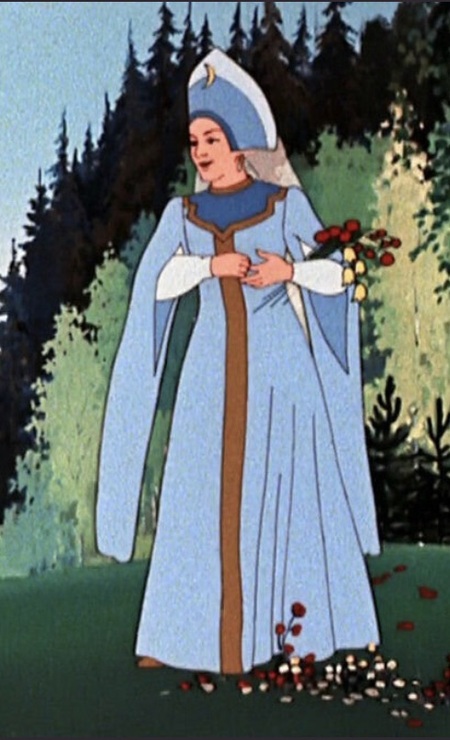
Mikhail Tsekhanovsky’s film is a full-length animated adaptation of a Russian folk tale, released by Soyuzmultfilm in 1954. Vasilisa the Wise in this film establishes a visual canon that would be reproduced and varied throughout the following decade. [2][7]
The key visual strategy here is fluidity. The contour line is soft and flowing; the figure’s proportions approximate the classical «ideal» (elongated limbs, slim waist, rounded hips). The costume is decorative: a kokoshnik, an ornamented sarafan, and a long braid. Vasilisa’s movements in the famous dance scene are structured as a continuous stream, contrasting with the abrupt, «burly» movements of Ivan’s brothers’ wives. One viewer review precisely captures this contrast: «The graceful, refined dance of Vasilisa the Beautiful stands in contrast to the vulgar, sharp, and burly movements of the wives of Ivan the Tsar-Prince’s brothers.» [2]
Visually, this contrast is important not as a moral judgment, but as a signifier of gender norms through plasticity. «Femininity» here equates to fluidity; «unfemininity» equals angularity and sharpness. The film’s color palette is rich and decorative—warm golden, red, and blue tones that work to create a «fairy-tale» atmosphere. The space where Vasilisa exists is a closed, decorative interior (a pavilion, a banquet hall), not an open, functional space like Arina’s.
«Royal Rabbits» (1960): Laziness as a Visual Characteristic
The Princess from Vladimir Polkovnikov’s «Royal Rabbits» represents another facet of the same paradigm. She is not wise like Vasilisa, but capricious: her desire to obtain one hundred live rabbits drives the plot. Visually, she is rendered as a doll figure: a round face, plump lips, a voluminous dress, and a lack of active plasticity. Her movements are measured and confined to the palace space. If Vasilisa from 1954 demonstrates mastery (dance, weaving), the princess from 1960 signifies consumption (demanding, capricious). Both heroines are decorative, but where the first’s decoration is tied to skill, the second’s is tied to idleness. This shows that the «fairy-tale beauty» was not a monolithic type: within the paradigm existed different visual and behavioral models, and the choice between them was determined not only by ideology but also by genre logic (heroic fairy tale versus satirical one).[3][12]
«Vovka in the Three Kingdoms» (1965): Decorativeness with Irony
In Boris Stepanstev’s film, the characters Vasilisa Premudrye appear as a collective image—several identical figures wearing kokoshniki, who teach Vovka wisdom and sense. Visually, they retain the decorative qualities of the 1950s (costumes, hairstyles, smooth lines), but their function changes: they are not objects of admiration, but subjects of action (teaching, correction). The irony is achieved through the contrast between their «fairy-tale» appearance and their «contemporary» intonations (the voice of Klara Rumyanova). This is the first sign of a shift: decorative elements cease to be an end in themselves and become an object of light reflection.[4]
«Hybrid»: Subjectivity without the Loss of Femininity (1975–1984)
«Vasilisa Mikulishna» (1975): Masquerade as a Visual Strategy
Roman Davydov’s film, based on Russian bylinas, presents a particularly compelling subject for research. Vasilisa Mikulishna is a bogatyrsha—a heroine who cuts her hair, changes into men’s attire, and sets out to rescue her husband from prison. A visual analysis must capture the duality of her character: at the beginning of the film, she appears in feminine costume (kokoshnik, sarafan, long braid), and later—in masculine dress (kaftan, hat, no braid).[5][10]
This duality is not a simple «re-dressing.» From the perspective of visual language, the film proposes two parallel systems of representation: the feminine (decorative, fluid, passive in form) and the masculine (functional, active, angular). Vasilisa switches between them, but her subjectivity is manifested precisely in her ability to control that switch. The script was written by Victoria Tokareva, and this perhaps explains the heroine’s psychological motivation—something uncharacteristic of epic folklore: she acts not out of coercion, but by choice.
Visually, the film maintains the decorative tradition of «Soyuzmultfilm» (saturated colors, ornamental details), but Vasilisa’s plasticity in male guise approaches the functional angularity of Arina. This is not a return to 1928; rather, it is a synthesis: the heroine retains the visual appeal of her feminine form while gaining dynamism in her male form. This hybridity is achieved through the narrative mechanism of masquerade, not by altering the very canon of female beauty.
«The Flying Ship» (1979): Subjectivity without Masquerade
Tsarevna Zabava from the film Harry Bardin represents the next evolution. While she doesn’t dress as a man, her visual persona and physical gestures deviate from the 1954 canon. She retains decorative qualities—large eyes, expressive facial movements, an elaborate costume—but her actions are dynamic: she argues with her father, sings, and runs away. Visually, she is closer to a «modern girl in a fairy-tale setting» than to the traditional «fairy-tale beauty» Vasilisa the Wise. Agency is achieved here without disguise, through the direct infusion of active physicality into the decorative image.[1]
«Careful, Monkeys» (1984): A Working Mother
Leonid Schwartzman’s Mama Monkey represents the final point of evolution within this selection. Its visual character is built upon fatigue and speed: it is constantly in motion, its form is dynamic, and its face conveys concern. This is a return to the theme of «woman and labor, ” but approached with a comedic sensibility. Unlike the 1928 Arina, it does not struggle against domestic life—it overcomes it through superhuman (super-monkey) energy. Visually, this is expressed through hypertrophied facial expressions and almost caricatural plasticity, which aligns it with satirical tradition rather than poster art.
Conclusion
The analysis conducted allows us to draw the following conclusions. First, Soviet animation does not demonstrate a linear evolution from the «liberated worker» to the «passive beauty» and back. Rather, we observe shifting visual regimes, each constructing «femininity» through a specific set of formal parameters: angularity and functionality (1928), fluidity and decorative quality (1954–1965), and hybridity and controlled transition (1975–1984). Second, the hypothesis of a «shift in visual regime» during the 1930s–1950s is confirmed: the transition from Arina to Vasilisa is not merely an ideological regression, but a change in the character’s line type, proportions, and spatial positioning. Third, the hypothesis regarding the hybrid type of the 1970s is also substantiated: Vasilisa Mikulishna and Tsarevna Zabava retain visual appeal but gain active plasticity and subjectivity, achieved either through the narrative mechanism of masquerade in the former, or through direct modification of the canon in the latter.