Rubrics
— Concept
— Artistic Style
— Unique Artistic Techniques
— Framing and Composition
— Conclusion
— Bibliography
— Image Sources
Concept
For my visual investigation, I chose Bastien Luccia’s graphic novel, «Crime and Punishment.» My interest in this work stems from the unique visual adaptation of Dostoevsky’s famous literary piece, a work where the internal experiences and emotional states of the characters play a crucial role. While reading this book, I was strongly drawn to the abundance of artistic techniques, compositions, and drawing styles that Luccia employs and changes according to the unfolding action.
Upon reading and reanalyzing the graphic novel, I selected the most interesting and illustrative spreads and fragments from the book that showcase the diversity of Bastien Luccia’s compositional and artistic decisions.
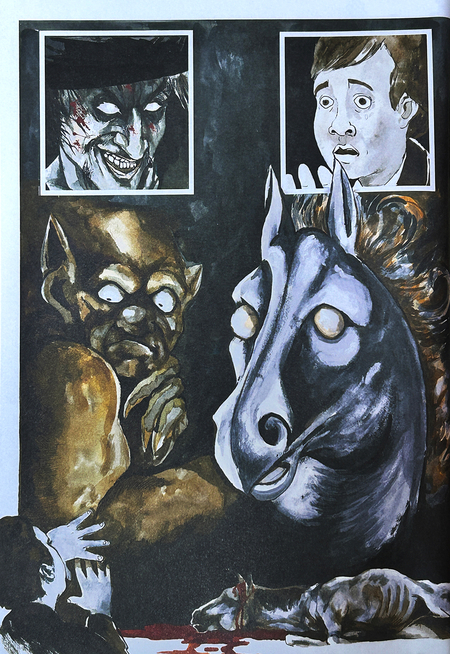
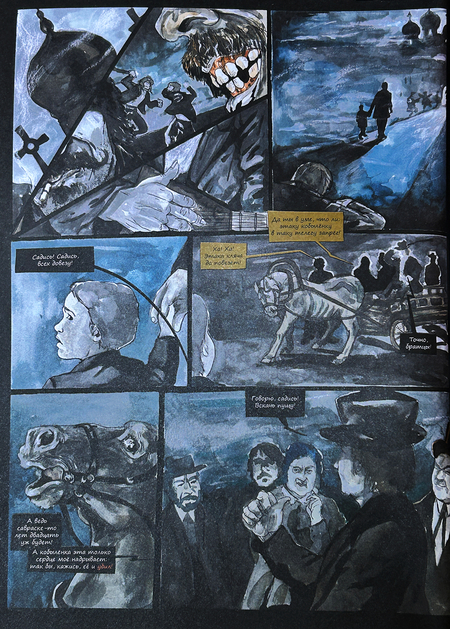
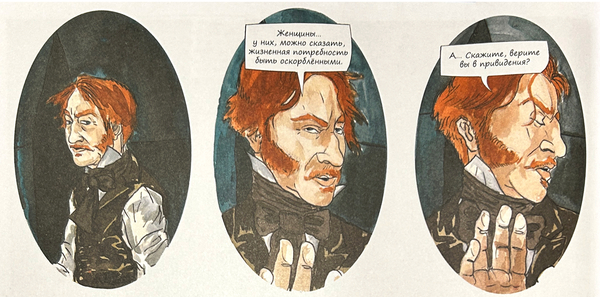
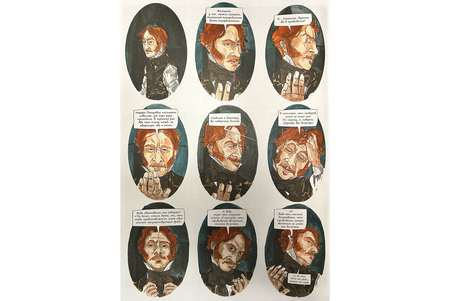
Material selection was based on a thematic principle. In my visual research, I would like to examine episodes from Raskolnikov’s dreams that show a gradual shift from relatively realistic depiction to a Constructivist drawing style. I have also selected spreads featuring unconventional compositional solutions and framing. Additionally, I want to focus on the specifics of the drawing style and color palette of the graphic novel.
My visual investigation is structured as a transition from general elements of artistic «language» to the most specific techniques of visual storytelling. The first section will analyze the artistic stylistics of Bastien Lucciani, as well as the specific use of color in this work. In the second section, I intend to analyze the artistic decisions that strike me as unusual, and the third section will focus on the composition and framing in individual spreads of the graphic novel.
The theoretical foundation of this research will be comprised of materials from lectures on the theory and history of the comic book, in addition to two relevant books on the same subject. Among the textual sources, Will Eisner’s Comics and Sequential Art is likely the primary text. Additionally, I read Scott McCloud’s Understanding Comics: The Invisible Art. All of this will help me better analyze the graphic novel Crime and Punishment, specifically by examining the characteristics of transitions between frames, the overall organization of the comic, the general interplay of images across a spread, as well as the expressiveness of the perspectives and the interaction between text and image. A supplement to the theoretical section is an article on comic creation and Bastien Luccia’s graphic novel Crime and Punishment itself.
In my visual research, I want to answer the question: «How does Bastien Lucia employ unconventional artistic and compositional solutions to visualize the psychological states of characters in his graphic novel?»
My project hypothesizes that Bastien Luccia uses the visual language of the comic book as a flexible system capable of shifting according to the narrative character and the emotions of the protagonist, Rodion Raskolnikov.
Artistic Style
Creating this graphic novel, which offers a fresh perspective on classic texts, required two years of work. Bastien Lukia traveled to St. Petersburg to immerse himself in the city’s atmosphere and worked on the screenplay and illustrations for this adaptation.
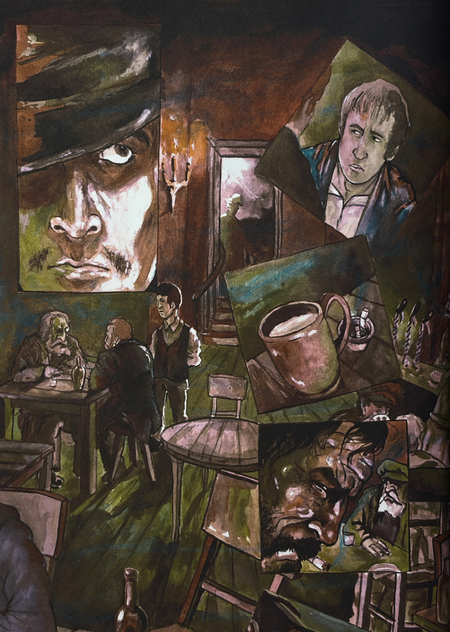
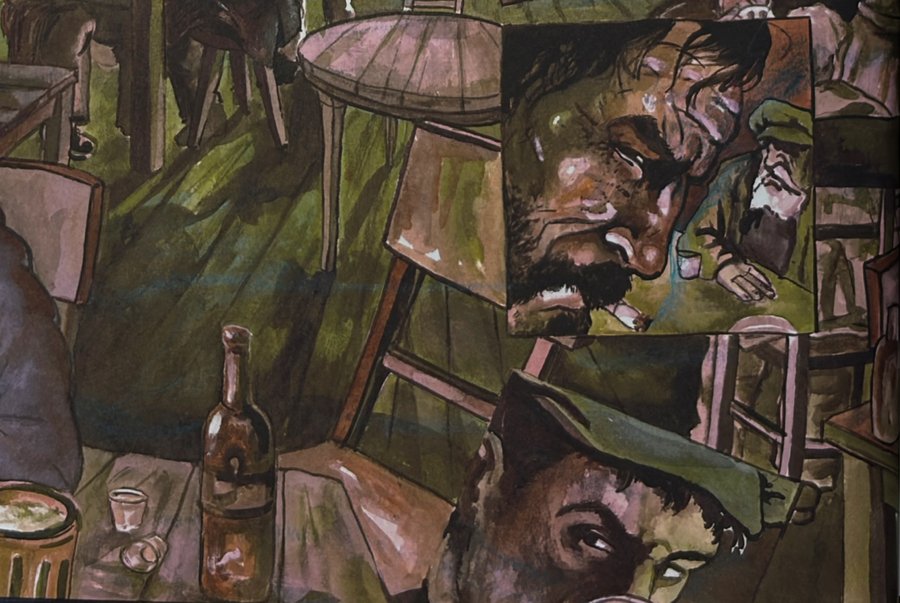
One of the defining features of Bastien Lucia’s graphic novel is its painterly style. Unlike many comics, Lucia employed a more freehand technique that strongly resembles painting. Here, we can observe watercolor washes, variegated texture, and in places, even glimpses of the original pencil sketch.
The artist utilizes watercolor and walnut shells, which gives the images a textured and variegated quality. I feel this drawing style further immerses the reader in the atmosphere of 19th-century St. Petersburg. Furthermore, Lukia works not only with watercolor washes but also elaborates on fine details. He pays significant attention, including, to the characters' expressions and physical characteristics—wrinkles, stubble, hair, and so on. Yet, Bastien Lukia does not idealize his characters; on the contrary, the heroes can appear unappealing, tired, or frightened, and their features are not perfect: large noses, either with or without a hump, or full or thin lips.
The color palette used by Bastien Luquia also plays a vital role in establishing the atmosphere. The prevailing tones are muted, earthy shades (yellow, ochre, brown, gray). When creating illustrations, the artist uses consistent hues for both the characters and the environment, thereby avoiding the isolation of the protagonist and instead emphasizing their connection to the setting. It is also interesting to note that the color scheme and level of detail in the illustrations change slightly depending on what is happening in the comic. However, the overall stylistic consistency of the graphic novel is maintained.
Unconventional Artistic Techniques
When discussing interesting artistic techniques in the graphic novel, one noteworthy example is the gradual shift in drawing style across the episodes featuring Raskolnikov’s dreams. Each dream is depicted differently, allowing the reader to witness the protagonist’s slow descent into madness. While the first dream is symbolic and terrifying, the second reveals the nightmarish imagery conjured in Rodion Raskolnikov’s imagination. The final dream, however, plunges into Constructivist aesthetics, pushing the scene with the animated pawnbroker to an absurd extreme.
Frames and Compositions
Conclusion