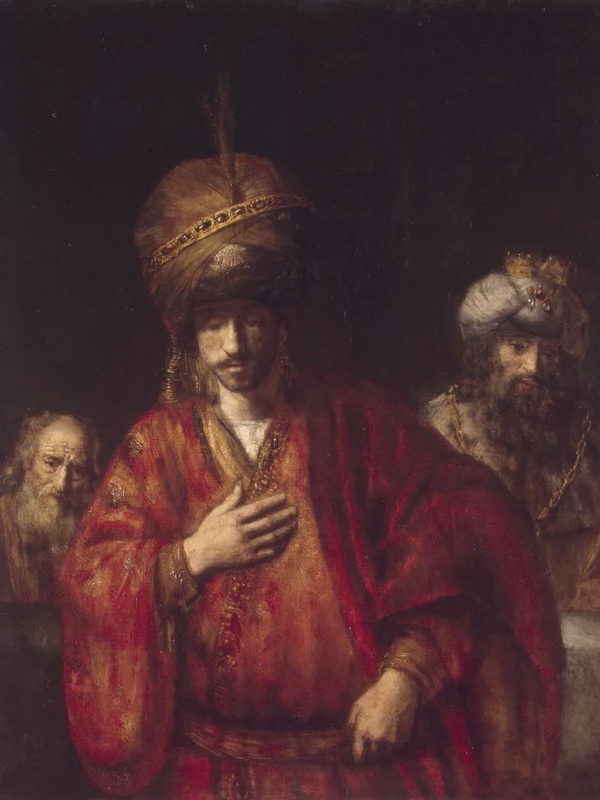
This project focuses on Rembrandt’s painting, «Armand Takes His Fate.» The work examines how the artist conveys power and its loss through costume, scale, and space.
CONCEPT
I chose «Aman Discovering His Fate» because this painting allows for an exploration not only of the biblical narrative but also of how painting can depict a person’s shifting position within a system of power. The painting features three characters, yet there is almost no apparent action between them. They are not speaking, not looking at each other, and do not form a cohesive group. Nevertheless, the central figure sharply contrasts with the others in scale, clothing color, and degree of detail.
At first glance, the protagonist appears to be a man of high status. He wears luxurious red garments, a massive turban, and rich fabrics. His figure occupies a significant portion of the space. However, these signs of wealth begin to function ambiguously. The closer one examines the painting, the more pronounced the gap becomes between the hero’s external splendor and his standing among the other figures. He seems to retain all the markers of courtly authority, yet he is already isolated from the people around him.
This characteristic is particularly important due to the history of the painting’s interpretation. Today, the Hermitage calls it «Aman Discovering His Fate, ” but specialists long debated which specific biblical episode it depicted. The painting has been linked to the story of Haman from the Book of Esther, to David and Uriah, and to other biblical subjects. The Metropolitan Museum of Art notes that it is the conciseness of Rembrandt’s later historical paintings that makes some of them extremely difficult to identify. (hermitagemuseum.org)
For my study, this uncertainty is significant not in and of itself. I view it as an opportunity to look at the painting not as an illustration of a specific biblical event, but as an image of the downfall of a courtier. If we perceive the central figure as Aman, we are looking at a man who still maintains the outward signs of high standing, but who already knows that his power has been destroyed. In this context, the contradiction between the clothing, the figure’s scale, and his actual isolation becomes especially critical.
The central question of this research is: how does Rembrandt depict a person’s changing position at court through his clothing, scale, space, and relationship with other figures?
I hypothesize that in Rembrandt’s painting, he intentionally juxtaposes two facets of one person: one who appears powerful externally and one who has already lost power internally. The luxurious clothing and large scale suggest his status, but the lack of contact with other figures, the figure’s closed posture, and its isolation from the surrounding space transform these indicators of power into signs of alienation. Therefore, the painting can be viewed not merely as a depiction of a biblical hero, but as an exploration of how precarious the position of an individual is when their power is sustained by courtly systems.
To test this hypothesis, I selected excerpts that particularly highlight the signs of status and how they change within the composition. I focused on the protagonist’s attire, the scale of his figure in relation to his surroundings, the placement of characters across different planes, the absence of direct gaze and gestural interaction, as well as the color contrast between the central figure and the background. I am also specifically examining the Eastern motifs present in the clothing and objects. The Hermitage Museum connects the artwork’s world to Rembrandt’s interest in Eastern depictions, travel, engravings, Mughal miniatures, and expensive textiles. (hermitagemuseum.org)
However, the luxurious clothing alone does not prove the presence of power. Therefore, I compare it to the figure’s spatial positioning. If a person is dressed as a powerful courtier but is compositionally isolated and excluded from relationships with other characters, a contradiction arises between perceived status and actual condition. I consider this contradiction to be the primary subject of my study.
In addition to «Aman Knowing His Destiny, ” I have included Rembrandt’s „Waltazar’s Feast, ” „David and Jonathan, ” and other biblical scenes where the artist portrays the relationship between power, the courtly setting, and the individual. „Waltazar’s Feast“ is particularly significant because there, wealth, clothing, feasting, and the courtly environment are directly linked to the display of power, which is subsequently threatened throughout the scene. This comparison allows me to investigate what visual devices Rembrandt uses to represent status and its erosion.
I also refer to Dutch art from the 16th–17th centuries, which features lavish textiles, Eastern costumes, and depictions of courtly life. This allows me to view the protagonist’s clothing not as a random detail, but as part of a broader visual culture where costume signified a person’s status.
The work is divided into five parts. First, I examine the painting as a whole and analyze how the three figures are positioned relative to one another. Next, I focus on the main character’s clothing, investigating how the costume constructs his image as a high-status individual. In the third section, I examine scale and space: why the central figure is significantly larger than the others and what this compositional arrangement does to his status. Following that, I compare «Aman» with other biblical scenes by Rembrandt where power is conveyed through character interaction. The final section is dedicated to the issue of the hero’s identity and how different interpretations of the plot alter our understanding of his position.
The visual sequence alternates between overall views and close-up details. The general view allows one to see the structure of the courtly scene and the arrangement of the characters. Enlargements are necessary to analyze the costume, turban, gesture, face, and fabric texture. I do not use a single detail as proof of the artist’s intent; every conclusion is built upon the comparison of multiple elements.
When selecting textual sources, I relied primarily on materials from the State Hermitage Museum and the catalog «The Fall of Aman»: Rembrandt’s painting in the mirror of time, published by the Hermitage in 2019. This catalog is particularly significant because it focuses precisely on the history of the painting—its interpretations, attribution, dating, restoration, and artistic context. The Hermitage also highlights the work’s connection to Rembrandt’s interest in exotic motifs and Eastern imagery. (hermitagemuseum.org)
For me, it is crucial to distinguish between two things. It cannot be proven solely from the painting that Rembrandt intended to depict the «fall of power» in a specifically modern political sense. However, it can be shown that the composition creates a tangible contradiction between the signs of high status and the figure’s position among the other characters. Therefore, in this study, I will not address what the artist «definitely intended to say, ” but rather how the painting itself allows us to read the image of power and its loss.
WHAT POWER LOOKS LIKE
Jerome Rembrandt. «Aman Learns His Fate.» c. 1665. The State Hermitage Museum.
It is immediately noticeable in the overall composition that the central figure is significantly larger than the other two. She is placed in the foreground and dominates much of the image. The remaining characters are pushed into the background and rendered more restrainedly.
The Metropolitan Museum of Art specifically draws attention to this distinction: the secondary figures are considerably reduced in scale and painted more simply, whereas the central protagonist receives the artist’s primary focus. (resources.metmuseum.org)
This construction immediately establishes a hierarchy. The main character appears to be the most significant person in the scene.
Yet, this hierarchy proves peculiar: the more attention the central figure receives, the more strongly she is separated from the others.
Three people occupy the same space, yet they barely interact. They do not form a unified compositional group in the conventional sense. Their gazes do not connect the characters, nor do their gestures suggest a continuous action.
This is particularly significant in the biblical narrative. If we are observing the scene of Amaan’s punishment, one might expect a clearer interaction between the characters.
However, Rembrandt leaves them almost outside the frame.
Therefore, the focus shifts from the question, «What are they doing?» to the question, «What position does each occupy?»
The main character is closest to the viewer. Their body almost fills the vertical space of the image. They physically occupy more space than the people surrounding them.
However, their figure does not connect with them.
This creates a paradox: the person visually possesses the greatest significance, yet socially remains isolated.
This contradiction forms the basis for the further analysis.
COSTUME AS A STATUS SYMBOL
The most striking detail in the painting becomes the red clothing. Against the muted background, it appears especially rich and saturated.
The Hermitage Museum specifically highlights the «boiling» red of the clothing as one of the most crucial elements characterizing the figure. (hermitagemuseum.org)
But color is important not only as an emotional effect. It visually separates the figure from the rest.
The protagonist seems to exist in a different color mode.
This can be compared to his social status: he stands out from the group just as much as his clothing stands out from the surrounding space. The enormous turban increases the visual scale of his head, making the figure even more extraordinary.
For Rembrandt, Eastern clothing was not a random, fanciful element. The Hermitage catalog links the artist’s interest in Eastern imagery to his travels, engravings, Mughal miniatures, and textile collecting. (hermitagemuseum.org)
Therefore, the costume can be viewed as part of the painting’s artistic language.
The protagonist is not merely richly dressed. He looks like a man whose identity is connected to courtly life. The more luxurious the central character appears, the more evident it is that he is not included in the space of the others.
This is particularly relevant for interpreting Amane.
In biblical history, Amane is a man at court who wields immense influence. His status depends on his proximity to the king.
Therefore, his luxurious attire may signify not only wealth but also his position within the courtly hierarchy.
However, on the painting, this position is already beginning to unravel.
WHEN SIZE STOPS BEING A MARK OF POWER
The main character is significantly larger than the others.
This could be read as a simple indicator of his importance.
But scale works in a more complex way.
It doesn’t just make the character central—it physically separates him from those around him.
The figure becomes so large that it functions almost as a self-contained image within the image.
As a result, the person who should be at the center of the courtly system ends up visually isolated.
There is significant space between the characters.
They are near each other, but they are not in contact.
This is unusual for a scene that could be interpreted as a courtly event.
Instead of a cohesive group, there are several individual figures.
This composition allows the painting to be read not as an image of collective action, but as one of fractured social connection.
No character establishes any obvious eye contact with another.
This is particularly important because in historical painting, gaze often connects characters more strongly than physical proximity does.
Here, there is almost no such connection.
Therefore, it is impossible to definitively say who is telling whom the news, who is judging whom, or who is observing what is happening.
It is precisely this lack of connection that helps maintain the narrative’s mystery.
The history of the artwork itself demonstrates how difficult it is to definitively identify the depicted subject matter.
For a long time, the painting was known as «The Fall of Amana.» In the 20th century, interpretations emerged linking it to Uriah, and other versions were proposed. The modern title, «Aman Learns His Destiny, ” is related to the research of Christian Tympel and has become established in contemporary literature.
Therefore, the painting’s title cannot be taken as a completely undisputed key to its content.
If we take Aman’s version, luxurious clothing and courtly appearance take on special significance.
Before us is a person who still looks like a court official but is already on the brink of his own downfall.
Then, the contradiction between costume and isolation becomes central.
The person is still dressed as a figure of power, but his authority is no longer confirmed by his relationships with those around him.
Uriia’s version changes a specific narrative, but it does not negate the issue of the human figure within an authoritative system.
Uriia is also revealed to be a person whose fate is determined by another individual who holds greater power.
In this case, the central figure is not an image of a courtier who loses power, but rather an image of a person who becomes the object of someone else’s decision.
These two interpretations cannot be fully merged. However, it is precisely their difference that demonstrates how crucial the issue of power is to the painting.
I began my investigation by asking why the painting is so difficult to read.
Now, it’s clear that this difficulty stems not only from a lack of specific narrative attributes. Rembrandt constructs the scene in such a way that the viewer simultaneously gains and loses information.
We see a wealthy, clearly high-status individual, but we don’t precisely understand what action is taking place around them.
We see other characters, but we don’t understand their relationships.
We see luxury, but we don’t see power in action.
We see a person occupying almost the entire foreground, yet they appear isolated.
CONCLUSION
The research suggests that the central issue of the painting lies not only in the question of who is depicted, but also in how painting conveys the changing position of an individual within a system of power.
If we consider the protagonist as Amana, the contradiction between his external status and his position within the composition becomes particularly salient. His luxurious red robes, massive turban, and large figure scale make him the visually most significant character. Yet, he is barely connected to the other figures. His gaze does not connect with theirs, the gestures do not form a unified action, and the space between the characters remains fractured.
Thus, the markers of power are separated from power itself. The protagonist still appears to be an influential courtier, but he no longer seems like someone capable of directing events.
This is why the title, «Aman Discovers His Fate, ” can be understood as more than just a reference to the Biblical story. It establishes a specific temporal point: the protagonist retains the external appearance of his former standing, but his future has already been determined.
I am not asserting that Rembrandt intentionally created a modern political allegory. That interpretation would be too simplistic. It is more prudent to say that the artist creates a visual tension between the status a person projects and the position they actually occupy.
The history of the painting reinforces this problem. Throughout the 20th century, scholars have proposed various identifications for the protagonist—from Amana to Uria and other characters. The Metropolitan Museum notes that it is precisely Rembrandt’s refusal to offer a detailed narrative that makes this painting one of his most enigmatic historical compositions.
Therefore, the narrative ambiguity in this study becomes not an endpoint question, but an analytical tool. It compels us to look not only at the story the painting tells, but also at how it distributes power, space, and visual attention among the characters.
As a result, «Aman Learns His Fate» can be viewed as a painting about the fragility of status: a person can continue to appear powerful even when their standing has already collapsed. It is this gap between external grandeur and internal change in position that makes the painting particularly compelling for research.