During times of peace and prosperity, both the state and individuals are guided by noble intentions because they do not encounter difficult circumstances that force them to act against their will. War, however, by stripping away the customary contentment of daily life, proves to be a harsh teacher and likens the passions of most people to their current condition.
Thucydides, History of the Peloponnesian War, III, 82, 2 (translated by G. A. Stratanovsky)
Life in the Antigonid City of Pantikapeia During Wartime and Peacetime
Categories
1. Research Concept
2. Architecture of Panticapaeum
3. Military Events and Artifacts
4. City Life in Peace
5. Symbols of War and Peace in Artifacts
6. Conclusion
7. Sources
Research Concept
Panticapae, located in modern Kerch, offers the possibility of depicting the ancient city in various states: periods of everyday, stable life and periods of military threat. Even in difficult times, the city’s inhabitants engaged in domestic activities, construction, trade, and craft, and religion was an especially vital aspect of daily life during battles. Military danger always disrupted social order, necessitating the strengthening of city defenses and reconstruction and improvement.
Through the study of artifacts found in Panticapae, both facets of the city’s existence can be presented: the peaceful and the military.
Archaeologists find bowls, ceramic inscriptions, decorative objects, and symbolic imagery near arrowheads and the remains of fortifications. Comparing these items helps reveal the life the city protected and how danger altered the values of its inhabitants.
How do architecture, domestic items, and imagery on objects help us see the interaction between the peaceful life and the military culture of Panticapae?
It is important to demonstrate, based on the visual analysis of archaeological materials, how everyday life and the necessity of defending the city were intertwined in Panticapae.
The war and peace of Panticapae are presented in defensive and domestic artifacts, respectively, as interconnected processes within a single city. Everyday objects indicate the needs of the residents, while the fortifications and finds from layers of destruction point to the changes induced by danger. In certain objects—especially coins and symbolic imagery—domestic, military, and religious meanings merge into a specific system.
Architecture of Pantikape
Рис. 1
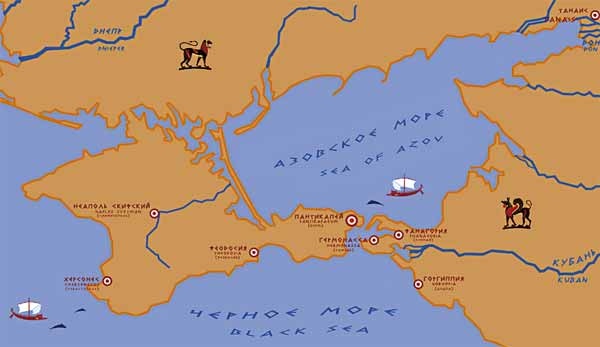
Рис. 2
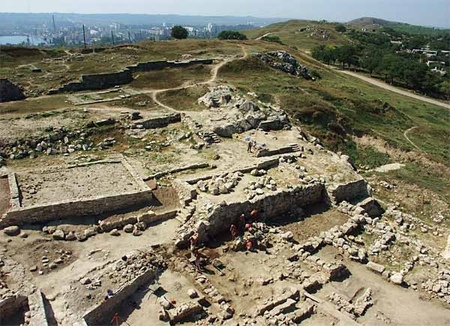
Fig. 1. Map of the main cities of the Crimea-Scythian area. Illustration from V. P. Tolstikov’s article in the journal «Our Heritage, ” 2015, No. 114.Fig. 2. Remains of structures from the end of the 6th to the first quarter of the 5th century BCE on the western plateau of Mount Mithridates. Excavations at Central and Central North sites, photo by V. P. Tolstikov.
Panticapaeum’s geographical location speaks to the city’s importance, as it was connected to the continent via the maritime routes of the Bosporus. The map diagram shows that the city was part of the settlements surrounding the strait. Meanwhile, based on the remains of structures on the slopes and plateaus of Mount Mithridates, captured in the second photograph, we can infer that the artifacts being studied were part of political, commercial-craft, and defensive activities.
Fig. 3. Buildings and fortifications of Pantikape near 480 BCE. V. P. Tolstikov, 2023. p. 27, Fig. 12. Left: reconstruction, right: plan.
In the late 6th to early 5th centuries BCE, a complex of structures featuring a tholos—a circular building—existed on the western plateau, setting it apart from the surrounding rectangular complexes. The difference between the central circular structure and the surrounding architecture is particularly evident in the plan photograph. Such a composition suggests a purposefully organized space, rather than a random aggregation of dwellings.
It is important to distinguish between a city plan and an archaeological excavation photograph. While the discovered architectural remains helped reconstruct the appearance of the buildings, the scholarly reconstruction depicts the height and placement of the structures, but one cannot assume that the finished facades and roofing were directly visible during the excavations. Therefore, we should also focus on another aspect of the comparison—how the space of everyday life and the defensive line occupy the same urban territory. This means that when a military threat arose, the existing city center itself became its defense.
Military Events and Artifacts
In the study by Pantikapey V. P. Tolstikov, the catastrophe of 480–475 BCE is examined in connection with Scythian raids, which led to the discovery of evidence of fires and collapsed walls at the excavation site, and arrowheads found in the corresponding soil layers allow for discussion of armed attacks on the city.
Fig. 4
Fig. 4. Arrowheads of Scythian types from destruction layers around 480 BCE. Pontic Cape Upper and Western Plateau, V. P. Tolstikov, 2023. p. 18, fig. 4.
The reconstruction of the defensive wall on the plan, dated to around 480 BCE, defines the city’s protective boundaries, while the pattern of arrowheads emerges from archaeological layer excavations. The practical significance of the defense is revealed through the contrast between the studied objects—fortifications protected buildings, supplies, and the people themselves. According to researchers at the A. S. Pushkin Museum of Fine Arts, after the destruction of the building complex, Panthikape residents began constructing sunken buildings instead of continuing above-ground stone construction, which only resumed during a more stable period. This illustrates a shift in people’s way of life and values. The arrowhead shape is pointed, while the base allows for attachment to the shaft. Differences in outline and cross-section are clearly visible in the comparative table of tools. The weaponry reveals not only the «warfare» of Panthikape but also the technical knowledge and skills of its inhabitants.
Рис. 5
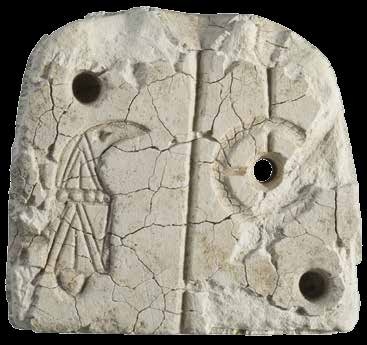
Рис. 6
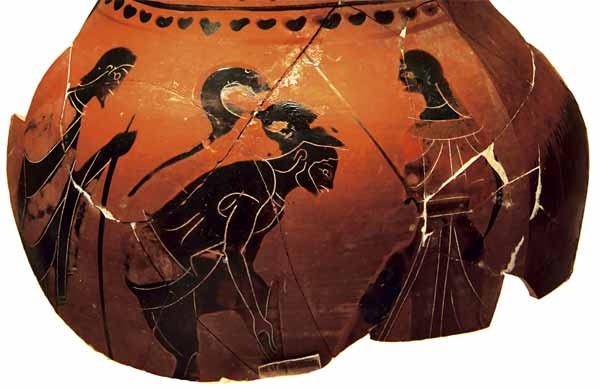
Fig. 5. Half of a limestone mold from Pantikape. First half of the 6th century BCE. VKIKMZ, inv. No. KH-18035, KP-188175. Excavations by V. P. Tolstikov, 2015. Catalog 2017, p. 353, cat. 283. A mold for decorative elements, not for arrowheads.Fig. 6. Fragment of Attic black-figure pottery depicting an armed warrior. 520–480s BCE. From the destruction layer of the ensemble with a telos in Pantikape. Pushkin State Museum of Fine Arts. Illustration in the journal «Our Heritage, ” 2015, No. 114.
- Military culture encompasses the production of objects. Not all casting molds were created for making arrowheads, but a limestone mold from the first half of the 6th century BCE found in Pantikapee contains indentations for suspension and a wheel-like element. Visible channels and holes indicate the organization of the casting process. This artifact expands our understanding of the city’s crafts but does not provide grounds to call it specifically an arrow mold.
Thus, judging by the casting mold, the craft and material processing technology were needed for people to create ornaments, household items, and weaponry, suggesting a possible connection to the city’s military culture.
- A fragment of Attic black-figure pottery from Pantikapee preserves a composition featuring an armed warrior and figures facing him, also armed. The helmet, shield, and long spear of the central figure are particularly striking. This scene differs from a depiction of real arrows: here, the military theme exists in the imagery on the vessel—in the symbols of war.
Visually, the figures are united by gesture and the direction of their gaze. The image on the artifact can be interpreted as the military-political relations of the people, the transition from civilian life to combat.
The Peaceful Life of the City