CONCEPT
The turn of the 19th and 20th centuries was an era that perceived itself as a crisis. Decadence (derived from the French décadence—meaning «decline») arose in European art not merely as a style, but as a way of experiencing history: the loss of teleology, distrust of progress, and the sense of cultural exhaustion. Decadence is characterized by the individual’s constant reflection on the unfulfillment of their hopes, leading to a desire to perceive the world through a new lens—one that is grotesque, oppressive, and overwhelming to their capacity. In painting, this manifested as a cult of morbid beauty, duality, excessive introspection, and imagery of decline, moral decay, and escapism. Decadent art does not so much depict death as it makes it aesthetically alluring, transforming decline into an object of mesmerizing contemplation. However, behind the superficial pessimism of decadence lies an experience that can be examined through Immanuel Kant’s concept of the Sublime. For Kant, the Sublime is not a property of the object but a feeling experienced by the subject when confronted with something infinite or immensely powerful—something against which the imagination fails, yet the reason reveals its superhuman capacity. This is a «negative pleasure»: the displeasure stemming from sensory impotence coupled with the pleasure derived from the apprehension of reason.
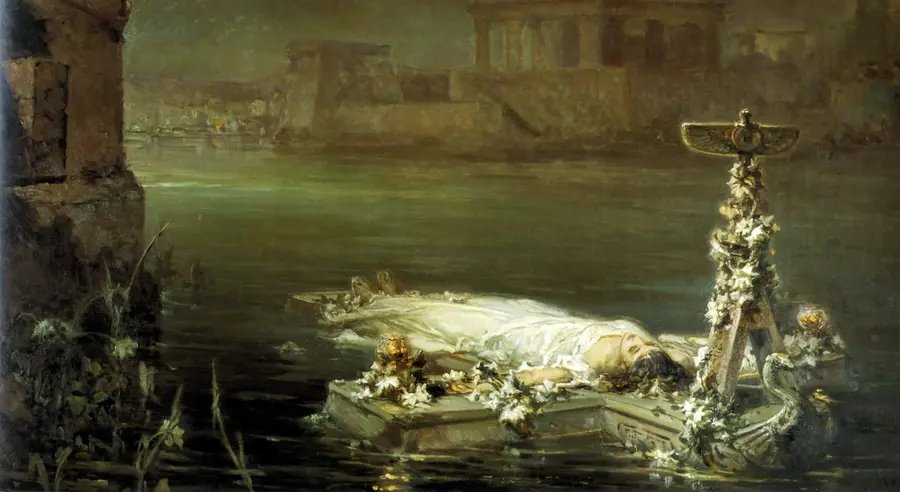
«Victim of the Nile, ” Alexander Kotarbinsky
Before decadence, the sublime in art was more often associated with nature—storms, mountains, the infinite sky—or with heroic historical narratives. Romanticism made the sublime central, yet it still allowed for catharsis and transcendent solace. Decadence radically shifts this perspective: nature no longer inspires awe, history does not move toward a goal, and the subject is not autonomous. The sublime does not disappear—it migrates into the grotesque, the monstrous, the void, and the boundless space without exit. The connection between the sublime and decadence is paradoxical, yet it rests on a profound foundation. If for Kant the sublime culminates in the triumph of reason, in decadence this triumph is transformed: reason itself becomes part of the problematic. The sublime becomes the experience of a dead end, of being stuck in a moment of collapse, the aestheticization of inescapable futility. The grotesque here is not a negation of the sublime, but its new form: it overloads the imagination and does not let go, holding the subject in a state of fascination. In painting at the turn of the 19th and 20th centuries, this is expressed through strategies that can be described in terms of Kant’s mathematical and dynamic sublime. The mathematical sublime manifests not in the relativity of the individual to something greater, but in the impossibility of grasping the whole: a void without reference points, infinite multiplicity, microscopic complexity, and the feeling of irreversible collapse. The dynamic sublime is expressed through the monstrous, the grotesque, mutilation, and human transformation. Thus, the sublime continues to exist in decadent art, but in a different form—as the experience of undergoing decay, which is both mesmerizing and overwhelming. The goal of this study is to demonstrate how decadence does not negate the sublime, but rather radically rewrites it, making the grotesque the conduit for the experience that Kant described as encountering that which transcends the human.
Deterioration, decline, and negative pleasure
At Kant, the sublime is structured paradoxically: pleasure arises through displeasure. Imagination is defeated—it cannot grasp the infinity of nature or its power—and in this moment of defeat, the subject discovers within itself a capacity that surpasses imagination: the capacity of reason to think the absolute whole, the moral law, the supersensible purpose. Defeat becomes the condition for victory. Negative pleasure is not the pleasure of destruction, but the pleasure that the destruction of imagination opens the way to something beyond imagination. This implies that negative pleasure changes its nature. In Kant, it was transient: moving from displeasure to pleasure, from defeat to discovery. For the decadent movement, it becomes static: displeasure and pleasure coexist simultaneously, resolving into neither one nor the other. The subject does not overcome finitude—they remain with it, and it is in this preservation that they find a strange, uneasy pleasure.
«…the sublime is a pleasure that arises only indirectly—through the sensation of a momentary suspension of vital forces, immediately followed by their more powerful effusion, and because it is an emotion, it seems not like a game, but a serious undertaking of the imagination. Therefore, charm is incompatible with it; and since the soul is not merely attracted by an object, but alternately repelled by it, the pleasure of the sublime contains not so much positive pleasure as awe or respect, and thus merits the name of negative pleasure.»
«Critique of Judgment» Immanuel Kant
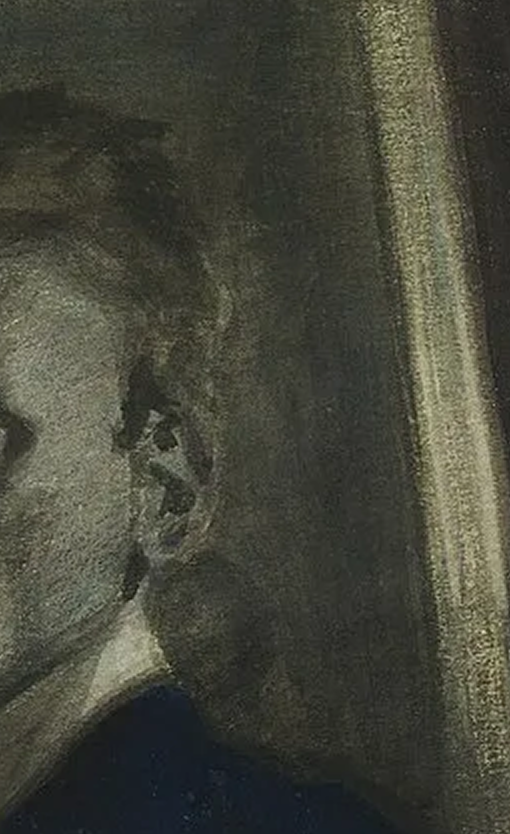
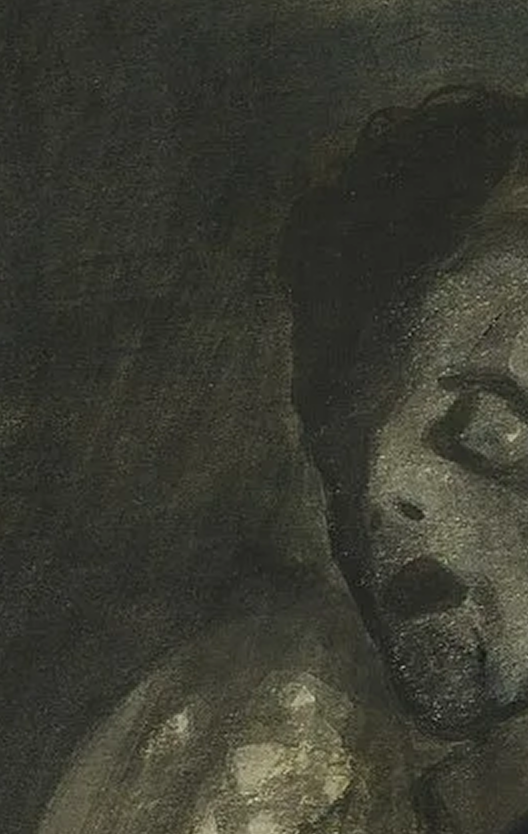
In Decadent painting, this feeling of sublimity arising from one’s own finiteness is manifested in the genre of the self-portrait (which can be called the most revealing of Decadent ideas due to its literal self-reflection on the canvas). This can be traced in Leon Spilliart’s work, «Self-Portrait in a Mirror,» 1908. The first thing that catches the viewer’s eye on this painting is the depicted figure’s haggard face. The skin, rendered in gray-brown tones, is painted as a single mass; the details of the face are maximally merged together. The only things we can discern are a deeply sunken, closed eye and an open mouth expressing either horror or disdain. The character resembles a dead, decaying creature more than the painter depicting himself.
«Self-Portrait in the Mirror, ” Léon Spilliaert, 1908