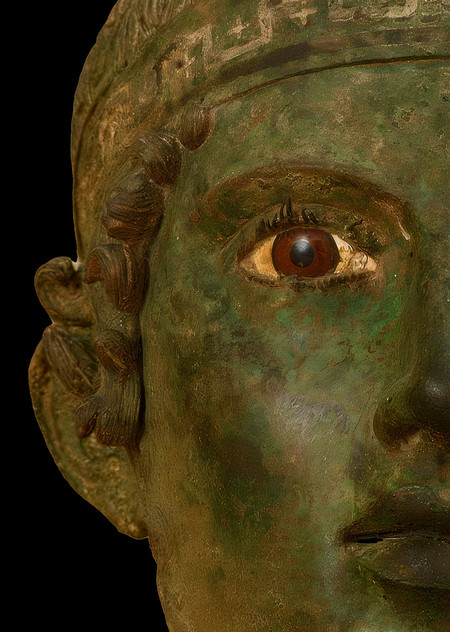
- Research Concept
- Eyes as a Key Element of the Image
- Sculptural Modeling Technique
- Painting Technique
- Inlay Technique
- Conclusion
- Bibliography
- Image Sources
Research Concept
We are accustomed to perceiving ancient sculptures as stark white figures with empty eye sockets—symbols of eternity and serenity. This myth was established during the Renaissance, when time-weathered, faded statues were mistakenly accepted as the standard for classical beauty. However, such a perception would have been impossible for people of that era. The ancient Greeks viewed the stone sculptures as an integral part of the surrounding life, and they actively used vibrant paints, metal, precious stones, and other materials when creating them.In the context of this topic, it is interesting to examine how eyes were depicted in antiquity. Within this vibrant imagery, the gaze was endowed with sacred meaning and often rendered using a distinct style, separate from the other parts of the sculpture. Yet, only a few surviving statues remain close to their original appearance.
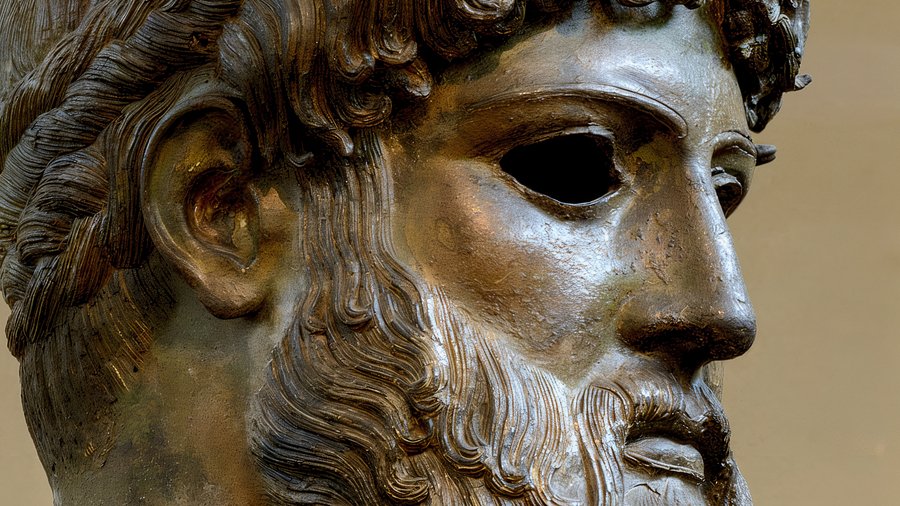
Zeus from the Artemision Cape, fragment. Circa 460 BCE. Bronze. National Archaeological Museum, Athens.
Therefore, the starting point of the research became the question: how did the choice of material and artistic technique shape the viewer’s perception of the statue, and why did the surviving sculptures appear «blind»?
It should be noted that most ancient Greek statues survive to us through late Roman copies. Therefore, the primary objects for analysis will be select bronze statues that have survived to the present day, as well as examples of Roman sculpture. Consequently, the focus period will be Antiquity, spanning from the 8th century BCE to the 1st century CE.
The study suggests that the eyes were a pivotal element in the statue, shaping its final appearance. The sculptor emphasized them, employing special techniques and materials in their creation. However, it was this meticulous attention to the gaze that rendered the eyes the most vulnerable part of the sculpture—a part that was not always capable of surviving the shifting eras.
The primary objective of this study is to identify the range of artistic techniques, methods, and materials sculptors employed to convey the character of the gaze in their works, as well as to analyze how their use influenced the transformation of statue appearances over time.
Athena Piriaica. Circa 330–340 BCE. Bronze with inlay. Archaeological Museum of Piraeus, Athens.
For this research, I drew upon both archaeological materials—which offered a deeper dive into the techniques used to create various types of eyes—and historical and cultural studies, which focused on the aesthetic and semantic role of gaze in sculpture.When structuring this work, I focused on the core artistic techniques sculptors employed in rendering eyes. Each identified technique imparts a unique character to the statue’s gaze and serves specific functions in constructing the overall image. It is also worth noting that sculptors often combined several techniques within a single piece: for instance, they might first define the look through plastic modeling and then apply coloration to intensify the artistic impact. However, in this narrative, I concentrated on the most striking examples of applying one technique or another.
Eyes as a key part of the image
In antiquity, sculpture was not viewed merely as decoration; for instance, it was conceived as a physical vessel for the divine. Correspondingly, the eyes of these statues were imbued with sacred meaning. We can recall the legend of the sculptor Daedalus, who «unlocked» the eyes of statues—previously, figures were crafted with closed eyes. Only after mastering the convincing modeling of a gaze did masters begin to fully emulate living nature.
Three wooden votive figurines (ksoans) from Palma di Montecchiaro. Circa 650–580 BCE. Wood (cypress, poplar). Regional Archaeological Museum of Paolo Orsi, Syracuse.
This imitation reached its peak during the ancient period, when sculptors, striving for realism, paid attention even to the finest details. For instance, masters would even add eyelashes, crafted from thinly sliced bronze leaves, to their statues.
Pair of inlaid eyes from a bronze statue. 5th century BCE or later. Bronze, marble, frit, quartz, obsidian. Metropolitan Museum of Art, New York.
The materials and techniques used to execute the eyeball itself are also important. Depending on the era, the subject of the statue, and its purpose, masters could employ diverse materials and methods. In the early stages of ancient art development, eyes were typically modeled and painted, but as techniques for working with metal and stone improved, the eyes began to be inlaid.
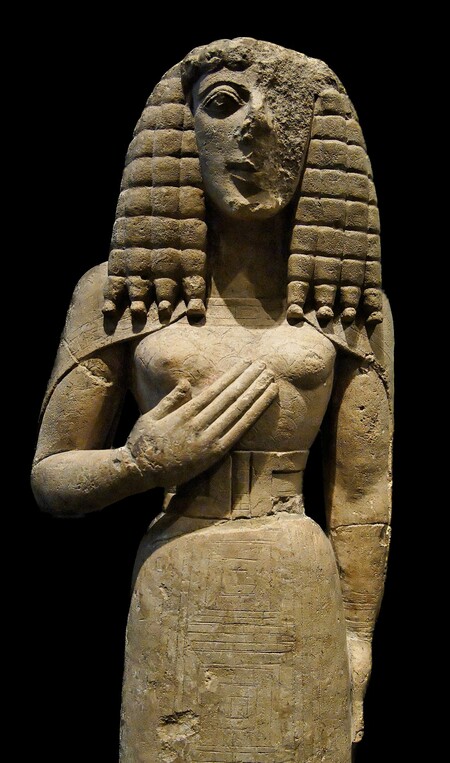
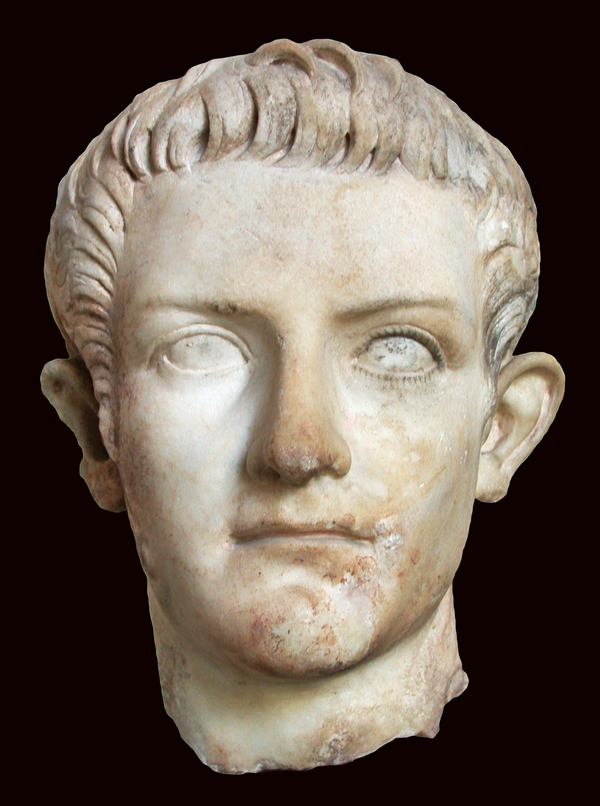
Lady of Oser, fragment. Circa 640–630 BCE. Limestone. Louvre, Paris, and Portrait of Emperor Caligula. Circa 37–41 CE. Marble. Neues Glyptothek, Carlsberg, Copenhagen.
Plastic Modeling Technique
Modeling is one of the oldest methods for representing eyes in sculpture. It allowed for the creation of an expressive gaze purely through the manipulation of the material itself, without relying entirely on paint or the insertion of additional elements. Within the context of this technique, attention should be paid to the evolution of artistic choices: as mentioned earlier, initially, eyes were rendered closed, not emphasizing the gaze’s prominence in the image; however, over time, eyes have come to receive increasing focus.
Kuros from Tenea, fragment. Circa 560–550 BCE. Paros marble. Glyptothek, Munich.
In the context of developing plasticity and expressiveness, the sculpture «Laocoön and His Sons» is a notable example: here, the heroes' gazes harmoniously combine with the large form, developing the composition’s dynamic quality.
Laocoön and His Sons (Sculptors Agesander, Athenodor, and Polydorus). Late 1st Century BCE — Early 1st Century CE. Marble. Vatican Museums (Pius Clementino Museum), Vatican.
Laocoön and His Sons (sculptors Agesander, Athenodor, and Polydorus), fragment. Late 1st century BCE — early 1st century CE. Marble. Vatican Museums (Pius Clementino Museum), Vatican.
In the master’s compositions, not only the eyes of people are rendered with detail; the gaze of the snake gains an equally powerful expressiveness.
Laocoön and His Sons (sculptors Agesander, Athenodor, and Polydor), fragment. Late 1st century BCE — early 1st century CE. Marble. Vatican Museums (Pius Clementino Museum), Vatican.
Laocoön and His Sons (sculptors Agesander, Athenodor, and Polydorus), fragment. Late 1st century BCE — early 1st century CE. Marble. Vatican Museums (Pius Clementino Museum), Vatican.
Each character is assigned a unique gaze, subtly conveying their emotional state.
Laocoön and His Sons (sculptors Agesander, Athenodor, and Polydor), fragment. Late 1st century BCE — early 1st century CE. Marble. Vatican Museums (Pius Clementine Museum), Vatican.
Painting Technique
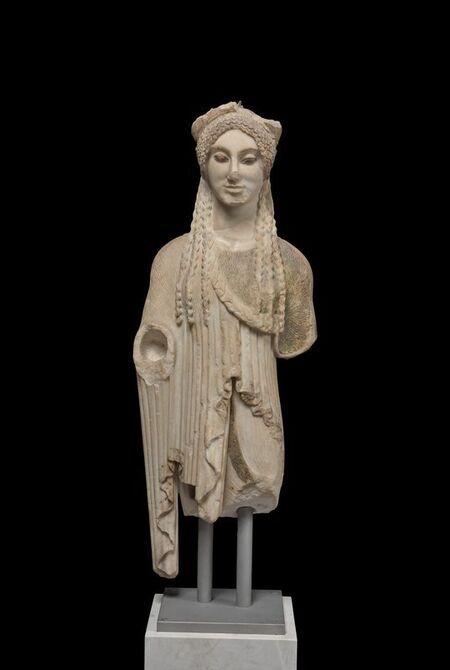
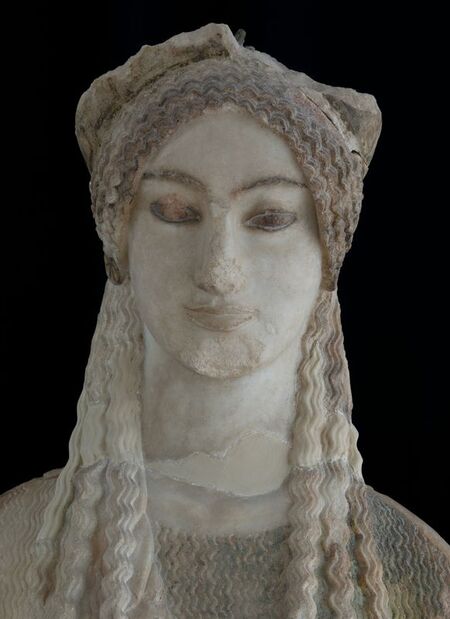
Parchment with almond-shaped eyes (Acropolis Parchment No. 674). Circa 500 BCE. Paros marble, remnants of painting. Acropolis Museum, Athens.