Navigation
I. Research Concept
II. Geography and Archaeological Context
III. Wealth and Status
IV. The Structure of the Mirror and Self-Perception
V. Mutual Gaze and Attention
VI. The Gaze as Interpretation of Signs
VII. Hypothesis Confirmation
VIII. Conclusion
Research Concept
Concept and Topic Rationale
Concept: This research is based on the premise that the engravings on Etruscan bronze mirrors resonate with the functional purpose of the mirror in their narratives. Specifically, the motifs were chosen so that the story either featured the mirror itself, a reflection, or the character’s interaction with a reflection—perhaps even in a metaphorical sense. For instance, the reflection of a character’s positive and negative traits within a myth. Some of the scenes focused on close observation or the study of minute details, including attempts to discern omens in divinatory narratives. In essence, the engraving’s narrative seems to address the mirror’s owner, who, much like the story’s protagonist, examines themselves through the mirror.
Rationale for the Topic: Etruscan mirrors allow for a comparison between observing one’s own reflection and the perspectives of the engraved characters. An analysis of the head turns, gestures, and figure placements reveals the role of the gaze in composition and its connection to the object’s function.
Rationale for Material Selection
These objects were selected for visual analysis because they share similar material, form, and purpose, yet they represent diverse modes of depicting gaze. The scenes featuring Thetis and Malevich allow for the exploration of reflection, self-observation, and attention to appearance; the depictions of Admetus and Alcestis, Paris, Turan and Helen, and Zipuna and her companions explore mutual attention and inter-character relationships. The Mirror of Kalchas is examined as an early comparative example of a gaze directed toward interpreting signs. Comparing these pieces allows us to determine how directions of gaze and gestures organize the composition and connect the image to the function of the mirror.
Principles of Categorization and Selection
The visual research material is structured according to the nature of the depicted gaze and its role in the composition. For each object, we examine the arrangement of figures, head turns, gestures, the presence of reflections, the characteristics of the engraving, and the connection between the subject matter and the object’s function. For this study, Etruscan bronze mirrors with engravings are selected where the viewing of a reflection, observation, or the search for hidden meaning plays a significant role in developing the narrative. The connection to the mirror’s function can be direct or metaphorical and can be traced through the characters' actions, gestures, and the direction of their gazes. Mirrors with ornamentation or narrative engravings where the gaze holds no independent significance are excluded from the selection.
Sources, scope, time, and geography
Principle for Selecting Textual Sources: Scientific research is utilized to interpret the themes depicted on the objects under study (Etruscan mirrors).
Area of Study: The visual culture and decorative arts of the Etruscans; the compositional and semantic role of gaze, reflection, and self-observation in the engravings on bronze mirrors.
Time and Geography of Study: Etruria, Central Italy, 4th–3rd centuries BCE. The Calchas Mirror, dated to around 400 BCE, is examined as an early comparative example at the turn of the 5th–4th centuries BCE.
Key Question
How do the characters' gazes and gestures organize the composition of Etruscan mirrors and connect the image to the object’s function?
Research Question
How do directional viewpoints, gestures, and character placement organize the images on Etruscan bronze mirrors, and how do they connect the content to the object’s function?
Hypothesis
It is hypothesized that the composition of the bronze Etruscan mirrors relates to their functional purpose—meaning the mythological narratives and the arrangement of characters within the composition are linked to how the mirror was intended to be used, thereby creating a distinct dialogue between the narrative and the user.
Goals and Objectives
Objective:
To identify and compare the methods used to depict gaze and self-observation on specific Etruscan bronze mirrors, determine their role in compositional structure, and establish their connection to the mirror’s intended function.Tasks:
1. To refine the dating, material, purpose, and subject matter of the selected mirrors. 2. To analyze the placement of figures, head orientations, directions of gaze, and accompanying gestures. 3. To investigate the motif of the mirror and self-observation in scenes featuring Thetis and Malavis. 4. To determine the role of mutual attention and observation in the depictions of Paris, Turan and Helen, Admetus and Alcestis, and Zipunus and his companions. 5. To examine the gaze of Calchas as a means of investigating and interpreting visible signs. 6. To compare the objects, identify the relationship between the depicted action and the mirror’s function, and evaluate the validity of the hypothesis.Geography and Archaeological Context
Findings Geography
Map base — Natural Earth. Archaeological data — CIE M.2; Carpino, 2008; De Puma, 2008, 2013; CSE Italia 8, 2018; Manniez, 2024; Gran-Aymerich, Domínguez-Arranz, 2025
Most of the finds marked on the map are located in Central Italy, where major Etruscan centers were situated, including Tarquinia, Vulci, and Orvieto. In Vulci, for example, workshops operated that manufactured bronze mirrors. Many specimens have been preserved in necropolises because the Etruscans placed mirrors in tombs along with other personal belongings of the deceased. Finds in Bologna, Marzabotto, and Spinea are linked to the presence of the Etruscans in the Po Valley, where these cities were part of a network of trade connections with Central Italy. Mirrors from Aleria in Corsica reflect the Etruscan presence on the island, and an artifact presumably found in Emporiae may have arrived there through Mediterranean exchange.
Archaeological Context of Etruscan Mirror Finds
Mirrors were included in Etruscan burials selectively. In one sector of the Monteotti necropolis in Tarquinia, they were found in 26 out of 173 tombs—roughly in one out of every seventh tomb. Some tombs had been disturbed, so 15% represents the proportion of tombs where mirrors survived until the excavations. In another sector of the same necropolis, Calvario, Aleksandra Carpino was able to link the mirrors to specific deceased individuals. They were placed in 4 out of 16 women (25%) and 2 out of 19 men (about 11%). In this sample, mirrors were more frequently associated with women, although most women did not have them in their burial inventory.
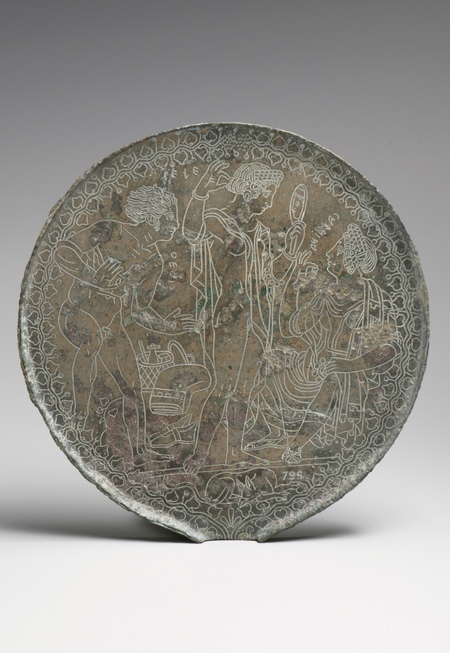
Etruscan Mirror «Peleus, Thetis, and Galen.» Etruria. Circa 350 BCE. Bronze, engraving. The Metropolitan Museum of Art, New York. Inv. No. 09.221.16.
Etruria. Circa 350 BCE. Bronze, engraving. Found in the autumn of 1877 during excavations of Etruscan burials in the Fattoraccio area near Castel Giorgio (Umbria, Italy). The mirror is among three bronze mirrors discovered during the Mancini excavations, alongside other grave goods.
Etruscan mirror, «Hercules, Dionysus, Ariadne, and Eros.» Etruria. Circa 325–300 BCE. Bronze, engraving. Walters Art Museum, Baltimore. Inv. No. 54.85.
The mirror was discovered in the autumn of 1877 in the burial site belonging to Count Bizzio Bucchosanti. Three mirrors are listed in the Corpus Inscriptionum Etruscarum among the finds from several burials. In May 1878, two bronze legs from a cista (box), a plain gold ring, lead fragments, a sandstone tombstone with an illegible inscription, and a sandstone bust, presumably female, were found in four collapsed tombs at Fattoraccio. These finds belong to a separate group of burials, which was studied a year later.