Navigation
— Introduction and Hypothesis — Visual Imagery of the Female Silhouette Under a Veil — Control Over the Female Body and Fate — Woman in the Context of War and Trauma — Characteristics of Graphics and Narrative — Author’s Stance — Conclusion — Sources
Introduction and Hypothesis
The veil can symbolize control, but it can also become a symbol of resistance. So, where and when does imposed restriction end and personal choice begin?
The image of a woman with a covered face or head occupies a significant place in visual culture, reflecting societal perceptions of female roles, appearance, and acceptable boundaries of self-expression. Depending on the cultural and social context, covered appearance may be interpreted as a result of imposed restrictions, a means of conforming to social norms, or a conscious personal choice.
The research hypothesis is that the visual image of a woman veiled does not carry a singular meaning. On one hand, it may symbolize patriarchal control, the concealment of individuality, and the restriction of freedom. On the other hand, it can become a way to preserve one’s identity, express one’s stance, and resist imposed rules. Therefore, the meaning of covered appearance is determined not only by its visual form but also by the circumstances in which it exists and the woman’s attitude toward it.
To test this hypothesis, the methods of depicting the female silhouette under a veil are examined in the graphic works of Marjane Satrapi, «Persepolis» and «Weaving, ” as well as in the Egyptian webcomic „Cairo, ” created by artist Dina Mohamed in 2013. The study combines an analysis of the visual language of the works with an examination of the social issues revealed through the stories and figures of the heroines. Special attention is given to how artistic devices interact with themes of social control, female identity, gender inequality, freedom, and resistance. The listed comics are viewed not merely as visual works but as a space for contemplating the social contradictions related to women’s position in society.
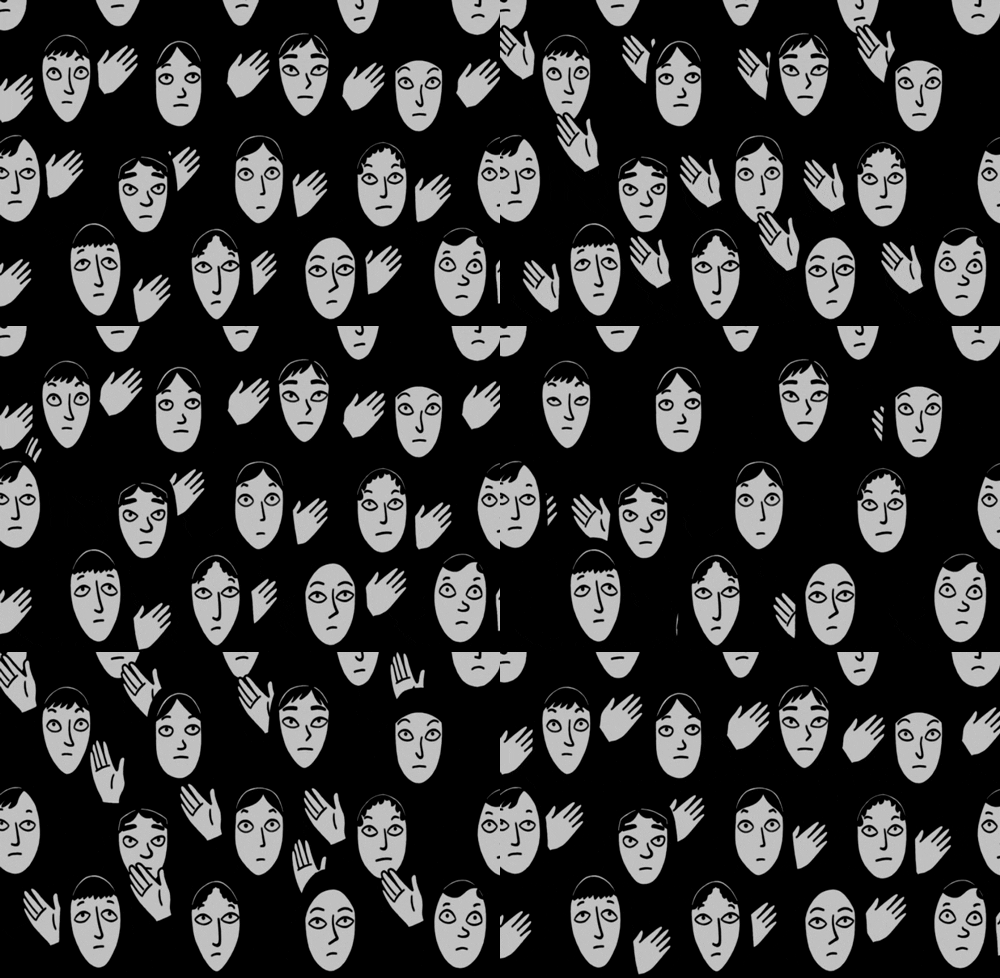
Stills from the animated film «Persepolis» (directed by M. Satrapi, V. Paronnaud, 2007). Source: Maudit, GIPHY.
Visual depiction of the female silhouette under a veil
The visual representation of the female silhouette under a veil is built upon how clothing becomes an integral part of one’s external appearance. The covering of the head and body transforms familiar proportions, obscuring hair and facial features. This shifts the focus from individual characteristics to the overall shape, contour, and degree of figure concealment. The veil does not simply complement the look—it actively shapes its visual perception.
A characteristic technique in depicting such silhouettes is the use of solid, dark color masses. In black-and-white graphics, dark clothing unifies parts of the body into a single form, creating contrast with exposed areas of the face and the background. This juxtaposition emphasizes the boundary between the hidden and the visible.
Marjane Satrapi, «Persepolis.» Vol. 1, p. 8
In «Persepolis,» Marjane Satrapi, this visual principle is particularly vivid in the very first chapter, «The Veil.» On the initial pages, the schoolgirls are depicted wearing identical black headscarves, creating a sense of visual homogeneity where individual figures merge into a collective. However, subsequent frames demonstrate that uniformity of dress does not preclude individuality: the girls interact with the headscarves in diverse ways, incorporating them into games and devising their own methods of wearing them. The contrast between the standardized appearance and the characters' free behavior underscores the difference between an imposed form and the personal perception of one’s own image.
Yet, the visual unity of Iranian women concealed deep disagreements regarding their attitude toward the head covering. While some women found in the headscarf an expression of their religious and cultural identity, others actively resisted its mandatory wearing, advocating for their autonomy in matters of appearance. «Persepolis» vividly illustrates this struggle through episodes of protest against the compulsory veil. This demonstrates how the same external symbol can take on opposing meanings—being an act of personal freedom or a sign of coercion.
Marjane Satrapi, «Persepolis.» Vol. 1, p. 10
The face, by remaining exposed, becomes the key carrier of individuality: facial expressions, the direction of gaze, and the expression in the eyes take on special significance against the backdrop of a uniform dark covering.
Dina Mohamed’s comic, «Cairo,» presents an alternative perspective on depicting the female figure in modest dress. Here, the heroine possesses a cohesive, instantly recognizable silhouette shaped by her clothing. The primary channel for conveying emotion and character becomes the open area of her eyes. Importantly, the dark covering does not render the character passive. On the contrary, her dynamic poses, directed movements, and active interaction with her environment transform the closed silhouette into a symbol of strength and autonomy. Unlike the schoolgirls from «Persepolis,» whose figures merge into a single form due to their clothing, Kahira gains her individuality through how she commands her body and operates within space.
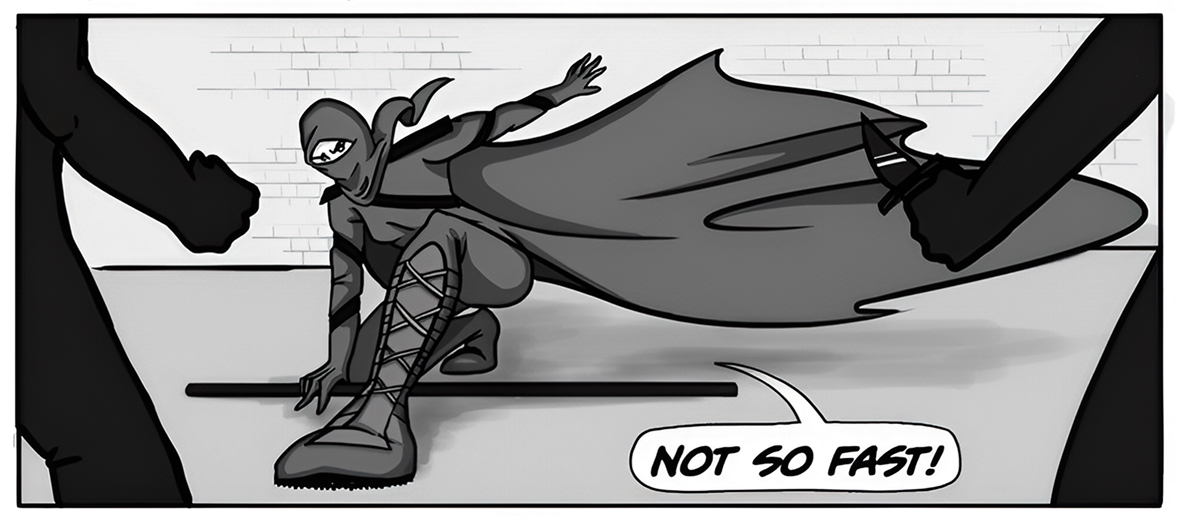
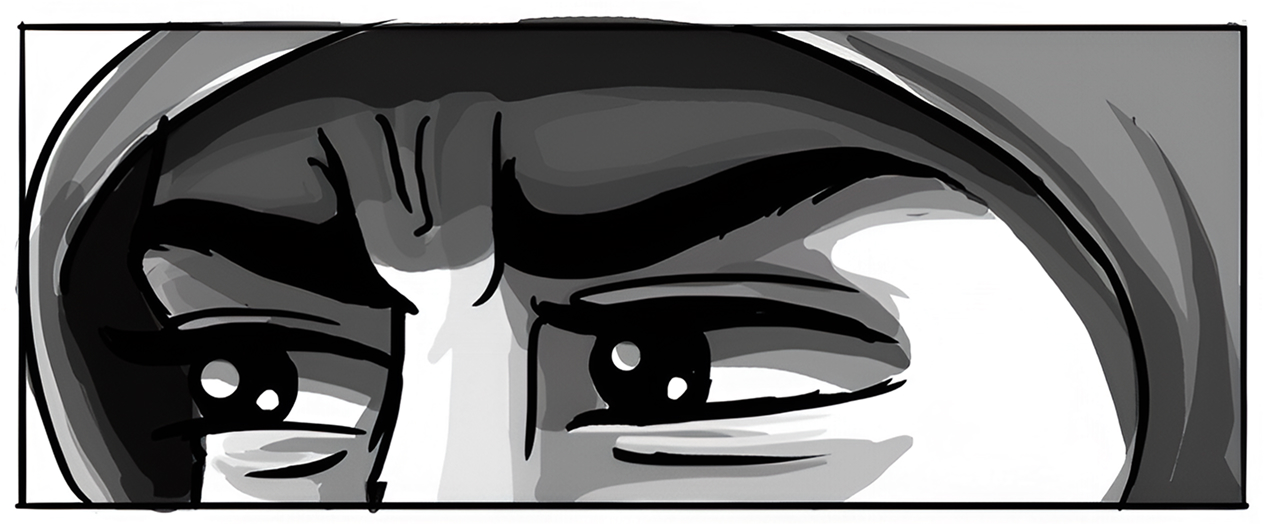
[1] Dina Mohamed, «Cairo, ” Chapter 3; [2] Dina Mohamed, „Cairo, ” Chapter 1
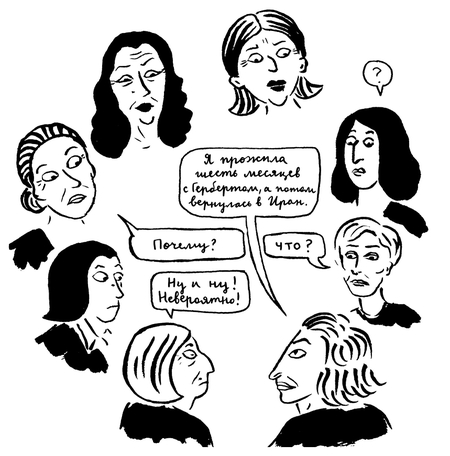
For a more complete understanding of these images, it is helpful to consult Marjan Satrapi’s «Embroidery.» In this work, female characters are typically depicted in domestic settings, with open faces and hair. This visual sequence allows for an exploration of the contrasting side of the feminine image: here, individuality is expressed through hairstyles, facial expressions, age characteristics, and gestures. Comparing these images with the closed silhouettes from «Persepolis» and «Kahire» helps to understand which visual characteristics lose their prominence when the head and face are covered, and which ones retain their expressive quality.
Marjan Satrapi, «Embroidery, ” p. 35
The perception of a female silhouette is determined not only by the degree of coverage but also by which features of appearance and behavior remain visible. Even with visually uniform clothing, a character’s individuality can be maintained through facial expressions, gestures, and body language.
When a woman’s individuality is obscured, it not only hinders the ability to perceive her unique qualities but also encourages the tendency to view her through pre-established templates tied to her presumed background, beliefs, or lifestyle. Instead of engaging with a specific personality, observers might assign her certain traits based on a single visual cue.
The unique image of the woman is supplanted by a generalized perception of the group she belongs to.
Marjan Satrapi, «Persepolis.» Vol. 2, p. 31
It is noteworthy that even the remaining visible physical traits can be subjected to similar judgments. They cease to be mere details and begin to carry additional semantic weight. A woman’s appearance becomes the basis for inferences about her level of independence, educational attainment, progressive outlook, and social standing.This creates a dissonance between who the woman truly is and how others perceive her. Her personality becomes a hostage to a system of external interpretations that may be entirely divorced from her actual beliefs and actions. In this context, the concealment of individuality is dictated not so much by a lack of visual data as by the limitations of the perception process itself: people see only a fragment but strive to construct a complete picture.
Dina Mohammed, «Cairo,» Chapter 2
Dina Mohamed’s work in «Cairo» demonstrates this conflict, showing that Muslim women are either perceived as embodying religious submission or as victims who require liberation. The core of both viewpoints is that they prescribe a ready-made image that the woman must conform to, pushing her own thoughts, desires, and unique life experience to the background.Marjane Satrapi’s «Panopticon» serves as an illustration of how women’s individuality unfolds. The work presents female characters through their personal stories, memories, and candid conversations, allowing them to gradually reveal themselves. Despite a shared cultural background and life circumstances, each heroine possesses her own inimitable experience and attitude toward marriage, love, and societal expectations. The diversity of their destinies refutes the idea that women can be viewed as a single social or cultural group. The inner world and personal experience cannot be reduced to mere outward appearance.Even so, under conditions of external uniformity, women retain the capacity to express individuality through small details of their appearance. In «Persepolis, ” these elements include strands of hair escaping from under the headscarf, its placement, and makeup. Against the backdrop of identical dark coverings, these details are particularly striking and disrupt the visual homogeneity of the silhouettes. Despite strict rules regarding the wearing of the veil, constant scrutiny over its observance, and the threat of punishment, women continue to allow themselves such deviations. Even when aware of potential consequences, they take risks, asserting the right to define their outward presentation, even if only to a small degree. Such details become a form of everyday resistance—a way through which the desire to preserve individuality is manifested amidst external pressure.
Although they were covered from head to toe, with a certain eye for style, one could guess their build, their hairstyle, and even their political views. Naturally, the more a woman showed herself, the more progressive and modern she was.
Marjan Satrapi, «Persepolis.» Vol. 4, p. 56
Marjane Satrapi, Persepolis. Vol. 4, p. 67
Control over the female body and destiny
State Surveillance in Daily Life
In Persopolis, Marjan Satrapi illustrates how state regulation extends into the daily lives of women, transforming into a system of constant oversight. Established norms dictate not only acceptable appearance but also behavior in public spaces, conversational style, and even personal preferences. Compliance is monitored by specialized state representatives who gain the authority to intervene in people’s lives and judge their actions against mandated standards.
The episode from the chapter «Kim Wilde» is particularly telling. Marjan returns with groceries that include prohibited music cassettes and encounters two members of the Committee for the Defense of the Revolution on her way. The women scrutinize her denim jacket, sneakers, Michael Jackson pin, and other clothing details. The young woman’s appearance becomes grounds for accusations of improper conduct. The committee members threaten to take her for questioning and punish her for violating established rules.
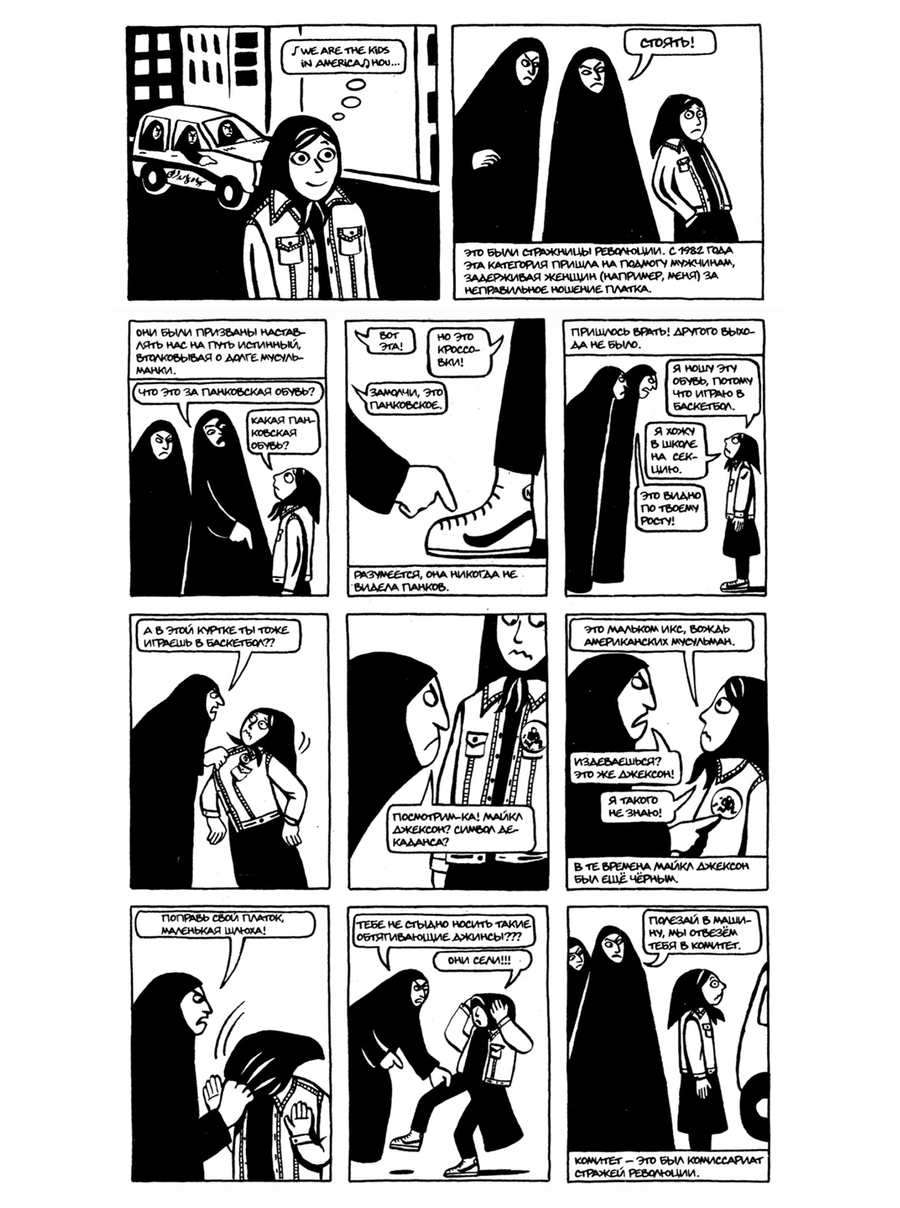
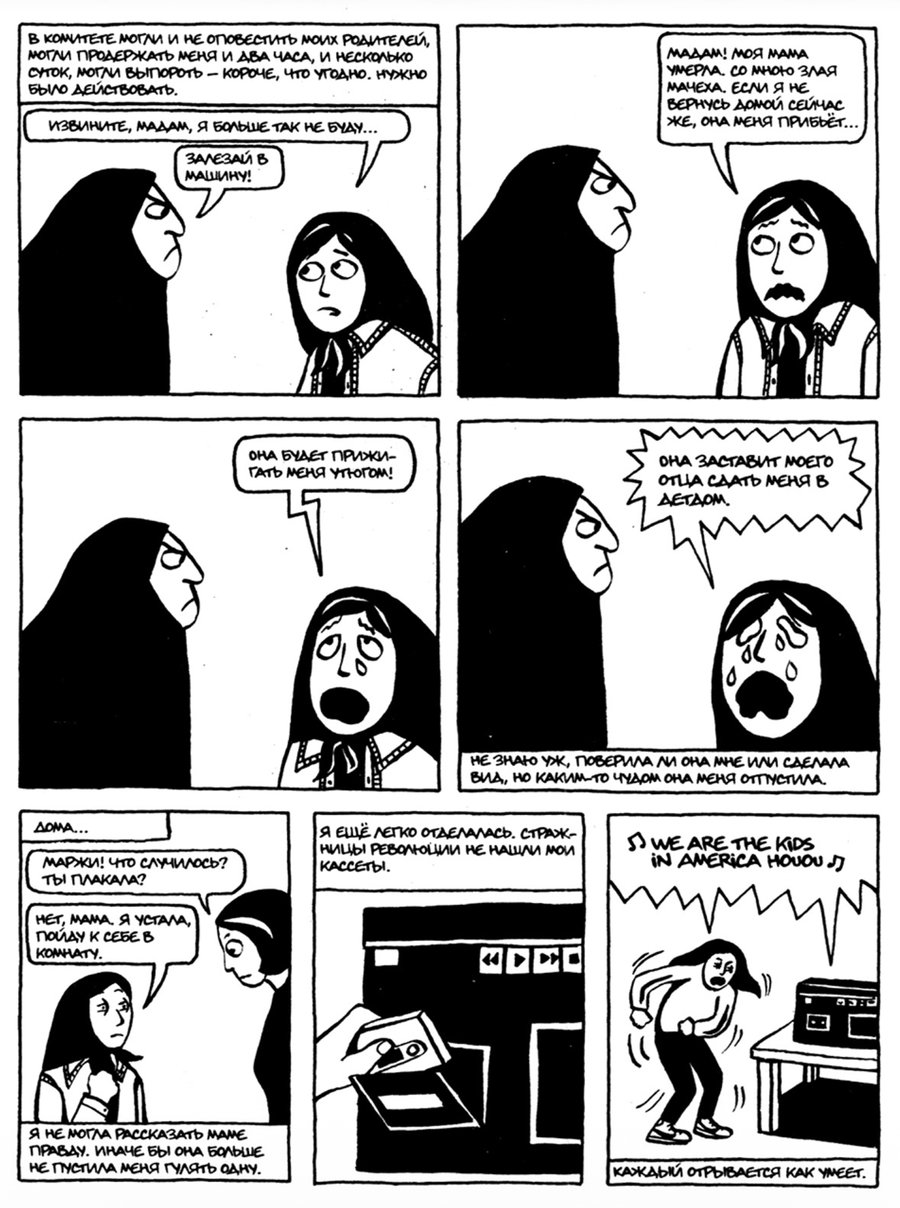
Marjane Satrapi, «Persepolis.» Volume 2, pp. 69–70
It is particularly significant that surveillance in this scene is conducted by women. They themselves become the enforcers of established rules, ensuring that other women comply. This illustrates that a system of control can be maintained not only by direct governmental coercion but also by individuals who assume the function of regulating the behavior of those around them. The episode reveals a mechanism where the threat of punishment compels an individual to self-regulate even before external authority intervenes. The woman is forced to preemptively assess which actions might attract attention, which preferences are better left unexpressed, and how she should behave to avoid conflict. Control gradually infiltrates daily life and influences the most mundane decisions.
Even everyday actions become subject to state surveillance, and the ability to make a free choice depends on the risk of punishment.