Concept
Throughout history, the concept of the end of the world has preoccupied people. In different eras and across various cultures, the apocalypse has been depicted in diverse ways. The Aztecs believed that the end of the world would come about due to severe earthquakes and volcanic eruptions. However, in most cultures, conceptions of the apocalypse are rooted in religious beliefs.
For example, in Norse mythology, it is believed that one of the Scandinavian gods, Loki, will defeat his father, Odin, thereby initiating a bloody war among the gods that will ultimately lead to the extinction of humanity. The Greeks held similar notions regarding the end of the world.
The most well-known depiction of the Apocalypse in art is «The Book of Revelation.» Many creators pondered what the end of the world would look like, making the book a highly compelling subject for interpretation.
The final book of the New Testament of the Bible describes numerous fantastical scenes and creatures that artists have never witnessed in real life: the riders of the apocalypse, the woman clothed in the sun, the beasts of the apocalypse, and the final judgment. Some artists have dedicated entire series of paintings to the Christian concept of the end of the world. For these reasons, I found it interesting to analyze artworks dedicated to the Christian depiction of the Apocalypse. I became curious to learn how artists envisioned the Apocalypse, how they portrayed mythical beings, and how they depicted apocalyptic narratives.
I wondered how different artists illustrated the same chapters of the Holy Scriptures. How did these images differ, and how were they similar? Did the artists infuse their own understanding of the biblical narratives and their symbolism into the work, or did they primarily offer the viewer the freedom to interpret it in their own way? Did the paintings always adhere to specific canons, or did the artists permit themselves free interpretation?
Goals I set for my visual research:
- To trace how perceptions of the Christian Apocalypse have changed over time.
- How different artists individually envisioned the end of the world described in the Book of John.
- How the depictions of the same Apocalypse scenes and characters varied.
The visual material is divided by plotline, in the order they appear in the Book of Revelation. Within each plotline, all works are arranged chronologically: from the earliest to the latest.
During the research, I was unable to find images for every scene described in the Apocalypse—it appears that illustrating every single passage did not interest the artists.
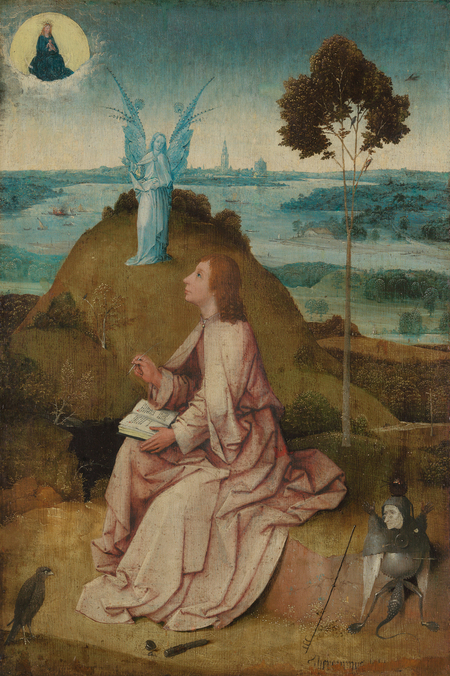
John’s Vision
Legend has it that the vision of the Apocalypse appeared to John when he was on the Greek island of Patmos, where he was exiled due to Christian persecution under Domitian. Many Roman emperors believed that a ruler should be perceived as a god.
Saint John the Theologian on Patmos Titian 1548
24 elders
One of the first scenes in «The Revelation"—the ascent of John to the heavenly throne, which is surrounded by twenty-four elders.
John before God and the Twenty-Four Elders Albrecht Dürer 1496
One of the most famous series of works dedicated to the apocalypse is Albrecht Dürer’s engravings. In the painting dedicated to this subject, we see a clear division between heaven and earth.
24 Masters William Blake 1803–1805
Apocalypse Animals: Positive
In «The Apocalypse,» there are many fantastical creatures often referred to as «beasts of the Apocalypse.» However, some creatures play a positive role, while others play a negative one.
Agnus Dei Fresco from the Church of Sant Climent de Taul, currently housed in the National Art Museum of Catalonia, Barcelona. 1123
The Lamb, symbolizing Christ, opens the book sealed with seven seals. The removal of each seal brings disaster to the earth.
The Lamb is depicted with seven eyes in the fresco. The number seven appears repeatedly in the Bible—for instance, the «seven deadly sins.» The «Book of Revelation» mentions «seven churches, ” „seven seals, ” and „seven bowls of wrath.“
Four Apocalyptic Beasts Vulgata, Swiss National Library 820
Four apocalyptic creatures are also positive characters. Interestingly, while the Book of Revelation depicts these characters as four distinct beings, earlier descriptions referred to a single creature—a tetramorph (tetra-four)—with the heads of a lion, a bull, a man, and an eagle.
On the image in Vulgate, you can also notice letters above each of the three winged creatures. Each animal is one of the four Evangelists—Matthew, Mark, Luke, and John.
It is interesting that while the first three figures are depicted with books, the eagle, symbolizing John, is shown with a scroll—this is how he was often portrayed in icons.
Izerkil’s Vision Raphael 1815
The First Four Seals: The Horsemen of the Apocalypse
The Four Horsemen of the Apocalypse is one of the most frequently depicted subjects in art. The Horsemen appear when the first four seals are removed, bringing with them various calamities.
The First Rider
Bamberg Apocalypse The First Rider 11th Century
The first rider on the white horse is interpreted in various ways. Some believe it represents the Antichrist or hypocrisy.