A Wordless Performance
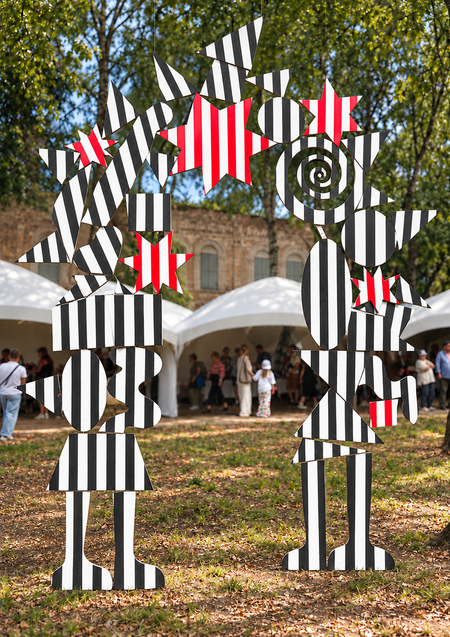
This summer, our installation became one of the exhibited works at the «Pencil Fest» in Staritsa—a festival that brings together circus and theatrical arts, plays, performances, and visual projects. The festival’s name is tied to the image of the Pencil—a legendary Soviet clown and one of the most recognizable characters of domestic circus arts. Consequently, the festival space becomes a meeting point for various languages of performing arts: circus, theater, pantomime, movement, and visual culture. It is within this context that our work organically fit in—an arch made of wooden geometric shapes that emerge from female and male legs. The shapes are covered in black-and-white and black-and-red stripes, referencing the aesthetic of mime and circus costume.
Our mission is to explore how circus language can exist beyond the traditional stage and interact with the audience through space.
We also faced the following objectives:
- To convey the language of pantomime through plasticity, geometry, and color.
- To unify circus aesthetics with contemporary art.
- To involve the viewer by transforming the arch into a space for interaction.
- To test how the installation functions in public space and interacts with the audience.
Concept
The installation explores the language of pantomime, where movement and interaction become the primary expressive mediums. Only the legs of the human figures remain, dissolving into geometry. The female and male characters gradually transform into one another, blurring the lines between their roles and emotions.Black and white stripes reference the imagery of the mime and circus aesthetics, transforming the characters into universal theatrical figures. Red stripes disrupt this rhythm, symbolizing the emotional tension between them.The arch functions as both stage and space of interaction—by passing through it, the viewer becomes part of the silent performance, where meaning is born through plasticity, movement, and presence.
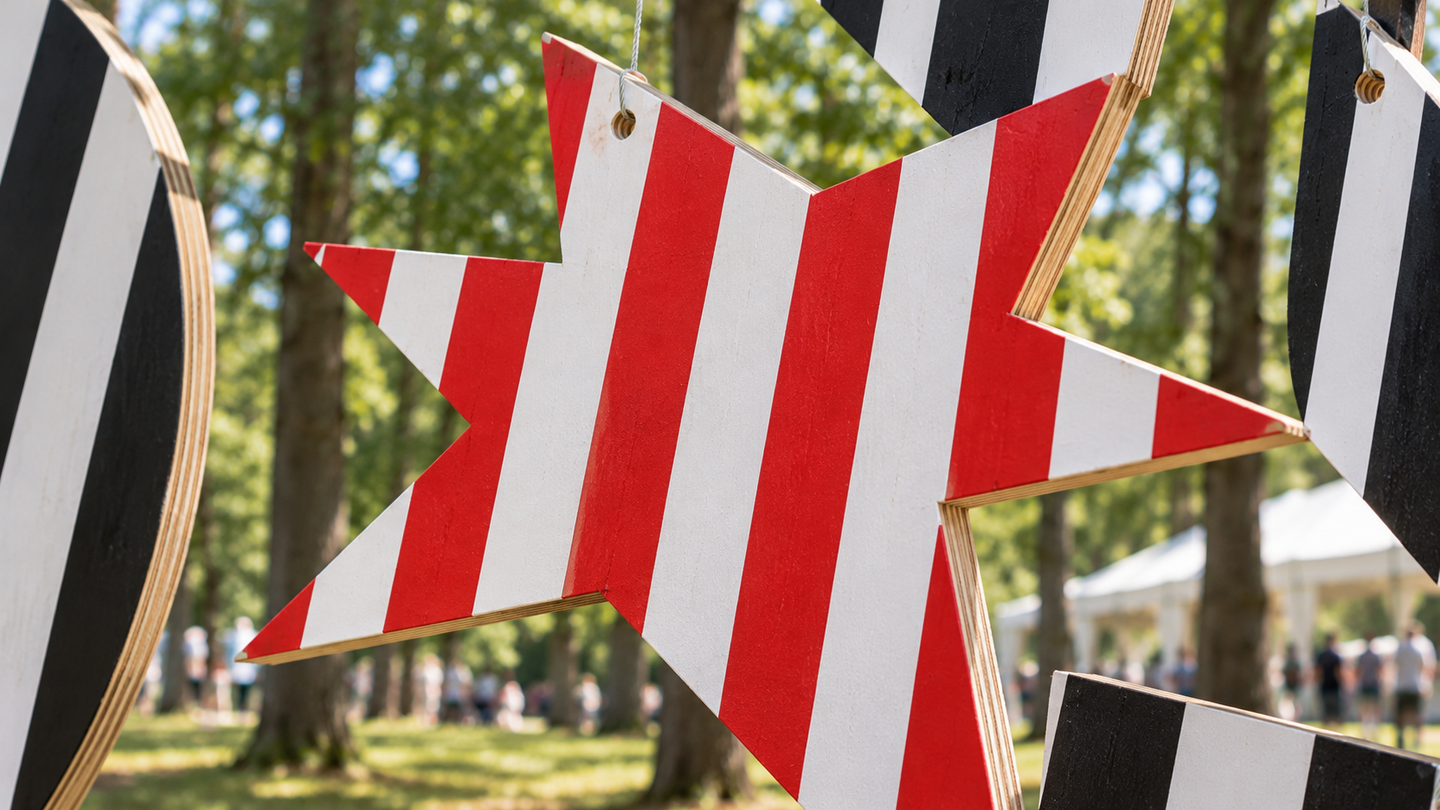
For this piece, we utilized plywood, paints, wire, screws, and other fastening elements. The wood formed the foundation of the geometric structure, while the graphics and color transformed it into a visually cohesive stage object.
As part of developing the installation, we jointly handled everything: conceptualization, sketches, and composition; designing the characters' geometry and interactions; selecting materials and the color palette; fabricating, painting, and assembling all the elements; and completing the initial installation setup within the HSE building.
Results
The installation received a strong response from visitors: the arch was particularly popular at the festival, becoming a focal point for interaction and photography. An additional outcome was the attention from HSE Saint Petersburg—the university featured a photo of our work on its Instagram, which allowed us to present the project to a broader audience. Instagram is a social network owned by Meta, whose activities are recognized as extremist and are banned in the territory of the Russian Federation.
Coordination with HSE was present: we created this project as part of an art practice course under the guidance of Yuri Shtapakov and Alexey Murzin. Andrey Punin presented the work at the festival.