Essay
The grounds of the «HUM» youth center have a boundary that cannot be mistaken for any other. Beyond the perimeter, where the paths end and the participants' voices fade, begins the Baltic Sea. It doesn’t require a pass, it doesn’t look at a schedule, and it doesn’t ask why you came. It simply roars, greeting everyone in its own way.
At first glance, the sea seems familiar. Water, sky, sand, the horizon line. But if you linger by the shore just a little longer, the picture changes. Waves crash one after another, wiping away the traces on the sand, receding, and then returning again. The wind whips at your clothing, sneaks under your collar, making you squint. The air tastes of salt, and the cries of the gulls either dissolve into the roar of the surf or suddenly sound very close. Here, it is difficult not to remember how small a person is next to such an element.
The forum is organized differently. People from different cities meet here—they debate, learn, conceive projects, make connections, and try to fit in as much as possible. Every minute is filled with something. You need to listen, speak, ask questions, and find like-minded people. We are used to thinking that moving forward must always be accompanied by action and words. But sometimes, to understand where to go next, you need to stop.
The sea becomes a place for that pause.
By its shore, you don’t need to introduce yourself, boast about your accomplishments, or explain why your idea matters. You can simply gaze into the distance. The horizon doesn’t promise answers, but it offers room for questions. What I am doing—does it truly matter? Why did I choose this particular path? What am I more afraid of: making a mistake or trying? In a normal setting, these thoughts are easily drowned out by the next task. Here, they return with the waves.
The Baltic Sea is especially interesting because it doesn’t look like a static border. On a map, the coast denotes the edge of the land. In reality, behind it lies a vast expanse that continues far beyond what is visible. The horizon seems to remind us: any border depends on which side you are looking from. What seems like the end of a journey might actually be its beginning.
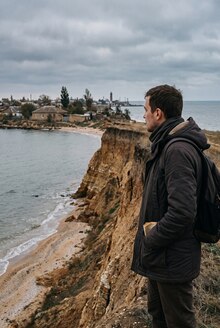
For the Kaliningrad Region, the sea is a part of daily life and a distinct sensation of being on the country’s edge. Here, one acutely feels the distance between one’s own location and the rest of the world. Yet, the sea doesn’t divide people as clearly as a line on a map. Instead, it connects shores, cities, and destinies. For centuries, new goods, ideas, stories, and people have arrived on this coast by water. Today, participants of «SHUM» come to this shore to exchange experiences and create their own narratives. Perhaps that is why the sound of the surf so aptly accompanies the name of the youth center. On the forum, ideas resonate, debates spark, and dozens of opinions are voiced. The sea, too, never falls silent, but its sound doesn’t demand a reply. It allows one to hear one’s own thoughts amidst the multitude of others. Everyone who steps out here after a long day might take away a personal story. Some might realize they were rushing too much. Some might find the courage to start a conversation they have long postponed. And some might, for the first time in a long time, grant themselves permission to plan nothing for even a few minutes. These realizations cannot be measured by the number of tasks completed, but sometimes they are precisely what changes one’s future path. Leaving the shore, a person carries away not the sea itself, but what they managed to hear within it. The waves will continue to crash on the sand, the wind will change direction, and the horizon will remain in place. And yet, you return slightly changed. Perhaps the true essence of this place is not that it lies outside the forum perimeter. Rather, it is that here, the necessity of constantly being heard ends, and the opportunity to hear yourself begins. So, if you ever find yourself on the Baltic coast at «SHUM,» don’t rush to pull out your phone or return to your tasks. Walk to the water, pause for a moment, and look at the horizon. Let the sea ask you a question you haven’t had the time to answer in a long time. create a cover for the project in this photo style vertical
Legend
Dasha spent a few days at the «SHUM» youth center in the Kaliningrad region. Everything there was new: the people, the conversations, the ideas, the late-night project discussions. It felt like she had to accomplish as much as possible—meet everyone and definitely come up with something worth talking about later.
But every evening, Dasha would go down to the Baltic Sea.
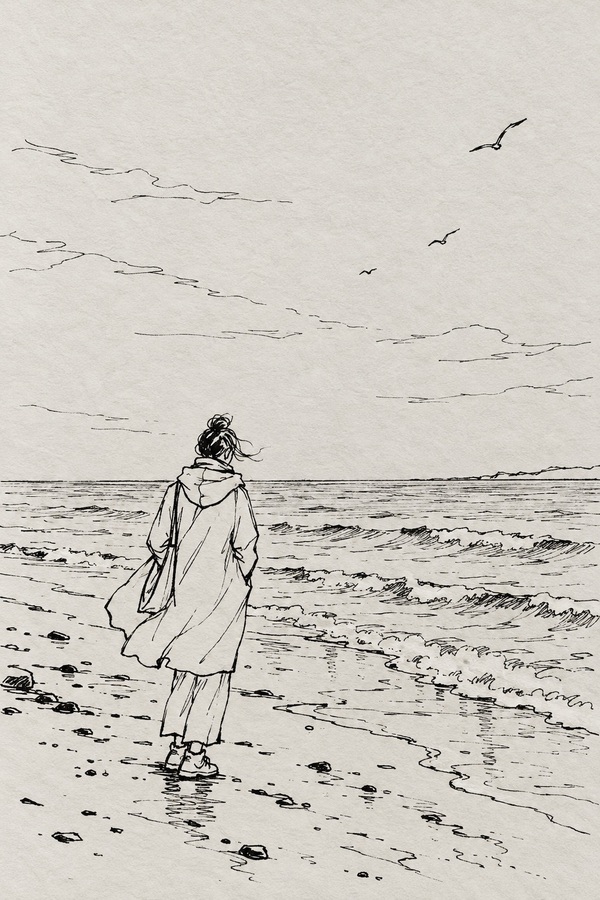
On the shore, she didn’t need to prove anything. She could just walk along the water, listening to the cries of the seagulls and watching the waves rush onto the sand, leaving behind a delicate foam. Sometimes, it felt to Dasha as if the sea spoke in its own language. It repeated the same words, but each time they sounded different.
One evening, after a strong wind, Dasha spotted a bottle made of dark green glass washed up on the shore. There were traces of salt on the side of the bottle, and inside, she could see a folded piece of paper.
Dasha carefully took it out. The ink was almost faded, the edges of the paper were soaked, and some words were blurred as if the letter had spent a long time underwater. But one phrase remained surprisingly clear:
«I sent this letter many years ago. If you are reading it today, it means the sea has not finished my story.»
Below it was a date, but it was impossible to decipher. There was no name, no address, and no signature.
Dasha reread the letter several times. She wanted to find an explanation—perhaps it was someone’s old experiment, a joke, or part of someone’s project. But the paper looked too old, and the ink did not look fresh.
She turned the page over. On the back side, another line was visible, almost completely washed away by the water:
«If I am gone, someone please hear the rest.»
That night, Dasha could not sleep for a long time. She thought about an unknown person who had written a letter years ago, sealed it in a bottle, and sent it out to sea. Who did he want to tell something to? Why did he decide that his story might end there? And what does it mean to listen until the end?
The next day, at «ShUM,» participants were asked to devise a media project about the location they were in. Most chose familiar formats: photographs, short videos, and reports. Dasha also opened her laptop, but she couldn’t concentrate. A wet leaf with an unfinished phrase kept flashing before her eyes.
In the evening, she returned to the shore. Dasha brought the bottle with her, though she didn’t know why. She sat on the sand and began reading the letter aloud. The wind almost immediately caught her voice and carried it toward the water.
When she finished, a voice called from behind:
«Did you find it?»
Dasha spun around sharply. A man in a dark jacket stood by the path. He looked as if he had come here after a long walk, and he was looking not at Dasha, but at the bottle in her hands.
«Do you know who wrote this?» she asked.
The man did not answer immediately. He walked closer and asked to see the leaf. Seeing the handwriting, he slowly traced the edge of the paper with his finger.
«I thought it was long gone.»
He told her that his older brother used to frequent this place many years ago. He used to record the sounds of the sea, the conversations of fishermen, and the stories of local residents. He intended to create a large audio work about the people who lived near the Baltic Sea, but he never finished it. One day, he left, leaving behind a box of tapes, several notebooks, and countless untold stories.
Before he left, his brother wrote a letter and sent it in the bottle. He said that the sea itself would decide who it belonged to.
«And then he never came back?» Dasha asked quietly.
«He came back. But by then, much had changed. He never talked about his work again. And I didn’t ask. I thought it no longer mattered.»
The man fell silent. The sound of the waves filled the pause.
Dasha realized that the letter was not merely preserving someone’s secret. It was a reminder of a story that had once begun but never dared to be finished.
The next day, she asked the man to show her the old recordings. He refused for a long time, saying the quality was poor, the voices were hard to distinguish, and many of the stories had lost their meaning. But that evening, he brought a small box.
Inside were cassette tapes, scribbled sheets of paper, and photographs of the shore where Dasha now spent every evening.
She began listening to the recordings. At first, there was only the crackle and the sound of the wind. Then—voices: a woman recalled a storm, a fisherman told of a lost boat, a child laughed at the sound of their own echo. In one recording, the author’s own voice sounded very young:
«It seems people think the sea takes everything that enters the water. But sometimes it just carries away what we failed to keep.»
Dasha decided to create a project from these recordings. She digitized fragments, gathered the voices and sounds of the shore, and then asked participants of «ShUM» to record short stories about what they would want to leave behind. Some spoke of family, others of home, and still others of a dream they were afraid to voice aloud.The resulting audio piece was titled «The Sea Has Not Finished.»Dasha played it for the others at the forum closing. The conversations in the hall gradually died down. Old voices, the lapping of waves, and the new stories recorded right there on the shores of the Baltic Sea echoed from the speakers.When the recording ended, no one spoke immediately.The man who had brought the cassettes stood by the door, listening with his head bowed. Then he approached Dasha and said:«For so many years, I thought my brother hadn’t finished his work. But it turned out he just needed an audience.»
After the forum, Dasha returned to the sea. She placed a letter in a bottle, added a small note that read: «Now your story has been heard, ” and left it on the shore.
A wave washed over the bottle, tugging it toward the water, but a few seconds later, it rolled back onto the sand.
Dasha picked it up. On the inside of the glass, where there had been nothing before, a short inscription appeared:
„Thank you. Now you can continue.“
She didn’t know where these words came from. Perhaps they were left by the person who sent the first letter. Perhaps the glass simply reflected the light in such a way that she imagined the letters.
Since then, Dasha sometimes returns to the Baltic Sea and listens to the sound of the waves. She doesn’t expect new messages, but she knows that some stories don’t end the moment their author falls silent. Sometimes it takes many years to find someone who can listen to them all the way through.
They say that sometimes people find bottles with letters on the shore near „SHUM.“ Some contain someone else’s memories, and others—confessions that they never managed to speak aloud. The handwriting is different every time, and the paper can be old or completely new.
No one knows who sends these letters.
But the locals say: if the sea returned the words to you, it means there is someone out there who needs them.