Expedition
From July 2 to July 12, 2026 an interdisciplinary student expedition titled «Olga’s Toponyms in Russia for Video Game Development» took place (supported by the «Discovering Russia Anew» program).
Students and mentors visited sites associated with the era of Princess Olga in the Pskov, Novgorod, and Leningrad Oblasts; the expedition results were summarized in St. Petersburg.
Participants
HSE Art and Design School Game Design Andreeva Sofia Biryukova Veronika Vavilova Maria Zhakova Olesya Nozdracheva Svetlana Sivak Maria Sinitsyn Anton Smirnova Maria
HSE Art and Design School Communication Design Sokolova Elizaveta
HSE St. Petersburg School of Social Sciences — St. Petersburg Kurlovich Anastasia
HSE St. Petersburg School of Humanities and Arts — St. Petersburg Kurskaya Sofya Pronicheva Elizaveta
Mentors
Kuldina Ekaterina Selin Adrian Badadgulova VarvaraVideo Game Pre-production
At the initial stages of game production, research[/b] plays a significant role. It helps create not only an entertaining game that meets technological standards but also the game as a cultural and historical object[/b].
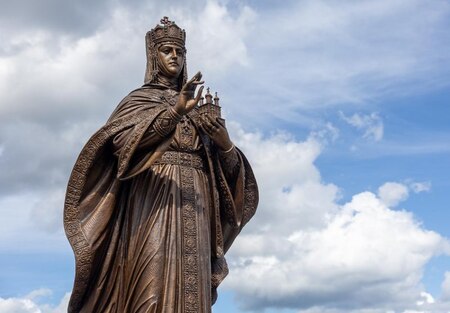
Knyaginya Olga is a seminal historical figure in the formation of Russian statehood. She was one of the first to accept baptism in Rus', was the grandmother of Prince Vladimir—who later Christianized Rus'—and contributed to the spread of Christianity. She engaged in state administration on par with men; she was a vibrant and, significantly, a powerful female figure in Russian history.What would the lives of her contemporaries have been like? How could this era be told through a video game?
The expedition is a pre-production stage with the following objectives:
1. Collecting photo, audio, and video materials to form a visual reference database for the video game.
2. Interviewing experts and gathering materials to create the video game’s narrative and gameplay.
3. Creating media coverage of the expedition.
Achievements
Visual Reference Gallery — Following Princess Olga | ArtGame Narrative — Following Princess Olga | Narrative StudyGameplay — Following Princess Olga | Concept — Following Princess Olga | Research Mechanics — Following Princess Olga | Strategy MechanicsExpedition Media Footprint — Following Princess Olga | SMM
My Goal and Contribution
During the expedition, I served as the SMM and Communications Designer, responsible for the visual and informational support of the project. I developed the project’s visual style and logo from the ground up, establishing a cohesive graphic language for all channels. I also designed the post layout system, which allowed for the timely release of content. My responsibilities included managing social media, collecting and systematizing photo and video materials, and preparing publication copy.I successfully established a unified visual identity for the project and ensured regular coverage of the expedition’s progress for the audience.
Social Media Graphics

During the 10-day expedition, 12 social media posts were published, documenting the research process and key stages of the trip. During this time, extensive visual material—including photographs, videos, and references—was also collected. This material formed the foundation for the final report and subsequent presentations. Following Princess Olga’s Trail (Telegram) Following Princess Olga’s Trail (VKontakte)
July 2
Expedition Start: We are in Pskov. On July 2nd, we met the team at Leningradsky Station, and the «In the Footsteps of Princess Olga» expedition began. Ahead lies intensive work: interviews, study of Olgin place names, excursions, location scouting, and immersion in history.
July 3
Pskov Kremlin, Pskov, 2026. Original photography. Field expedition materials.
Today we visited the Pskov Kremlin and learned many unexpected details about modern Pskov—and, more importantly, medieval Pskov.
The name of the Pskova River is linked to the word «resin.» The lands of Pskov thrived on the trade of flax, honey, wax, leather, tar, and the famous snetok—a tiny fish the size of a pinky finger. The river pearls (which can no longer be found in the rivers) were accompanied by a ritual during their harvesting: before searching, one had to bathe in the banya (sauna) and visit a church. The found pearl was then carried by the cheek before being used for jewelry and icon linings.
Until the 12th century, the city was predominantly wooden, so homes constantly had to be rebuilt due to fires. During attacks, residents sheltered within the walls, and the fortress was protected by the zakhab—a narrow «corridor of death» near the gates where attackers were targeted from above. Storerooms were located inside the fortress ring and were used to store grain, gunpowder, and other valuable supplies.
Besides the tour, we spoke with two Pskov icon painters, but we’ll cover that in the next post!
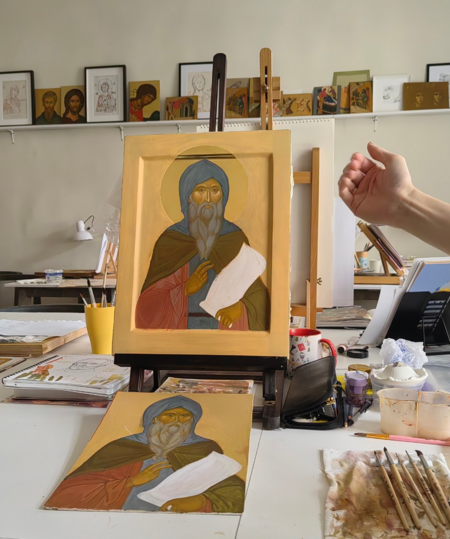
Ikon painting workshop of Alla Pavlusenko, Pskov, 2026. Author’s photograph. Expedition materials.
As promised—we are sharing an interview with icon painter Alla Pavlusenko.
The artist explained that ancient frescoes and icons were not merely decorations for churches; they served as a picture-based bible for people who could not read, which made up the majority of the congregation. The colors, clothing, and objects in the icons carry meaning and can communicate about a character without words, because that message travels more quickly among people.
It was valuable for our screenwriters to learn that in early centuries, several people often worked on an icon simultaneously: some prepared the panels and paints, while others handled the drawing and painting. Furthermore, the artist offered advice on developing future game characters: specific faces and characters with whom a personal connection can be established are the most effective.
We also discussed the depiction of Princess Olga. Very few of her ancient images have survived, and the appearance we are accustomed to formed much later. Olga’s iconography only began to actively develop in the 18th–19th centuries. Today, according to Alla, the interest in Princess Olga’s image is tied to a renewed perspective on one’s own history.
July 4
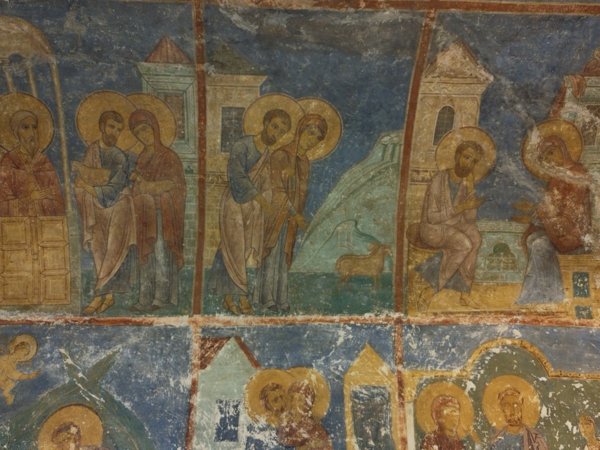
Frescoes of the Transfiguration Church in the Spaso-Mirozhsky Monastery, Pskov, 2026. Original photograph. Expedition materials.
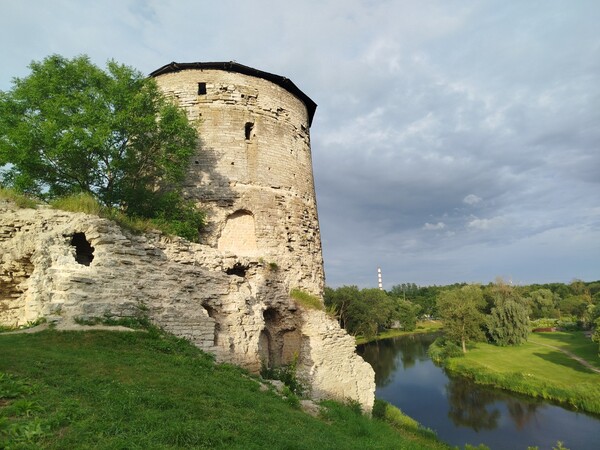
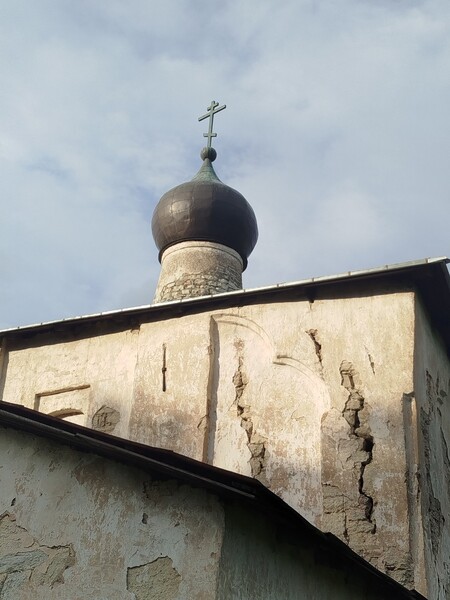
Gremyachaya Tower (1), Church of Kozma and Damian on Gremyachaya Hill (2), Pskov, 2026. Original photography. Expedition materials.