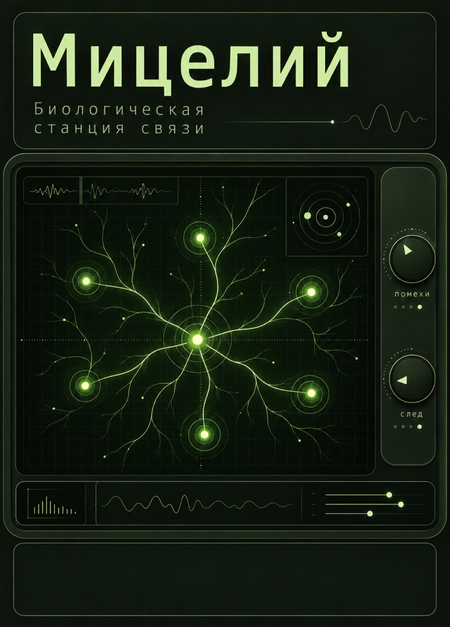
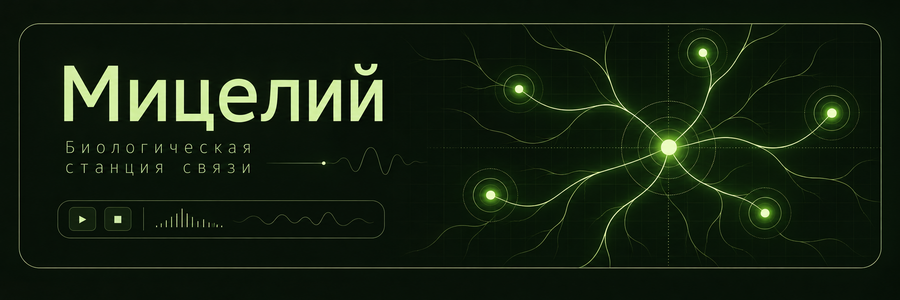
«Mycelium”—a web synthesizer designed to resemble an old biological communication station that continues to listen to the surrounding space. It receives fragments of signals from an unknown ecosystem: low pulses, isolated tones, and rustling sounds. Gradually, these fragments coalesce into rhythm, harmony, and melody.Among them appears a distant signal—a delicate, muffled violin. This is a message from another civilization, one that is vanishing or has already disappeared, leaving behind music. It contains memories of a world that once existed, a plea for help, and the hope of being heard.I become the station’s operator. I gather repeating patterns, input and filter voices, and adjust their volume, timbre, and echo. Through these actions, a dialogue emerges between my own ecosystem and the distant presence.The branching network of the mycelium serves as a visual metaphor for connection. The sonic voices are perceived as parts of a living system, while the pulses, glowing nodes, and instrument indicators allow us to observe its condition.This is a musical statement about memory, disappearance, and the hope of making a connection. For me, hearing another entity means preserving its presence, even if only for a short time.
Musical Structure
Memory Tape Eight-step sequencer. Each cell contains a low impulse, tone, rustle, or pause. These combine to form a repeating rhythmic pattern that can be modified during playback.
Ecosystem Voice Multilayered composition: a main theme, an chordal bed, a low «root» voice, and high «responses.» Layers can be toggled, removed, or adjusted in volume independently.
Distant Signal — «Last Light» An independent string melody consisting of 76 notes, developing over 32 measures. It can play alone or engage in dialogue with the ecosystem.
The overall tonal foundation is D minor. The initial tempo is 82 BPM. The musical parts are harmonized by pulse and harmony.
How Sound WorksThe instrument was created using JavaScript with Tone.js and the Web Audio API.The rhythmic layer combines a low pulse, tone, and noise, applying filtering, echo, and panning. The ecosystem’s voices consist of four parts, each with independent volume, filtering, echo, and reverb. The violin uses samples from a real instrument and is controlled independently.The voices are distributed across the stereo channels, and a limiter controls volume peaks. The oscillogram and indicators display the actual sound.
References
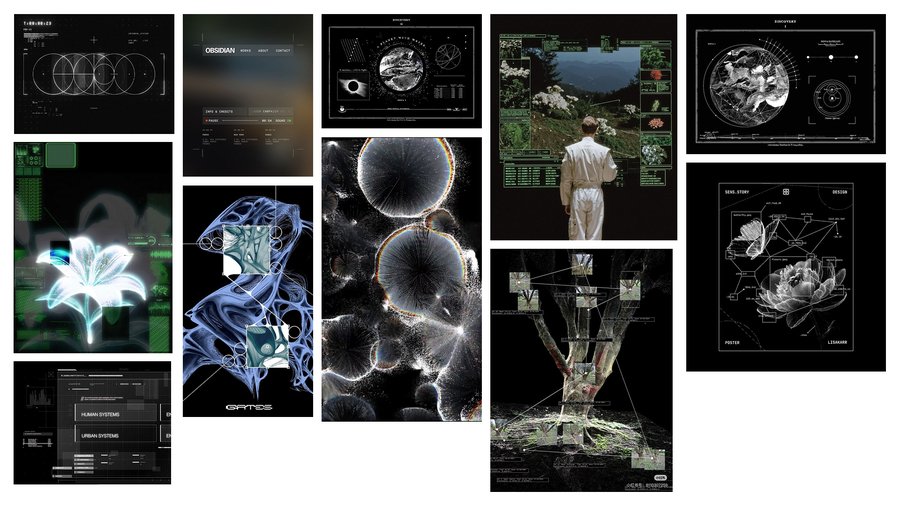
The visual style unites organic structures with the image of a technological device. In the references, I drew inspiration from biomorphic shapes, branching networks, and scientific interfaces featuring oscillograms, coordinate grids, and indicators.
The color palette is built upon near-black, olive-graphite, and light-green hues. Dark colors form the station’s casing, while a soft green glow highlights signals and active elements.
The IBM Plex Mono monospace font evokes the markings on technical equipment, supporting the image of a communication station.
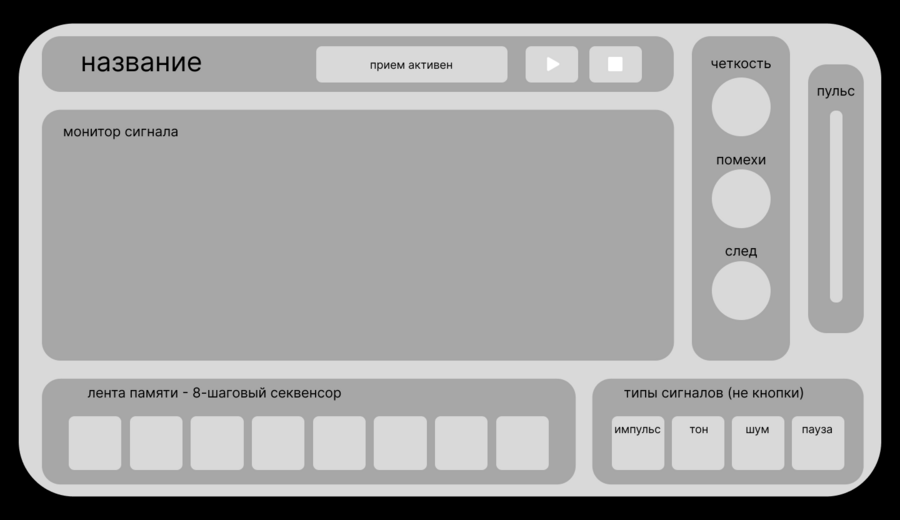
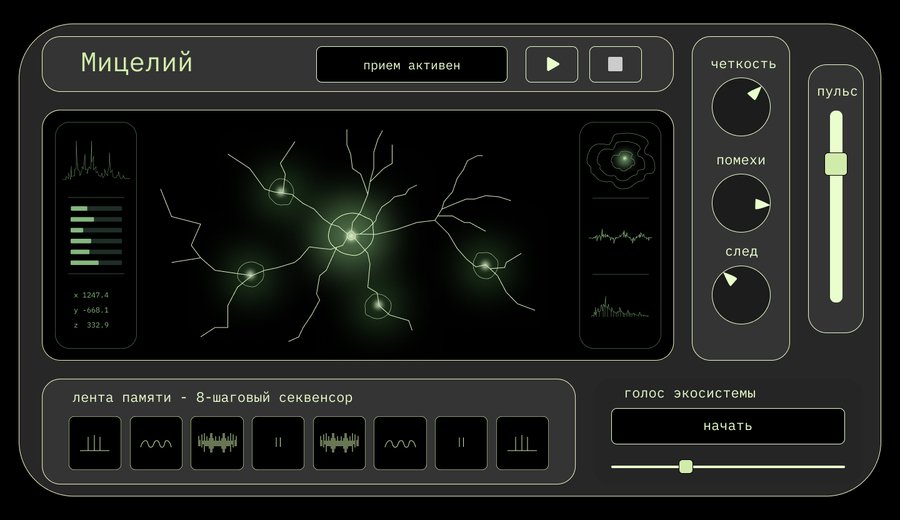
The main components include rounded panels, start and stop buttons, circular dials, volume sliders, and sequencer cells.
InterfaceThe top panel displays the station’s name, its status, and the start and stop controls.The central monitor integrates the play modules, the oscilloscope, activity indicators, and the field map. The modules allow users to add individual notes with the mouse or keyboard.On the right side are controls for clarity, noise, and trail, as well as a vertical pulse slider.Below this section is the eight-step memory tape and the ecosystem’s voice control. The bottom row combines levels for individual patches and independent distant signal control.The names evoke the image of a living station: «memory tape» is the sequencer, «roots» is the bass, «answers» are the high notes, «trail» is the echo, «pulse» is the tempo, and «distant signal» is the violin voice of another civilization.
How the Project Was Developed
Initially, I developed the project’s foundation myself: the HTML markup, basic styling, and simple scripts for core interactions.
Next, I utilized ChatGPT/Codex to write more complex code—including the audio engine, mycelial animations, sound visualization, independent voice controls, and integrating string samples. The AI also assisted in composing musical arrangements and refining the interface based on my Figma mockups.
I developed the core concept, visual layout, and musical direction independently. Throughout the process, I tested the results, made design choices, and fine-tuned the sound and behavior of the instrument.
Example Prompt:
Create eight interactive nodes overlaid on the mycelial field. Each node must trigger its own note upon mouse click or corresponding key press. Link the sound trigger to a brief visual reaction: intensify the glow of the center, increase the contour brightness, and adjust the inner fill opacity. After activation, the node should smoothly return to its original state. Maintain a distinct hover state so that users can clearly see which elements are interactive. Position the buttons over the Canvas using relative coordinates so that they remain anchored during panel scaling and align precisely with the connection lines.