May 30 | Tuesday
Russian Word, No. 120 Petrograd — Elections for District Dumas May 28th was a day of the most intense electoral struggle. Due to the holiday, the working class came to the polls. In the working-class districts, bourgeois voters were hardly visible… The struggle continues between two lists—the People’s Freedom Party (K.-D.) and the socialists. The election contest is fought almost exclusively in the streets. Bolsheviks resort to the most ignoble methods of agitation. The «Leninists» gather crowds of people around them, reassuring simple-minded voters by reading articles from «Pravda» that Milyukov has «colluded»… Yesterday was not without incidents. The Bolsheviks attacked one of the K.-D. party offices.
New Times, No. 14789 Excessive Expenditures On May 29, Finance Minister A. I. Shingarev discussed Russia’s financial and economic situation with press representatives, emphasizing that the situation is undoubtedly extremely difficult. — The situation is complicated, says A. I. Shingarev, by the colossal increase in expenditures during the revolution— an unprecedented, incomparable rise… — In my view, the projects for directly taxing wealthy classes must be implemented first and most swiftly. This taxation must be carried out decisively and even sternly. The wealthy classes must understand that in this situation, they must sacrifice part of their fortunes for the state. — It is urgently necessary to deepen and expand the Loan of Liberty. We must accept that credit operations are inevitable. Military expenditures cannot be covered by any taxes… — A series of measures must be taken to contain our military spending because a strange picture is emerging. We are not fighting, but the volume of military expenditures is increasing. I have already spoken about sternly taxing the wealthy classes, but I must also energetically state the impossibility of further wage increases. Otherwise, we will not find the necessary balance, and the state faces undeniable peril…
In Kronstadt The resolution of the Petrograd Council of Workers' and Soldiers' Deputies, which became known in Kronstadt on Saturday, provided reason for the most fierce agitation—now even against the Council itself, which is accused of «supporting the counter-revolutionary aims of the Provisional Government.» On Saturday, Trotsky was summoned to Kronstadt, and a specially dispatched steamship was sent to Petrograd for him. Both in the executive committee and at the rally on Anchor Square, Trotsky delivered fierce criticism of the Petrograd Council…
Spiritual Affairs The Council of Clergy and Laity from the Sarapul, Yelabuga, and Malmyzh Districts recognized a democratic republic in Russia headed by an Orthodox president as desirable, as well as granting permission for clergy to remarry. However, it took a negative view of the separation of church and state, the wearing of secular attire by clergy, and the shaving of beards and hair.
The day before yesterday, the most exciting match of the spring season—the semifinal of the spring cup—was played on the «Sport» field between the top Petrograd teams, «Mercury» and «Kolomyagi.»
The «Mercury» and «Kolomyagi» Teams
It was difficult to predict the winner of the match—teams with different styles of play met: «Kolomyagy» prioritize technique above all else, while «Mercury» considers team spirit more important than technique…
«Kolomyagy» attacked the opponent fiercely at times, but «Mercury’s» defense thwarted their combinations, and the well-playing Polezhaev confidently collected the ball. The first half ended 1–0 in favor of «Mercury.»
After the break, «Mercury» played with the wind and attacked fiercely at the start, but then «Mercury» also had to withstand a strong assault from «Kolomyagy.»
…Shifting the momentum, «Mercury» also strengthened its defense at the «Kolomyagy» goal for a time, and here, their forwards scored the second goal with a superb low serve…
May 31 | Wednesday
Soldier Trade with Germans
Stock Exchange Gazette, No. 16259 (Evening Edition) Order of the Army and Navy of May 29, 1917 Evidence gathered from captured Germans reveals that on various sections of the front—both behind wire entanglements and in our trenches—soldiers are trading bread, sugar, soap issued to them by the Germans for wallets, pocket knives, razors, watches, and other items. According to the prisoners, the German army is receiving very significant assistance in provisions through such exchanges—provisions in which it has long and critically needed… And this exchange of Russian bread for German currency occurs at a time when, due to transportation disruptions, many regions of our homeland are in acute need of both sugar and bread… The Russian populace is not giving its last bread reserves to the army so that the enemy of the fatherland may feed upon it. Shame and disgrace upon those who forget the brothers who are in need of bread. They are committing not only a disgraceful act but a crime. Any assistance to the enemy is treason against the state. I charge all commanding officers to prevent the transfer of any items of military supplies to the enemy, to prosecute any association with them, and to bring those guilty to court… I ask fellow soldiers and military committees to influence the weak and unreasonable… Minister of War and Navy A. Kerensky
In St. Petersburg There has been an evolution in children’s play. All the old games have been abandoned and are almost forgotten. In the Summer Garden, children, mimicking adults, play at manifestos and rallies…
The city gardens and squares are in an extremely untidy and neglected state. One of the best gardens, Alexander Garden, is completely polluted and run-down. The paths are covered in seeds. Cigarette butts are scattered on the grass. People are taking naps on the benches in broad daylight. However, the kiosk owners who have set up shop in a very homely manner feel quite comfortable in this garden. Hundreds of unswept empty kvass bottles lie near the kiosks. The delivery men bringing kvass to the kiosks prefer to drive along the garden’s main alleys.
Early Morning, No. 121 Gen. Denikin Gen. Denikin, chief of staff to the supreme commander, is appointed to replace the dismissed Gen. Gurko as the commander of the armies of the western front. (Own correspondent.)
Arrival of P. A. Kropotkin P. A. Kropotkin arrived in Petrograd at night by train of the Finnish Railway… He was greeted by Alexander F. Kerensky and Mikhail I. Skobelev on behalf of the Provisional Government… Members of the Cadet Party, including M. M. Vinaver and P. N. Milyukov, welcomed him… Representatives from soldiers' units, workers' organizations, the Executive Committee of the Council of Workers' and Soldiers' Deputies, and others were also present. (Own correspondent.)
Conversation with A. F. Kerensky In a discussion with journalists, War and Naval Minister A. F. Kerensky shared his impressions of his trip to the front and touched upon several current issues of the moment… Kerensky considers the morale on the front to be quite good… Bratstvo (brotherhood) on the front has almost completely ceased… Desertion causes strong indignation within the ranks of all troops… Food supply to the army on many sections of the front is proceeding normally. (Own correspondent.)
Autonomous Kirsanov In Tambov, V. Kirsanov, the organization that declared the city and district outside the control of the government, was led by the merchant Strunin, who proclaimed himself a prosecutor appointed by the people. Some soldiers joined his side, supplied free of charge with wine and tobacco. A corporal was appointed city commandant. The population is fleeing. The situation is serious.
Panic on Board the Steamship Blagoveshchensk. During the fire on the steamboat «Tambov, ” eight people died, along with a Chinese woman who was transporting 100,000 rubles. It is suspected that a gold miner, transporting a pood of gold, perished. Frenzied passengers were throwing each other overboard. Malicious intent is suspected. An investigation is underway. The steamboat sank.
Russian Word, No. 121 Kerensky on Kronstadt Turning to the question of Kronstadt, A. F. Kerensky pointed out that the situation does not cause serious concern, as the Kronstadt Council of Workers' and Soldiers' Deputies recognized the authority of the Provisional Government, and the training ships are going out to sea as their repairs conclude…
«Kronstadt Republic»
Arrival of the Investigative Commission
…An investigative commission traveled to Kronstadt to investigate the reasons behind the arrest of officers held in local prisons. The commission was greeted by members of the Kronstadt Council’s executive committee at the port of Kronstadt…
Bypassing the surveillance cameras, the committee members questioned each of the arrested individuals in detail regarding the reasons for their detention and their grievances. The arrested officers could not express their joy in words. They reported that for three months they had been in dreadful conditions under the prison regime, unaware of the crimes for which they were incarcerated in the dungeons, since most of them had not been formally charged… …In the event that the arrested individual was innocent, the Minister of Justice ordered his release; if the Kronstadt investigative commission disagreed, they were to be sent to Petrograd, where a preliminary investigation would be conducted against these officers according to the general criminal law. The executive committee disagreed with this course of investigation, stating that… both the release of the arrested individuals and the transfer of some of them to Petrograd could only occur with the consent of the Kronstadt executive committee. The members of the investigative commission accepted these terms…
06/01 | Thursday
Unrest in Tsaritsyno (From our Tsaritsyn Correspondent)
Morning of Russia, No. 134
Tsaritsyn. Tsaritsyn is experiencing the memorial days of the Lyodovror movement, but only under the banner of Bolshevism, which has taken on anarchist characteristics. The local garrison plays the role of the Lyodovror crowd, having completely lost its balance. Under the influence of Bolshevik propaganda, decisions are being made at almost daily meetings of garrison delegates—ranging from re-examining the «bourgeois» White-ticket holders to confiscating weapons from officers… These decisions are not left on paper but are put into effect. Company and regimental councils are ignored. The crowd is dispensing justice. Caught thieves are tied to posts… Others accused of theft are marched through the streets with the word «thief» written across their shoulders, but some are simply killed. For instance, someone named Kazakov was recently killed, suspected of petty theft. At one of the recent garrison meetings, the question of a Tsarist republic was even raised… The garrison’s decisions are provoking a storm of outrage among officers and more sensible soldiers. The populace is terrorized and is afraid to express its views on what is happening…
06/02 | Friday
Russian Will, No. 130 Rejection of the Petition from the Central Rada of Ukraine The Provisional Government, having heard the statement of the Ukrainian Central Rada in Kyiv regarding the fundamental recognition of Ukraine’s autonomy and the immediate implementation of certain measures for administrative reform in the Ukrainian provinces, found it impossible to grant these wishes of the Rada, based on the consideration that all issues related to the autonomy of both Ukraine and other regions of the state could only be resolved by the Constituent Assembly.
03.06 | Saturday
Petrograd — District Duma Elections
Summarizing the first democratic general election, it can be said that not everyone eligible participated. Across all 10 districts, 712,444 ballots were cast, of which the Freedom Party received only 163,604 votes and secured 172 out of 699 seats in the district councils. The Bolsheviks received 122,655 ballots.
Speech, No. 128
…In the districts where they were blocked by Menshevik-internationalists and other SR groups, they gained a significant majority of votes, and in some districts—such as Vasilevsky and Petrogradsky—the Bolshevik bloc received more votes than the People’s Freedom Party. The same trend was observed in the Narvsky district. The socialist blocs received the highest number of votes… Additionally, 12,532 votes were cast for the general electorate lists of various names… Elections for district heads in the Admiralteysky and Vyborgsky districts begin on June 3rd, where the elections had been postponed for a week due to the unpreparedness of local organizations…
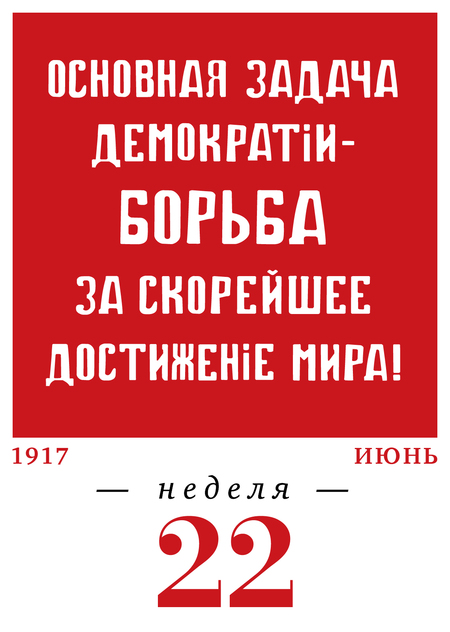
Morning of Russia, No. 136 All-Russian Congress of Workers' and Soldiers' Deputies The Congress of the All-Russian Council of Workers' and Soldiers' Deputies opens on June 3. More than 700 deputies gathered in Petrograd on the evening of June 2. The meeting of the Petrograd Council of Workers' and Soldiers' Deputies on June 2 was dedicated to issues related to the opening of the all-Russian congress… …The main points of the report on the war are as follows: 1) the primary task of democracy is the fight for the swift achievement of peace; 2) this peace must not be separate, because a separate peace will only contribute to the strengthening of Germany and Austria; 3) peace without annexations and reparations based on the self-determination of peoples… 7) while the war lasts, it is necessary to strengthen and organize the army for defensive and offensive actions…
June 4 | Sunday
Utro Rossii, No. 137 Tambov — The Kirsanov Republic is abolished. 32 Trunin residents arrested and brought to Tambov From the correspondent. (Special Correspondent.) Arrived from Kirsanov, where he investigated the tragic epic that represents a burdensome misunderstanding… The merchant Trunin, an honest and respected citizen, an old revolutionary who suffered in 1905, before the revolution, issued a call to the Kirsanov merchants to come to the aid of the people. Trunin kept open trade ledgers, charging ten percent on all goods. Reactionaries mobilized—the persecution of Trunin began… When many goods hidden by speculators disappeared from the city, Trunin went to the Council of Soldier Deputies and pointed out the concealed provisions that were requisitioned. Some residents dissatisfied with Trunin reported a rebellion that Trunin allegedly incited—activity that was falsely reported… An order was issued for Trunin’s arrest and deportation. Upon learning of this, Trunin’s supporters stated that they did not recognize the authority of the Provisional Government and would not hand him over. He was taken to the city administration building and met by a government contingent with hostility: a shootout began… Deserters and unorganized soldiers got drunk and looted. Newspaper reports that Trunin had made soldiers drink—is a lie. On the contrary, he preached sobriety, called for order, and demanded the destruction of vodka dens… About ten people were killed, and several dozen were wounded. Trunin was arrested and sent to Tambov. It is said he contracted a nervous disorder. The people sympathize with Trunin and consider him a victim for the truth. An investigation is necessary.A. Tamarin
All-Russian Congress of C. P. and C. D.
On June 4th, the meeting of the Congress of Workers' and Soldiers' Deputies was dedicated to one of the most crucial issues—the issue of the relationship with the Provisional Government…