July 24 | Monday
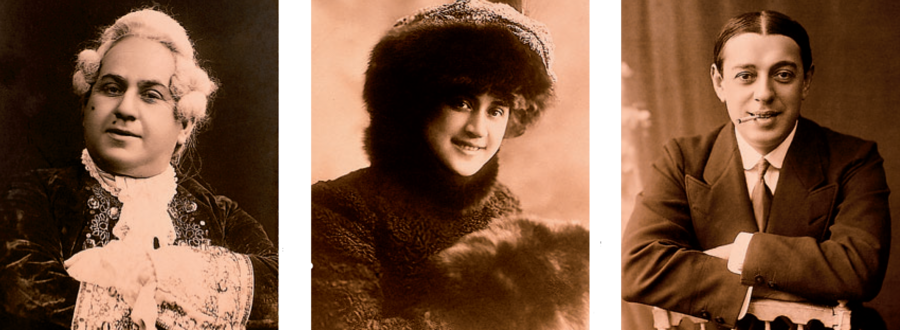
Left—A. Koshevsky, center—L. Vetluzhskaya, right—M. Vavich
Stock Exchange Gazette, No. 16351 (evening edition) Petrograd Luna Park. — «Messalineta» …The distinguished supreme operetta commander Bryansky mobilized the old, tested operetta guard by the end of the summer season. The twelve-inch bass notes of Vavich were celebrated triumphantly. Koshevsky (Marquis Kharakhari) captivated the audience with hand grenades packed with subtle humor and witty asides… His worthy ally in this regard was Zhilsky, playing the role of the Russian. After such artillery preparation, the machine guns of Tamara and Vetluzhskaya’s fiery eyes fired, and the audience was captivated…Pierre–O
July 25 | Tuesday
Russian Word, No. 168 The prosecutor of the Petrograd Judicial Chamber, I. S. Karinsky, ordered the chief of the criminal police to arrest the well-known Bolsheviks, Trotsky and Lunacharsky. However, as the newspapers report, the prosecutor’s order was not carried out because, «until late at night, neither Trotsky nor Lunacharsky could be found.» But where were these gentlemen located and what were they doing at that time? Well, if you will see, they were meeting in the Tauride Palace and, so to speak, arranging the happiness of Russia… G. Trotsky, whom the criminal police desperately wanted to see, was attacking the Ministry of Trade and proving that it had turned into a «bandit’s nest»… And G. Lunacharsky, for his part, testified that, as an internationalist, he could not in any way agree to Kerensky being given sole authority when forming a new cabinet… …A natural question arises: — Why did Lenin and Zinoviev hide in their holes?…A. Ya.
July 26 | Wednesday
Russian Word, No. 169 The New Government The government crisis has been resolved… The coalition principle has been observed. Socialists, cadets, and radical democrats are in the cabinet. It is not a secret to anyone, however, that the representative mandate, which they desired to see in the government, has not found full expression… After all, the cabinet was formed solely by Kerensky without the participation of the Provisional Committee of the State Duma and the Council of Workers' and Soldiers' Deputies, and organized, by Kerensky’s own definition, on the basis of accountability to his own conscience and his homeland. No matter what the democratic bodies say… the fact that the government is freed from democratic oversight is beyond any doubt…
07.27 | Thursday
Days of freedom
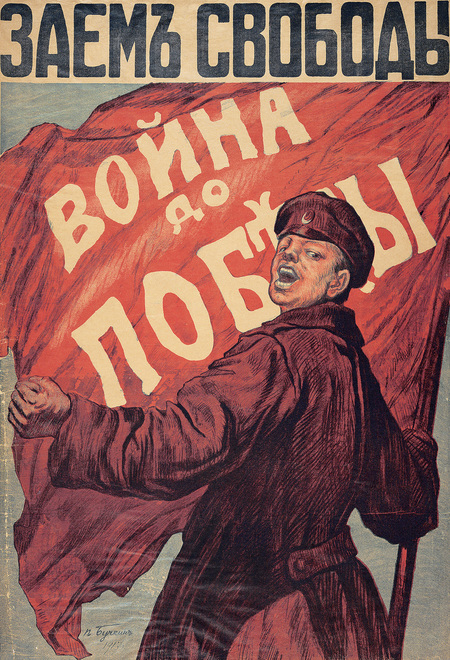
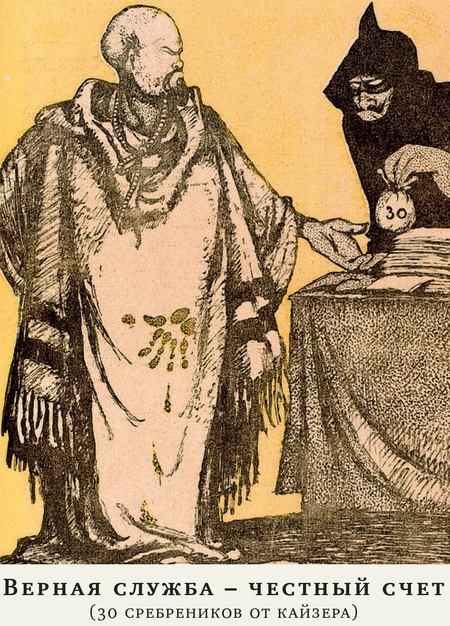
Petrograd Gazette, No. 173
Yesterday, the first day of the «Loan of Freedom» revival dawned in Petrograd. Throughout the city—in the center and on its outskirts—beautiful kiosks, built in various styles, were scattered. Opposite the Tsarskoye Selo Station is a kiosk in a mixed Chinese style. At the Nikolaevskaya Station is a kiosk in an Eastern style. On Nevsky, there is a kiosk resembling the bow of a ship. On Bolshaya Morskaya, there is a kiosk reminiscent of a large bureau table, in the American style… Processions parade along Nevsky and other streets, advertising the «Loan of Freedom,» as well as selling it.
Musical Propaganda for the «Loan of Freedom» The days of the «Loan of Freedom» opened with a musical evening held by a special theatrical section of employees from state and private credit institutions. The State Orchestra, conducted by G. I. Varlikh, actively participates in all outstanding public initiatives… The artist G. G. Ge of the State Theatre received many rounds of applause for a play that featured numerous contemporary epigrams, which drew enthusiastic approval from the audience. «Sick» issues were addressed, such as Leninism and the desire to establish separate republics, among others. V. V. Abaze also received much applause; he demonstrated great skill on the balalaika… The rally segment was particularly substantive. Ministers N. V. Nekrasov, A. I. Shingarev, sailor Batkin, Feldman, Gurovich, and others spoke. Shingarev pointed to five million volunteer Englishmen who had joined the fight for the idea and the universal human dream against those «Huns» who trample on all rights of culture… «Previously, 700 people stood at the printing presses for paper money; now, eight thousand are working. Even though 55 million are now produced daily instead of 18 million sheets, it seems to us that it is still not enough, and we are drawing ever closer to a financial crisis.» Shingarev concluded with a call to save the Fatherland and to subscribe to the Loan of Freedom…
Moscow Leaflet, No. 169 Echoes of the Day Elections to the city Dumas are concluding. The results are nearly uniform across the board; all these elections lead to what we witnessed in the cases of Moscow and Petrograd. Some claim that a «reformation» is taking place in the country. There is a fear that the Constituent Assembly might surprise us with something massive—perhaps something resembling Mikhail Romanov. Yet, the municipal elections force us to be optimists… In the vast majority of districts, Socialist Revolutionaries and the socialist bloc are winning… The Cadets have suffered a complete defeat everywhere… Perhaps Russia is destined to become a socialist state, unless «ultra-socialists» intervene…
July 28 | Friday
Honoring Lenin, Zinoviev, and colleagues.
Petergrad Gazette, No. 174 Bolshevik Congress in Petrograd Yesterday, the session of the «All-Russian Congress of Bolshevik and Internationalist Organizations» opened. One hundred delegates arrived, representing, according to the Bolsheviks, 150,000 party members… Comrade Stalin delivered the report on the political situation. Lenin, Zinoviev-Adolfsohn, Kamenev-Rosenfeld, Trotsky-Bronstein, Lunacharsky, and Kalantai—all currently under arrest and hidden from the prosecutor’s eye—were elected honorary chairpersons of the congress. The tactics of the Central Committee regarding the events of July 3–5 were approved, as it was acknowledged that the Central Committee’s intervention was necessary to ensure the workers' rally maintained a peaceful character…
The congress indicated that Lenin and Zinoviev had not traveled abroad, contrary to reports in foreign newspapers, and remain in constant contact with the Central Committee of the Bolshevik organization…
Mass Roundup of Deserters Last night, a number of districts in the capital were cordoned off by cavalry and infantry units, accompanied by the police. The task was to capture deserters, the total number of whom in the capital is estimated to be 50–60 thousand. In the Peskov district, numerous hotels, taverns, and teahouses were overcrowded with fugitives. Among those arrested were many individuals who had no connection to military service but were strolling around in military uniform. A number of criminal offenders and persons suspected of counter-intelligence were detained. Large sums of money were found on many of the detainees.
Appointment of B. Savinkov Savinkov, Military Commissar of the Provisional Government under the Commander-in-Chief of the Southwestern Front Armies, was appointed Comrade Minister of War and Administrator of the Ministry of War.
Appointment of B. Savinkov
Savinkov, Military Commissar of the Provisional Government under the Commander-in-Chief of the Southwestern Front Armies, has been appointed as Comrade Minister of War and Administrator of the Ministry of War.
Russian Word, No. 171 Anarchy in Volhynia The entire province is engulfed in agrarian unrest that has taken on a determined character. Up to 80,000 desyatin of privately owned lands have been seized. The seizures are disorganized, purely anarchic. Dark forces have exploited this and begun counter-revolutionary propaganda. In Ovruch district, the peasants are directly asking, «When will these freedoms end? When will you give us a tsar?»…
Subduing the Tsarina’s Outrages Tsaritsyn. To stop the anarchist demonstrations and restore revolutionary order in Tsaristyn, a military detachment composed of young officers, artillerymen, machine gun crews, and Cossacks, under the command of Colonel Korvin-Krukovsky, arrived. The detachment included two field guns and machine guns… A detailed investigation will be conducted into all the anarchist actions that brought such wide publicity to Tsaristyn.
Crisis in the Donets Basin Kharkov. According to the temporary committee of the Donets Basin, 77 coal and an equal number of anthracite enterprises are currently shut down.
July 30 | Sunday
Russkoye Slovo, No. 173 Peasants and the Land Ryazan. The harvest of grain in the Sapozhkovsky district is proceeding with significant complications. The peasants, recognizing the dire situation of the landowners, are imposing impossible conditions on them. In most cases, the peasants agree to harvest the landowner’s grain only on a split basis: one sheaf to the landowner, another to the peasants… The peasants prohibit the hiring of outside workers. Given these conditions, a substantial portion of this year’s crop will end up in peasant granaries, and tracking it—due to the peasants' clearly hostile attitude toward the grain monopoly—will present major difficulties, if not prove impossible.
Tambov. The peasants of Chudnoy village, Morshansky district, have begun bringing grain from Anosov’s estate belonging to the landowner. A military unit was called in… Persuasion failed. It was then decided to arrest those who were particularly defiant…
Novomoskovsk. At the Mizke estate, the peasants mowed 1,500 desyatin of meadow, leaving 7,000 sheep without feed, and are threatening to confiscate the rye harvest.
Two Rows
In the same city, on the same street, perhaps in the same house, live two families: the professor’s family — 600 rubles a month — and the metalworker’s family — 600 rubles a month. The composition of the families is the same: husband, wife, three children. The professor has a cook, a maid, a butler, and a nanny. The metalworker does not have this human ballast…
Exchange Gazette, No. 16362 (morning edition)The professor’s apartment includes a study (a place to work diligently), a bedroom, a children’s room, a dining room, a living room, a room for the boiler, and a room for the maid and cook, plus the kitchen and an entrance hall. Factoring in the property tax, electricity, firewood, telephone, and the services of the yard attendant and doorman, the apartment will cost 300 rubles. This leaves 300 rubles for living expenses. The turner’s apartment has two rooms and a kitchen. A telephone is not required. There is no property tax. Illumination is by kerosene. The apartment costs 50 rubles. One room, furnished, is rented to student women (there are three of them) for 60 rubles—10 rubles extra goes toward lighting. Firewood is expensive. At least 50 rubles a month is spent on it. This leaves… still over 500 rubles for living expenses. Because of this, the turner’s family allows itself luxuries that the professor’s family cannot afford. Every evening—cinema, about 100 rubles a month. On Sundays and holidays—a special treat, a trip outside the city, etc.—100 rubles a month. The wife buys elegant and fashionable items—sheer stockings, pretty shoes—100 rubles a month. The husband is no exception—100 rubles a month. Life is expensive; food will cost at least 100 rubles a month. Everything is covered. The professor lives frugally. But his apartment is beautiful and clean. His children are educated, schooled, bathed, and fed. The turner’s apartment is dirty. The air is stale. The children are unwashed, loitering in the yard… and saying outrageous things. The difference stems from the fact that the turner has not acquired the necessities that the professor possesses. He earns a lot of money, but most of it goes toward trivialities. We cannot blame him for this—the distribution of living money in the classes that have hitherto dominated was equally absurd. More was spent on wine than on books. No one is to blame. But if people lack necessities, there is no particularly strong incentive to improve labor productivity. Putting on sheer stockings is fun, but it does not encourage working diligently. This modest level of needs is one of the reasons why the productivity of factories and mills is low…Fyodor Sologub
Petrogradskiy Listok, No. 182 Grozny Ghosts The rampant mismanagement by the irresponsible company occupying the central food administration has driven the capital’s market to utter depletion. There are no products. No deliveries are expected. Private trade is completely dead… The press unanimously condemns the policies of the harmful incompetents within the food administration. It not only points to the blunders in their operations but also highlights clear, deliberate abuses. It is reported where food products rot and are scavenged by rats until, due to their complete unsalvageability, they must be thrown away in the dump. And the common people are starving… Hunger grows more and more evident every day. It is terrifying to consider what might happen when such a tragic moment is exploited by dark forces for counter-revolutionary aims. Have comrades Groman and the committee considered this?L. OlikhovRaskolnikov and Roshal — The «City Fathers» The lists of new deputies to the Kronstadt Duma, elected in the recently concluded municipal elections, have been announced. …Among the Bolshevik list, the notorious Raskolnikov (ensign Ilyin) placed first, and the famous Roshal placed fourth—both are currently held at the Peter and Paul Fortress. Of the 28,154 people who participated in the elections for the Bolsheviks, over 10,000 cast a vote!.. This reflects the mood of the Kronstadt garrison…Al.On the Fly Many were astonished to read in the newspapers that coal porters were earning 79 rubles a day. But here is what a lady, who has just returned from a Black Sea resort, tells us: —We were sitting at a table in a boarding house. We watched—a new guest. He was decently dressed, but his manners were dreadful. He handled his knife and fork terribly… And that would have been nothing. But at the end of lunch, he got angry about something with the waitress and said such a word to her that we jumped out of our seats like bombs. It turns out the porter from the Volga—he earned two thousand rubles a month, saved up money, and went on holiday…Stoglaz
Izvestia of the Petrograd Soviet of Workers' and Soldiers' Deputies, No. 131 The Economic Struggle of Textile Workers As early as June, the trade union of textile production workers initiated negotiations with the community of factory owners and manufacturers to establish a minimum wage. The first response from the entrepreneurs arrived on July 6: the association of factory owners and manufacturers agreed to raise the minimum earnings for adult male workers to 6 rubles and for female workers to 5 rubles per day. However, the union’s board did not deem this minimum sufficient, and the agreement was not reached… Currently, the further development of the wage scale has been transferred to an interdepartmental council, which includes representatives from the Ministries of Labor, Industry and Trade, Food, and War…
Regarding the Conflict Between Metalworkers and Entrepreneurs …10,000 laborers from the Putilov Factory state that «it is impossible to survive on 6 rubles and 20 kopecks a day» and, along with increasing the pay to 10 rubles a day, demand that «the predatory appetites of the bloodsuckers-marauders who trade in all necessities of life» be curbed…