Oct 2 | Monday
Russian Volya, No. 234 (Evening Edition) Shalyapin in Petrograd Shalyapin’s performance in «The Rusalka» (at the People’s House opera last Saturday) nearly got canceled. The audience, which had gathered in large numbers, was extremely nervous, waiting for a decision about his fate: would he sing or not? — until Mr. Aksarin announced the favorable decision. Shalyapin sang, but with a noticeable gravelly huskiness in his voice, which was evident during moments that demand vocal sweetness and lyrical charm. Regarding phrasing, however, the artist’s sublime penetration into the essence of the experience being conveyed was present, as always… The great simplicity of the means Shalyapin uses to solve such a complex psychological problem—how to reflect the full depth and anguish of the miller’s experience, who is brutally shaken by the death of his daughter—is astonishing. The healthy, straightforward egoist on stage, before everyone’s eyes, is replaced by a pitiable, deranged old man—a portrayal that is deeply affecting and moving. There is nothing fabricated or theatrical in this substitution… Among the other performers in «The Rusalka, ” no one stood out, but some were saved by their experience… others by the fine quality of their voices…
Oct 3 | Tuesday
New Times, No. 14887
Another rehearsal of the tragedy by A. Tolstoy—“The Death of Ivan the Terrible”—took place at the Mikhailovsky Theatre. Thus, the common sense of exemplary theatre triumphed over the Bolshevik protest of some minor artists: the play has been decided to go on.
In Moscow, at the Chamber Theatre, the first Russian production of Oscar Wilde’s play—"Salome"—will take place on October 5. As is known, this play was supposed to be performed several years ago at the V. F. Komissarzhevskaya Theatre, but after the dress rehearsal, the production of «Salome» was banned. This same play is currently being rehearsed at the Moscow Small Theatre.
Confession of Gen. Kornilov
V. L. Burtseva’s newspaper, «Obshcheye Delo,» was entirely dedicated yesterday to the rehabilitation of former supreme commander General Kornilov…
Early Morning, No. 225
«On August 26, ” Kornilov recounts, „in my office… there was a draft project for the ‘Council of National Defense, ’ involving the Supreme Commander-in-Chief, Kerensky, Savinkov, General Alexeyev, Admiral Kolchak, and Filonenko. This defense council was intended to implement a collective dictatorship, as a single dictatorship had been deemed undesirable…“ Telegram messages were sent to Kerensky, Rozhdanok, scholar G. V. Lvov, and Milyukov requesting them to arrive at the headquarters no later than August 29. Kornilov expected Kerensky to arrive at the headquarters on August 27, but that morning he received a telegram signed by „Kerensky, ” proposing that he hand over the position of Supreme Commander-in-Chief to Lukomsky and travel to Petrograd… After this, Kornilov decided to openly challenge the government and exert pressure on it. He instructed General Krymov that if the Bolsheviks rose up, he should immediately move with his corps to Petrograd, occupy the city, disarm the units of the Petrograd garrison that joined the Bolshevik movement, disarm the population of Petrograd, and disperse the Soviets… Concluding his explanation, Kornilov makes the following point: „The general, accused by Kerensky of treason and betrayal of the Motherland, nevertheless remained the head of the state’s defense until the evening of September 1. I have not been, nor do I belong, to any conspiracy… I will always stand for the idea that the Constituent Assembly should decide the fate of Russia and the form of the country’s government…“
Tails for Alcohol in Moscow …Huge lines are currently observed at wine warehouses for individuals obtaining alcohol with a permit from the medical administration. These permits are issued to private individuals for up to two buckets per person, based on prescriptions from doctors who prescribe alcohol swabs. There are no lines for alcohol—no queues like those for alcohol—even at bakeries for bread.
Arson at Two Factories In the suburban area of Odintsovo, near Moscow, the alarm rang out: Fire! Fire! It turned out that two factories were on fire: Sheikina and Yakunchikova… It was immediately established that both fires started with arson. News of the fire was sent to Moscow, from where the Arbat fire department was dispatched. Soon, through the diligent work of the firefighters and local residents, the fire was extinguished. Only sheds were burned. During the fire, one of the arsonists was apprehended, wearing a soldier’s uniform. With him, they found poison to poison a dog and other evidence… According to the arsonists, their goal was to burn down the factories so that, by attracting the public to the fire, they could begin robbing stores…
10/4 | Wednesday
Early Morning, No. 226 Secret Houses With the closure of a number of upscale city and suburban restaurants in Moscow—especially those favored by «Yara» and «Strelyany”—the idle public grows bored and seeks entertainment, even if it’s in a limited capacity and in surroundings far inferior to fashionable restaurants—on the side, in private apartments. On Alexandrovskaya Street, at Building No. 1, in two empty apartments, something resembling a restaurant was discovered. Upon the arrival of the police, who showed up in the middle of the deep night, the guests became embarrassed. Those present tried to claim it was a friendly gathering, but it turned out the guests didn’t know each other, and they were paying for all the entertainment. A wine cellar was found under the floor.
«BESIDE THE FIREPLACE»
Movie still. Lidiya is played by Vera Kholodnaya.
«By the Fireplace.» A banal and vulgar scenario, devoid of any psychological motivation… Yet, the monstrous, six-part film «By the Fireplace» attracts, primarily through the unprecedented simultaneous combination of three of Russian cinema’s most celebrated names—G.G. Maximov, Polonsky, and Ms. Kholodnaya—which allows one to preliminarily surmise the film’s extraordinary merits. In reality, viewing the movie is not only disappointing and relegates it to the category of merely mediocre, undeniably dull fare, but it also inevitably leads to an overestimation of these celebrated «forces.»
The Theater Gazette, No. 39–40
…The most striking element in the picture is Mrs. Kholodnaya’s performance, which bears no resemblance to the great reputation of this actress in film roles. Her limited, seemingly unable-to-express facial movements are immediately noticeable—they are not only monotonous and expressionless but frankly unpleasant when the performer—apparently inherently—twists her mouth to mimic a smile… Mrs. Kholodnaya’s shuffling, «unheroic» gait, her lack of gesture, and her inability to «strike a pose"—that is, to convey something through body positioning, tension, etc.—are evident. Mrs. Kholodnaya is simply unable to play even moderately complex situations…
Mr. Polonsky also fails to live up to his reputation. He has a cold, monotonous face that offers no nuances of expression—perhaps due to overly heavy stage makeup. …The actor is unfocused and impassive, despite the intense dramatic circumstances. He has not reached the heights of his reputation, and Mr. Maksimov, whose performance relies on darting glances and broken body language. Slightly.
The staging of this extraordinarily drawn-out picture is mediocre and rather careless… Too much automobile and carriage movement. A comically drawn tree in the snow. The unexpected appearance of Lanin at the ball in Peshchersky’s estate is not justified by the narrative. The technique of placing the heroine in the foreground is monotonous. The crude method of establishing depth by panning the camera is poor. The photography is satisfactory only in very few moments. These are the main defects.
Li
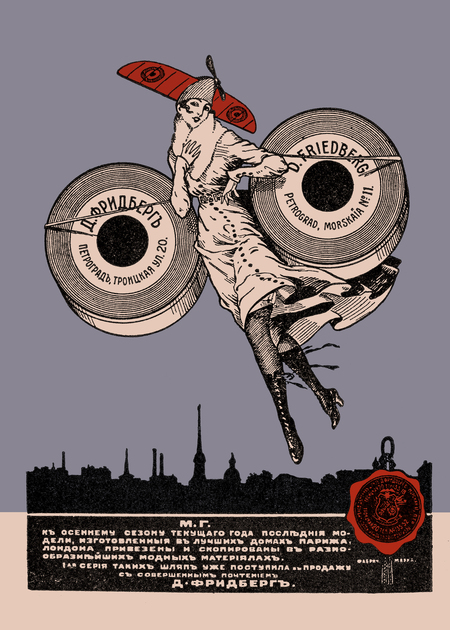
FASHION
The autumn and winter seasons typically set the main tone for outerwear for almost the entire year, so it is necessary to highlight the main strokes of the picture that is unfolding for us in the next «fashion year.»
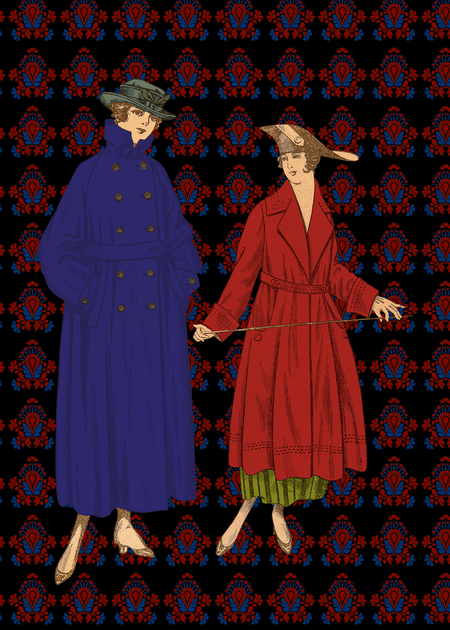
On suits, mantles, and furs, the «masculine» style is increasingly evident, softened by that elusive femininity reflected in the execution of every minute detail of the ensemble.
In Paris, the current height of chic is wearing a mantle resembling an attorney’s toga—the kind still worn by lawyers in tradition when arguing cases in the supreme court. It shares the same cut, with its straight, majestic folds, broad collar, and mantle. However, if one shortens this toga, adds a casually draped belt, or pins or fastens the capelet coquettishly—partially raising it like a collar to protect the neck and ears from the cold, reminiscent of stern upholders of the law—the effect is transformative.
The headwear must undoubtedly complement the rest of the ensemble. Here we see numerous berets, typically worn by artists, but embellished with purely feminine, almost imperceptible details. Worn coquettishly atop a hairstyle, it imparts that «masculine chic» flaunted by Parisian fashionistas.
English fedora-style hats also complement the loose-fitting tailoring of suits and traveling mantles. These hats are often made from soft felt, or stuffed with fabric or trim, which is both fashionable and practical. A carelessly draped ribbon or silk scarf with a decorative knot or bow completes these relatively formal headpieces. …One must also mention footwear as an accessory to the modern, relatively short suit. The scarcity and expense of leather have been greatly felt, and those high boots made entirely of one type of leather are now rarely seen. Generally, the shape of the boots has not changed; they remain equally tall, but they are now mostly made of fabric, with only pieces of leather used as trim on the toes, sides, and heels. In the summer, footwear with low heels was highly visible, but the approaching city season has once again constrained the foot in high ankle boots with relatively high heels. Shoes are less about shine and more about practicality—fortunately, fashion has banished the overly expensive, jewel-encrusted ornaments, permitting only, occasionally, quite large ribbon bows and shiny orange buckles.
Oct 5 | Thursday
Russian Word, No. 227 «Dictatorship of the Proletariat» Across Russia. Power is effectively in the hands of spontaneous organizations—primarily the councils of workers and soldiers' deputies. No legal authority recognized by the council is acknowledged. Council Chairman A. Okulov is at the telegraph, demanding the telegrams received from members of the Provisional Government for review. He personally puts resolutions on the telegrams such as: «Do not execute, ” „Postpone, ” etc. At Okulov’s order, raids are carried out, led by the „well-known“ anarchist Kaminsky… „Free Siberia“ reports that three men were shot during the last raid conducted under Kaminsky’s guidance…
280 Rubles Daily Wage Nizhny Novgorod. The drunken clamor of porters at ships and Volga piers continues. In Tsaritsyn, porters presented a demand to raise the unloading fee for steamboats and the loading fee to 250–300 rubles per 1,000 puds. The Nizhny Novgorod Council of Shipowners’ Conventions telegrammed the Ministry of Labor, pleading for immediate action against these insane demands, which threaten to completely halt Volga transport.
The Romanovs in Tobolsk Tobolsk. Today, the city’s food committee issued ration cards for all members of the Romanov family, their servants, as well as officers and soldiers of the guard unit—at the insistence of the provincial commissariat.
KING OF HUNGER
New Satiricon, No. 37. Drawing by Re-mi
Kuryan and Kaluzhany Kursk has finally decided to take energetic measures against the mass removal of bread from the Kursk Governorate by the Kaluzhany. Severe hunger has long plagued the Kaluga Governorate. According to local reports, due to the lack of bread, the population is consuming ground straw, crushed wood scraps, and so on. The Kaluzhany have flocked to neighboring governorates seeking bread… …From May onward, the Kaluzhany have been transporting bread out of the Kursk Governorate by rail, by water, and by sledge, using any means necessary to acquire it and showing no hesitation about the price. They are paying a frantic price—30 rubles or more—per pud of bread. Through this smuggling route, the Kaluzhany have taken out of the Kursk Governorate three times more bread than was allotted in the permits. Bread supplies in the Kursk Governorate are nearing exhaustion…
Driven by Hunger In the cities of Nizhny Novgorod. There is complete anarchy on the Volga. Crowds of near-starving people from the Kostroma and Nizhny Novgorod Governorates, along with children and women, have moved before the navigation season closed to procure bread for themselves by purchasing it at lower river landings and on the Kama. A spectacle reminiscent of the early days of Volga steamers is being observed: cargo barges, filled with people, follow the towboats.
More Bread Than Bread In Minusinsk, Yeniseysk Governorate. The Minusinsk Food Administration contacted the Governorate Food Committee via telegraph requesting the release of 10,000 puds of rye for the Mikhailovskaya and Lugovaya districts, where there is an acute need for bread. Meanwhile, the Minusinsk Uyezd is the breadbasket of the governorate. There is so much bread in the Uyezd that the residents literally do not know what to do with it. Tens of thousands, hundreds of thousands of puds of rye are being converted into moonshine…

Unrest and Riots To Kyiv. Today, the congress of Ukrainian commissars opened… Delegates described a horrifying picture of anarchy in Ukraine in their reports—a situation growing increasingly severe as the front lines approached. In the Kyiv Governorate, there have been no riots yet; only isolated land seizures have been observed… In the villages, illicit winemaking is widespread, and instances of vigilante justice and secret murders are very common. The most significant disaster in the Chernihiv Governorate is the looming famine… Requisitions must be resorted to, or starvation riots are inevitable. In the Poltava Governorate, the fight against unauthorized searches conducted by soldiers is underway… The situation in the Podolsk and Volyn Governorates is completely different… …The presence of an army corps that passed through several districts of the Podolsk Governorate is equivalent to a Tatar invasion. Everything in these districts has been destroyed. Crops, livestock, and poultry have been wiped out; pond water has been drained; settlements have been looted. In the villages, only blackened, burnt stumps remain… Almost all the villages in the Volyn Governorate are involved in clandestine winemaking. In some villages, alcohol is distilled in every house. This spirit is sent to the front. The price of spirit rises as the front approaches.On the Railways Reports from provincial newspapers indicate that various acts of violence, robbery, and theft committed by soldiers on the railways are becoming spontaneous. Soldiers from different passing trains, as well as local military detachments on the Ryazan-Ural Railway within the Moscow Military District, are attacking trains and stations…According to the Copin, Ryazan Governorate. Last night, five estates in the Skopinsky district were plundered and burned. Convoys are moving without hindrance, destroying everything in their path…
October 5–8
MOONZOUND