December 25 | Monday
Christmas
And so, here it is—the great Russian revolution… This is the long-awaited era of liberation, the awakening of the Russian people, the «dawn of enchanting happiness.»
Russia’s Morning, No. 285 | New Life, No. 210 | Early Morning, No. 274 In the Christmas Night …We see a great collapse; we live amid the ruins… And deep down, a terrifying question is being born: —Was the entire emancipatory movement of the last century nothing more than a protracted process of Russia’s decay? Did the best people err? For no matter how dreadful the events we are experiencing, there can be no slightest doubt that they are organically connected to the entire history of our emancipatory movement. They are genuine; they are national… The entire Russian intelligentsia and the whole Russian people are directly responsible for the current revolution. There is no trace of randomness in what is happening to us… Russia will be the first to bring socialism to the world. Russia is called upon to «ignite the fire of the world socialist revolution,» «provide the impetus,» and so on… Let it be madness, but it is an old and true Russian madness, in which Herzen meets Khomyakov, and Narodnichestvo meets Marxism… And now, from the underground—from Bakunin’s French books, from the London press, and the Parisian cafes—this madness has been carried to the Winter Palaces and the Kremlin walls, suddenly sweeping over all of Rus', driving it mad… …The Bolsheviks are a scourge not only for the sins of Russian autocracy but also for the sins of the Russian intelligentsia… Their program is madness, often crossing into crime, but one must admit that this is the delirium of a sick homeland, a sick Russia, tossed about in frenzy… Eras of destruction are the prelude to creative eras: Providence destroys only for the sake of creation… …A new Russia, a new nation, a new culture are being born from agony. We live at a juncture, in this dark Christmas night. The blizzard is still raging, and our common home is still crumbling. But with a deep faith in the future, we greet tomorrow: —The great Russia is dead! Long live the great Russia!
N. Ustryalov
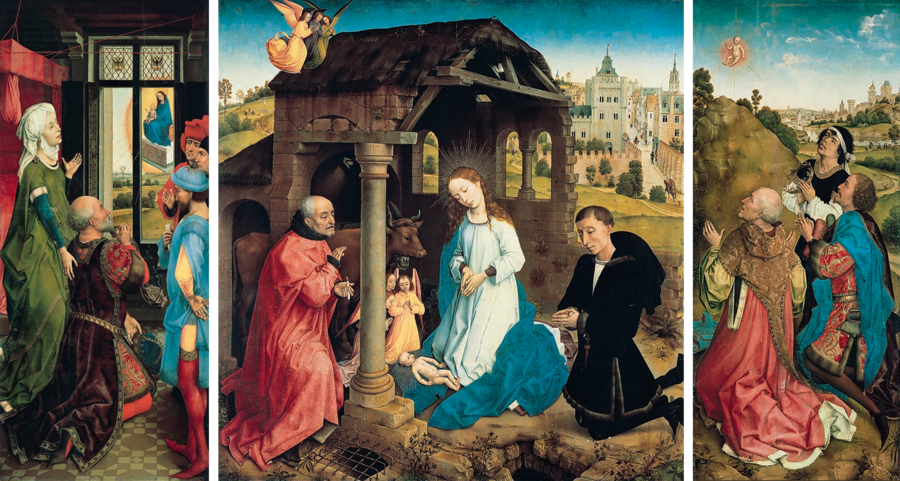
Van der Weyden. Nativity. Middelburg Altar
Yes, we are weathering a storm of dark passions; the past has exposed its deepest recesses to us, showing us to what a degree man is grotesquely distorted… Perhaps we have perished? It is better to burn in the fire of revolution than to slowly rot in the garbage dump of monarchy, as we did before February. We, Rus’, have clearly arrived at a time when all our people, deeply stirred, must wash away, shed the filth accumulated over centuries from our way of life, kill our Slavic laziness, rethink all our skills and habits… awaken all our strength and abilities, and finally, enter into the universal human endeavor of organizing our planet—as the most talented workers. Yes, our situation is deeply tragic, but above all, man is in tragedy… Today is the Birthday of Christ, one of the two greatest symbols created by humanity’s striving for justice and beauty. Christ is the immortal ideal of mercy and humanity, and Prometheus is the enemy of the gods, the first rebel against Fate… A day will come when the symbols of pride and mercy, of meekness and mad courage in achieving goals—both symbols—will blend into one great feeling, and all people will realize their significance, the beauty of their aspirations, and the shared bond uniting everyone. In these terrible days of rebellion, blood, and hostility for many, we must not forget that through great suffering and unbearable trials, we are heading toward human liberation… Let us believe in ourselves, let us work obstinately; everything is within our will, and there is no other legislator in the universe but our rational will… And a heartfelt greeting to all the innocently imprisoned in jails.M. Gorky
What is salvation? Amid the whirlwind of human passions, the celebration of Christ’s Nativity returns to our country—a festival of love, peace, and truth, a festival of pure, good souls… But alas! The brightest light of this joyful day is now framed by the mourning of endless human sorrows… Wretched, suffering Rus', what has happened to you? Did wise people not call you holy through the ages for your meekness, your patience, and your sensitivity to the Christian faith… Yes, sorrowful Rus', the idols of ancient paganism—the lust for power and materialism—resurrected by the deceivers of the people, have forced you off the direct path of history, and you trembled… Salvation came to the ancient world with the Nativity of Christ the Savior, and our afflicted homeland has salvation only in serving the ideals of goodness, truth, and love brought to earth by God, born in Bethlehem… …Therefore, on this quiet, luminous night, we firmly send to the exhausted country a long-forgotten truth: man is not a beast, but a bearer of the image of God; therefore, he ought not to live like an animal—but according to the laws of truth revealed by Christ—"Do not do to others what you would not wish for yourself.»
Holy V. Vostokov
December 28 | Thursday
Bolshevik Decrees
The People’s Commissars issued a decree halting payments to funds and dividends. According to the decree… 2) all transactions involving securities are prohibited; 3) for violating Article 2 of this decree, the guilty parties will be subject to trial, and their property will be confiscated.
New Petrograd Newspaper, No. 20 From Petrograd to Tsarskoe Selo — A 10-Hour Journey Something dreadful is happening to the railways!.. Previously, the trip to Tsarskoe Selo was a pleasant ride. You would sit in a warm carriage and, within about 30–35 minutes, you would already be in Tsarskoe. Now, first of all, there is no timetable. People literally cannot catch a train for three days… Along the way, the train stops endlessly for various reasons and sometimes stands still for several hours. Just the other day, a train that left Petrograd at midnight did not arrive in Tsarskoe Selo until the next day at 10 in the morning! The result of this chaos is the mass migration of Tsarskoe Selo residents to Petrograd.
«VANDEA» (Impressions from Novocherkassk) It wasn’t a city, but rather a large, quiet stanitsa. Desolate, snow-laden streets… The melodious chime of wind chimes… But behind the scenes of this peaceful stanitsa idyll, a historical farce is unfolding—one that is simultaneously bloody and comedic… Our hotel was a refuge for «living corpses.» Under borrowed names, dressed in unfamiliar attire, known generals, strategists, and public and political figures from all over Russia took shelter here… To reach the Don, most had to overcome incredible hardships, repeatedly staring death in the face… What tribulations: prison, escape, in our age of electricity and steam, trekking hundreds of miles on foot, changing into women’s dresses, into priestly robes… In military uniform with insignia, only Cossack officers and retired generals were seen. True military figures transformed into elegant gentlemen in frock coats and tuxedos. But that distinct posture, that gait!…
The Don is the subject of the day—anger. What is truly happening on the Don? Unfortunately, only the Don Cossacks and the military government can answer this question definitively, as the «guests» gathered in Novocherkassk from all over Russia keep their endeavors and plans under the greatest secrecy. There are three main currents in Novocherkassk: the Kaledinsky (purely local, Cossack, and democratic), the Kornilovtsy (republican), and the Alekseevtsy (more conservative)… General Alekseev heads a purely military organization. He already has a full staff with all departments in place; communication is established. Officers coming to Novocherkassk receive shelter and the opportunity to operate. The Alekseev organization rejects any committees, is characterized by the strictest discipline, and consists exclusively of officers, junior cadets, and cadets. The Bolsheviks recounted during the Rostov uprising: «The soldiers are advancing, and if you kill them—he wears blue officer trousers under a grey soldier’s greatcoat, and a woolen tunic!» General Alekseev’s stature is too well-known for it to be assumed that he would pursue goals other than fighting the Bolsheviks and defending the Constituent Assembly. However, among the Alekseevtsy are individuals with a distinct monarchist lean. Z. Richter
On the Domestic Front Feodosiya (Personal Correspondent). Contrary to newspaper reports, the route Moscow — Feodosiya is unhindered; there are no battles in Kursk; Kharkiv is occupied by the Bolsheviks. The route from Kharkiv to Sevastopol is safe; excesses occur only in Lozova, which is occupied by a detachment of Red Guardsmen. On the third day, two passenger trains were shelled by these Red Guardsmen; they believed the Cossacks were traveling in them. One was shelled by machine-gun fire, and the other—the mail train—was shelled with crossfire for five minutes without any provocation during Christmas Eve. Four people were killed, and sixteen were wounded—all soldiers. The train was delayed for eight hours while passengers used the telegraph to find out if there were ambushes further down the line. Everything is calm to the south. There are Hydra-men in Sinelnikovo and Alexandrovsk. At the Lozova station, all officers without documents signed by regimental committees are detained. It is reported that Bakhmach was in Ukrainian hands three days ago, and Bryansk was held by the Bolsheviks. There are no battles there. The mail service has resumed.
War or Peace?
At the closed session of the demobilization commission held a few days ago, Ulyanov-Lenin unexpectedly appeared and delivered a speech that caused a sensation.
«I fear, ” Ulyanov-Lenin said, „that we will have to halt demobilization. If Germany and its allies do not accept our terms, we will declare revolutionary war on Germany. We will not go for a shameful peace…“ Officers arriving from the front report that Krylenko’s order has been published on the front, commanding officers to return to the posts they held prior to the coup…
12/29 | Friday
Morning of Russia, No. 287 «Revolutionary War» Here it is. It has happened. …The order of Ensign Krylenko sweeps across all of Russia, calling up the entire «revolutionary» army, declaring a sacred war against the German bourgeoisie—that is, simply against Germany… …And wasn’t that what we called for in March, when… in the great surge of spirit, the entire united and cohesive people of Russia could truly give a «serious resistance» to this very «German bourgeoisie» and, together with the allies, achieve a honorable democratic peace…? Uncovered ignorance and piggishness walked through Russia for nine months, ignoring the voice of reason and wanting to prove their point with their own intellect. And they got through. Now Krylenko’s group is repeating everything the «bourgeoisie» once repeated… They even arrived at the point that a powerful army is needed, that the sturdiest discipline and the last exertion of strength are required. They repeated all our bourgeois words! But when? When did they get through, when did they repeat them? When they destroyed the army. When they dismantled the industry. When they dismantled Russia itself. And finally… they killed the revolutionary momentum of the people and, inciting one part against another, tortured everyone and forced everyone to curse the revolution they once lived for…T. Ardov
12/28–12/30
Exhibitions
N. Krymov. Summer Landscape
Birthday celebrations — time for art vernissages. This Moscow tradition has not been altered by the exceptional, tragic nature of the times we are experiencing. On Tuesday, several art exhibitions opened their doors to the public, eloquently testifying that, contrary to the known Latin aphorism, the muses do not fall silent amidst the clamor of weapons or the storm of revolutions.
Russkiye Vedomosti, No. 278 | Early Morning, No. 277
…These storms did not derail our artists, nor did they dissipate their creative spirits. If not all of them, then the majority of painters worked extensively during these revolutionary months. Their artistic work continued along the same, previous lines—neither in themes nor in methods of creation—failing to reflect the changes that had taken place around them. Without the dates on the canvases, their work could confidently be accepted as the artistic output of any of the preceding pre-revolutionary years.
This applies equally to both major exhibitions—the Union of Russian Artists, which has returned to its former premises at the School of Painting and Sculpture, and «Mir Iskusstva» (World of Art), which remains in the Mikhailova Gallery. While the spirit of the moment did not manifest in the exhibitions, it was also reflected in Moscow’s interest… Both vernissages were completely packed. The «tails» reached here as well: one had to wait quite a while in line before reaching the ticket booth… And this, despite the entrance fee having been significantly increased. At the Union exhibition, almost all the artists kept their previous placements, which greatly simplifies the task of initial orientation. As always—Korovin is at the end of the first hall… And as has been the case in recent years, Korovin is the center of attention for the large exhibition audience, drawing a dense crowd. The last year has been very productive for him: 17 canvases, including several Gurzuf landscapes and several «Roses”—morning roses, white roses, roses and fruit, simply roses, etc. Portraits are presented at Korovin’s by Sobinov and Ms. Kistyakovskaya. As always—a true celebration of vibrant colors.
S. Vinogradov. Crimean Landscape
More abundant than usual is Vinogradov. He has over ten canvases inspired by Crimea: the sea in various light conditions; he also has several views of Odesa, in addition to several «pages from an album» displayed on the gallery wall… Zhukovsky’s collection is less extensive: two «Kuskovs,» a green June night, and the first summer day. Krymov has four landscapes and about ten studies. Turzhansky is very extensive with his pensive, modest village songs. This time, there is greater variety in the subjects—the entire spectrum of spring and autumn moods. Yoon presented Moscow in winter, several quiet rural corners near river bends, and in small studies—a Moscow ring dance, Pskov, Uglich, and the Kremlin. Maliutin provided a large female portrait—Mrs. Karinskaya—and portraits of I. D. Syitin, V. T. Belskoy, and Mrs. Kondakov. Vasnetsov has Old Moscow and a series of landscapes; Pasternak has a series of pencil drawings; Petrovich has roses, chrysanthemums, still lifes, and a series of landscapes; Sredina features unchanging interiors… The entire sculpture section of the exhibition consists of three works by Konenkov—the head of a Maenad, a torso, and a large female figure depicting «Awakening.»
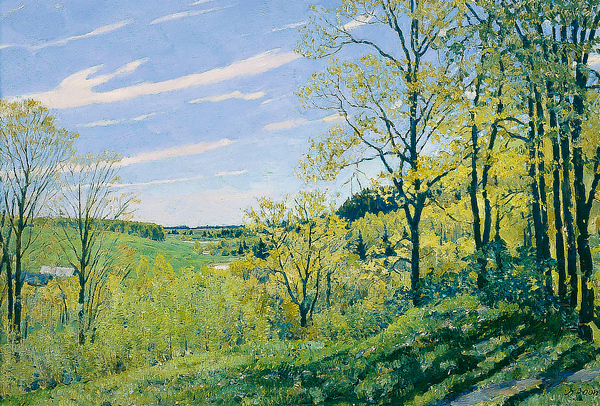
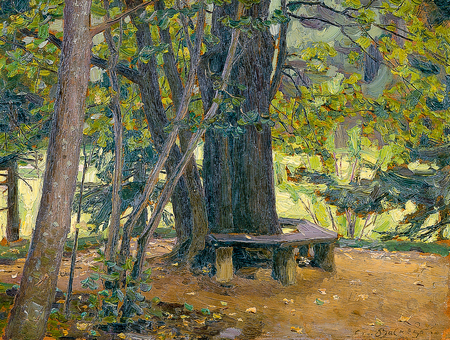
Left: K. Yeon. May Morning. Nightingale Place. Right: A. Vasnetsov. Landscape in Demyanovo. Bench under a tree
At the «Mir Iskusstva» exhibition, Konchalovsky is the dominant presence—he contributed a massive canvas depicting the artist, his wife, and his daughter, as well as a series of still lifes executed in his characteristic manner, and several landscapes, in addition to a large female portrait. Lentulov features prominently, with many sketches of New Jerusalem, a large «Tverskoy Boulevard,» and several other Moscow landscapes. Falk also occupied a significant space, having marked all of his paintings with three stars—including portraits, genre scenes, and other compositions displayed beneath them. Boris Grigoriev offered many interesting pieces, such as the large canvas «Apashi,» «Jewish Girl,» and others. Dubuzhinsky presented sketches for «Stepanchikov’s Village» (for the Art Theater) and several smaller works. Pavel Kuznetsov displayed «Flowers in the Workshop of a Bukhara Artist, ” other still lifes, and landscapes. Simultaneously, Konenkov’s sculptural exhibition opened in his studio in Presnya.
P. Utkin. Night