Ancient Rome is a chronicle of a small city-state’s transformation into the greatest Mediterranean power, whose cultural legacy continues to shape the face of Western civilization. In the timeline presented, we will trace this journey through thirteen key eras—from the legendary founding of the city to the fall of the Western Empire. Each period will be examined from two perspectives: the general historical and the artistic. Roman art, unlike its contemplative Greek counterpart, was always closely linked to the practical needs of the state—glorifying power, immortalizing ancestral valor, and organizing public space. It is this unity of politics and aesthetics that makes Roman art a unique phenomenon, which we propose to explore.
753–509 годы до н. э.
Roman Kingdom
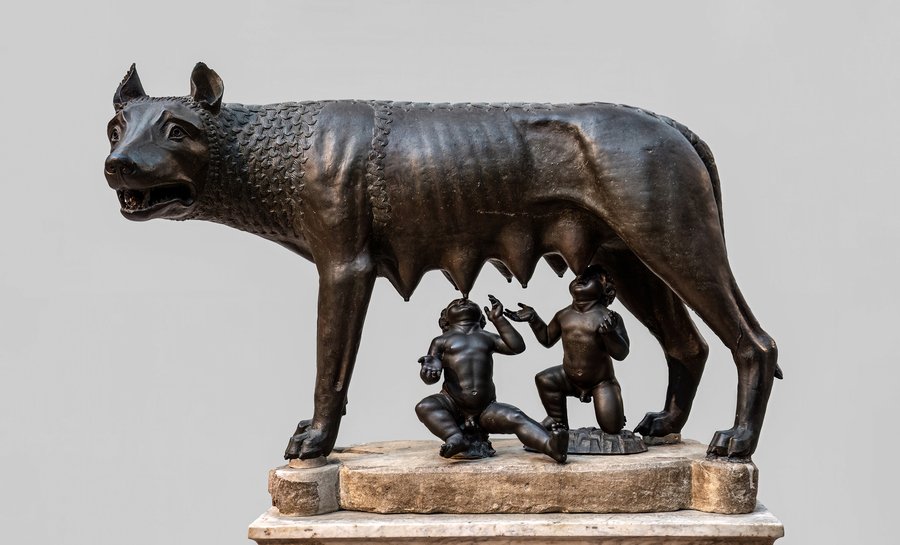
The Capitoline Wolf nursing the twin infants Romulus and Remus, the legendary founders of the city of Rome.
According to the legend passed down by Titus Livy, Rome was founded by Romulus and Remus in 753 BCE. Over two and a half centuries, seven kings succeeded each other in the city—from Romulus to Tarquin the Proud. The senate, curiae, and priestly colleges were formed; the city grew, successfully fighting wars against the Etruscans, Latins, and Sabines living around it. By the end of the 6th century BCE, Rome already had a developed infrastructure, including sewer systems. In 509 BCE, Tarquin was exiled by the city’s populace, and a republic was established.
The art of the royal period is inextricably linked to Etruscan traditions. The architecture of that era is characterized by axial planning, squared masonry, and terracotta cladding. An example is the Temple of Jupiter Capitoline (dedicated in 509 BCE), which established the canon of a three-chamber cella and a high podium. The sculpture of the age is represented by terracotta statues and pediment reliefs. Surviving fragments (for example, from the temple in Veii) demonstrate the dynamism and vibrant polychromy inherited from the Etruscans.
509–264 годы до н. э.
Early Republic
Image of Samnite warriors on the frieze of the tomb in Nola. 4th century BCE.
After the expulsion of the kings, power in Rome passed to elected consuls and praetors. The city waged constant wars with the Gauls, Volsci, and Etruscans; in 390 BCE, it was burned by the Gauls. By the mid-4th century BCE, the Romans had rebuilt the city and began expanding into Central Italy. During the Samnite Wars from 343 to 290 BCE, Rome conquered almost the entire Apennine Peninsula. By 264 BCE, after the war with Pyrrhus, Rome finally became the master of all of Italy.
The architecture of this era remained relatively modest. Temples, basilicas, and engineering structures—like the Appian Way (312 BCE) and aqueducts—were built. Sculpture is known through bronze votive statuettes and early funerary reliefs. The most significant innovation—portraiture linked to ancestor worship: wax masks (imagines maiorum) became a precursor to realistic plasticity. Frescoes in tombs (such as the Tomb of the Fabii) demonstrate the era’s masters' interest in individual features.
264–133 годы до н. э.
Middle Republic
George Pence. Fall of Carthage. Engraving. c. 1550
During the First (264–241 BCE) and Second (218–201 BCE) Punic Wars, Rome defeated Carthage. Macedonia was crushed in 197 BCE, and Corinth and Carthage were destroyed in 146 BCE—Rome became the hegemon of the Mediterranean. Large estates grew within the country, there was an influx of slaves and Eastern luxuries, and a cavalry class emerged. The state began experiencing its first social conflicts (the slave revolt in Sicily, 135–132 BCE)—conquests not only brought unprecedented wealth but also sharpened the contradictions between the patricians and the plebs.
The art of the Middle Republic was powerfully influenced by Hellenism. Following the capture of Syracuse (212 BCE) and Corinth (146 BCE), Greek statues, paintings, and artisans flooded into Rome. Architecture began to feature the first marble temples (the Temple of Portia), basilicas (the Basilica of Aemilius), and theaters (the Theatre of Marcellus). Sculpture blended Republican portrait realism with Greek plasticity. Frescoes, imitating Greek models, appeared in the homes of the elite.
133–31 годы до н. э.
Late Republic
Cubiculum (bedroom) of the villa of P. Funnius Sinistor in Boscoreale. Late Republic. Fresco. Circa 50–40 BCE.
The reforms of the Gracchi brothers (133–121 BCE), which attempted to overcome the social crisis in the state, led to their demise. The war against Jugurtha (112–105 BCE), Sulla’s dictatorship (88–79 BCE), Spartacus’s revolt (73–71 BCE), the First Triumvirate (60–53 BCE), the civil war between Caesar and Pompey (49–45 BCE), Caesar’s assassination (44 BCE), and finally, the conflict between Octavian and Antony, culminating in the Battle of Actium (31 BCE)—all of this resulted in the de facto collapse of Republican institutions, with power concentrating in the hands of military commanders. The Senate lost its influence, and the Roman army became an instrument of political struggle.
The art of the late Republic was characterized by eclecticism and psychological depth. Busts featuring wrinkles, sagging cheeks, and stern gazes (such as the portrait of Pompey) captured age and character. Grand public buildings were constructed—the Theatre of Pompey (55 BCE), Caesar’s Forum (46 BCE), and the Tabularium on the Capitoline. Painting of the era is represented by the «Second Pompeian Style, ” which featured illusory architectural perspectives (like the houses in Pompeii). It was during this time that Romans began creating their own historical reliefs to glorify military victories—the precursors to triumphal columns.
27 год до н. э. — 14 год н. э.
The August Principate
Fragment of the Altar of Peace (Ara Pacis). 9 BCE
Augustus Octavian became the first emperor of a state renovated after the fall of the Republic—though he formally maintained republican magistracies, he centralized all power in his own hands. His reign was a «golden age» of culture: a flourishing of literature (Virgil, Horace, Livy), massive construction, and moral reform. According to him, he «received Rome brick and left it marble.» The Forum of Augustus, the Altar of Peace (Ara Pacis), the Mausoleum of Augustus, and the Theatre of Marcellus were built. Foreign policy stabilized the borders: the Alpine tribes were conquered, as were Pannonia and parts of Germany.
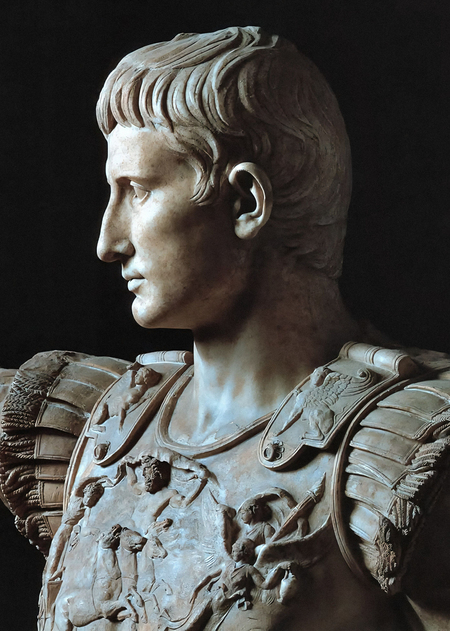
Augustan Art—a style of «Augustan Classicism» that returned to Greek classical forms from the 5th century BCE. Augustus’s sculpture (the statue from Prima Porta) became majestic and serene. Corinthian order and marble were employed in architecture, while painting featured the «Third Pompeian Style» with flat ornamentation. The Altar of Peace is a masterpiece of relief sculpture, weaving together mythological scenes with historical ones. The canon established by Augustus became the template for imperial art for decades to come.
14–68 годы
The Julio-Claudian Dynasty
Gemma Claudia. 49 CE
After August, power shifted to Tiberius, then Caligula, Claudius, and Nero. Their reign was marked by palace intrigues and scandals, but also by the empire’s territorial expansion. In 64, a great fire destroyed part of Rome, and shortly thereafter, the entire dynasty was broken—after Nero’s suicide in 68, a civil war broke out in the country.
The architecture of Nero’s «Golden House» was astonishing in its scale, mosaics, and frescoes. The portraits of Tiberius and Nero were highly psychological, conveying the rulers' contradictory natures. A masterpiece of glyptic art from that era was the cameo of Claudius depicting the imperial family. In painting, the «Fourth Pompeian Style» developed, featuring fantastical compositions. It was at this time that Roman art definitively departed from Greek models, acquiring its own imperial gravitas.
69–96 годы
The Flavian Dynasty
Ambrogio Brambilla. Cross-section and facade of the Colosseum in Rome. Engraving. 1581
After a year of four emperors, Vespasian came to power. He suppressed the revolt in Judea and destroyed the Temple in Jerusalem. His sons, Titus and Domitian, continued to strengthen the empire. Titus completed the construction of the Colosseum—the most magnificent amphitheater in the state. Domitian became the last emperor of the dynasty—the ruler’s despotism led to a conspiracy against him, his murder, and the cursing of his name in 96 AD.
Flavian Art—a flourishing of portrait sculpture and monumental architecture. The Colosseum features three tiers of arches adorned with Doric, Ionic, and Corinthian orders. Titus’s Arch of Triumph is a classic example, featuring a relief depicting a procession bearing trophies from Jerusalem. For the first time, middle-class figures appeared in portraiture. Painting and mosaics became even more decorative.
96–192 годы
The Antonine Dynasty