The French Revolution was a fundamental turning point not only in European history but in world culture as a whole. It dismantled the feudal system and undermined the foundations of European absolutism, establishing the sovereignty of the nation and the principles of liberty, equality, and fraternity as the basis for the state structure. The Revolution also gave birth to a new aesthetic—art became an active instrument of political struggle, a tool for forging a new national identity, and a medium for disseminating revolutionary ideas. Our timeline traces France’s journey from the philosophical Enlightenment to the Napoleonic upheaval, illustrating how culture accompanied, preceded, and interpreted every milestone of this tumultuous revolutionary drama.
1715–1789 годы
Enlightenment
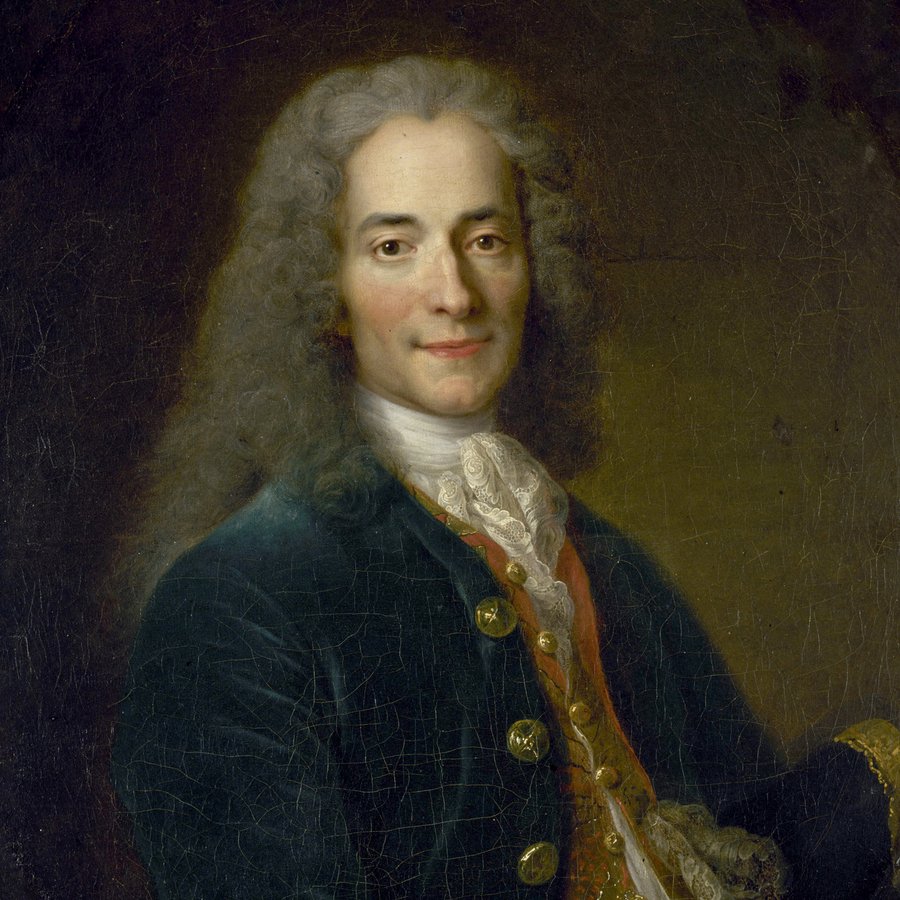
Nicolas de Larjiller. Voltaire at the age of twenty-four. Fragment. 1718–1724
The philosophical movement of the 18th century, known as the Enlightenment, laid the intellectual foundation for the French Revolution. French thinkers—Voltaire, Charles Louis de Secondat, Baron de Montesquieu, Jean-Jacques Rousseau, and the Encyclopedists led by Denis Diderot—launched ruthless critiques against absolute monarchy, church dogma, and class privileges. Voltaire advocated for freedom of conscience and speech; in Persian Letters, Montesquieu satirically condemned despotism; and in his treatise The Social Contract, Rousseau described the theory of popular sovereignty, writing in 1767: «We are approaching an age of crisis, the age of revolutions.» The Enlightenment thinkers' ideas about natural human rights and the separation of powers permeated the minds of the educated bourgeoisie and parts of the nobility, creating the ideological ground for the coming upheavals.
The cultural legacy of the Enlightenment extended far beyond philosophical treatises. Voltaire and Rousseau were the foremost writers of their time—it was their novels and short stories that shaped the pre-revolutionary social consciousness. Diderot and d’Alembert’s encyclopedic project systematized all the knowledge of the era, becoming a kind of foundation for enlightened reason. In the visual arts, Neoclassicism emerged, drawing upon the ancient ideals of citizenship and heroism, foreshadowing the coming revolutionary fervor. Jacques-Louis David’s salon paintings, long before the Revolution, glorifying Roman heroes («The Oath of the Horatii, ” 1784), already carried the seeds of republican spirit that would flourish during the revolutionary years.
1774–1792 годы
Louis XVI
Antoine-François Callé. Louis XVI in coronation regalia, with royal emblems and the cross of the Order of the Holy Spirit. 1778–1779
Louis XVI ascended to the French throne in 1774, inheriting a treasury depleted by wars and extravagance from his grandfather, Louis XV. The new king was a kind-hearted man, fond of blacksmithing and hunting, but completely incapable of decisive governmental reforms. By the 1780s, the financial crisis had become catastrophic: national debt reached 4.5 billion livres, and the budget deficit exceeded 100 million annually. The attempts by finance ministers—Turgot, Necker, Calonne—to introduce tax reforms and levy taxes on privileged estates met with fierce resistance from the aristocracy.
The era of Louis XVI was a time of contrasts between the fading Rococo and the emerging Neoclassicism. Court art from the final years of the Old Regime retained its lightness and hedonistic focus, but voices demanding seriousness and moral rectitude were growing louder around it. Pre-revolutionary literature was abundant with political pamphlets exposing corruption and despotism; banned books critical of royal power became widely circulated. Louis XVI himself was a passionate reader and book collector—but his extensive library could not save him from political blindness. Forced to convene the Estates-General (for the first time since 1614), he inadvertently initiated a revolution that would destroy both his kingdom and himself.
Jacques-Louis David. The Oath of the Horatii, June 20, 1789
On May 5, 1789, the Estates-General convened at Versailles, called by the king to resolve the financial crisis. Representatives of the Third Estate—who comprised 98% of the nation’s population—faced the insulting procedure of voting by order, in which their votes held almost no weight against those of the clergy and aristocracy. On June 17, the Third Estate delegates declared themselves the National Assembly, asserting that they represented the entire nation. On July 9, the Assembly proclaimed itself Constituent, beginning the process of drafting a new constitution. This was an act of unprecedented political audacity: the delegates essentially staged a governmental coup by refusing to submit to the king’s will and seizing supreme legislative power.
The cultural significance of the National Assembly’s activities is hard to overstate. On August 26, 1789, the Assembly adopted the Declaration of the Rights of Man and of the Citizen—a document that became the manifesto of a new world. This text, inspired by the ideas of Rousseau and the American Declaration of Independence, proclaimed freedom, property, security, and resistance to oppression as natural human rights. The debates in the Assembly transformed into a grand political theater: speeches by Mirabeau, Abbé Sieyès, and other orators were recorded and disseminated across the entire country, shaping a new political culture. Political clubs emerged in Paris and the provinces, where news from Versailles was discussed; newspapers and pamphlets multiplied at an unprecedented rate, turning politics into a mass spectacle and creating a new public sphere.
14 июля 1789 года
Bastille
Storming of the Bastille, July 14, 1789. Canvas, oil. Circa 1789–1791.
On July 14, 1789, the Parisian insurgents, concerned by rumors of the royal troops marching to the capital, moved toward the Bastille fortress-prison to seize weapons and gunpowder. After several hours of defense, the fortress garrison surrendered, and the people freed the prisoners held there. The fall of the Bastille—a symbol of royal despotism and arbitrary power—served as the signal for a nationwide uprising. The King was compelled to recognize the National Assembly and recall Necker from exile. This day marked the beginning of the French Revolution, and July 14th is still celebrated annually in France as a national holiday.
The Storming of the Bastille inspired numerous works of art. As early as 1789, the first engravings and paintings depicting the siege of the fortress emerged; these spread across Europe, transforming the event into a widely recognized symbol of liberation. In literature, the Bastille became a metaphor for oppression and unfreedom—its fall was described in poetry, pamphlets, and the earliest historical chronicles of the revolution. In popular culture, the image of a «good» people crushing an «evil» fortress was cemented; songs and vaudevilles glorified the heroes of July 14th. The fortress itself was demolished within days of its founding, and its stones were dispersed across France like relics of a new era, symbolically signifying the death of the old France and the birth of the new.
Jacques-Louis David. Death of Marat. 1793. Fragment
Jean-Paul Marat, a physician and radical journalist, became one of the most influential voices of the Revolution. Beginning in 1789, he published the newspaper «Friend of the People,» where he mercilessly and sharply exposed the Revolution’s enemies and demanded the harshest measures against them. Marat enjoyed immense popularity among the sans-culottes—Parisian urban poor, craftsmen, and small shopkeepers who became the main driving force behind the emerging Terror. On July 13, 1793, Charlotte Corday, a young Girondin noblewoman, gained entry to Marat’s home and stabbed him with a dagger in his own bathtub. This death transformed Marat into a martyr of the Revolution.
The Cult of Marat became a defining phenomenon of the revolutionary era. Artist Jacques-Louis David created the famous painting, «The Death of Marat» (1793)—an ascetic, almost iconographic canvas on which the assassinated revolutionary is presented as a secular saint, offered up as a sacrifice for the people. This painting became the primary visual manifesto of Jacobin aesthetics, uniting classical rigor with revolutionary pathos. Literature glorified Marat in odes and revolutionary songs; his name was etched onto buildings and monuments. The sans-culottes, meanwhile, entered history not only as a political force but also as a new type of hero—a commoner, armed with a pike, dressed in a carmagnole, and driving history forward. Their image was solidified in engravings, popular prints, and theatrical productions, becoming a symbol of popular fury and revolutionary energy.
Jean-Joseph François Thásser. Exclusion of the Girondins, May 31, 1793–1800. Engraving
The Girondin political faction began to coalesce in the spring and summer of 1791 around the salon of the Rolan couple and a circle of deputies from the Gironde department, led by Pierre Vergniaud. Journalists like Jacques-Pierre Brissot (the Brissotins), the philosopher Condorcet, and others joined them. Proponents of personal liberty and admirers of Rousseau’s democratic theory, the Girondins became ardent defenders of the revolution, which they wished to extend beyond the borders of France. They gained power after the overthrow of the monarchy on August 10, 1792. Their moderate policies and indecision on economic matters led to a conflict with the radical Jacobin Montagnards.
The popular uprising of May 31–June 2, 1793, organized by the Montagnards and Sans-Culottes, stripped the Girondins of power. Some deputies were arrested, and on October 31, 1793, 21 Girondins, including Brissot and Vergniaud, were guillotined by the Revolutionary Tribunal. The Girondins possessed brilliant rhetoric but lacked organizational talent and party discipline. Their cultural legacy is tied to literary salons—especially Madame Roland’s salon, which left behind the famous «Memoirs.» In the nineteenth century, their image as tragic heroes destroyed by their own revolution was immortalized in Alphonse de Lamartine’s eight-volume «History of the Girondins» (1847), as well as in the novels and plays of Romanticism, where they were depicted as idealists who fell victim to terror.
21 января 1793 года
The Execution of Louis XVI
Confrontation of the rebels and Louis XVI at the Tuileries Palace, June 20, 1792. Engraving.
Following the overthrow of the monarchy on August 10, 1792, and the declaration of the republic in the same year, Louis XVI’s fate was sealed. In December 1792, the Convention began a trial of the former king, charging him with conspiring against the nation’s liberty and maintaining secret correspondence with France’s enemies. On January 15, 1793, 387 deputies, who voted for the death penalty, over 384 deputies who voted for other punishments, decided the monarch’s fate by a margin of just three votes. On January 21, 1793, at 10:20 AM in Place de la Révolution (now Place de la Concorde), the blade of the guillotine ended the life of Louis XVI, whom the revolutionaries simply called «Citizen Capet.»
The King’s execution became a cultural and political trauma that divided Europe. It shocked all European courts and led to the formation of the first anti-French coalition. In art, this scene was immediately reflected in numerous engravings and popular prints distributed across Europe, eliciting terror from some and jubilation from others. Literature produced dozens of pamphlets and poems mourning the «martyr» or glorifying the «triumph of justice.» The guillotine itself, a relatively obscure instrument until then, became the primary symbol of the revolution—and simultaneously a subject of cultural reflection, appearing in caricatures, theatrical productions, and even fashion (women wore brooches shaped like a guillotine). The English poet William Wordsworth and other Romantics viewed Louis XVI’s execution as a tragic turning point, signaling the collapse of the old world and the birth of a new, frightening era.


