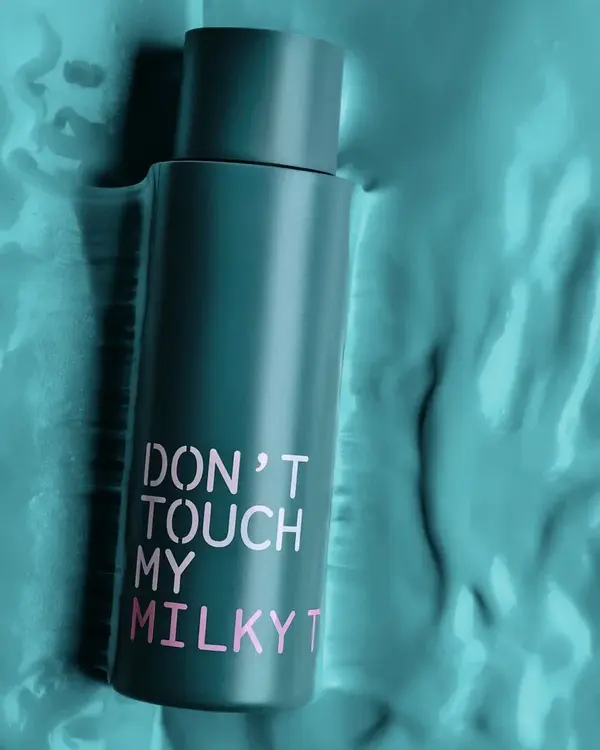
DON’T TOUCH MY SKIN is a manifest of conscious minimalism.
Table of Contents
Section 1: Introduction and History Section 2: Communication Channels and PR Section 3: Theoretical Framework Section 4: Strategic Analysis Through the Lens of Theories Section 5: Conclusion and Effectiveness
Section 1: Introduction and History
DON’T TOUCH MY SKIN (DTMS) was founded in 2019 by Adele Miftakhova with the help of the team at the multi-brand store FOAM. The brand’s founder, Adel Miftakhova, is the author of a popular science blog on cosmetics with an audience of over 50,000 people and a faculty member at Moscow State University.
Brand description and positioning:
DTMS was created for “skintellectuals”—a new generation of consumers who are no longer swayed by flashy labels, but instead study ingredient lists and make informed choices in favor of ingredients with proven effectiveness. Unlike glossy giants, the brand doesn’t focus on flaws or sell “problem” solutions. Its mission is to teach people to respect their personal boundaries and inner comfort, while also caring for the environment and supporting charity.
Target audience:
Conscious men and women aged 25–35 who are willing to pay for effective formulas and transparency. What matters to them isn’t brand status, but a scientific approach to beauty that doesn’t cause offense or create new insecurities.
Section 2: Communication Channels and PR
Promotional video DTMSkin
Communication platforms: YouTube Telegram Instagram** Website
*an organization whose activities are prohibited within the Russian Federation
Website advertisement banner
DTMS employs a hybrid communication model, in which its PR strategy is grounded in corporate social responsibility (CSR), manifested not through one-off campaigns but through systematic, measurable actions. The brand consistently pursues several key areas:
Telegram (Main PR Channel): Adel Miftakhova runs the channel “Don’t Touch My Face” (with about 50,000 subscribers), where she serves as a science editor, debunking myths about the beauty industry.
Environmental Initiative: A program to collect empty bottles (for recycling) and transform them into jewelry, in partnership with Recycle Object and Lamoda.
Support for Vulnerable Groups: A partnership with the "Sisters" center, which assists women who have survived sexual violence. This aligns with their philosophy of prioritizing boundaries and safety. U&G: This addresses the audience’s emotional need for a sense of connection, allowing them to do a good deed through a simple purchase.
Don’t Touch My Skin & Recycle Object Collaboration
Value-driven collaborations: A joint swimwear collection with the brand Blizhe that promotes body positivity and rejects imposed beauty standards. U&G: Fulfills the need for self-expression and a sense of belonging to a community that shares similar values.
Offline-retail: Available in major retail chains (such as "Zolotoe Yabloko") and at our own FOAM store, which also serves as a drop-off point for empty packaging.
Don’t Touch My Skin & Blizhe Collaboration
PR Strategy and Audience Communication: Moving Away from Pushy Tactics and Building a Community
The "DON'T TOUCH MY SKIN" PR strategy is perhaps the most striking and compelling case study in the Russian beauty industry, where a business builds a long-term reputation not on bold claims, but on consistent actions deeply rooted in the brand’s own values. This strategy fits perfectly into the Uses and Gratifications theory, where every element of communication fulfills the audience’s need for security, knowledge, and self-actualization.
The brand’s core communication principle can be described as “honesty and moderation.” Instead of the classic “You have a problem—here’s our solution” approach, DTMS says, “Don’t use the serum if you don’t want to—it’s not mandatory.” This creates a unique tone of voice (ToV)—respectful, knowledgeable, and caring. All communication is built on respect for the consumer’s personal boundaries, which resonates with a modern audience.
Promotional video DTMSkin
«Anti-PR»: Why Honesty Matters More Than Hype
The most striking aspect of DTMS’s PR strategy is its willingness to tell the truth, even at the expense of its own sales. The most striking example is the public story surrounding the release of their SPF cream. The brand’s founder, Adel Miftakhova, candidly stated in an interview that the production of their sunscreen had reached “such a level of absurdity that it would be better not to release it at all.” This episode is the quintessence of the brand’s philosophy: safety and honesty toward the audience take precedence over short-term profit. This is the most striking example of “salvific” anti-PR: discontinuing a product if it does not meet the brand’s standards works harder for the brand’s reputation than any advertising campaign.
Section 3: Theoretical Framework
Why do people choose «high-end» cosmetics and remain loyal to the brand? To analyze the DTMS strategy, we have chosen the uses and gratifications theory, first introduced by Jay Blumler and Dennis McQuail. UGT posits that audiences actively choose between different types of media based on which best serves to satisfy their needs. According to the classification by Katz, Gurevich, and Haas, there are five key needs:
Cognitive needs – the need for knowledge and new information, curiosity about other people’s lives
Personal identity/interactive needs – understanding one’s place in society, social status, self-esteem
Social interaction and integration needs – the need for interaction and relationships with others
Affective needs– the need for positive emotions
Need for stress relief—shifting focus away from life’s difficulties, escapism
Section 4: Strategic Analysis Through the Lens of Theories