Navigator
1. Concept
2. Chapter I. Badari: The Body as Fertile Function
3. Chapter II. Nakada I: The Body as Sign and Magical Protection
4. Chapter III. Nakada II: The Body as Ritual Gesture and Social Status
5. Conclusion
Concept
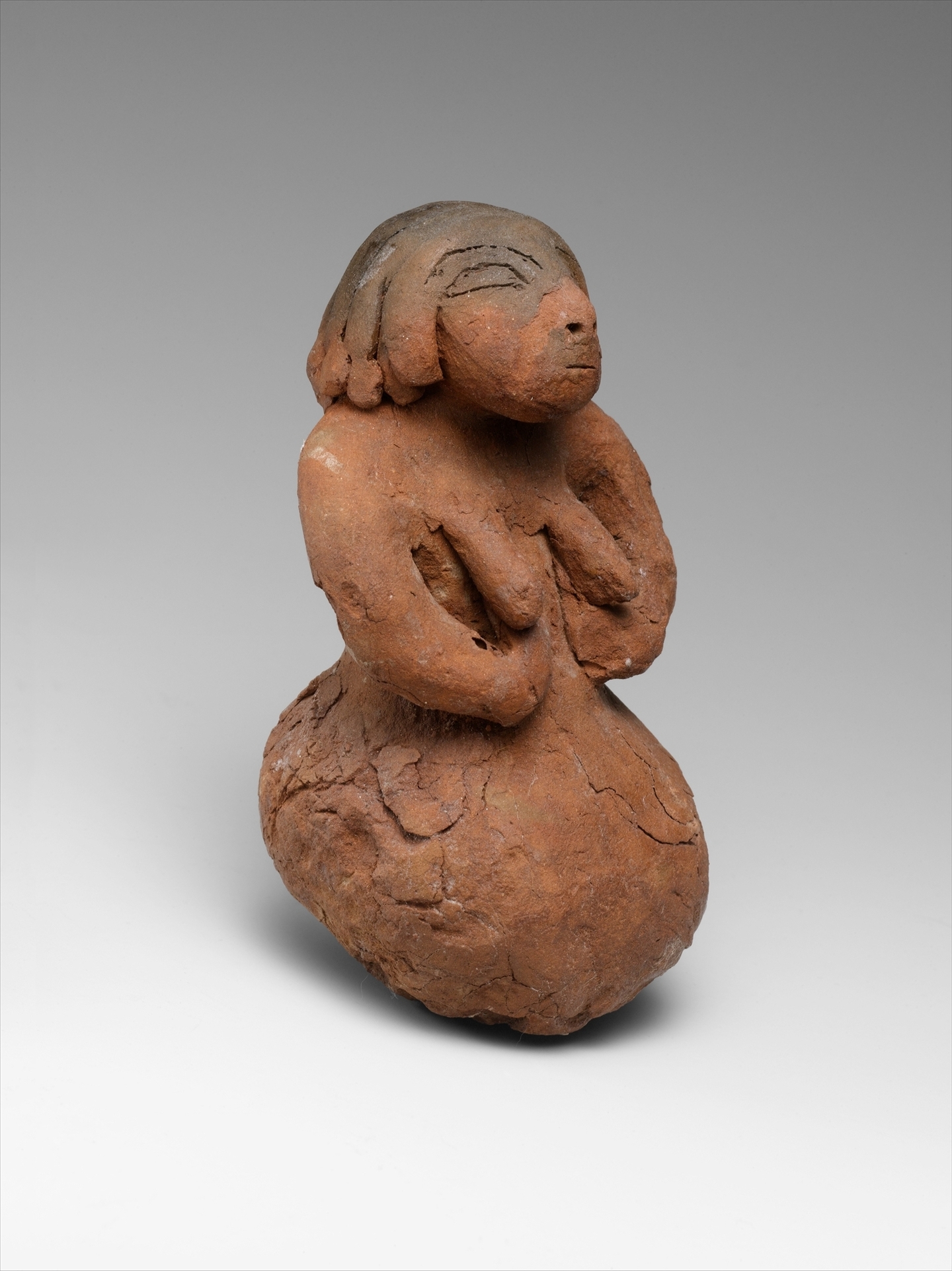
Since ancient times, humans have strived to understand themselves and the world around them. One of the earliest ways to express this yearning was through the depiction of the human body. During the Neolithic era in Egypt, people began creating small figurines in which the human form adopted unusual shapes and acquired special symbolic meaning. However, the longer one looks at these figurines, the more questions arise. Why did ancient masters depict people in this specific way? Why were some body parts exaggerated while others remained unchanged or were completely omitted? And what meanings did the creators embed within these figures?
Why did ancient people depict the human body in this manner, and what ideas about life, nature, and the self did they seek to convey through these images?
These questions have greatly interested me. Through this research, I aim to trace the evolution of the human figure in representation. I want to investigate which specific characteristics became most significant and the reasons why. Particular attention will be paid to the symbolism of female and male figures, unusual anthropomorphic artifacts, as well as the potential function of the figurines. Ritual objects, amulets, symbols of fertility, or embodiments of divinity—there are numerous different meanings and interpretations that allow us to view these finds from a new perspective.
By studying the forms, proportions, materials, and execution details, I hope to get closer to understanding what motivated ancient artisans and what they intended to convey through their creations. I believe it will be vital not only to examine the images themselves but also to consider the living conditions, beliefs, and relationship to the surrounding world of the people of that era.
This study is an attempt to look beyond the boundaries of conventional depictions of the human body and to see something more within it. Perhaps Neolithic figurines tell us less about how humans looked and more about how they perceived the world and themselves—what they considered important and what they believed in. By creating their own images, humans were first attempting to answer the question of the self.
Comparing finds from different periods and regions of Egypt will allow us to trace which features were repeated in the imagery and which were characteristic only of specific cultures.
My hypothesis is that the anthropomorphic figurines from Neolithic Egypt were created not so much for realistic human depiction as for conveying the essential concepts of life, fertility, procreation, and the structure of the surrounding world for that ancient society. The distinctive features of their appearance reflected the symbolic perception of the human body and its role in the world.
Chapter I. Badari: The Body as a Function of Fertility
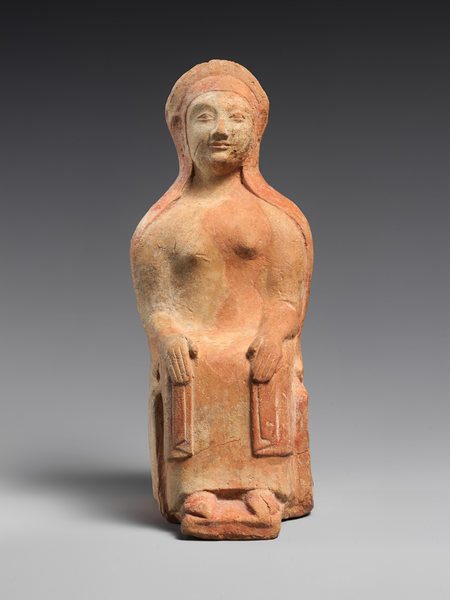
The Badari culture (c. 4400–4000 BCE) represents a developed Neolithic culture of Upper Egypt. During this period, humans transition to settled agriculture and animal husbandry, radically altering their relationship with the world. The first burials with grave goods appear, indicating the emergence of a belief in the afterlife. Objects that might be needed in another world begin to accompany the deceased. It is in this context that the first anthropomorphic figurines arise, serving as magical substitutes for the deceased.
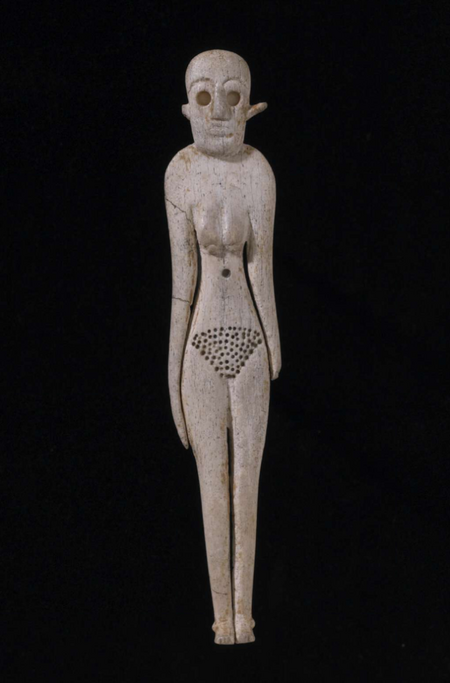
The Badary artisans used hippopotamus bone and ivory to create figurines. The choice of material was not arbitrary: animal bone linked humans to the totemic world, emphasizing their inseparable bond with nature. The carving technique was still primitive, which accounts for the schematic nature and monolithic quality of the figures.Nevertheless, even with a limited set of tools, the ancient sculptor knew how to capture the essential features—the reproductive characteristics that were considered sacred. The lack of detail in the faces and limbs was compensated for by the hypertrophy of the hips and chest.
First bone figurines
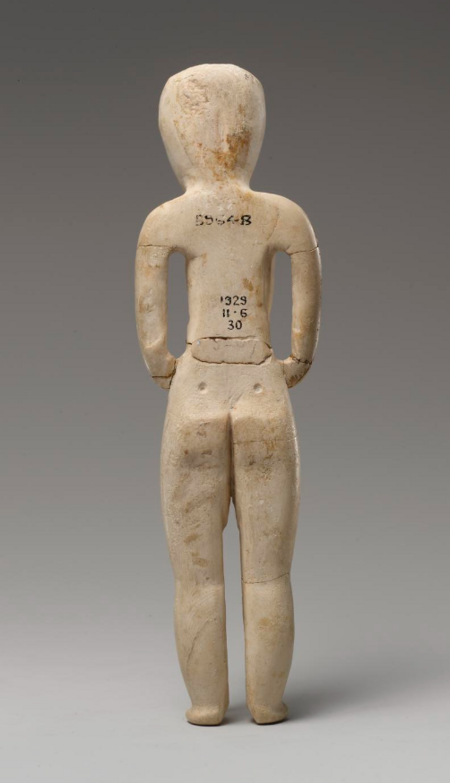
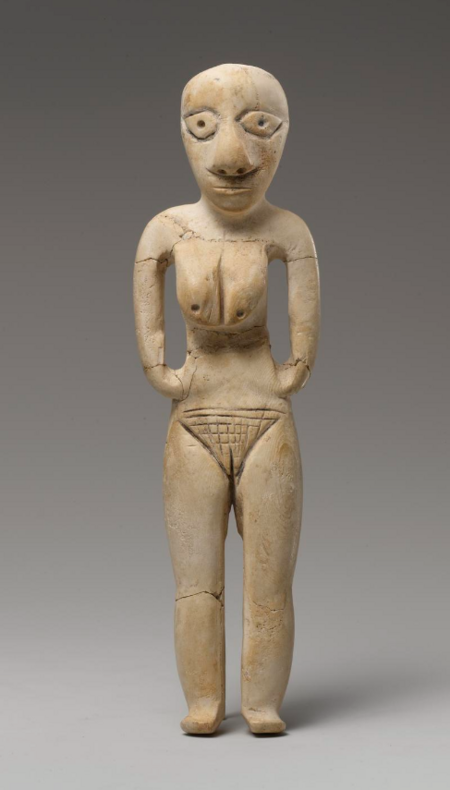
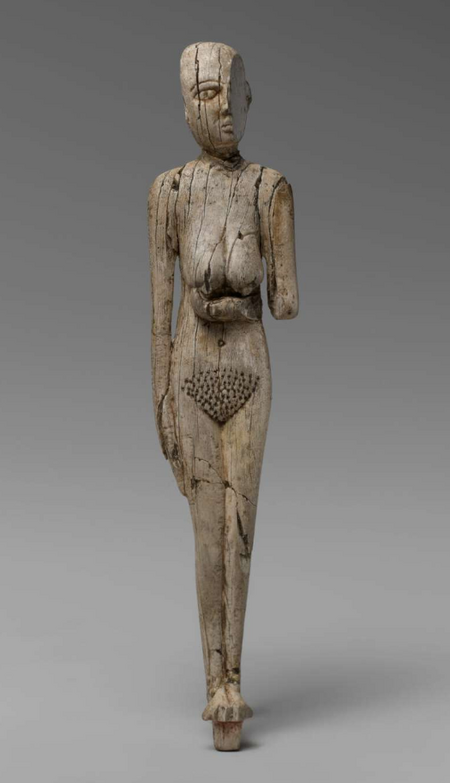
Badari bone figurine (c. 4400–4000 BCE)
Late Nakada II: humans are social beings. This path leads to the formation of pharaonic civilization.
The image presented above is a Badari bone figurine. The female figure is extremely minimalist: an elongated head without detailed facial features, arms held down by the sides, and the emphasis is shifted to the hips, chest, and pelvic area, which is accentuated by distinct, dotted dynamism.
The sculptor intentionally forgoes portrait likeness, transforming the body into a symbol of fertility and rebirth.
Such a figurine, discovered in burials, served as a magical substitute for the deceased or the giver of life. Here, the body is a vessel of fertility intended to ensure the continuation of the lineage and well-being in the afterlife. Individuality had not yet become a value; life itself was the value.
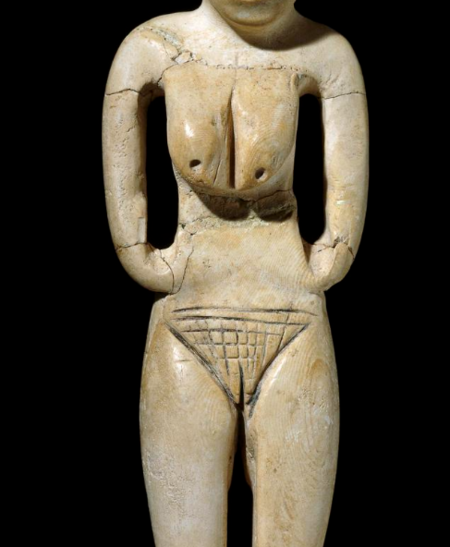
Even the smallest details of the Badari figurines hold significance. A punctate incision in the pubic area is not merely decoration, but a marker of a sacred zone associated with procreation. A net-like pattern on the body may denote clothing, tattooing, or ritual painting.
The answer to the key question of the Badaari period is as follows: the body was conceptualized as a function. It was not an individuality, nor was it a portrait of a specific person. Rather, it was a universal formula for life, necessary for rebirth in the afterlife.
In any case, the body surface becomes a carrier of information about status and function. The ancient sculptor did not «paint» the body; he «wrote» a message to the gods with it. Every scratch, every opening—it is a word in a sentence about the world.
Chapter II. Nakada I: The Body as Sign and Magical Protection
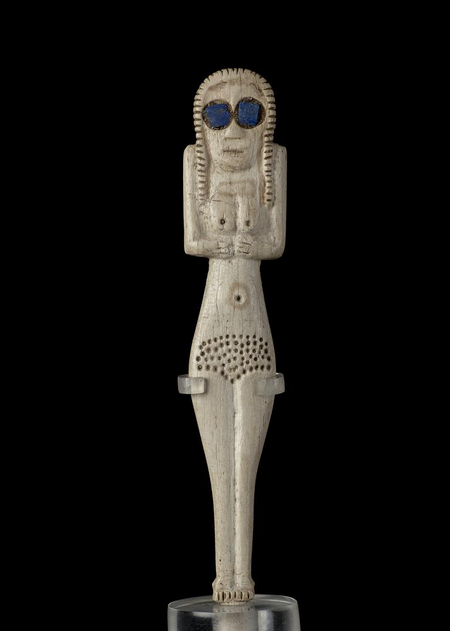
Nakada Culture I (c. 4000–3600 BCE), also known as the Amari culture, marks the beginning of the path toward statehood. During this period, there is an increase in social stratification, the emergence of the first leaders, and the development of trade.
Not only does the pottery change, but so does the perception of the human form. The body in art becomes more vertical and upward-striving. Male figures appear, indicating the formation of patriarchal structures and the ancestor cult.
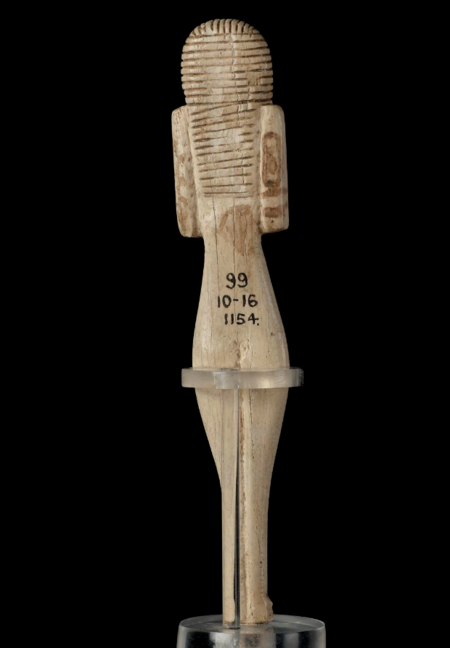
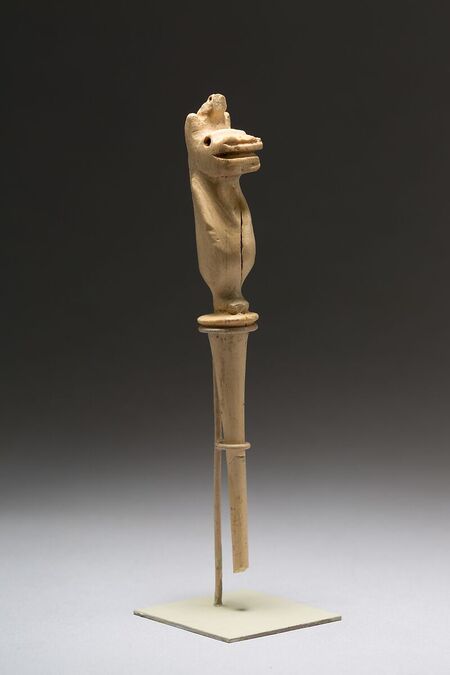
The geometrization of forms—a narrow waist, broad shoulders, and the merging of legs into a single shape—indicates the birth of a canon that would later evolve in Pharaonic art. This is a view of art where the body is a symbol that demands knowledge and an understanding of iconography, rather than mere contemplation.The notches in the body ornamentation may denote clothing or tattooing, but in any case, they emphasize the depicted individual’s social role. The body becomes a «seal.»
Lapis Lazuli Eyes
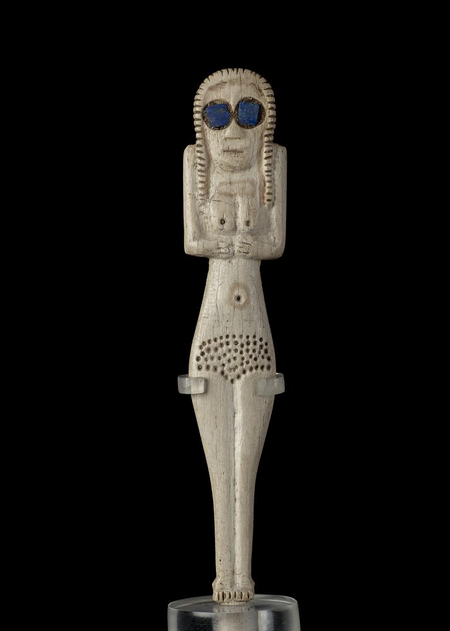
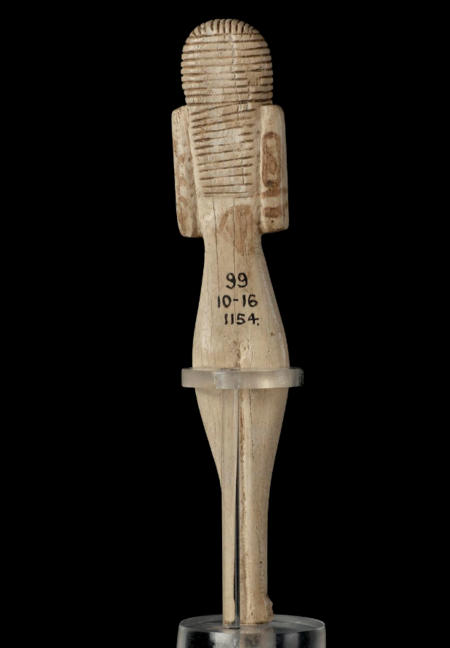
Bony figurines with lazurite eyes (Nakada I, c. 4000–3600 BCE)
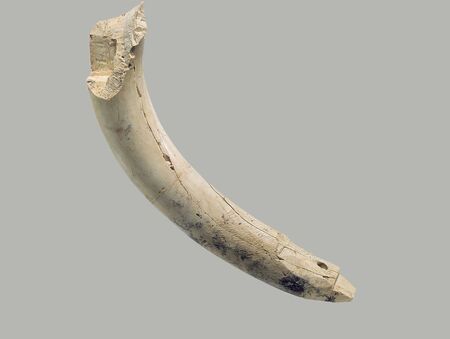
Artifacts on hippopotamus tusks
Hippopotamus tusk figurines (Nakada I — early Nakada II, c. 3800–3400 BCE) represent hybrid images. The upper part of the tusk transforms into a head with a long «beak» or beard, while the lower part remains smooth, indicating the body or a shroud.
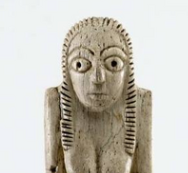
Eyes and mouth are etched with deep lines, creating an archaic, almost grotesque mask. The human body here is not separated from the animal and lacks distinct boundaries.
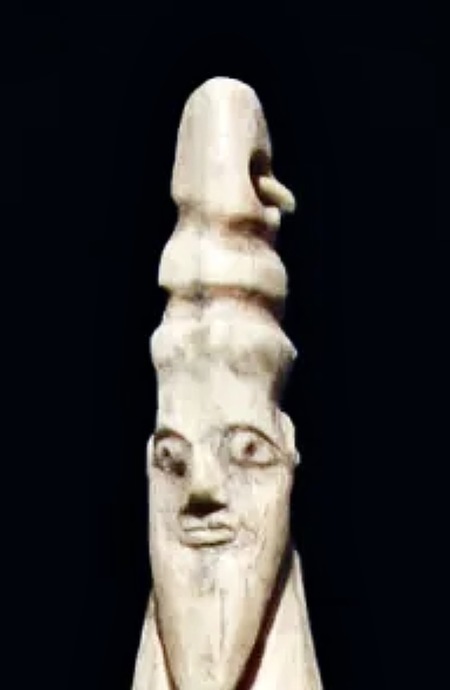
These artifacts, often called «bird-men» or «bearded men, ” demonstrate hybrid thinking. It is a body amulet, which was hung through a hole in the top. It is interpreted as a mask concealing the face.The question of „how the body thought“ is answered: the body was conceived of as a transition, a temporary casing that could be „worn“ onto a tusk or taken off. It is not whole; it is fragmented, but it is precisely in this fragmentation that it gains its magical power.
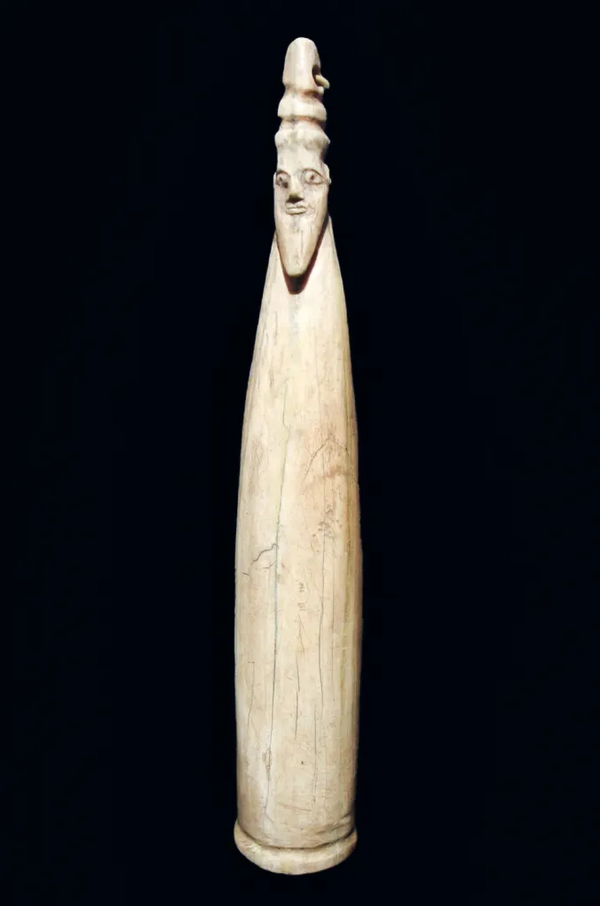
Figurines on hippo tusks (Nakada I — early Nakada II, c. 3800–3400 BCE)
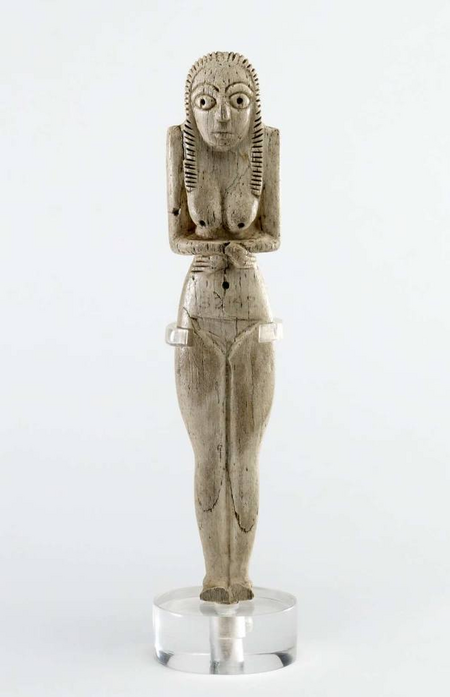
Figurines on hippopotamus tusks (Nakada I — early Nakada II, c. 3800–3400 BCE)