Navigation Menu
- Visual Research Concept The Birth of Kraftwerk: Music of the Technological Future
- Human and Machine: The Group’s Musical Language
- From Sound to Image: Kraftwerk’s Visual Identity
- Robots Instead of Musicians: The Group’s Stage Persona
- The Concert as a Digital Space: Light, Graphics, and Technology
- The Berlin Television Tower: A History of Its Creation
- Architecture of the Future: Concrete, Metal, and Geometry
- Alexanderplatz: The Space of the Technological City
- From GDR Symbol to Modern Berlin Symbol
- Dialogue Between Electronic Music and Architecture
- The City as a Stage: The Concept of a Live Performance
- The Visual System of the Event: Light, Graphics, and Stage Imagery
- Conclusion: Architecture as an Extension of Electronic Music
- Bibliography
- Image Sources
Concept
The visual research, «Architecture of the Future: Kraftwerk’s Electronic Music in the Space of the Berlin TV Tower, ” is dedicated to the interplay between music, visual art, and architecture. The main body of the research is based on the German electronic group Kraftwerk, which developed a distinctive artistic language rooted in technological imagery, mechanical rhythms, and digital graphics. The Berlin TV Tower was selected as the architectural space, as it stood as one of the most renowned symbols of Germany’s technological development in the latter half of the 20th century.
Kraftwerk created a musical world where electronic voices, repetitive rhythms, and robot imagery became the primary means of artistic expression. The television tower in Germany serves as a symbol of technological progress. In the former case, technology becomes a musical and visual language; in the latter, it becomes an architectural form that defines the image of Berlin.
Kraftwerk emerged in Düsseldorf in 1970, which was within the territory of West Germany (FRG). The Berlin TV Tower opened in 1969 in East Germany (GDR). The group and the architectural formation developed almost simultaneously, but under vastly different political and cultural conditions. This comparison allows us to examine how technology became a symbol of the future on both sides of a divided Germany.
The research is divided into three parts. The first examines the history of Kraftwerk, the second investigates the creation of the Berlin TV Tower, and the third synthesizes the research findings to propose a concept for a live Kraftwerk performance near the tower.
The core research question is: How can Kraftwerk’s electronic music interact with the architecture of the Berlin TV Tower to transform urban space into a part of a musical performance? The group’s visual identity and the TV Tower’s architectural language share common principles: geometry, technologicality, repetition, and an aspiration to express a vision of the future.
The Birth of Kraftwerk: Music of the Technological Future
Kraftwerk was founded in 1970 by Ralf Hütter and Florian Schneider in Düsseldorf. The band emerged during the development of experimental music. Unlike traditional rock groups that focused predominantly on guitars and drums, Kraftwerk began using electronic devices as the foundation of its sound.
Kling Klang Studio played one of the most crucial roles. Kraftwerk experimented with electronic instruments, synthesizers, voice processing, and repetitive musical sequences. The studio evolved into an autonomous creative environment where not only music was created, but also the artistic identity of Kraftwerk was forged. Thanks to this approach, the group was not merely a musical ensemble, but a project that unified sound, technology, and visual art.
Kraftwerk. Cover art for the debut album by Kraftwerk, 1970.
The most significant stage in the group’s development was the release of the album Autobahn. Its concept is dedicated to movement along a highway. Repetitive musical structures convey the sensation of a continuous journey, while electronic sounds shape an image of technological advancement. After transportation, communication, computers, and the interaction between humans and machines became the foundation of Kraftwerk’s creative language.
Human and Machine: The Musical Language of Groups
Kraftwerk’s musical style is built upon the use of electronic sounds, synthesizers, mechanical rhythms, and repetitive sequences. The group’s music relies on uniformity and repetition. These techniques create the impression of a mechanism where individual sounds exist as elements of a single system.
Processed vocals take up a special place in the group’s creative work. Electronic effects, synthesized speech, and vocoders allow for a change in the conventional perception of vocal performance. The voice functions not only as a means of conveying emotion but also becomes an integral part of the electronic soundscape.
Kraftwerk. Photograph of group members at electronic music equipment
The mechanical rhythm of a piece can be correlated with recurring elements in industrial design and architecture. Just as a building is formed from structural components, music is constructed from individual sound sequences. This becomes relevant for further study, as it allows electronic music to be viewed not only through its sound but also through geometric forms.
From Sound to Image: The Visual Identity of Kraftwerk
The visual identity evolved alongside the development of their musical language. The album covers transformed into autonomous artistic statements that reflected the content of the compositions. Technological imagery, geometric compositions, and limited color palettes were utilized. The visual aspect became an extension of the music.
Emil Schult. Album cover for the band Kraftwerk’s Autobahn, 1974.
In 1975, the technological theme receives a new visual continuation in the Radio-Activity album. The radio receiver in the image references information transmission devices while simultaneously alluding to the nature of electronic sound itself. The object becomes the primary artistic motif of the cover. Kraftwerk transforms elements of contemporary technological culture into the signs of their own visual system.
Emil Schult. Cover art for the Kraftwerk album Radio-Activity, 1975.
The album Trans-Europe Express was released in 1977. It is dedicated to movement, transportation systems, and the image of modern Europe. The cover features portraits of the musicians in sharp suits. The members appear restrained and still, a stark contrast to typical rock aesthetics. This image underscores the group’s commitment to discipline and the construction of a distinct public persona.
Morris Seymour. Photographic portrait of Kraftwerk for the Trans-Europe Express album, 1977.
Emil Schult. Album cover for Kraftwerk’s Computer World, 1981.
Robots in place of musicians: the stage persona of a band
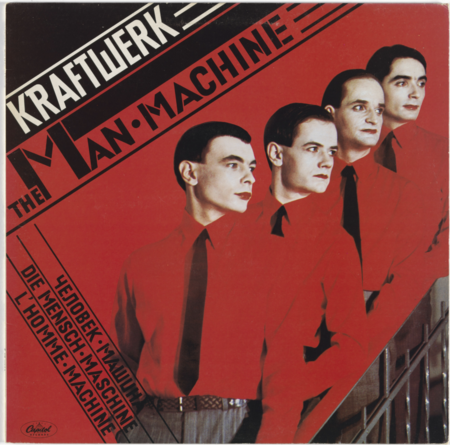
Kraftwerk’s most iconic image is the robot. This theme was particularly emphasized in the album The Man-Machine, released in 1978. On the cover, the musicians are wearing identical red shirts and black ties. The poses are rigid, the clothing is repetitive, and the color palette is limited. This imagery conveys the impression of a unified mechanism where individuality yields to a collective system.
Karl Kliefisch, Günter Fröling. Cover art for the Kraftwerk album The Man-Machine, 1978.