Concept
Topic and Artwork Selection
In Soviet animation, architecture helps the viewer understand the structure of the fictional world. Based on the form of the buildings, the scale of the interiors, the color, and the placement of objects, one can surmise how its inhabitants live, what technologies are available to them, and how safe the environment is. These details shape the film’s atmosphere and influence the plot’s development. The connection between the artistic representation of space and the events occurring became the starting point for this research. Four works from 1981–1988 were chosen for comparison: Roman Kachanov’s «The Secret of the Third Planet,» Efrem Pruzhansky’s «Alice Through the Looking Glass,» Nazim Tulyakhodzhaev’s «It Will Rain Kindly,» and Vladimir Tarasov’s «The Pass.» They were created by different studios and feature diverse fantastic spaces. The first film showcases vibrant space cities, public areas, and researchers' technology. In the second, familiar objects obey unusual rules. The third deals with an automated house after its inhabitants have disappeared. The fourth sets the action in a harsh alien landscape. This selection allows for a comparison of 1980s approaches without claiming to characterize all of Soviet animation from that era. Architecture is examined broadly: buildings, interiors, transportation structures, routes, and object systems. The natural landscape is included in the analysis when it dictates movement, the scale of the human figure, or the placement of shelter. The material consists of 30 original frames from the four films and four short video clips. The frames allow for an examination of the set designers' final decisions, while the videos illustrate how the environment unfolds in motion.Material Selection and Analysis Principle
Each scene is analyzed based on several criteria: architectural form, color and texture, composition, scale, object function, and spatial accessibility. It is crucial to understand what impression these elements create for the viewer, what role they play in the event, and what they reveal about the image of the human, technology, and society. Ideas about the future are primarily explored in films where the plot is connected to technology and the structure of future life. For «Alice in Wonderland, ” the spatial contingency and the alteration of familiar rules are more important. The comparison is built around four models: the territory of discovery, the system of rules, the house without people, and the space of trial. These help answer the question of how architecture and environmental design shape the character of a fantastic world and sustain its narrative. Particularly telling are analogous situations with different meanings: a habitable ship versus a hard-to-reach technical shell, a communal table versus an empty place for a meal, a recognizable road versus a complex route. The primary methods involve compositional and comparative analysis of frames and episodes, supplemented by information from credits, catalogs, and interviews. Artistic effects are described according to visible material; the authors' intentions are asserted only when a corroborating source is available. The research outcome must demonstrate how spatial solutions unveil the character of fictional worlds, the human attitude toward technology, and the living conditions of their inhabitants. For environmental and industrial design, this topic is critical due to the connection between an object’s form, its perception, and its potential use.
Problem statement, research question, hypothesis
Problem Statement
In fantastic animation, architecture and the material environment shape the perception of an imaginary world. However, their role is often examined primarily through the peculiarity of the drawing and decorative features. For a more complete analysis, it is important to determine how architectural forms, color, scale, and composition create atmosphere, reveal the character of the world, and participate in narrative development. This leads to the research question and hypothesis.Research Question
How do the architecture, environmental design, and artistic means of Soviet science fiction animation from the 1980s shape the character of fictional worlds, influence the viewer’s perception, and help unfold the plot?Hypothesis
Architecture and the spatial environment participate in creating the artistic image of the fictional world and developing the narrative. Through form, scale, color, composition, and spatial organization, artists convey atmosphere, reveal the characteristics of the surroundings, and express notions about the relationship between humanity, technology, and society.Research Goal, Objectives, Object, and Subject
Objective
To investigate how the architecture and artistic design of the spatial environment shape the imagery of fictional worlds and contribute to the storytelling in Soviet animated films from the 1980s.Tasks
To analyze four animated films; to examine architectural forms, scale, color, texture, and composition; to determine their influence on atmosphere and the perception of space; to establish the connection between the artistic solutions and the plot and character actions; to compare representations of humanity, technology, and world structure; and to formulate general conclusions.Object of Study
The fictional worlds of four selected Soviet animated films.Subject of Study
The architectural and spatial design solutions, their artistic expressiveness, and their role in creating the image of the fantastic world and developing the narrative.Methodology
The core of the research consists of a comparative visual and compositional analysis of the original frames. The analysis examines form, scale, color, texture, spatial depth, object placement, and the relationship between characters and their surroundings. Four video inserts illustrate the transformation of space in motion. Information from title cards, catalogs, and interviews is used to refine the historical and authorial context.
Navigation
1. Introduction 2. The World as a Territory of Discovery 3. The World as a System of Rules 4. The Home That Lost a Person 5. Space as a Challenge 6. Four Models of Space 7. Conclusion
1. Introduction
Soviet science fiction animation of the 1980s crafted various images of fictional worlds: vibrant cosmic cities, a nation with mutable rules, automated housing, and harsh alien territories. The atmosphere of these worlds is formed by architectural forms, color, texture, and composition. These same elements help the viewer understand the environment in which the characters exist and what events are possible within it. Through four examples, we will trace how the artistic design of space connects to the development of the narrative and perceptions of humanity, technology, and society.
«The Secret of the Third Planet.» Director Roman Kachanov; Production Designer Natalia Orlova. Soyuzmultfilm, 1981. Original Frame 02:00
The fantastic city is depicted through a system of towers, bridges, and varying-height structures. A large vertical volume stands out in the foreground, behind which a smaller urban fabric continues. The difference in scale establishes several spatial planes and prompts the viewer to mentally divide the environment into distinct zones. The city is perceived as a complex yet organized environment. Exposed supports and crossings suggest possible pathways, even though the full routing remains unknown. The contrast between the dark near volume and the light distant cityscape makes the depth legible; the varied silhouettes lend the city a vibrant diversity. Familiar architectural elements, rendered in unconventional proportions, help suggest the function of the structures and convey the autonomy of the fictional world. This approach to spatial construction is particularly crucial for «The Mystery of the Third Planet»: the journey necessitates constant exploration of new places, and visual landmarks help maintain a coherent logic for the events unfolding.
«The Pass.» Director Vladimir Tarasov; production designers: Anatoly Fomenko, Svetlana Davydova, Tatiana Zvorykina. Soyuzmultfilm, 1988. Original frame 06:00.000
In the shot from «The Pass,» the character’s large face occupies a significant portion of the image, while the stretched texture of the surface guides the viewer’s eye into the depth. A distant light form serves as a landmark, yet its distance is difficult to ascertain. The space is perceived through the figure’s placement and the limited field of their vision. Unlike the multi-layered city in the previous frame, familiar architectural cues are almost absent here. Repeating landscape elements create a rhythm, but their scale and function remain unclear. The viewer must evaluate the surroundings alongside the character, using their body as the only discernible measure. The recurring graphic rhythm and the sharp tonal contrast between the face and the surface create a tense atmosphere. The number of visible objects alone does not define the environment’s legibility; to connect what is seen to a route, the viewer requires familiar landmarks and the ability to gauge distance. In this shot, the sensation of an unfamiliar world emerges alongside the limitations of human sight.
Conclusion
In both frames, the artists employ scale and compositional depth, yet they create different perceptual experiences. The fantastic city offers numerous landmarks, whereas the unfamiliar landscape makes distance and direction less defined. This dependency will be examined further through the structure of specific worlds.2. The World as a Territory of Discovery
«The Secret of the Third Planet» (1981)
In Roman Kachanov’s film, the journey is constructed as a sequential introduction to diverse environments. The spacecraft, public structures, industrial infrastructure, and natural territories form a setting where the characters constantly encounter new objects and methods of action. Production Designer Natalia Orlova worked on the imagery of fantastic locations, including the robot planet of Shelezyak and Bluk. When analyzing these spaces, it is important to track how familiar functions combine with unusual forms and help the viewer navigate.«The Secret of the Third Planet.» Director Roman Kachanov; Production Designer Natalia Orlova. Soyuzmultfilm, 1981. Original frame 47:00
The spacecraft «Pegasus» stands out among the flora due to its vertical composition. Rounded tiers, supports, and upper structures are assembled around a central axis. Unlike the winding forms of plant life, the technical object possesses a clearly legible geometry and a stable silhouette. Its significance unfolds through the sequence of journeys. Characters visit different planets, encounter unknown creatures, and explore unfamiliar territories, yet they retain their own inhabitable space. «Pegasus» becomes a constant point of return, linking the disparate episodes of the film. The ship’s stable silhouette and clear geometry express confidence in the capabilities of space technology: amidst unfamiliar vegetation, a recognizable human anchor is maintained. This helps the viewer navigate the change in environment and connect various locations into a unified route. «Pegasus» supports the independence of the travelers; they have a place from which the exploration begins and to which they can return.
«The Secret of the Third Planet.» Directed by Roman Kachanov; production designer Natalia Orlova. Soyuzmultfilm, 1981. Original frame 08:20
The Gromozeka is significantly larger than a human, yet the characters interact around a familiar table. The composition keeps them within a shared space of communication: the arrangement of the chairs and tabletop unites the figures, despite the differences in their sizes. The artists retain the recognizable scenario of a public interior while altering the ratio between the body and the material environment. The viewer understands the nature of the scene through the spatial organization. The fantastical creatures are perceived as participants in social life with familiar needs for interaction. Here, an important characteristic of the fictional world emerges: the physical differences between the characters do not impede the shared use of space. Its structure allows for contact. This principle can later be compared to the empty dining table in the film It Will Rain Softly, where the familiar organization of the interior is maintained, but communication becomes impossible.
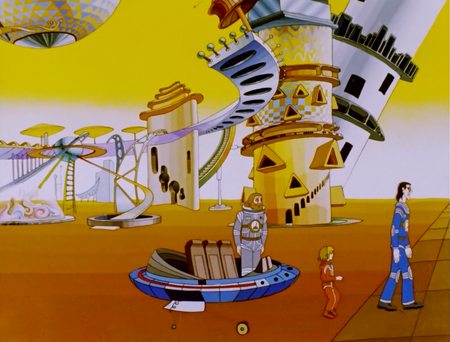
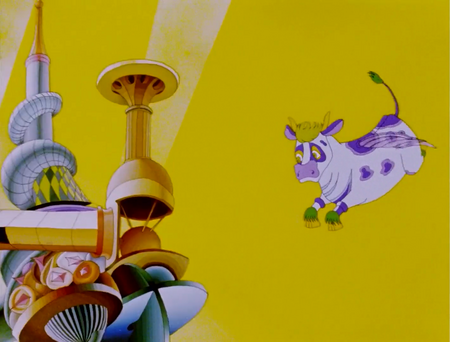
«The Secret of the Third Planet.» Directed by Roman Kachanov; Production Designer Natalia Orlova. Soyuzmultfilm, 1981. Original frame 13:00 «The Secret of the Third Planet.» Directed by Roman Kachanov; Production Designer Natalia Orlova. Soyuzmultfilm, 1981. Original frame 17:00 (left to right)
The Museum and Market of Bluke illustrate two modes of social interaction. On the left side of the frame, rounded volumes, tall supports, and sections of the building elevated above the ground create an unfamiliar geometry, but the figures of the visitors and the events of the scene make the structure’s purpose clear. The expedition comes here in search of information regarding the captains: the architectural setting connects the search with the history of a fantastic society and its practice of memory preservation. On the right side of the frame, elongated supports, rounded plazas, and a peculiar creature form a rich, multi-layered composition. The bright background and contrasting silhouettes convey the vibrancy of Bluke. While the museum provides access to preserved knowledge, the market scene puts the characters in direct contact with the planet’s inhabitants. The diversity of forms suggests different activities and modes of transit, and the familiar scenario of exchange helps the viewer understand the unusual environment. Both spaces participate in an investigative journey through different forms of social life: the appeal to memory and the direct encounter. The architectural strangeness is sustained alongside the recognizability of its functions; color and composition transform this relationship into an image of a populated, accessible cosmos for exploration.
«The Secret of the Third Planet.» Directed by Roman Kachanov; production designer Natalya Orlova. Soyuzmultfilm, 1981. Original frame 25:00
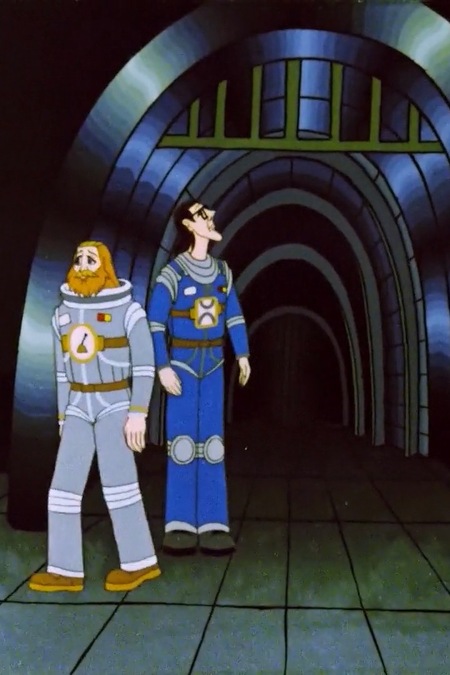
The interior of Shelezhyaka is structured by staircases, pipes, passages, railings, and cylindrical mechanisms. Repeating geometries unify the individual components into a cohesive technical environment. The vertical and horizontal transitions suggest the presence of multiple service levels. Unlike the open and dense space of Bluk, Shelezhyaka’s space is perceived through its apparatus. The repetition of pipes, cylinders, and railings creates an industrial rhythm; the restrained cool tones amplify the impression of a mechanized environment. Movement is linked to the operation and access to these devices, so their arrangement simultaneously defines the look of the interior and explains its functions. According to the plot, the protagonists encounter malfunctioning robots. Consequently, the technical interior takes on the meaning of a place requiring intervention. The expedition shifts from observation to assistance. This episode refines the model of discovery. Encountering a new world requires the ability to understand the workings of another system and discover its limitations. The architectural organization aids the viewer in grasping this challenge.
«The Secret of the Third Planet.» Director Roman Kachanov; Production Designer Natalya Orlova. Soyuzmultfilm, 1981. Original frame 33:00
Light, rocky forms rise out of the mist, creating an alternation between close and distant planes. Vertical masses occupy a significant portion of the image, and the gaps between them appear narrow and ambiguous. Cold, light tones and bands of fog soften the boundaries of the distant forms, establishing a mysterious, almost weightless atmosphere. The composition conveys a sense of depth but does not reveal the sequence of transitions. The viewer sees a vast expanse while simultaneously experiencing uncertainty—a clear path through it still needs to be found. Unlike technical or civic interiors, the natural environment lacks a familiar functional organization. Navigating it requires direct movement, testing distances, and seeking passage. This suggests that the world of «The Mystery of the Third Planet» is not merely about free travel between accessible locations. Some territories create their own obstacles. The narrative’s exploratory nature persists precisely because new objects and landscapes must be studied.