Concept
Urbanization, the rise of the urban middle class, and the concentration of economic and social opportunities in large cities contributed to the proliferation of high-rise apartment housing. Given the high population density and limited urban space, the apartment building became one of the primary forms for organizing residential space. Yet, the pursuit of individual comfort and privacy was complicated by the necessity of constantly coexisting with many people occupying physically close, yet formally segregated, spaces.This form of housing organization shaped specific relationships between neighbors. Unlike traditional forms of local community, spatial proximity in an apartment building does not necessarily imply social closeness. Residents might live next door to each other for years without knowing each other’s names or engaging in direct interaction. The neighbor is simultaneously physically near, yet depersonalized: they may constantly be present in a person’s daily life while remaining outside their established social connections.Furthermore, the structure of apartment buildings rarely guarantees complete isolation from one’s neighbor. Insufficient soundproofing in walls and floors makes the daily lives of others accessible through sound. Footsteps, conversations and arguments, music, dog barking, moving furniture, and the operation of household appliances—along with other noises—filter through the physical boundaries of the dwelling, serving as evidence of the invisible Other’s presence.


1. Murino, suburb of Saint Petersburg 2. Kudrovo, residential complex «Noviy Okkervil»
Raymond Murray Schafer, a Canadian composer and ecologist, describes in his text «Industrial Revolution» how the right to produce noise without censorship is a sign of absolute power. Thus, regular noise from neighbors can be viewed as an invasion of private life and space. Resistance to neighbor noise is therefore seen as an attempt to reclaim control over personal space.
In the article «Strong, Weak and Invisible Ties: A Relational Perspective on Urban Coexistence,» Maxim Felder, while reviewing literature on typifying neighborly relationships, mentions that a «good neighbor» is one who maintains a friendly distance. Also common types of relationships in apartment buildings are those where one only knows the other exists and occasionally observes them. In other words, people living in the same building rarely form close relationships or engage in dialogue, share responsibility, etc. Therefore, Felder calls this relationship a «familiar stranger.» However, if this person, despite being a stranger, regularly bothers with noise.
Ambient noise functions as a form of unintentional communication between people who may never meet. The audibility of someone else’s life often becomes irritating—it is perceived as an intrusion into one’s personal acoustic space.
To assert the right to personal sound space, people have long started using powerful speakers and subwoofers as retaliation against loud neighbors. As a result, a specialized product called «Anti-Neighbor» has emerged in the market—a powerful vibration speaker that turns solid surfaces (ceilings, walls, floors) into a source of loud sound and vibration to affect noisy residents through the wall.
Speakers on OZON
In this study, I aim to explore how everyday noise becomes a medium of mediated communication between neighbors and under what conditions this interaction escalates into conflict. Special attention is paid to practices of acoustic resistance: how residents, without engaging in direct dialogue with their neighbors, utilize the «Anti-Neighbor» device to delineate and defend the boundaries of their own acoustic space.
The research is based on an analysis of user comments published on marketplaces under the «Antisocial Neighbor» device listings, as well as comments on a related YouTube video report. These materials are considered evidence of the subjective perception of neighborhood noise and acoustic resistance practices. The comment analysis allows us to trace how everyday noise becomes a basis for forming perceptions of the Other, the emergence of conflict, and attempts to defend one’s own acoustic space.
The Neighbor as Stranger: Social Distance in Conditions of Spatial Proximity
Most neighbors perceive one another as an invisible social environment. Sociologist Olga Tkach, in her study «Elastic Neighboring: Everyday Life Within the Geometry and Materiality of Large Housing Estates, ” examines the daily relationships among residents of large residential complexes in St. Petersburg. The author notes that expectations for neighborly civility decrease each year due to the high density of people in the area and the frequent turnover of residents. She introduces the concept of „elastic neighboring,“ demonstrating that the boundaries of neighborly interaction are flexible and dependent on architectural, material, and social circumstances. Living in the same building does not necessarily create a community; residents may maintain formal relations, limit themselves to greetings, or interact only when a common problem arises.One of the respondents characterizes neighbors as only those who live immediately adjacent to the boundaries of her apartment: „Today, neighbors are only those in my immediate circle—up, down, left, right, and everyone else.“ This definition of neighbors is shaped by the fact that communication through acoustic space occurs far more frequently than face-to-face interaction.Even personal encounters rarely lead to close bonds. One respondent said that while she feels guilty about avoiding greetings with her neighbors, she still prefers to remain „invisible“ in the massive building. Some participants in the study were unsure about the number of floors, meaning they might not even be aware of the existence of certain neighbors.
Apartment numbering in the entrance hall
This situation can be examined through the concept of the stranger, as defined by Zygmunt Bauman. In his book Modernity and Ambivalence (1991), Bauman describes the stranger as a figure that disrupts the customary dichotomy of the familiar and the unfamiliar. The stranger exists within the space of everyday life, yet occupies no defined place within the system of close social relationships.Applied to the apartment building, this concept allows us to view a neighbor as someone who is simultaneously close by and remains a stranger. Residents share common infrastructure—walls, floors, landings, and utility systems—but this material communalism does not guarantee social intimacy.
An apartment building presents a space of contradictory cohabitation. Its architecture allows for individual organization of daily life, yet simultaneously makes residents interdependent. This contradiction becomes particularly apparent when one person’s actions extend beyond their own apartment and begin to affect the daily lives of others.
The Acoustic Presence of the Other: Domestic Noise as an Invasion of Private Space
Following the Industrial Revolution, when the clamor of city life drowned out the sounds of nature and human activity, the right to silence and acoustic space became particularly valuable. To describe the modern soundscape, Raymond Scheffer uses the concept of acoustic overcrowding—a state in which numerous sounds overlap, making them difficult to distinguish and creating a constant auditory load. In his analysis of the influence of industrial noise on soundscape quality, he also noted: «the person with a loudspeaker is more imperialistic than the person without a loudspeaker, because they can dominate a larger sonic space.»Although Scheffer primarily examines historical changes in the soundscape, his approach allows us to consider acoustic overcrowding at the level of an individual dwelling. In an apartment building, a person is compelled to perceive not only the sounds of the city but also the acoustic traces of their neighbors' lives.
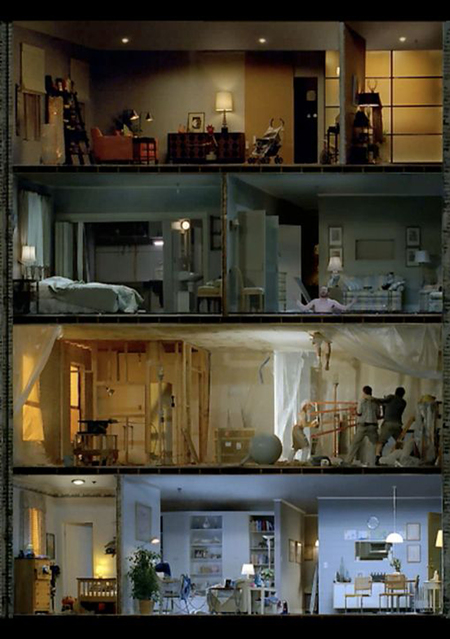
HBO Voyeur Project 2007
In the article «Public Intimacy in Neighbour Relationships and Complaints» (2006), Elizabeth Stocko examines a specific form of forced proximity between neighbors. The physical boundaries of housing do not impede the flow of information regarding the private lives of its inhabitants. Sounds of conversations, family interactions, and daily activities become accessible to outsiders who do not necessarily seek to hear them. In this scenario, the invasion of privacy is mutual: one person unintentionally discloses details of their life, and the other is forced to become their listener.This acoustic proximity takes on a particularly contradictory nature when there is no direct interaction between the neighbors. A person may not know their neighbor personally but regularly encounters the consequences of their presence. Moreover, the limited information about the other fosters subjective interpretations of their behavior. Repeated noise can be perceived not as a random result of domestic life but as a sign of disregard for another’s comfort or even a deliberate violation of personal boundaries.Consequently, domestic noise can transform from a mere reflection of another’s life into the basis for conflict regarding the Other. This intrusion occurs not through the physical crossing of apartment boundaries but through the propagation of sound that the listener cannot fully control. When direct communication between neighbors is absent or ineffective, the desire to restore acoustic privacy may lead to seeking alternative ways to influence the source of the noise.
Acoustic Resistance
Before examining the marketplace comments, let’s look at how people dealt with neighborhood noise before the advent of specialized technology.


1. 2019 Report on the Revenge of a Man from Nizhny Novgorod Against His Neighbors 2. 2021 Report on the Court Proceedings
Yuriy Kondratyev, as reported, drove his neighbors crazy for two years with a speaker pointed upward. At first, he played classical music and the work of the German metal band Rammstein; later, he started playing the sound of a horse whinnying.
He grew tired of the stomping from the upstairs neighbors and the noise created by that family’s children. He is very comfortable being in an environment of loud home music all the time. He tells the reporter directly that he has a choice between using headphones/earplugs to block out external sounds and using a loud speaker inside his apartment. This brings up the issue of invasion of privacy. Therefore, the man chose not to endure the endless acoustic intrusion from his neighbors and started filling the sound space himself. Even though he has to wear earplugs in his own apartment, he is not bothered by the very loud noise and music he generates himself.



Following several lawsuits from neighbors, a criminal case was opened. The sentence was a suspended prison term of three and a half years. The neighbors remained dissatisfied with the verdict and feared Yuri’s return to the building. Many residents described his activities as deliberate torment.