Бархат и шёлк в женском парадном портрете XVI века
Живописные приёмы, орнамент и символика ткани.
This research examines the depiction of velvet and silk in 16th-century female formal portraits. Using works by Titian, Bronzino, Sofonisba Anguissola, and English court painters, it explores the pictorial methods used to convey the texture, color, and ornamentation of fabrics.
Particular attention is paid to how the depiction of costume influences the portrait’s composition, emphasizes the model’s social status, and contributes to the creation of a symbolic image.
The comparative analysis ultimately highlights three primary functions of textile representation: pictorial, compositional, and representational.
Navigation
- Concept
- Key Question and Hypothesis
- The Parade Portrait: Why Does Clothing Become the Focal Point?
- Velvet and Silk: How Does the Artist Transform Material into Image?
- One Era—Different Artistic Solutions
- When Does Fabric Become More Important Than the Face?
- From Texture to Image: What Does Fabric Tell Us?
- Conclusion
- Bibliography
- Image Sources
Concept
In 16th-century formal portraits of women, clothing often occupies a significant portion of the image. Artists meticulously render the folds, ornaments, sheen of silk, depth of velvet color, and intricate costume detailing. At times, the gown captures as much attention as the woman’s face. This focus on textiles is linked to the characteristics of courtly portraiture. Clothing served to convey a family’s wealth, a woman’s social standing, and her cultural affiliation. Furthermore, the artist did not merely reproduce the costume; they selectively emphasized certain details, controlled the distribution of light, and determined the fabric’s placement within the composition. The study examines 16th-century formal portraits of women created in Italy, Spain, and England. Special attention is paid to the works of Titian, Agnolo Bronzino, Sofonisba Anguissola, and English court painters. Comparing these portraits allows one to trace how the depiction of luxurious fabrics evolves depending on the artist’s style, composition, and the portrait’s intent. The research is based on the analysis of full images and enlarged fragments of the clothing. Texture is treated as the starting point for understanding broader artistic decisions.
Key Question and Hypothesis
Key Question
Why has the depiction of luxurious fabrics become one of the most significant expressive elements in the 16th-century formal portrait of women, and how did artists from different schools utilize it to craft an image?
Hypothesis
I propose that the depiction of velvet and silk in 16th-century female portraits served several functions simultaneously. On one hand, artists strove to convincingly convey the material’s properties: luster, color depth, folds, and ornamentation. On the other, the fabric helped organize the composition, guide the viewer’s eye, and establish the depicted woman’s social standing. I also suggest that the meaning of the fabric shifted depending on the artistic objective. In some works, it became the primary decorative focal point; in others, it emphasized the face and figure; and in royal portraits, it could participate in constructing a symbolic image of power.
Research Methodology
To test the hypothesis, I am using comparative visual analysis. I am examining the works based on four main criteria:
- Material and painting technique: how color, light, drapery, and ornamentation have been rendered.
- Composition: what role the clothing plays and how it directs the viewer’s attention.
- Artistic style: what differences can be observed between the works of different artists.
- Historical context: how the costume relates to court culture and the purpose of a specific portrait.
I am also using magnified excerpts from the works to compare individual pictorial solutions. It is important to note that the appearance of fabric does not always allow for precise material identification. Therefore, I distinguish between my own visual observations and information confirmed by museum descriptions.
The Parade Portrait: Why Does Clothing Become the Focal Point?
In the 16th century, the formal portrait was a means of presenting an individual according to their social standing. The artist considered not only the model’s appearance but also her pose, gestures, background, surrounding objects, and clothing. All these elements contributed to creating a specific impression. In women’s court portraits, costume held particular significance. Expensive fabrics, intricate tailoring, and embellishments were tied to court culture and the family’s material wealth. However, I became interested in the fact that clothing was not always a secondary detail. In some works, it is precisely the costume that forms a significant part of the composition and becomes one of the main visual focal points. To understand this, I decided to compare portraits in which artists distribute attention differently between the face and the costume.
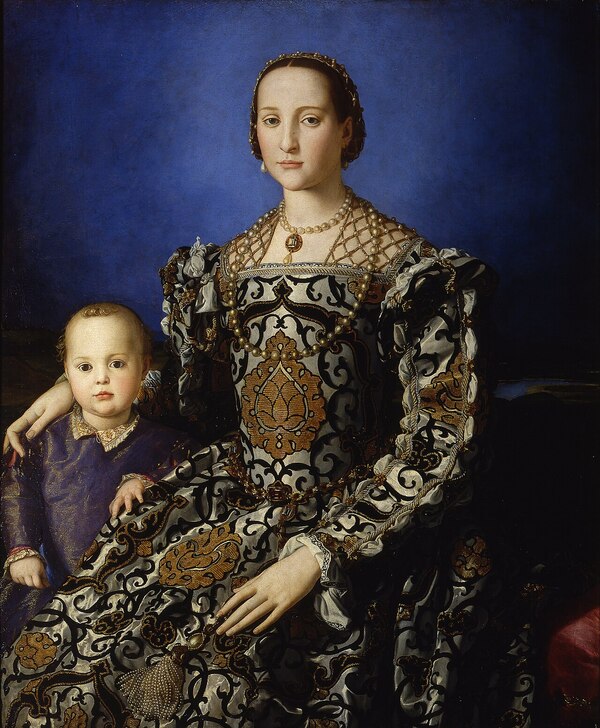
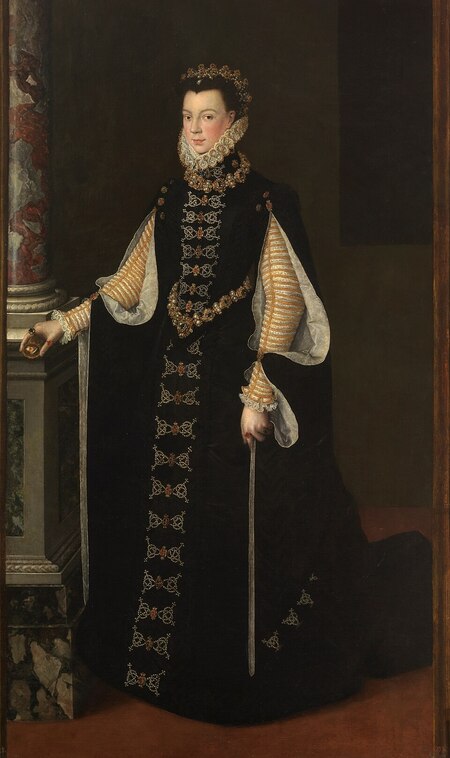
1. Agnolo Bronzino. «Portrait of Eleonora di Toledo with Son Giovanni,» c. 1545. 2. Sofonisba Anguissola. «Elizabeth of Valois with the Portrait of Philip II,» 1561–1565.
In Eleonora Toledo’s portrait, the Duchess’s gown immediately catches my eye. It occupies a significant portion of the image, and its large ornamentation is clearly visible even without zooming in. Meanwhile, Bronzino maintains a clear compositional hierarchy. Eleonora is positioned in the center, and the figure of her son Giovanni underscores the portrait’s dynastic content. The portrait of Elizabeth of Valois, created by Sophonisba Anguissola, is constructed quite differently. Here, dark clothing predominates. Against this backdrop, her face, hands, jewelry, and a small portrait of Philip II that the Queen holds are highlighted. Comparing the two, I noticed that the clothing serves different purposes. In Bronzino’s work, the fabric draws attention to its own surface. In Anguissola’s, the dark costume helps to emphasize other significant elements of the image. It turns out that even within the same genre, clothing can function as both an independent decorative accent and a means of organizing the composition.
To understand these distinctions, I examined the circumstances under which the portraits were created. Bronzino worked at the court of the Medici. Eleonora di Toledo was the wife of Cosimo I de' Medici and held an important position in Florence. According to Uffizi research, she participated in governing the state during her husband’s absence. Therefore, her portrait depicts not only a wife and mother but also an influential woman at court. The silken damask depicted holds particular significance. This expensive material was connected to Florentine textile production. Sophonisba Anguissola, conversely, worked at the Spanish royal court. In the portrait of Elizabeth of Valois, the miniature of Philip II emphasizes her status as the king’s wife.I concluded that the meaning of the clothing cannot be fully grasped without historical context. In one case, the dynastic role and courtly splendor are especially important; in the other, it is the official status and family connection.
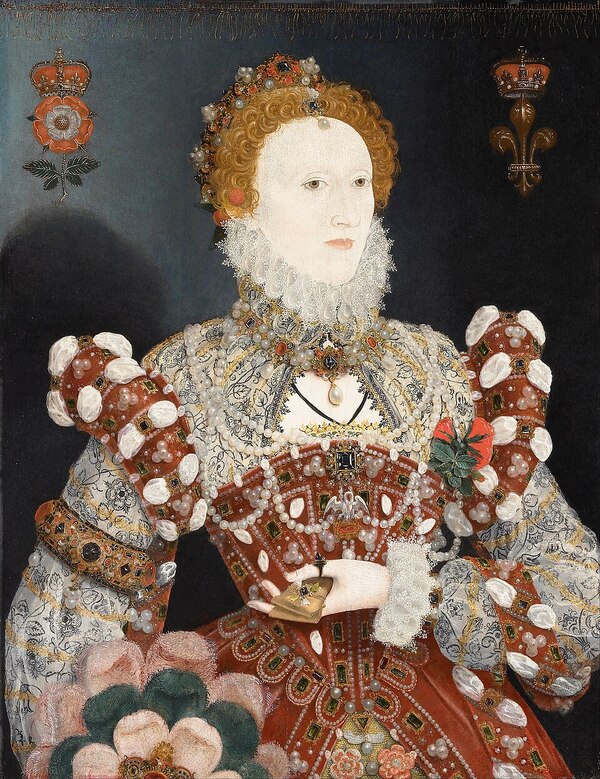
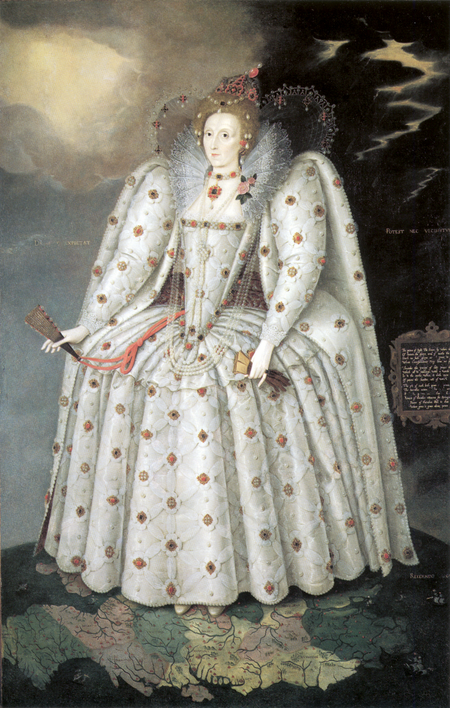
1. Nicholas Hilliard or his workshop. «Portrait of Elizabeth I with a Pelican, ” c. 1575. 2. Marcus Gerards the Younger. „Ditchley Portrait“ of Elizabeth I, c. 1592.
In the «Portrait of Elizabeth I with Pelican, ” attention is drawn to the red decorative elements of the costume, the intricate fabric embellishment, pearls, and precious jewelry. In the „Ditchley Portrait, ” Elizabeth is presented full-length. Here, the costume is perceived differently: the broad silhouette of the gown becomes part of a monumental composition. I was interested in how the first work directs focus to the texture and ornamentation of the fabric, whereas the second emphasizes the overall scale of the figure. The „Ditchley Portrait“ was likely commissioned by Sir Henry Le in connection with the Queen’s visit to his estate in 1592. Elizabeth is depicted standing on a globe featuring a map of England, and the surrounding space is filled with symbolic details. Therefore, her dress cannot be considered in isolation from the composition; it reinforces the impression of majesty and helps to form the official image of the monarch. First conclusion: clothing in a formal portrait does not simply display wealth. It can define the figure’s scale, draw attention to specific details, or participate in creating a monumental persona.
Velvet and Silk: How Does Material Transform into a Pictorial Image?
To understand how fabric can be depicted, I first examined the characteristics of the materials themselves. Velvet is distinguished by its nap. Depending on the direction of the pile and the lighting, its color can appear deeper or lighter. Silk is a fiber used to create fabrics with various properties. Therefore, one cannot assume that every silk fabric must be smooth and lustrous. For instance, damask is a patterned fabric, where the design is created by the interlacing of threads. Brocade is known for its complex decorative pattern, sometimes incorporating metallic threads. The painting conveys all these properties through pictorial means. However, the artist is not merely copying the material. Instead, they choose which features to emphasize and how to integrate the fabric into the overall composition.
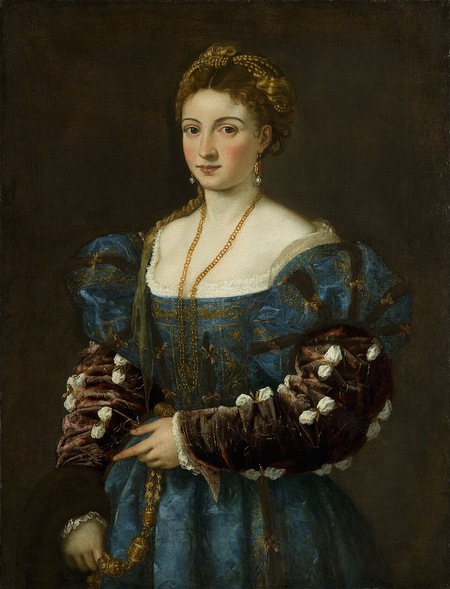
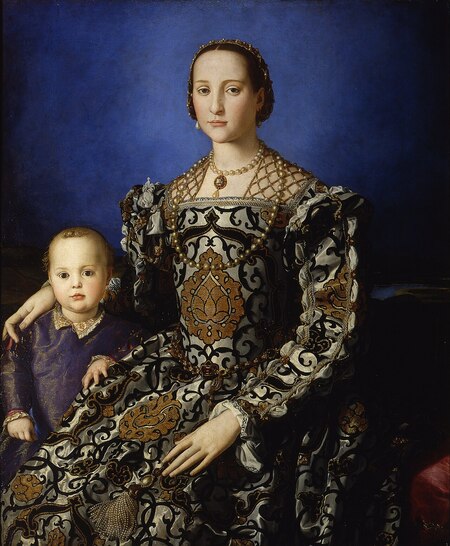
1. Titian. «The Beauty, ” 1536–1538. 2. Bronzino. „Portrait of Eleonora of Toledo with Son Giovanni, ” circa 1545.
In Titian’s «The Beauty,» a woman is depicted wearing a blue patterned dress with dark-red velvet sleeves. I was drawn to how the artist renders two different materials within a single costume. The velvet sleeves appear voluminous due to the soft transitions of light and shadow. The dark areas emphasize the folds, while the lighter areas help define the curves of the fabric. The blue damask bodice is perceived differently. Its surface looks more structured, and the golden ornamentation does not disrupt the overall form. Furthermore, it is important to note that the identity of the woman in the portrait has not been reliably established. The identity of the depicted woman is not reliably established. Therefore, the work can be viewed not only as a portrait but also as an embodiment of an idealized feminine image. Consequently, I consider «The Beauty» primarily as an example of the pictorial depiction of luxurious fabrics, rather than as a direct testament to the status of a specific woman. Bronzino uses a different approach in the portrait of Eleonora of Toledo. Here, the complex ornamentation of the silk brocade is the main focus. The artist meticulously renders the repeating motifs and the variations in their form across the drapery. In comparison, I noticed that Titian emphasizes color and tonal transitions, whereas Bronzino aims for greater graphic clarity.
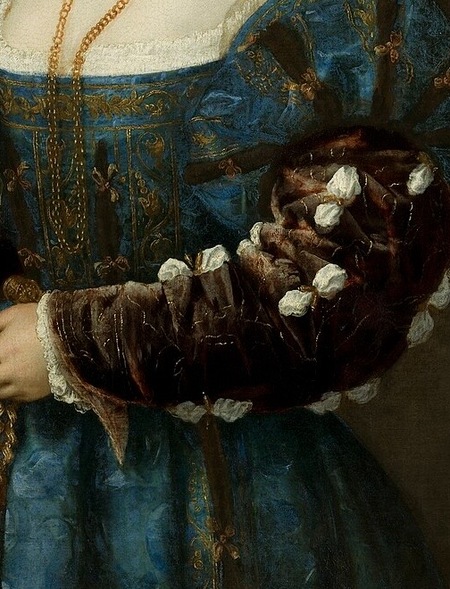
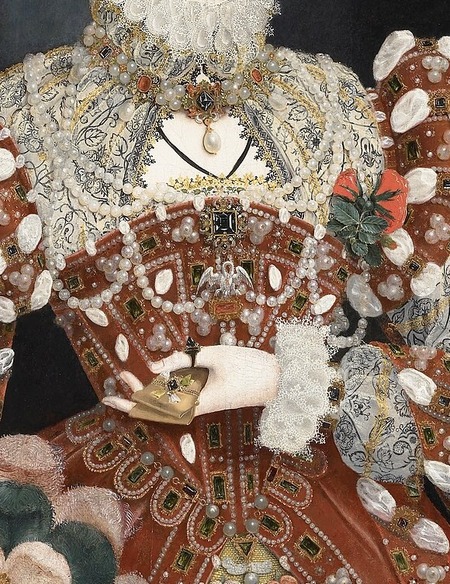
1. A fragment of a velvet sleeve from Titian’s «The Beautiful Lady.» 2. A fragment of Elizabeth I’s costume from «Portrait with a Pelican»: decorative trim, pearls, and precious jewels.
I decided to compare the ways velvet and costume ornamentation were depicted in 16th-century Italian and English portrait painting. In Titian’s work, the burgundy velvet is rendered through soft modeling. Light and shadow help convey the volume of the sleeves, and the fabric surface is not overloaded with minute details. In the «Portrait with a Pelican, ” the red velvet becomes the basis for numerous embellishments. Here, the artist focuses less on the folds and more on the precious ornamentation of the costume. In 16th-century English state portraiture, the representation of precious ornamentation could involve various pictorial and decorative techniques. In the „Portrait with a Pelican, ” the light accents that highlight pearls, metallic trimming, and gemstones are particularly noticeable. This especially interested me because it demonstrates how complex the methods of depicting precious surfaces could be. It appears that a single material can serve different artistic functions. In Titian’s work, the velvet helps create volume, whereas in the English portrait, it becomes part of the decorative system.
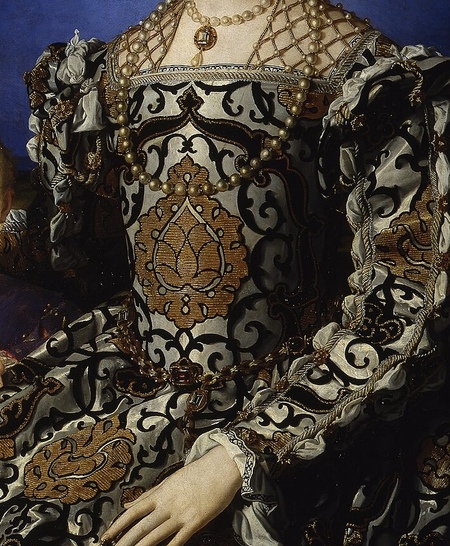
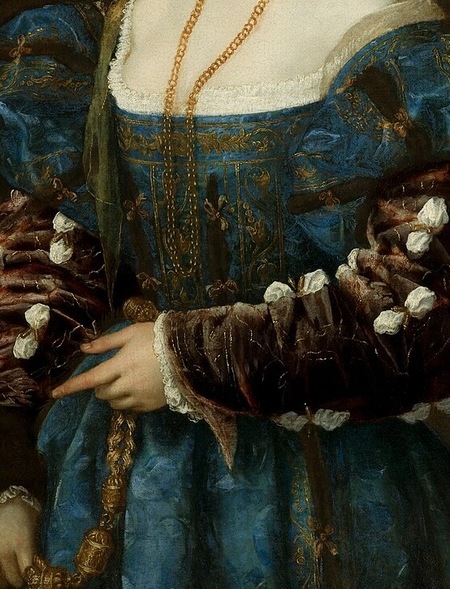
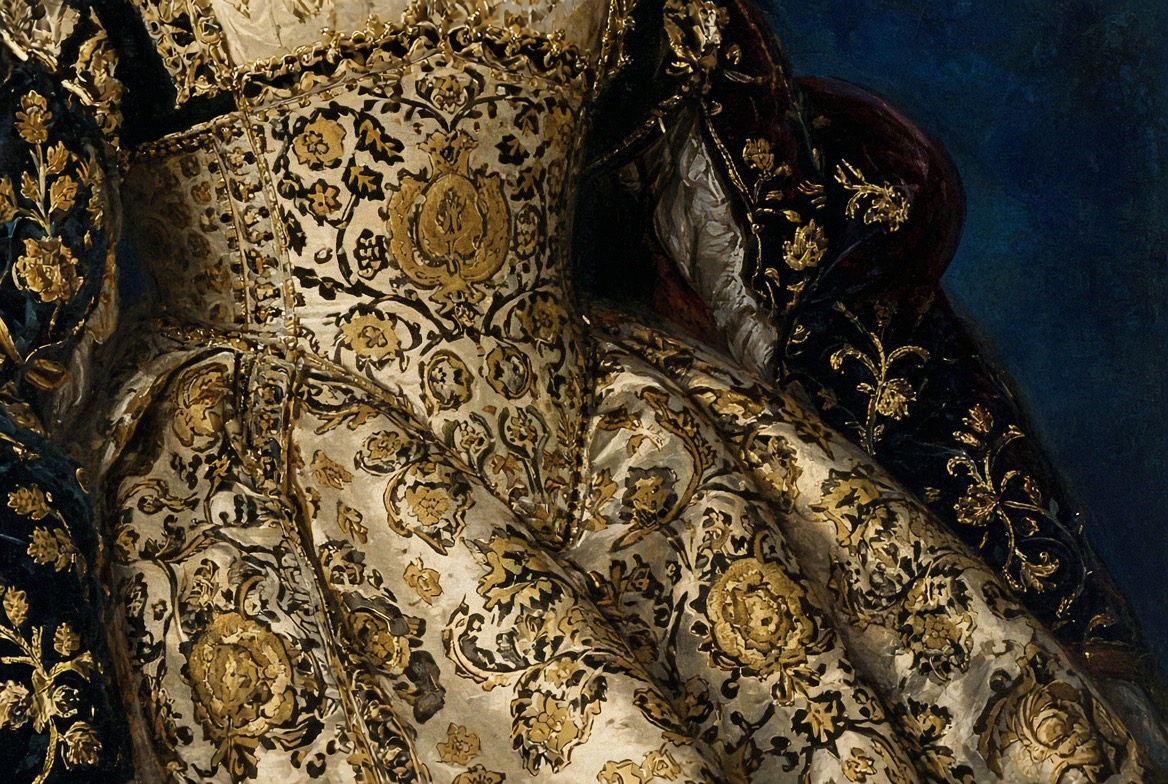
1. Fragment from Eleanor Toldeska’s brocade dress. 2. Fragment of the blue damask bodice from Titian’s «The Beauty.»
I focused particularly on the ornament of Eleanor of Toledo’s dress. On the flat sections of the fabric, the pattern is clearly visible. However, where folds form, individual elements are partially obscured or alter their shape. I felt that it was here that Bronzino’s mastery was most apparent. The artist maintains the clarity of the design while simultaneously conveying that we are looking at a voluminous textile, not a flat decorative surface. In Titian, the ornament on the blue damask is less contrasting; it is perceived as part of the overall color scheme. This comparison helped me understand that the depiction of patterned fabric depends not only on its material properties but also on the artistic intent.
The second conclusion is that the depiction of fabric allows one to see the peculiarities of the painting style. Artists do not simply reproduce the material’s properties; they interpret them using their own artistic language.
One era—different artistic solutions
After comparing velvet and silk fabrics, I became curious why similar materials could look completely different in paintings from the same era. I hypothesized that this related to artistic tradition, paint application technique, composition, and the specific goals of each portrait. Therefore, I decided to compare works by different artists, paying close attention to color, contour, light, and decorative details.