Concept
The material boundaries of an interior—walls, floor, ceiling, and the junctions where these planes meet—play a vital role in our perception of it. Window and door openings signify a transition between spaces, linking the interior to its surrounding environment. Light, finishes, and the object content also influence how we perceive the form and depth of a room.In his «Critique of Judgment,» Immanuel Kant examines the significance of form and external ornamentation in aesthetic judgment. He denotes decorations that relate to an object as an external addition using the term parerga.
«Even what is called an ornament (parerga)—that is, everything that does not belong to the concept of the object as an internal component, but is related to it only externally as an addition that enhances the refinement of taste—achieves this only through its form, such as picture frames, the drapery of statues, or the colonnade surrounding a magnificent building.» — Immanuel Kant, «Critique of Judgment»
For Kant, what role an addition plays in the perception of an object and how it affects the judgment of its beauty is crucial. This distinction allows us to look at the works of James Turrell and examine how the expressiveness of an interior can be built not through decorative embellishment, but through the manipulation of space and light.In Turrell’s works, light participates in forming the visual image of a space. It alters the visibility of surfaces, their color, and the perceived depth: the boundaries of the space may appear less defined, and light itself may take on the quality of a plane or a volume. The viewer’s attention is thus focused on the perception of space itself.In this study, «non-objective space» refers to an environment where material surfaces recede in perception, yielding to light, color, and the sense of volume.Therefore, «transcending material boundaries» is understood as altering their visual perception: physically, the walls and ceilings remain, but their layout and form are not always immediately apparent to the viewer.The concept of «free beauty» allows for further analysis. Kant links it to an aesthetic judgment that does not presuppose a preconceived notion of what an object should be. In this research, this concept serves as a starting point for the question: how is the form of luminous space perceived when the viewer’s attention is not focused on the function of the room?The study examines the architectural and lighting techniques Turrell employs to alter the perception of material boundaries.
«There are two types of beauty: free beauty (pulchritudo vaga) and attached beauty (pulchritudo adhaerens). The former does not presuppose a concept of what the object should be; the latter does presuppose such a concept and the perfection of the object in accordance with that concept.»
— Immanuel Kant, Critique of Judgment
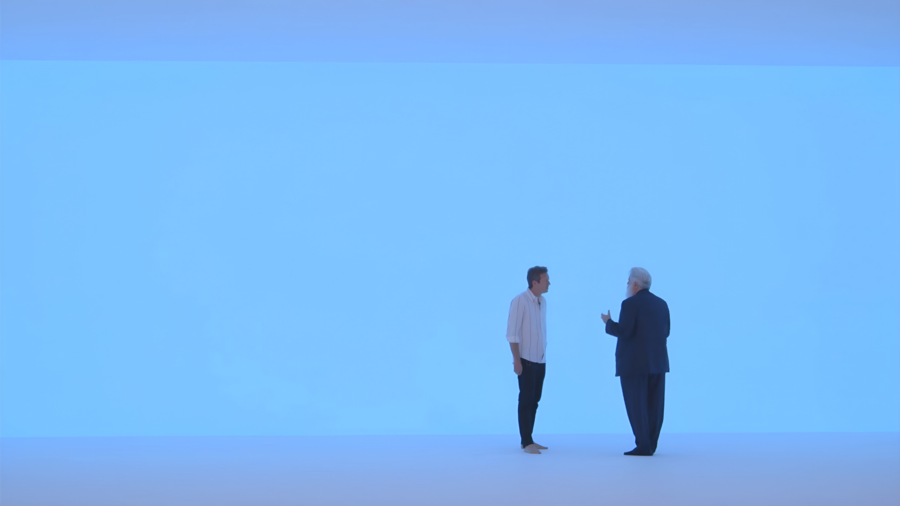
Interview / James Turrell and Doug Aitken
Light as a Pseudo-Object
«Projection Pieces»
The first part of this study examines the works of James Turrell from his Projection Pieces series. In these pieces, light projections intersecting the walls can be perceived as volumetric geometric forms. Notably, there is no physical object in the space that corresponds to the visible volume.Using these works as an example, we investigate how light alters the perception of a room’s angle: the material boundary remains in place, but its familiar form becomes ambiguous.
Conflict of Optical Perception and Physical Reality
In the photograph of the real installation (on the left), light is projected precisely into the corner. The room surfaces are devoid of decoration; the interior serves as a neutral environment. The vertical line where the walls meet extends from floor to ceiling, clearly defining the depth of the corner.
From the chosen viewpoint, this figure is perceived not as a flat spot of light overlaid on two walls, but as a three-dimensional geometric body projecting outward.
A visual paradox arises:
— the actual corner of the room is concave (the space recesses inward); — the perceived luminous volume appears convex (the edge of the cube seems to push out from the corner).
The graphic image (on the right) shows how Tarrell conceives of form: the plane of light is interpreted as an independent mass, completely overriding the spatial coordinates of the physical corner.
Thus, on a visual level, the material boundary of the interior (the corner) is not physically destroyed, but it is visually blocked and redefined by light.
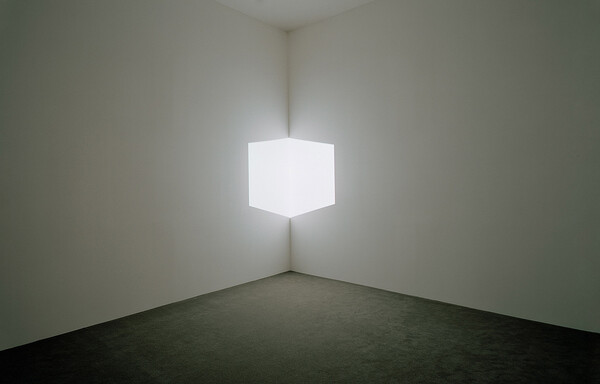
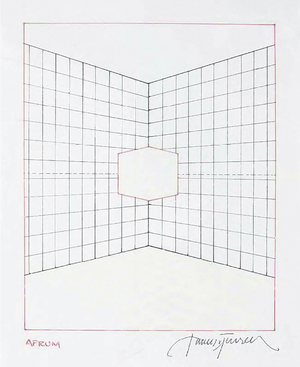
James Turrell, Afrum (White), 1967
The Boundary Between Illusion and Matter
As the viewer approaches the installation, the visual experience shifts. In a macro shot, Afrum (Pale Pink) reveals the illusion disintegrating: the texture of the plaster and the surface irregularities, across which the light glides, become apparent. The viewer confronts physical reality—light does not exist independently of the wall, yet simultaneously transforms its perception from a distance.
James Turrell, Afrum (Pale Pink), 1967 (detail)
Projection Pieces Series
Comparing works from the Projection Pieces series demonstrates that the use of the angle is systematic.— In Enzu, light slices through a vertical joint, creating the sensation of an endless opening in a solid wall; — In Gard, light «cuts» the corner, replacing the juncture of the walls with a diagonal plane; — In Juke, the light polygon shifts onto a different plane, mimicking an architectural opening.James Tarrell, Enzu (White) / Catso (Pink) / Gard (Blue) / Juke (Green) / Afrum (Pale Pink)
In «Critique of Judgment,» Kant distinguishes between an aesthetic judgment and the cognition of an object’s properties. This distinction allows us to examine Projection Pieces not only from the perspective of projection mechanics but also from the perspective of form perception.
In the photographs of the light figure series, the forms relate to the angles and planes of the space, creating geometric shapes. The viewer may know that the projection is on the walls, yet still perceive it as a protruding volume. Knowledge of how the work was created does not invalidate this visual impression.
In § 16, Kant links free beauty to the appraisal of form, which is not determined in advance by a concept of what the object ought to be. This idea helps frame the question of perceiving Tarrell’s light forms: the viewer can focus on their outlines, proportions, and arrangement in space without reducing what they see to the recognition of a specific object.
In Projection Pieces, the light form becomes the subject of aesthetic attention while simultaneously altering the perception of the architectural corner.
Total erasure of boundaries
«Ganzfeld»
In the second part of this study, we examine a series of Ganzfeld installations (a term borrowed from perception psychology that denotes the phenomenon of a uniformly homogeneous visual field). Whereas in the Projection Pieces series the light interacted locally with the room’s angles, creating a semblance of a distinct geometric body, in the Ganzfeld spaces, the light encompasses the viewer’s entire field of vision.In these works, Tarrell addresses a more extensive alteration of the interior: the architectural environment is designed to eliminate familiar visual references—visible corners, surface junctions, shadows, and direct light sources. Using this series as an example, we investigate how a uniform luminous environment changes the perception of depth, distance, and the material boundaries of an enclosed space.
Video excerpt: «James Turrell: Retrospective» / https://youtu.be/Lc21q1d3oek?si=I3NknjbHlTVT5l6x
Spatial Diagram of the Installation Bridget’s Bardo
The architectural cross-section (left) captures the structural solution of the space: an extended, stepped ramp is situated within a closed, seamless light chamber.
The diagram, which illustrates the installation’s «field of perception, ” shows how the viewer’s sense of physical reference is stripped away, rendering the true physical scale and boundaries of the chamber visually indeterminate.
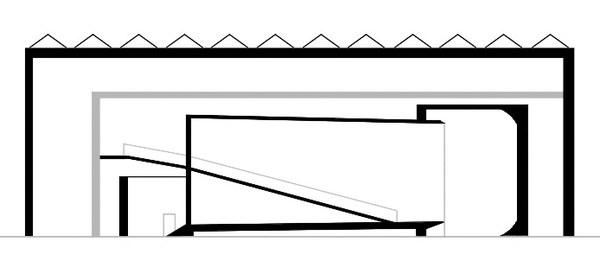
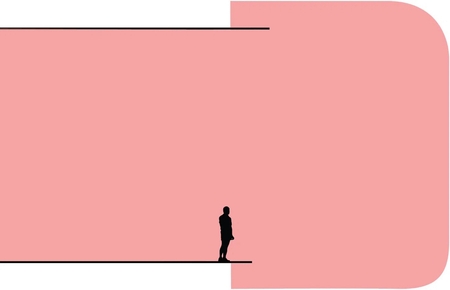
Architectural section of the Bridget’s Bardo installation / Diagram demonstrating the «space of perception» in the Bridget’s Bardo installation
Perceptual Experience of *Bridget’s Bardo*
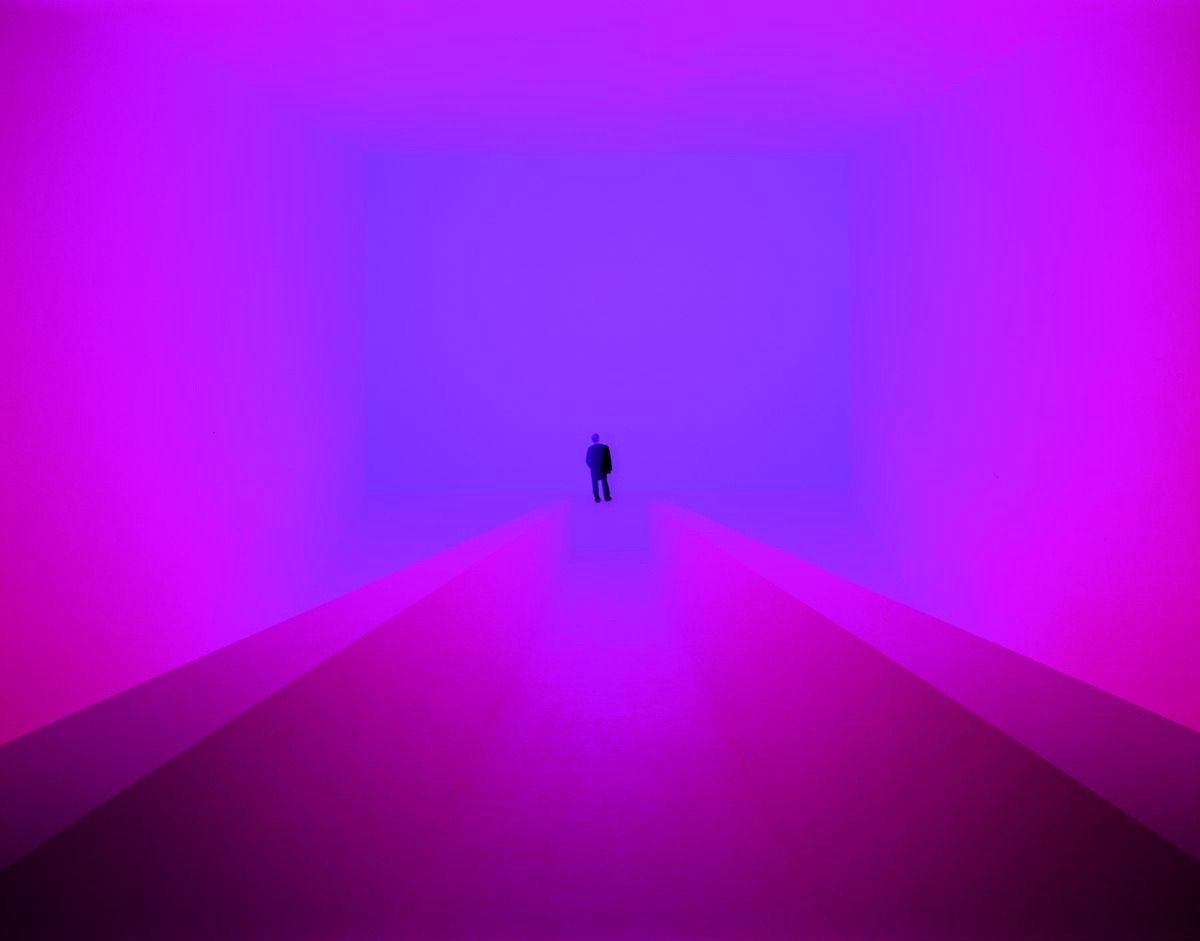
In the installation *Bridget’s Bardo*, Tarrell establishes a complex spatial contrast. The constructive volume of the staircase is perceived as the sole dark, tectonic anchor against a uniform field of light. Here, the viewer physically senses the solidity of the steps, the height of the railings, and the scale of the entry portals.James Turrell, Bridget’s Bardo, 2009 / View of the area beneath the stairs at the entrance with changing light scenarios
However, the camera surrounding this structure is designed on the principle of complete visual exclusion of architectural beams. With changes to the color schemes, the familiar suspended walls disappear. The view from the top landing of the staircase into the depth of the hall captures an optical paradox: the actual dimensions of the space cannot be discerned. The viewer does not see walls, but a continuous density of light, the distance of which is impossible to gauge visually.
James Turrell, Bridget’s Bardo, 2009 / Frontal view of the staircase from below / View from the upper landing into the volume of the room
James Turrell, Bridget’s Bardo, 2009 / Side view of the staircase with defined entryways / View from the top landing into the volume of the room
Installation *Perfectly Clear*
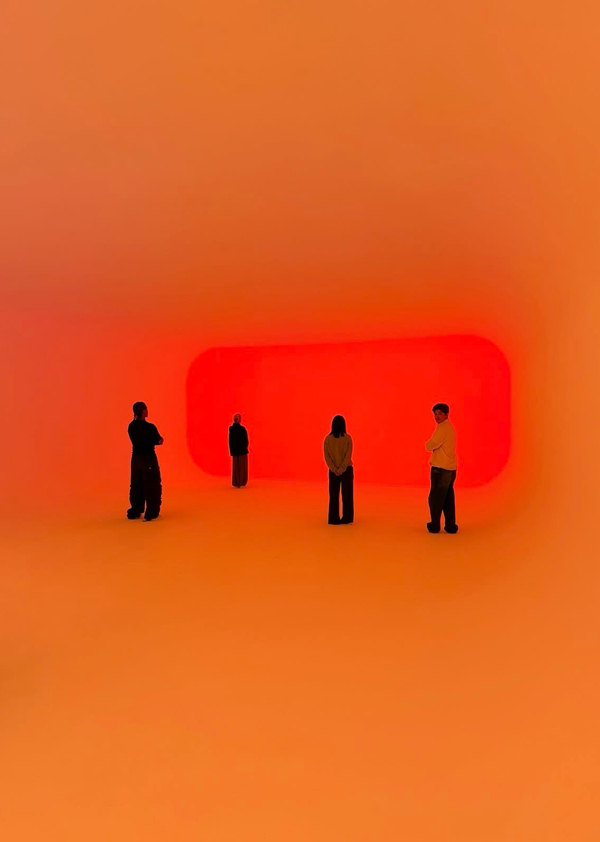
While in Bridget’s Bardo the viewer physically moves up and down the stairs within the venue, the installation Perfectly Clear reduces space to a concise composition. The viewer is situated in a viewing area facing a large, rounded light aperture.
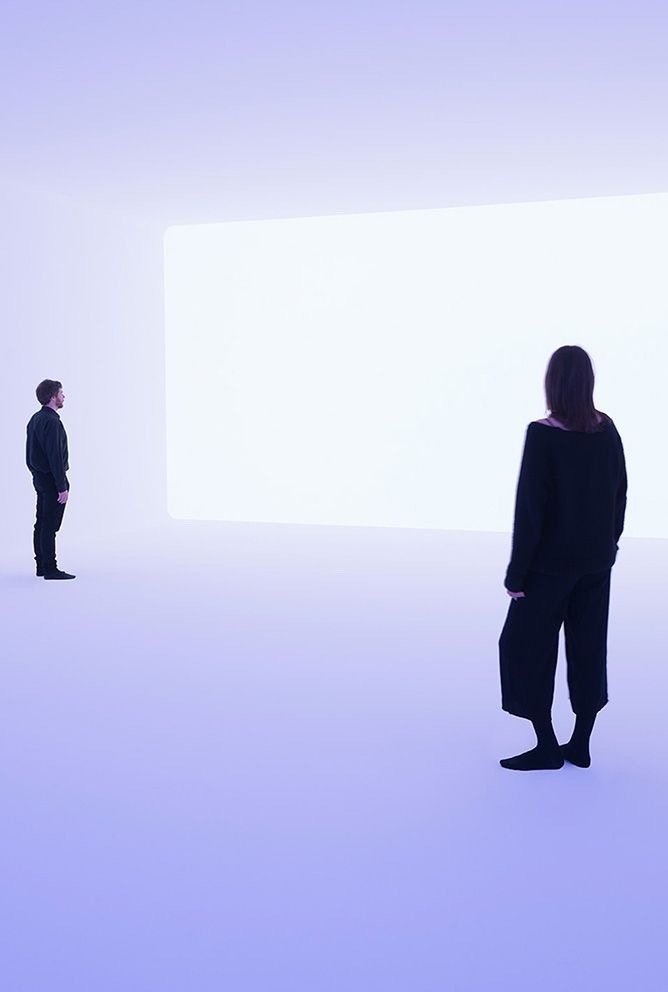
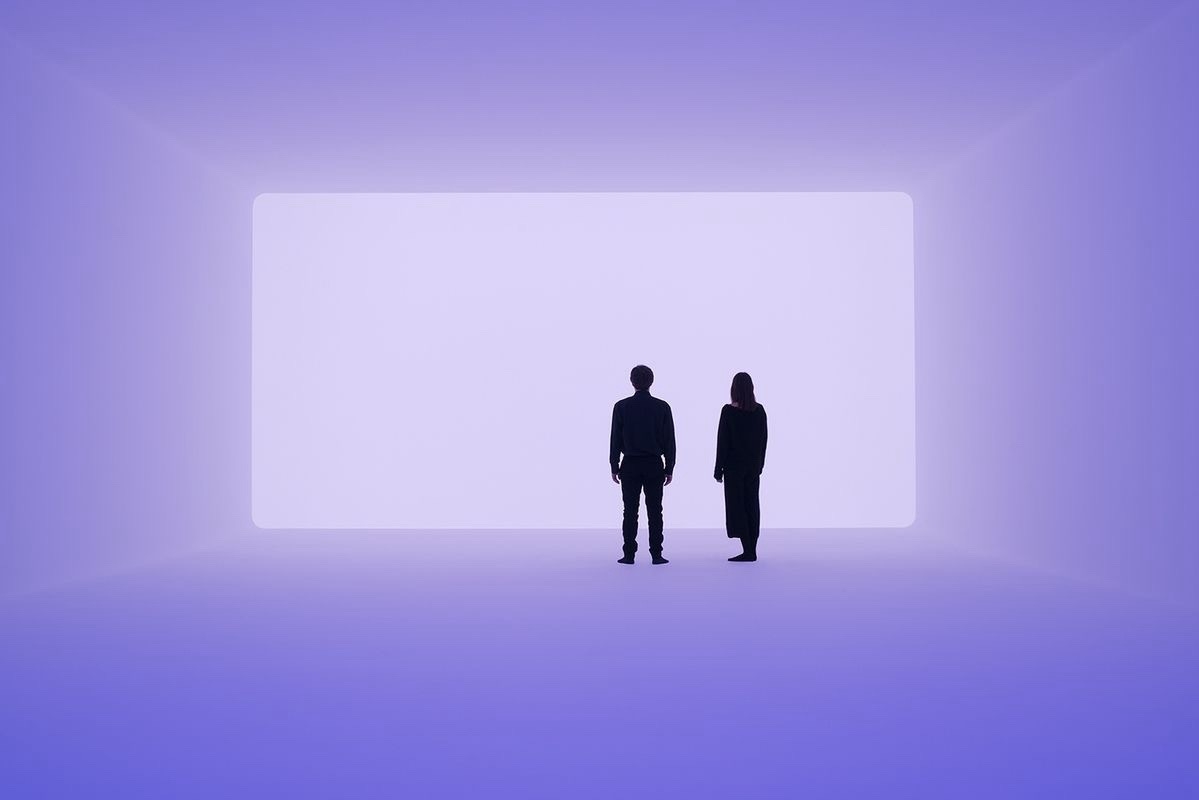
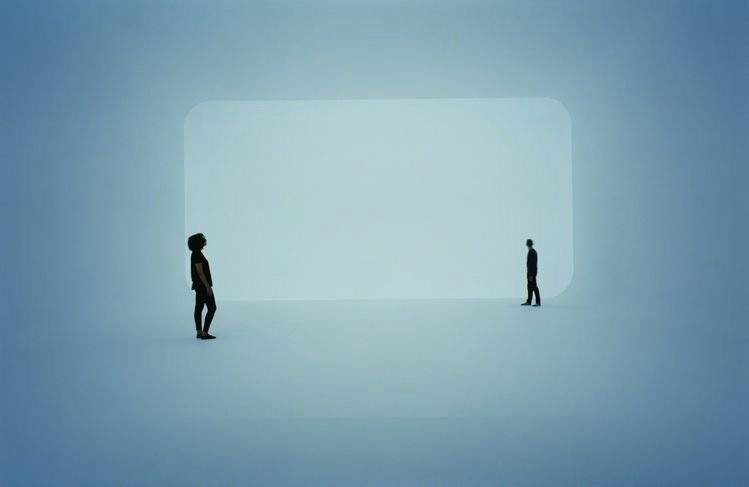
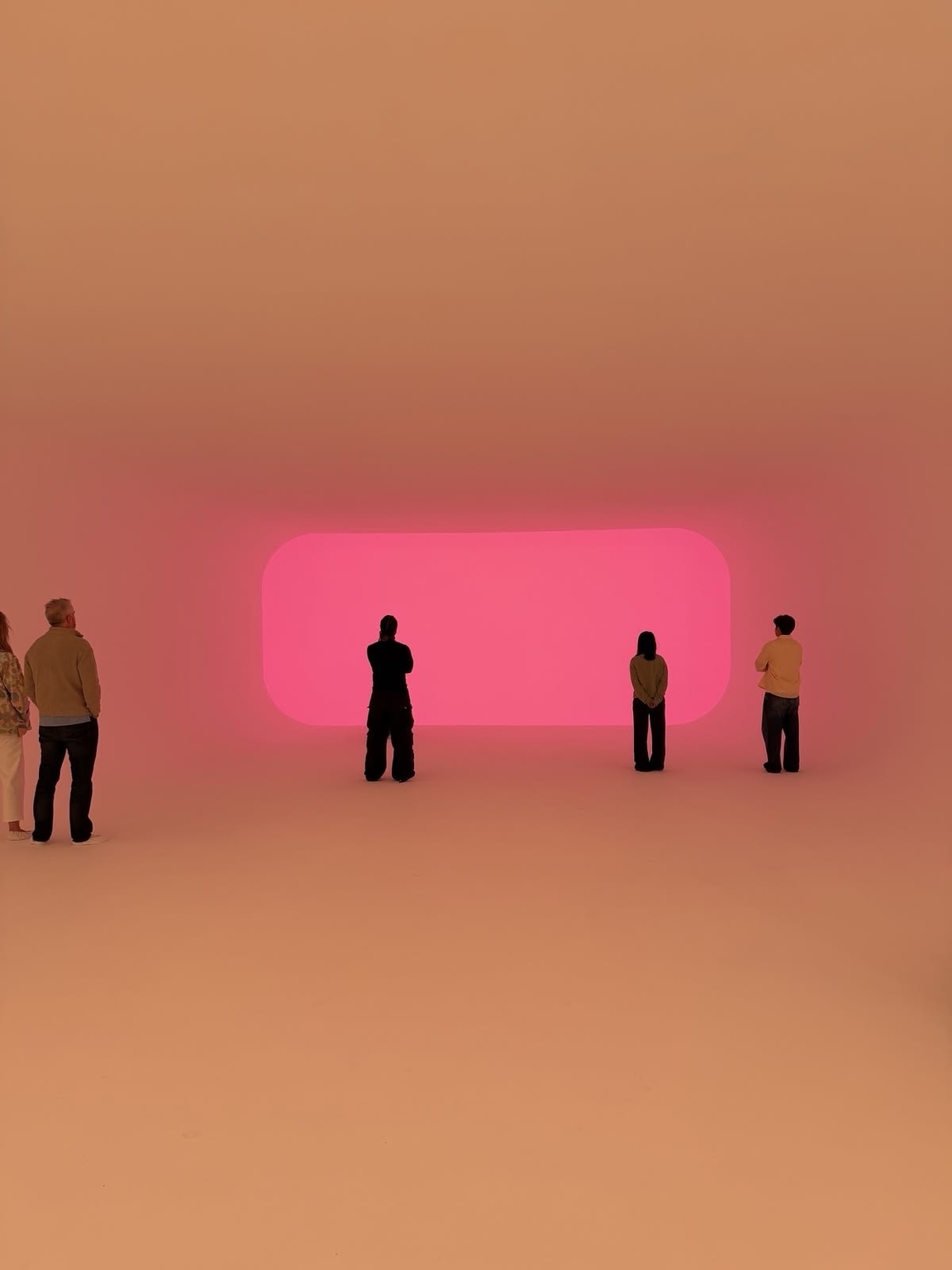
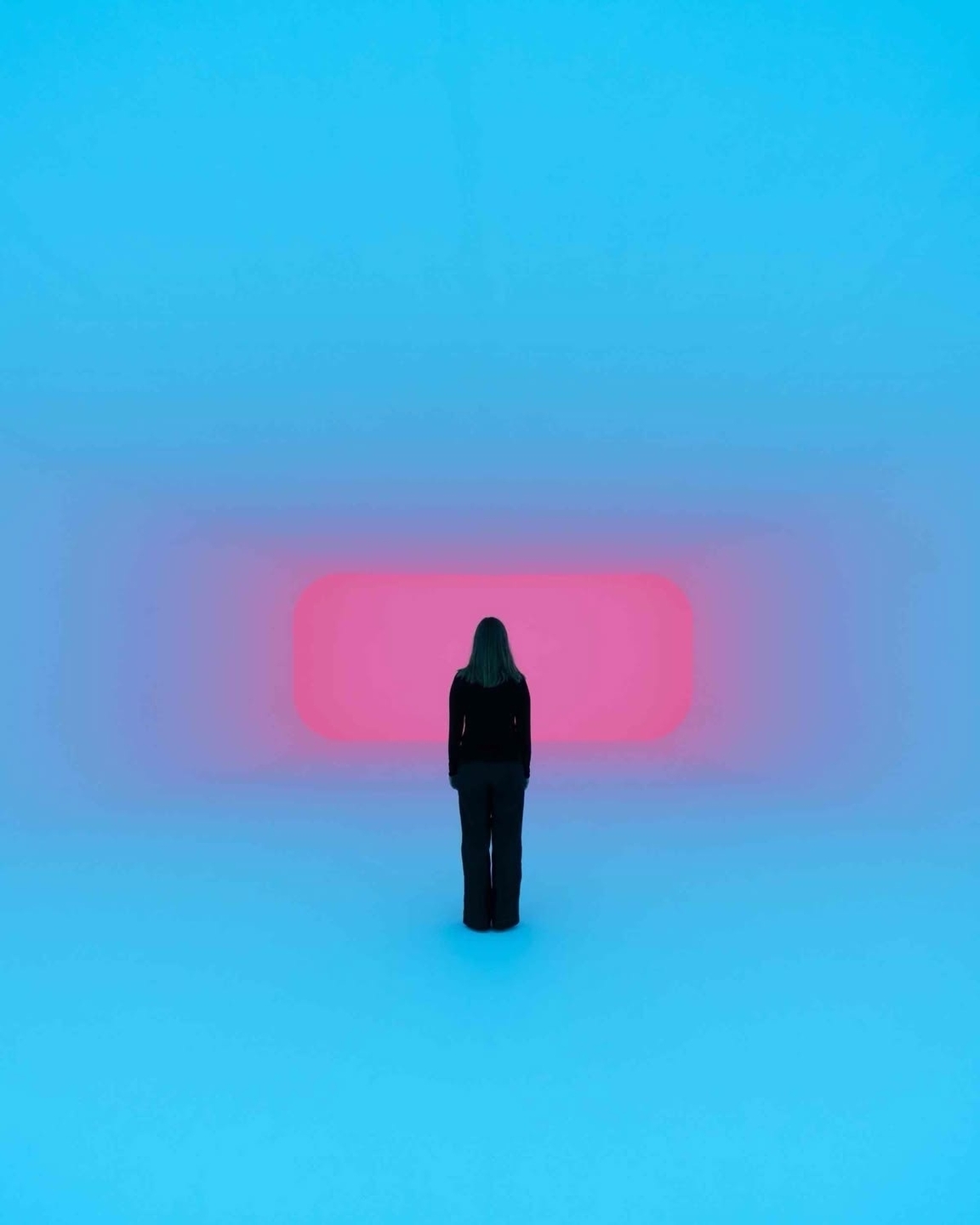
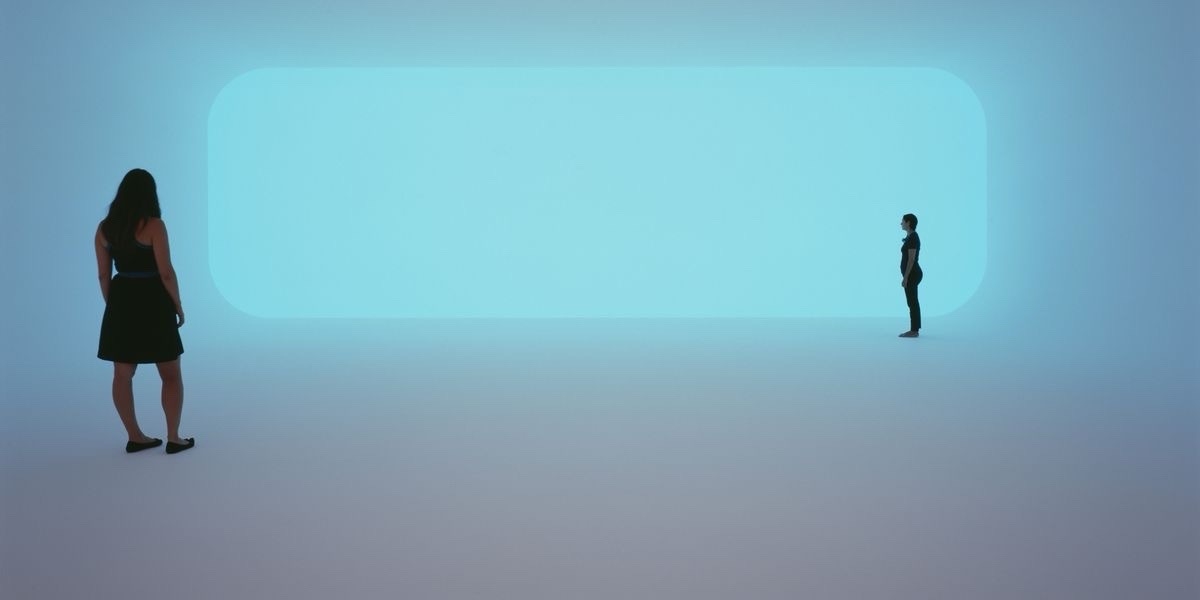
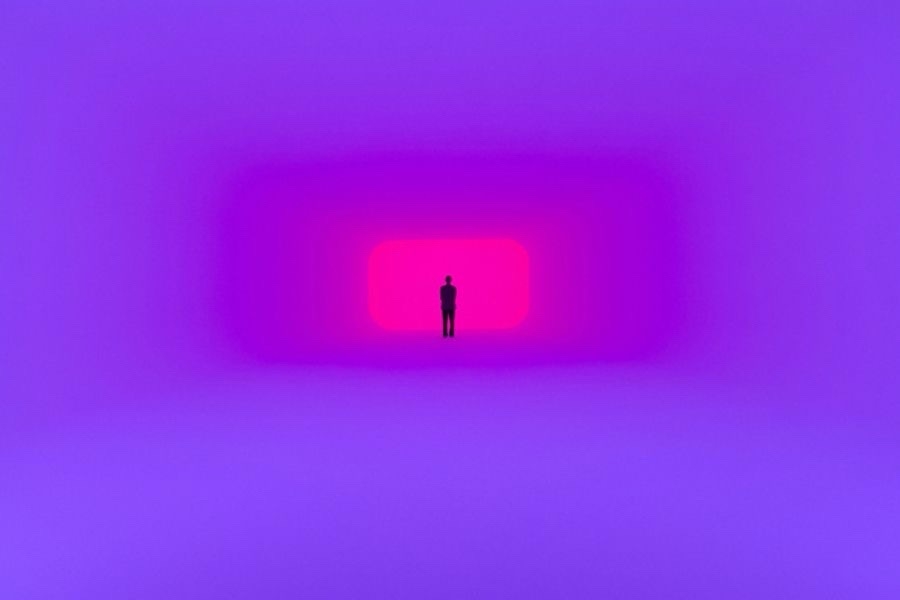
The photographs clearly illustrate the specific nature of this environment: even when a human figure is present in the frame, determining the form and depth of the space is impossible. The illuminated area is perceived ambiguously: the gaze sees it either as a flat, two-dimensional plane (resembling a glowing canvas) or as a bottomless spatial rupture. The material boundary of the wall is optically displaced by the pure field of light.