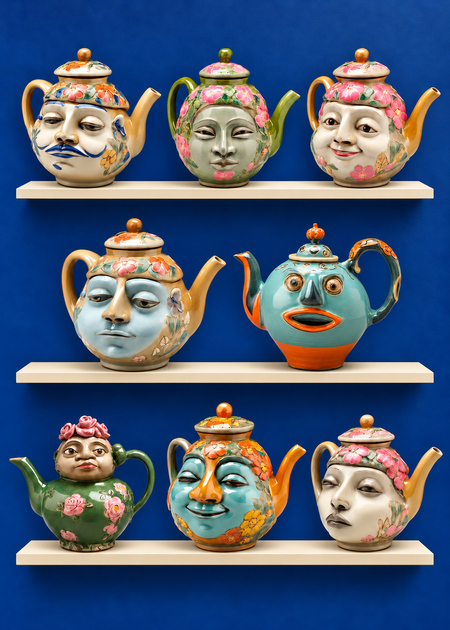
Every kettle has its own character. One holds its spout so high, as if it expects to be owed something. Another looks sleepy even with the lid open. A third seems to be asking to be left alone.I want to curate a collection of ceramic characters that people can recognize in themselves and in others. I am interested in how much mood can be conveyed by redesigning an ordinary object—through the curve of a handle, the tilt of a spout, or the proportions of the body.The foundation for this project will be a selection of historical ceramics from The Metropolitan Museum of Art’s open collection. In the final series, I will attempt to merge the characteristic forms of tableware with human habits. Each piece will receive its own name and a short museum label.
01 / Where Did the Kettles Come From
For this project, I selected 14 photographs of painted ceramic teapots from The Met Open Access. Initially, 40 candidates were uploaded. The final selection included objects with clearly visible handles, spouts, and lids. I was drawn to the rounded bodies, floral medallions, vibrant glazes, and subtle variations in proportion.All selected images are marked Public Domain in the museum’s database. For each one, I saved a link to the object’s card, the date, the material, and the museum attribution. The Met’s open images are distributed under CC0.The photographs were resized to a 1024 × 1024 pixel square. I kept the objects whole—any missing space around the edges was filled with the background color. The training data uses downscaled copies at 512 × 512. Each file has an English caption indicating CHAYNIK, the material, and the object’s name.Collection Source: https://www.metmuseum.org/hubs/open-access