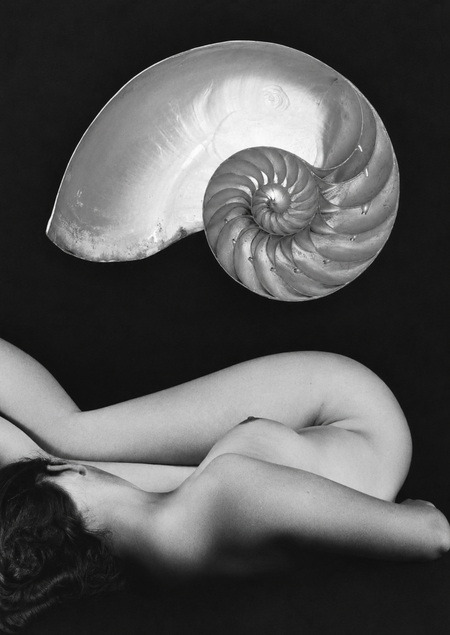
Concept
I. The Body as Sculpture and Composition
The first section begins with the most traditional art historical approach to the body: as a statue. I selected works where the figure is visible almost entirely, yet presented as an object. The model sits on a pedestal, compressed into a closed volume, concealed beneath wet fabric, or grouped with another body. Almost all photographs were taken in a studio against a dark background, with the light falling on the skin much like it would on marble or bronze in a museum hall.The body here performs a dual function: it becomes simultaneously a participant in the staging and the material for creating the image. The model holds a prescribed pose, tenses or relaxes their muscles, and changes their body position, while the photographer shapes the final image through light, angle, framing, and interaction with objects. The body’s primary function in this chapter is spatial. It occupies space, has weight and volume, and the viewer looks at it as if they were viewing a sculpture, mentally walking around it.This approach is particularly evident in the works of Robert Mapplethorpe. His interest in classical and Renaissance sculpture defined the way the human figure is depicted: the models adopt statuary poses, and the meticulously constructed light and composition accentuate the body’s proportions and physical expressiveness. The photographer employs props, drapery, and unusual framing, referencing techniques characteristic of sculpture photography.
McCartorp spoke directly about the proximity of these two practices: «If I had been born one or two hundred years earlier, I might have become a sculptor, but photography is a very fast way to see and create sculpture.»
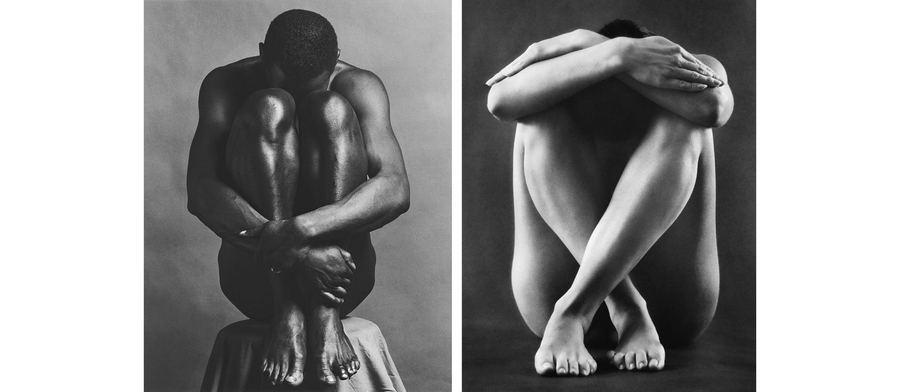
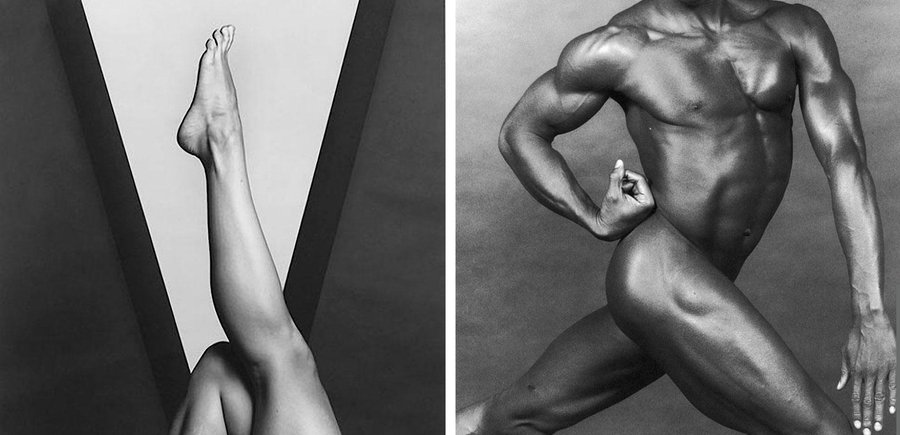
Another approach can be seen in the work of Ruth Bernhard. She aimed to free the image of the female body from conventional portrait expressiveness and focus attention instead on its plasticity. To achieve this, the photographer often concealed or excluded the models' faces from the frame, so that facial expressions would not distract the viewer from the form. Bernhard described her goal as striving «to isolate, simplify, and emphasize the form with maximum clarity» using light and shadow, revealing ideal proportions and sculptural mass.
In the «Body/Sculptures» series, Hans Breder employs the mirror as a tool for transforming the human body and constructing composition. The model interacts with the reflective surface, which conceals, divides, and multiplies discrete parts of the figure, generating new visual constructs. The real body and its reflection converge within a single space, disrupting the conventional notion of anatomical integrity. The mirror becomes an extension of the plastic material—through it, the photographer does not merely capture the model’s pose but creates a complex sculptural form existing on the boundary between reality and reflection. Thus, the body transforms into the basis of a compositional experiment in which the photographer explores the possibilities of its fragmentation, connection, and spatial transformation.
Thus, the sculptural image becomes one way to artistically interpret the human body in photography. The photographer moves beyond its conventional perception as the image of a specific person and instead focuses on its plastic qualities: volume, mass, surface, and spatial placement. While the body retains its anatomical nature and recognizability, it begins to be perceived primarily as an autonomous form that the photographer organizes within the frame much like a sculptor, establishing the relationship between volumes and achieving a specific visual expressiveness.
II. The Body as an Extension of the Surrounding World
In the second section, the body moves beyond an isolated space and engages with the surrounding nature. I selected photographs where the human figure becomes part of the landscape or visually merges with it. It was important to demonstrate how the body can mimic its environment, adopting its forms and textures, becoming an extension of it. In these images, humanity and nature cease to be perceived as opposing entities; instead, a sense of a single natural origin emerges between them, where human anatomy becomes yet another manifestation of the surrounding world.
The body in this section stops being the compositional focal point and is placed alongside rocks, dunes, and water. Its function is connective. Through the body, the viewer senses the scale and texture of the landscape, and through the landscape, the body is seen anew: the curve of a hip is read as a slope, a finger as a stone. From the human remains a form that nature repeats.
The photographer Minor White’s assertion—that one should photograph things not just for what they are, but for what else they can be—effectively conveys the possibility of viewing familiar objects differently. Within the context of this section, this perspective allows one to see something beyond a mere anatomical figure in the human body: it can be perceived as part of the natural relief, surface, or the overall structure of the surrounding world.
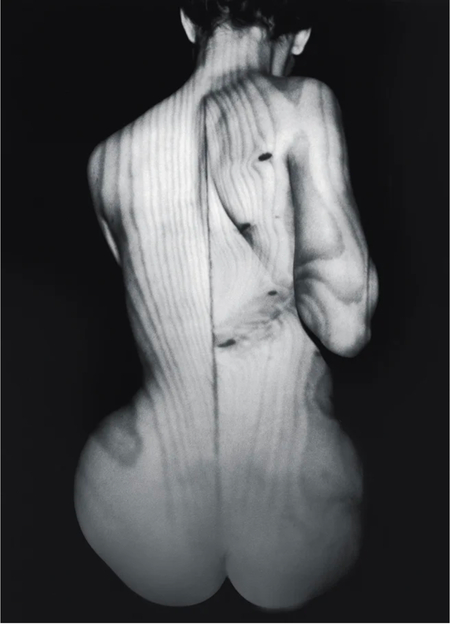
For John Bernhard, this idea is particularly direct. In the series «Transformation» and «Skindream, ” the photographer explores the possibility of transforming the human body into something resembling a natural landscape. In „Transformation, ” he describes the body simultaneously as an object of the image and as a landscape, demonstrating this through a series of photographs. In „Skindream, ” he projects his own photographs of natural elements onto the model’s body—textures of earth and natural surfaces merge with the human figure. As a result, the body becomes a kind of surface where human anatomy and the natural environment intersect. Here, the fusion of humanity and nature is achieved not only through formal resemblance but literally through the joining of two images.
In Bill Brandt’s beach photographs, the interaction between the body and nature is revealed through framing and the manipulation of light. In the work «Nude, Baie des Anges, France,» the photographer isolates specific parts of the human figure, causing familiar anatomical forms to resemble natural objects. Knees and fingers begin to evoke stones, while the light emphasizes the body’s volume and texture, bringing it closer to the surrounding landscape.
In the series «Nus de la mer et de l'étang,» Lucien Clergue places human figures in water, amidst sea foam and glints. Here, the body is not merely situated in a natural environment; visually, it becomes an extension of it. The fluid contours of the human figure echo the movement and forms of the water, and the sunlit reflections on the skin continue the interplay of light found on the water’s surface. Because of this, the body begins to resemble a natural formation: individual figures and anatomical fragments can be perceived as islands or stones rising from the glassy water. The person seems to lose their distinct separateness and transforms into another form of the natural landscape.