«We must descend first if we wish to ascend.»
—Inscription above the entrance to the Monastery of St. Jerome in Delft, 1614.
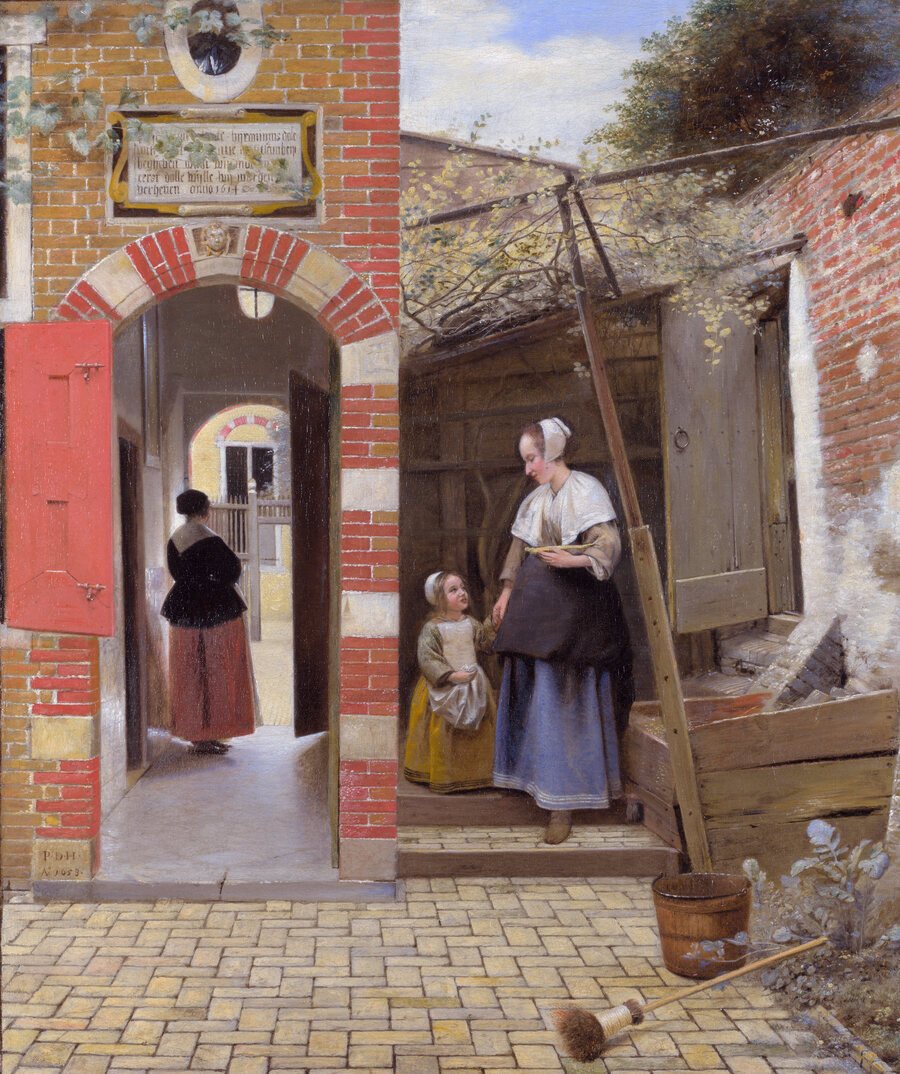
Piet de Hooch. «Courtyard of a House in Delft.» 1658
Concept
In 17th-century Dutch interiors, there is almost always a second space: an adjacent room, a courtyard, or a street visible through an open door. This is conventionally considered the «background,» but the recurrence of open doorways among various masters is too persistent to be accidental. Each instance solves a specific problem—it establishes depth, defines the viewpoint, separates the mistress from the servant, admits light, or conceals the narrative. The Dutch referred to this visual trope as doorkijkje («a glimpse through»).
The hypothesis posits that it is precisely the doorway that allows a painting to possess a narrative without a traditional story; the plot emerges from where the viewer stands, where the light falls, and who is situated on which side of the threshold.
The primary objective of this research is to examine the compositional functions that the doorway performs in 17th-century Dutch painting and how these functions alter the relationship between space, narrative, and the viewer.
Contents
Prologue. What is a doorkijkje
Chapter I. The Opening as a Frame
Chapter II. The Arcade: Depth as Rhythm
Chapter III. The Threshold: Boundary Between Private and Public
Chapter IV. The Opening as a Source of Light
Chapter V. Peeping: The Spectator-Participant
Chapter VI. Illusion: The Opening That Isn’t There
Conclusion
What is a doorkijkje?
Doorkijkje — a compositional device that became widespread in 17th-century Dutch painting, based on depicting one space through another. The artist places a doorway in the composition through which the viewer sees into an adjacent room, hallway, courtyard, or street.
The distinctive feature of this technique is that the doorway divides the pictorial space into several planes while simultaneously maintaining a visual connection between them. Because of this, the image is perceived not as a self-contained scene, but as part of a broader space continuing beyond the visible room.
CHAPTER I. The Aperture as a Frame
The doorway functions as a frame within a painting: its jambs echo the edges of the canvas, transforming the scene behind it into a second, nested picture. It draws the gaze to a single point, leaving the viewer outside, on the threshold—we see what is happening, but we cannot enter.
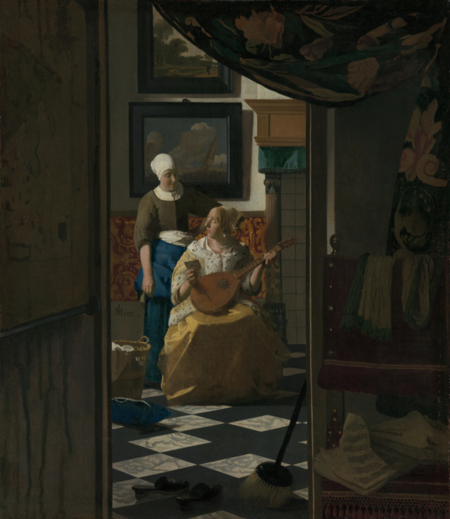
Jan Vermeer. «A Love Letter.» Circa 1669–1670
In «Love Letter, ” the near space occupies almost the entire height of the painting. On the left, a vertical element cuts the view; on the right, a curtain and objects in shadow narrow the space. The checkered floor unifies the planes. The second frame reduces the scene, rendering it precious, like a miniature in a case.
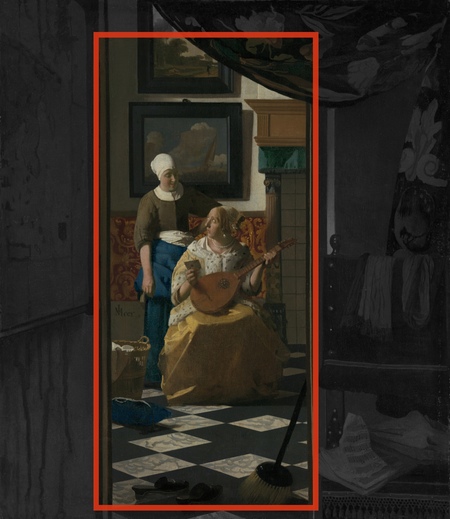
Jan Vermeer. Fragment of the painting «Love Letter.» c. 1669–1670
In Vermeer’s work, the top edge of the passage dissolves into the folds of the fabric. This compels the viewer to reconstruct it using the scattered details surrounding the bright interior.
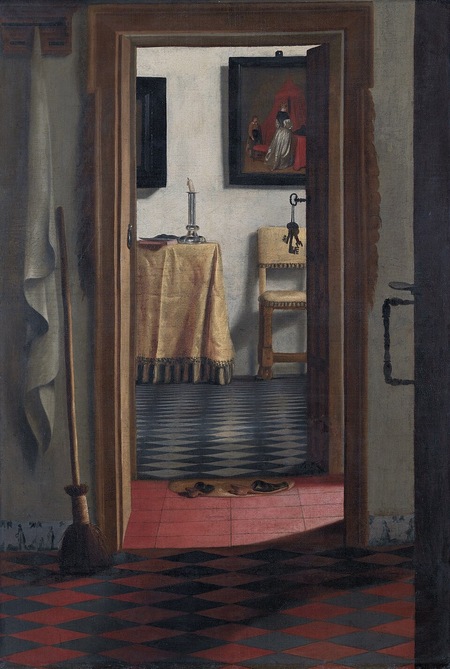
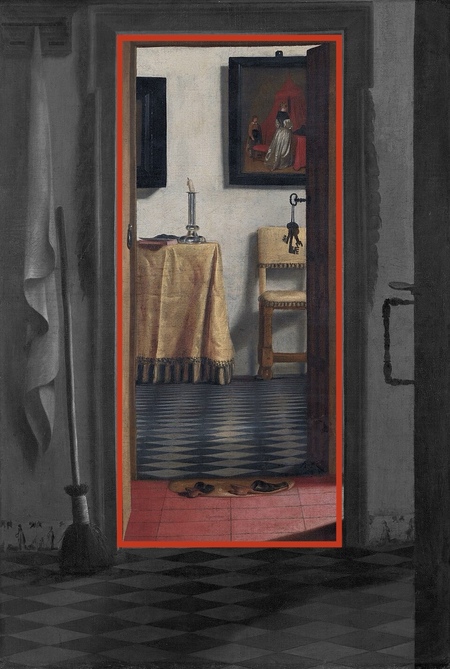
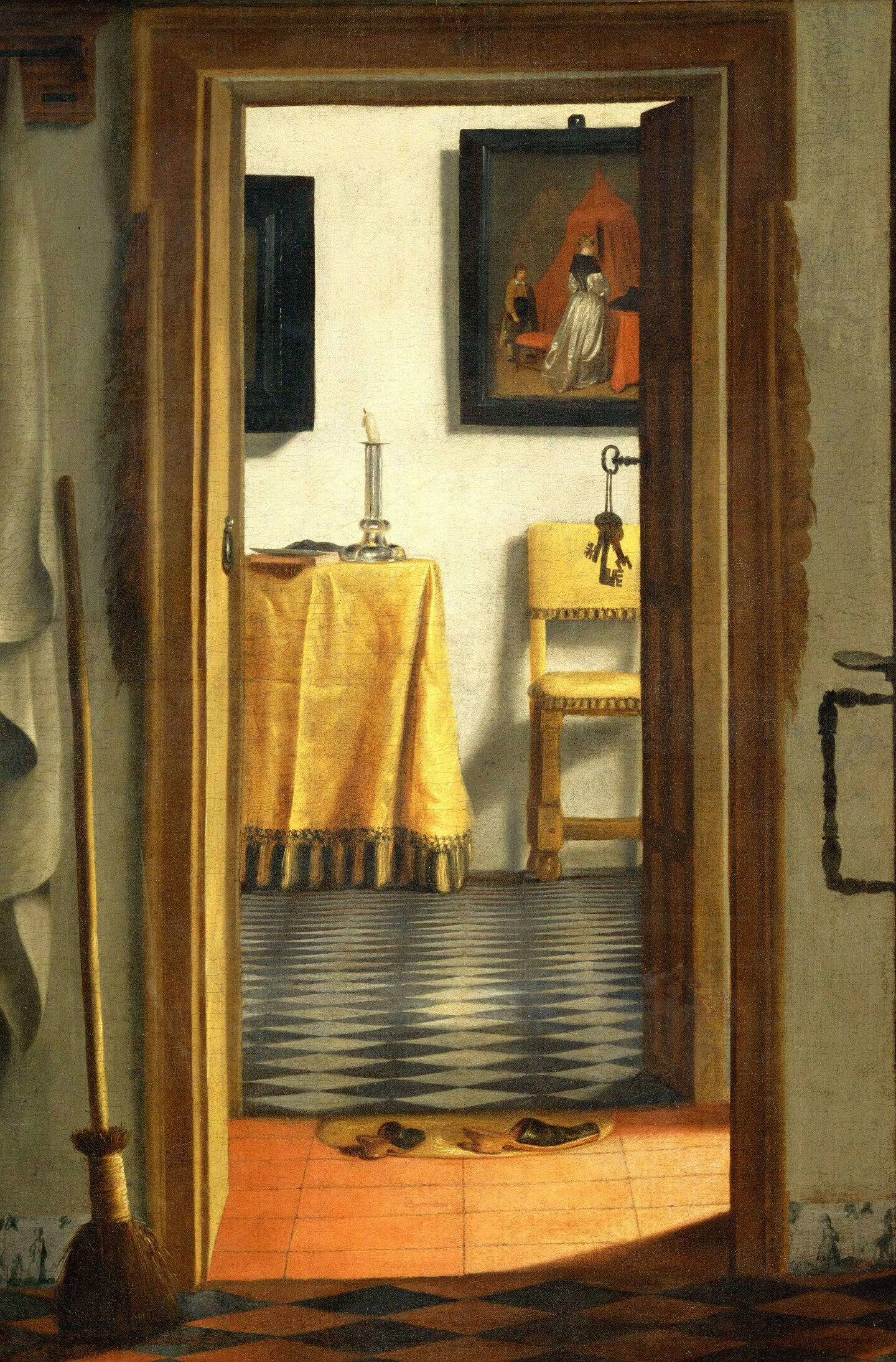
Samuel van Hoogstraeten. «Shoes.» Between 1654 and 1662
Vermeer frames the scene; Hogstaden frames the emptiness. There are no people: two doors in a row, a broom by the first door, discarded shoes, a key in the lock, a candlestick, and a painting on the far wall.
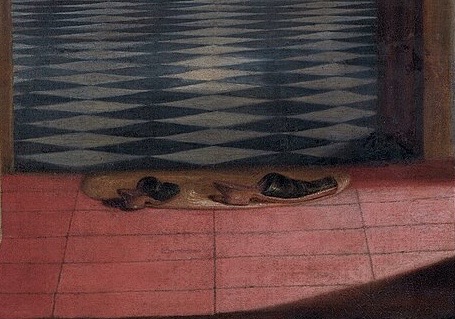
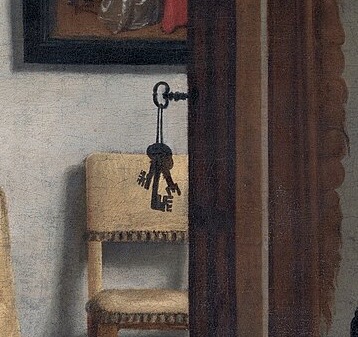
Samuel van Hoogstraten. Fragments from the painting «Shoes.» Between 1654 and 1662
The nested glitches function like a telescope: each subsequent layer is smaller and brighter, drawing the viewer inward. Without figures, the viewer builds the narrative themselves through objects—who took the shoes, who owns the key. There is nothing to tell; there is only something to look at, but the act of looking becomes the plot itself.
The frame establishes the viewer’s position before we even grasp what is depicted, and distance generates meaning. The next step—is to move inside.
CHAPTER II. The Arcade: Depth as Rhythm
The opening divides the space into layers: foreground, the first room, the second room, and the window. Each layer is lit differently, and the eye «steps» across them, as if climbing stairs.
Peter de Hooch. «Maternal Duty.» Circa 1660–1661
A vertical gap bisects the horizontal canvas almost in half. To the right is a dark corner featuring a built-in bed, a mother, a child, and a small child’s chair; to the left is an opening into the adjacent room, where an open window floods the floor with light.
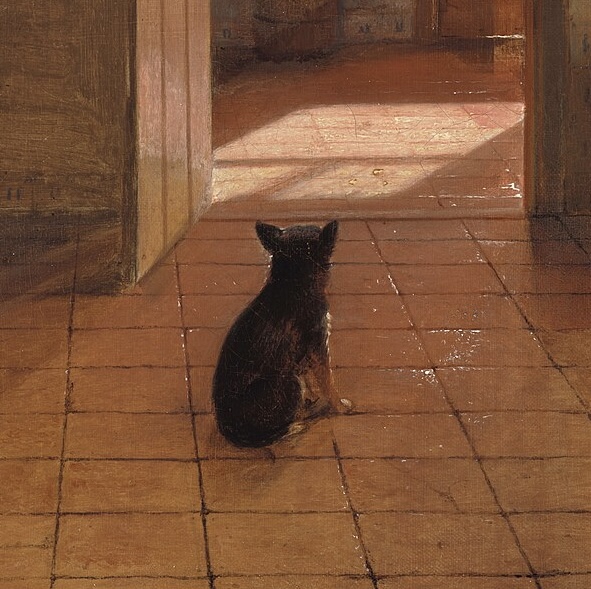
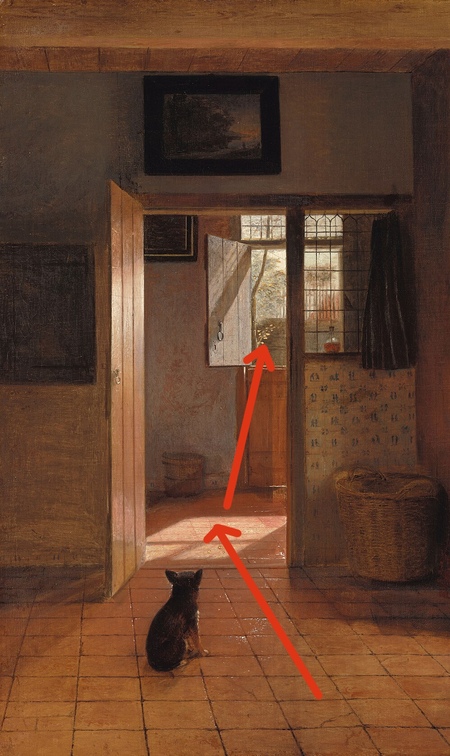
Piet de Hooch. Fragments of the painting «Maternal Duty.» Circa 1660–1661
The key to the composition is the dog; it looks out of the open window into the back room. It is the only character looking through the doorway, and its gaze links the two spaces. Three zones—the dark foreground, the illuminated floor beyond the threshold, and the bright square of the window—create depth that is not only linear but tonal.
Piet de Hooch. «Woman with Child in a Pantry.» c. 1656–1660
Attach card The same structure in an almost square format, but the arcade becomes the main subject. A woman offering a jug to a girl stands at the edge; through the opening, a distant room with a window, a chair, and a painting is visible. The grout lines lead the eye directly into the opening, and the figures are not in the center, but along the route, like a stop.
Anfilada transforms a room description into a route, but the route bumps up against the house wall.