CONCEPT
The animal drawings on cave walls emerged long before written history, yet many of them appear as if the creature is about to move. I became interested in how this illusion of movement arises on a static surface and whether specific techniques can be identified as responsible for it. The title, «Movement Before Animation, ” references modern animation, which shares the same goal—though Paleolithic artists lacked film or a screen to achieve it. The materials consist of paintings from three caves: Chauvet and Lascaux in France, and Altamira in Spain. Because they belong to different periods of the Upper Paleolithic and different regions, they allow for a comparison of how the same challenge was addressed across different times and under varying conditions.
Selection Criteria: Images are selected based on several criteria. The presumed movement should relate directly to what is visible in the drawing—for instance, the positioning of limbs, the repetition of contours, the arrangement of figures, or the form of the surface. One example illustrates a single technique, although in actual frescoes, techniques may be combined. Original frescoes, photographs, drawings, and reconstructions are distinguished in the captions because a drawing inherently contains the researcher’s interpretation. Ambiguous cases are shown alongside alternative explanations.
The work is structured according to the typology of techniques and consists of four chapters. The first is dedicated to silhouette layering, which can convey group movement, create depth, or serve as traces of drawings from different eras. The second examines multiple limbs and repeating contours—that is, instances where one animal is depicted in several positions. The third chapter addresses perspective and pose—the inclination of the head, the twist of the torso, and the positioning of the legs. The fourth discusses the relief of the wall, which gives the figures volume and can enhance the sense of dynamism. In the conclusion, all four techniques are compared. A chronological basis was not chosen because the work concerns methods, not the development of cave painting.
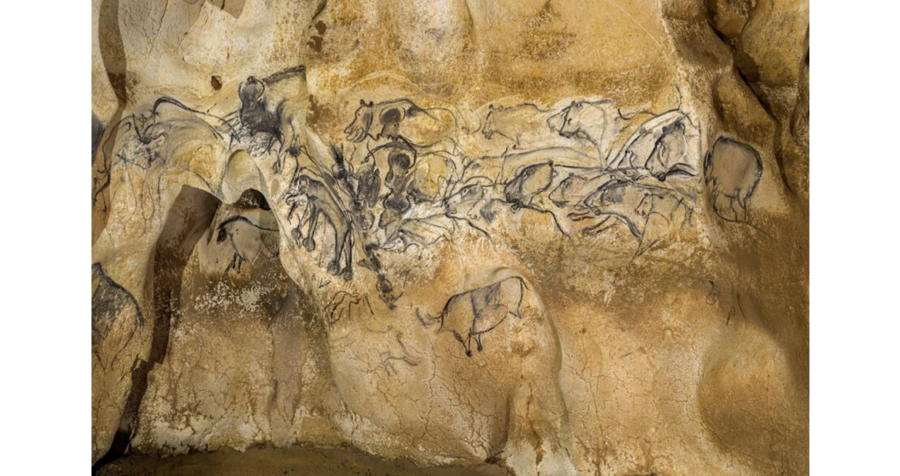
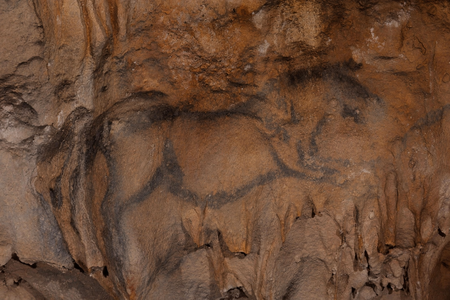
Lion Panel. Unknown authors. Upper Paleolithic. Chauvet Cave — Pont-d’Arc, France. Photograph: Arnaud Frich / Centre national de Préhistoire / Ministère de la Culture.
The theoretical foundation is built upon scholarly works on Paleolithic art, as well as materials from French museums and the Ministry of Culture. Jean-Marie Genest describes the large black bulls in Lascaux, which overlap horses and smaller red bulls, offering two interpretations: the obscuring of other artists' drawings or reverence for predecessors [1]. M. Azem and F. Rivers view parts of the imagery as an attempt to break down movement into phases [2]. The observation of the imagery and its scientific explanation within the work are separated because not every overlay or unusual limb posture is related to the intent of conveying movement.
What visual techniques did Upper Paleolithic artists use to convey the movement of animals on the static cave wall?
Visual means of representation are divided into two groups. The first conveys movement through time, presented as a series of positions, whereas the second conveys it through space, via perspective, posture, and wall form. The distribution into caves is not assumed in advance because, according to Azem and River, the most significant overlaps are found in Lascaux [2]. Intentional overlay differs from drawings from various eras in its overall technique and pigment, agreed-upon shift of contours, and proximity of dating. If the material does not support this division, that too will be a result of the work.
1. OVERLAY
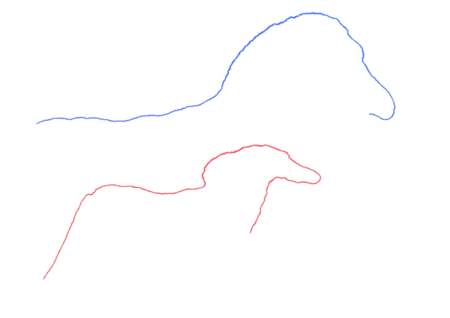
Overlaying silhouettes is the term used when one animal’s contour overlaps another’s. Such an overlap might be the trace of drawings from different eras, and what distinguishes it from an intentional technique is the general technique and pigment, the consistent shift of contours, and the proximity of the dating.
The superimposed horses. Unknown artists. Upper Paleolithic. Lascaux Cave, France.
The horses are drawn over one another. According to Azem and River, Lasco features the most instances of this overlap—about twenty animals, mostly horses [2].
Heads of Bulls. Unknown authors. Upper Paleolithic. Lascaux Cave, France.
Large black bulls in Lasko obscure the horses and the smaller red bulls. The upper figures sometimes completely cover the lower ones, while other times the lower ones peek out from underneath [1].
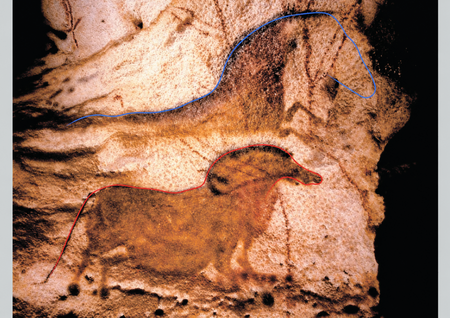
author’s schematic
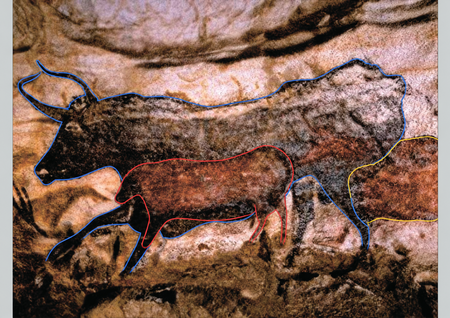
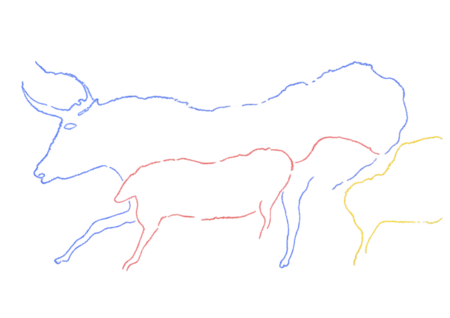
author’s diagram
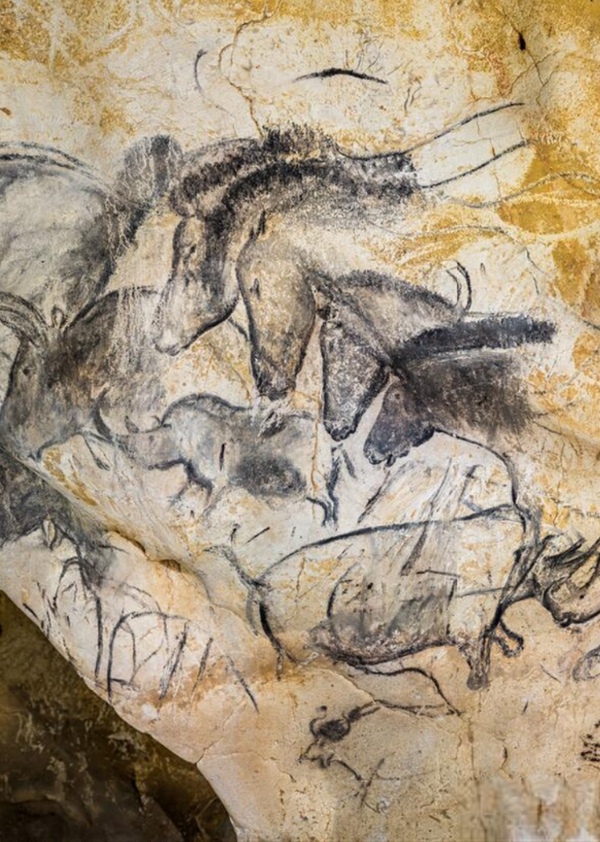
Horses Panel. Unknown artists. Upper Paleolithic. Chauvet Cave—Pont-d’Arc, France.
On the heads of several horses, they are aligned one behind the other with a slight offset. This can be read as a series of positions, but not necessarily as a single cohesive concept.
Lion Panel. Unknown artists. Upper Paleolithic. Chauvet Cave — Pont-d’Arc, France. Photograph: Arnaud Frich / National Center for Prehistory / Ministry of Culture.
This panel, named Azem and River, is referred to as the Great Panel in the Far Hall and is read like a frieze featuring lions and bison, unified in a single hunting narrative [2].
Conclusion: the overlaps in Laskò are interpreted differently. Jenest proposes two readings—the concealment of others' drawings or respect for predecessors [1], while Azem and River see the partial repetitions as unfolded phases of movement [2]. The drawing itself does not select between these interpretations. I consider the overlap as a technique for conveying movement only when the technique, pigment, and contour shift coincide.
2. REVISION
Polymorphism refers to instances where an animal has multiple legs, heads, or tails, or when a single figure is depicted in multiple positions. Azem and River documented such cases across 53 figures in 12 French caves.
Alcove of the Lions. Unknown artists. Upper Paleolithic. Chauvet Cave — Pont-d’Arc, France. Photograph: Carole Fritz, Gilles Tosello / CNRS / Chauvet Team / Ministry of Culture.
In the niche of 17 figures, among which are lions, horses, bulls, and bison.
Right-hand wall of the Alcove of the Lions. Unknown artists. Upper Paleolithic. Chauvet Cave—Pond-d’Arc, France.
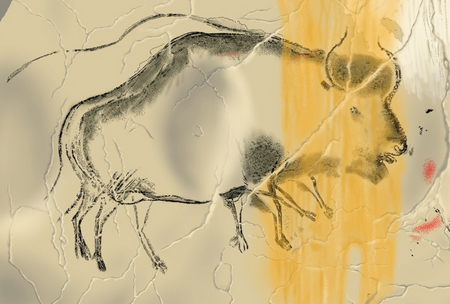
The bison retains a general contour of the torso, while the legs are shown in several positions. The repetition is concentrated in the movable parts of the body. Therefore, the figure can be perceived as a single animal whose pose is changing. Azema and River explain eight legs by superimposing sequential phases of movement. In the first chapter, independent silhouettes of animals overlapped. Here, parts of one figure are repeated. This distinction is important: several animals may form a group, whereas the additional leg positions suggest a change in pose over time.
Rhinoceroses. Fragment of the Hall of the Great Bulls panel. Unknown artists. Upper Paleolithic. Chauvet Cave—Pont-d’Arc, France. Photograph: L. Guichard / Perazio / SMERGC, 2008.
The outline of the horn and the front portion of the body are repeated in the upper figure. The shifting of the lines can be interpreted as a change in the animal’s posture. However, there is another explanation: we are looking at several rhinoceroses positioned side-by-side. Therefore, this example illustrates the boundary between conveying motion and depicting a group.
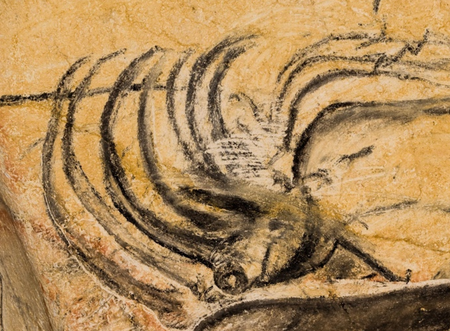
Recurring outlines of the front body and horns. A fragment of the previous image. The bison shows repeated leg positions, while the rhinoceros displays repeating outlines of the front body. Both examples allow for the interpretation of movement through line displacement. However, the rhinoceros image is more ambiguous: the repetition might represent several separate animals.