Concept
Photography is often perceived as an authentic representation of the surrounding world. In photographs, we recognize familiar objects, people, and places by their outlines and proportions. However, the apparent appearance of an object depends entirely on how it is captured. An unusual angle, optical distortion, or manipulation of the print significantly alters the familiar form. Straight lines appear curved, the human body loses its natural proportions, and real objects end up in impossible combinations. This raises the question: why do such images continue to feel convincing?
In the first half of the 20th century, photographers began to develop a new way of viewing the surrounding world. In the 1920s, avant-garde artists rejected the conventional perspective of shooting from human eye level. Alexander Rodchenko proposed photographing from above and from below, discovering unexpected geometric relationships in familiar objects [1]. Osip Brick, in his article «What the Eye Cannot See, ” wrote that „the cinematic and photographic eye can show us things from an unexpected point of view, in an unusual configuration“ [2]. Architectural structures and everyday objects began to look different because the camera highlighted lines and proportions that were invisible during ordinary observation.The camera’s placement and the frame’s boundaries determine which features of the subject the viewer will see. John Sharkovsky, in his book The Photographer’s Eye, discusses viewpoint and framing as crucial properties of the photographic image [3]. Ekaterina Lavrentyeva notes that Rodchenko’s angles allow one to „schematize the image, bringing it closer to a clear geometric structure“ [4]. Thus, the same object, while remaining unchanged, appears differently depending on where the lens is pointed.
Later, photographers began to alter the very form of the image. Curved mirrors stretch and compress figures, wide-angle lenses amplify perspective distortion when shooting from close range, and working with the print allows for modifications to the outlines of buildings. Rosalind Krauss, in her examination of surrealist photography, paid attention to experiments with reflections and combined printing [5]. Such alterations are clearly noticeable on the human body and architecture—structures familiar to the viewer. Even with significant deformation, individual details allow the original object to be recognized.
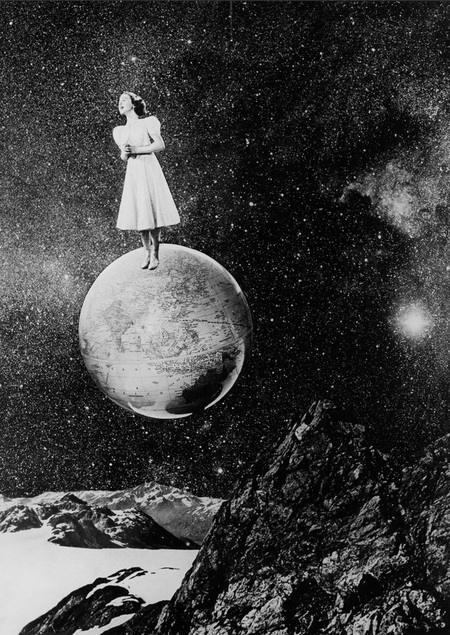
Photomontage alters the relationship between objects. People, buildings, and natural elements are combined into a single composition, even though in reality they exist in different locations and are incomparable in size. Each element appears realistic, yet the space created from them contradicts our conventional experience. The viewer recognizes the individual objects while simultaneously noticing the impossibility of their coexistence. This contradiction prompts reflection on how much our perception of reality depends on the photographic image.
Ключевой вопрос
How do experiments with form and space in 20th-century photography alter the perception of everyday reality, and by what means do even explicitly distorted images retain their visual persuasiveness?
Гипотеза исследования
Photographic distortions encourage a new perception of familiar objects by highlighting the divergence between their usual appearance and their image. Despite this, recognizable details, realistic textures, and the visual integrity of the composition allow the sense of authenticity to remain, even when proportions and spatial relationships are disrupted.
Sections
- Introduction
- A New Perspective on the Familiar
- Deformation of Architectural Form
- Deformation of the Human Body
- Disruption of Spatial Logic
- Conclusion
A New Perspective on the Familiar
Changing the shooting point reconfigures familiar forms and spatial relationships. In Alexander Rodchenko’s photographs, the low-angle view accentuates perspectival foreshortening and alters the conventional ratio of architectural elements. Balconies and staircases begin to be perceived as intersections of lines and planes, even though their actual form remains unchanged. Such angles compel a re-evaluation of the placement and scale of familiar structures [4]. The image remains authentic because only the viewpoint changes—the object itself is not distorted.
Alexander Rodchenko. From the series «House on Myasnitskaya»: «Balconies, ” 1925 / „Fire Escape, ” 1925
When photographing large architectural structures, individual elements often fill nearly the entire frame. For example, the metal components of the Eiffel Tower, as captured by Germaine Krull, form a complex intersection of lines, making it difficult to visualize the structure in its entirety. Yet, the building remains recognizable by its distinctive details, such as its filigree construction. The viewer understands that a familiar object is being presented from an unconventional vantage point and continues to accept the photograph as authentic.
Germaine Krull. From the Métal series, 1928
Ilse Bing. Le Coup de Vent, Eiffel Tower, Paris, 1931
Margaret Burk-White. Chrysler Building: Tower, 1930 / Berenice Abbott. Canyon: Broadway and Exchange Place, Manhattan, 1936.
Aerial photography alters our perception of scale and spatial organization. John Sharkovsky notes in The Photographer’s Eye that photography allows us to view the world around us from unexpected vantage points [3]. Streets, paths, and buildings lose their familiar three-dimensionality and begin to resemble a geometric pattern. From above, spatial connections become visible that are difficult to notice from the ground, yet we must reconstruct the real dimensions of the objects mentally. Thus, the frame boundaries and camera placement determine how we perceive the depicted space.
Elvin Langdon Coburn. «Octopus, ” 1912 / Laszlo Moholy-Nagy. From the Radio Tower, Berlin, 1928 / Laszlo Moholy-Nagy. Berlin, Radio Tower, 1928
The same occurs when photographing everyday objects and natural forms. An unusual perspective emphasizes the rhythm of repeating lines, curves, and perspectival reductions. The objects retain their recognizable outlines, but they are interpreted through unfamiliar geometric relationships that usually go unnoticed.
Tina Modotti. Staircase, 1924–1926 / Alexander Rodchenko. «Scots Pines. Pushkin», 1927
Deformation of Architectural Form
The conventional idea of architecture is associated with straight lines, stable proportions, and a specific arrangement of structural elements. In the photographs of Brett Weston, reflections disrupt the geometry of buildings, causing facades to curve. Because the windows and other architectural details remain discernible, the viewer can mentally reconstruct the building’s original form and perceive the extent to which the reflection has altered it.
Brett Weston: Building Reflection, 1955 / Building Reflection, Bank of America, 1975
More powerful transformations emerge in Uigji’s experimental photographs. During printing, he places curved or textured glass between the enlarger lens and the photographic paper, achieving image distortion [6]. Facades stretch and warp, acquiring an unusual plasticity. Buildings look as if they can bend and change shape. Such alterations are physically impossible, yet the photographic detailing of the surfaces maintains a connection to the real object.
Ugie. Gallery of Modern Art (distortion), 1967
When a familiar structure is distorted, a great deal relies on visual memory. For example, in photographs, the Eiffel Tower and the Empire State Building remain recognizable even after significant deformation. These familiar silhouettes allow a viewer to compare the image with the actual architecture and notice how much its geometry has been altered.
Widgi. Eiffel Tower distortion, 1959
Widge. Empire State Building distortion, 1955
Another method for altering architectural form is used by Paul Bury in his Cinétisations series. He cuts photographs into concentric fragments and reassembles them with a displacement, disrupting the continuity of lines and outlines. Stationary buildings acquire wavy contours and appear to be in motion [7]. Individual elements of the structures remain recognizable, even though their original arrangement has been altered.
Paul Bury: Le Carrousel du Louvre, 1963 / Eiffel Tower, 1963 / Eiffel Tower, 1964