Concept
This study examines the aesthetics of excess in the haute couture collections by Schiaparelli, created by Daniel Roseberry in the 2020s. Contemporary high fashion increasingly transcends conventional notions of clothing, transforming the suit into an artistic object and the fashion show into a standalone, almost theatrical event. This manifests particularly vividly in Roseberry’s work, as he engages with hypertrophied forms, illusions, anatomical motifs, and fantastic imagery. This continues the legacy of Elsa Schiaparelli and adheres to one of her core artistic principles: the interplay between fashion and art [1].
The central research question is: how does Schiaparelli Haute Couture create an aesthetic experience that transcends conventional perceptions of clothing and notions of beauty?
The research is founded on the understanding of aesthetics as a domain of sensory perception and aesthetic experience. The theoretical basis is Immanuel Kant’s treatise, «Critique of Judgment.» Kant examines aesthetic judgment through the interplay between imagination and reason, exploring the beautiful, the sublime, and the aesthetic idea. The aesthetic idea helps explain why an artistic image can evoke numerous associations that cannot be reduced to a single concept [2]. In the context of Sciaparelli, this makes it possible to view clothing as a source of complex aesthetic experience, which may encompass admiration, surprise, and tension.
Immanuel Kant’s treatise, «Critique of Judgment, ” became the primary textual source and allowed for the formation of a theoretical foundation for analyzing form, imagination, and aesthetic experience. To study Sciaparelli’s haute couture principles, official collection texts, statements by Daniel Roseberry, materials from the Victoria and Albert Museum, as well as publications from authoritative fashion journals, were selected. These sources are compared with visual material, allowing for the differentiation between the designer’s intent and independent interpretation, with Kant’s philosophical categories used as an analytical tool.
… a judgment of taste is not a cognitive judgment; consequently, it is not a logical, but an aesthetic judgment… [2, p. 40]
For this study, we selected couture collections by Schiaparelli, created by Daniel Roseberry in the 2020s, which most consistently exhibit the designer’s signature methods of artistic transformation of the costume. These include «Matador» — Fall/Winter 2021–2022, «Inferno» — Spring/Summer 2023, «Resurrection» — Fall/Winter 2022–2023, «Schiaparansiane» — Spring/Summer 2024, «Phoenix» — Fall/Winter 2024–2025, «Icarus» — Spring/Summer 2025, «Return to the Future» — Fall/Winter 2025–2026, «Agony and Ecstasy» — Spring/Summer 2026, and «Call of the Void» — Fall/Winter 2026–2027. This selection is based on the fact that exaggeration, surreal imagery, and artificiality function as means of constructing a cohesive artistic statement.The research is founded on an analysis of silhouettes, proportions, constructions, and motifs, as well as the organization of the runway shows. Visual material was curated based on the expressiveness of a specific aesthetic technique and its capacity to impact the viewer’s perception. In addition to photographs of individual looks, the study examines details, overall shots from the shows, and historical examples of silhouette transformation. This approach allows us to explore not only the garment’s form but also the conditions under which it is perceived.
Perhaps Elsa’s greatest legacy is not a collection of symbols, but a belief that impossibility itself can become a creative method [3]
The research is divided into three sections based on the principle of sequentially examining different levels of aesthetic impact: «Form and Perception, ” „Imagination and Artificiality, ” and „Spectacle and Experience.“ The first section focuses on the aesthetic perception of form, examining how the hyper-exaggeration of proportions and the alteration of conventional silhouettes affect the perception of clothing and its interaction with the human body. The second section explores the function of imagination and the perception of the artificial through anatomical constructs, fantastic imagery, and visual illusions that exist between the recognizable and the impossible. The third section is dedicated to the aesthetic experience that arises from the interaction between costume, runway presentation, and the viewer’s emotional response. This examines theatricality and sublime-like effects, visual shock, and the ambiguity of sensory perception. This structure allows for a progression from the analysis of a single object’s form to the perception of a complete artistic event.
The research hypothesis posits that the aesthetic impact of Scarparelli’s haute couture is formed through the deliberate disruption of conventional notions regarding human body proportions and material naturalness. Hyperbolized forms, artificial anatomical elements, fantastic constructions, and theatrical staging create imagery that invites multiple interpretations and transcends literal meaning. Consequently, the costume becomes a source of aesthetic experience rooted in the interplay between form, imagination, and the viewer’s emotional response. This experience is not necessarily tied to the concept of the beautiful, as its significance can manifest through the collision of contradictory feelings.
Beyond Proportion
Immanuel Kant, in the «Critique of Judgment, ” separates the aesthetic judgment from the cognitive judgment. The latter relates to defining the properties of an object, while the former relates to how the subject experiences the object’s presentation. Kant examines the beautiful, describing it as the influence of imagination and reason [2, 4]. This allows for the investigation of mood as a visual phenomenon capable of capturing attention, evoking emotion, and prompting reflection.
The subject feels how he is affected by the presentation [2, p. 41]
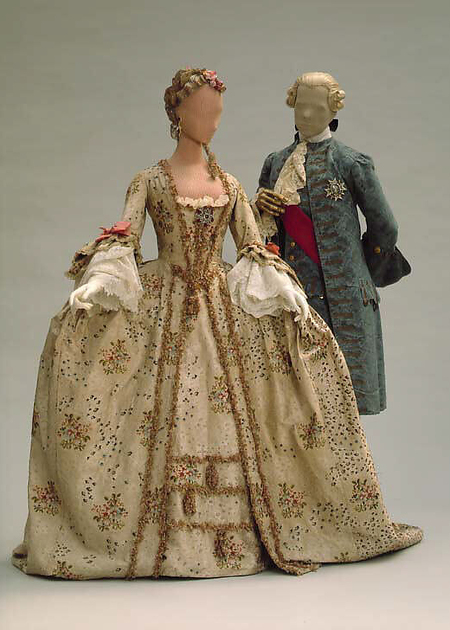
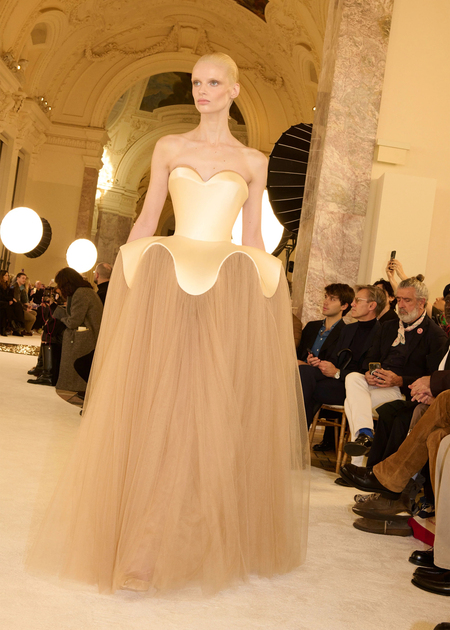
Left — «Robe à la française, ” France, circa 1770. Right — „Icarus, ” Image 3, Daniel Rosberry, Sciaparelli Couture, Spring/Summer 2025.
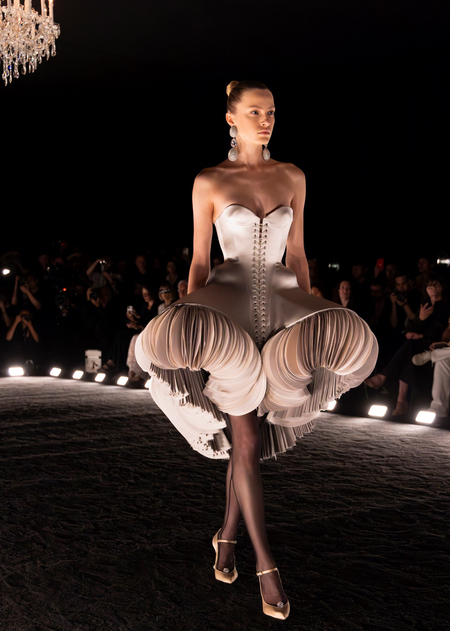
Clothing can not only replicate body proportions but also create an independent visual form. In the 18th century, special corsetry was used to significantly expand the silhouette, altering the perception of the body’s outline [5]. Daniel Roseberry uses a similar technique in the Skeparelli Haute Couture Spring/Summer 2025 collection. In both instances, the silhouette becomes an expressive device, and the aesthetic effect of perceiving an unusual form becomes the central focus.
Hyperbole as an Aesthetic Device
«Icarus, ” Daniel Roseberry, Sciaparelli Haute Couture, Spring/Summer 2025
Exaggeration alters familiar proportions of the body and clothing. Hypertrophied shoulders and hips, a strong emphasis on the waist, and elongated lines become the compositional centers of the image. Changing one part of the cut creates a new perception of the silhouette; the clothing is perceived as an independent form. In Sciaparelli’s haute couture collections, this technique shifts the viewer’s attention from the practical function of the costume to its visual expressiveness [1, 6].
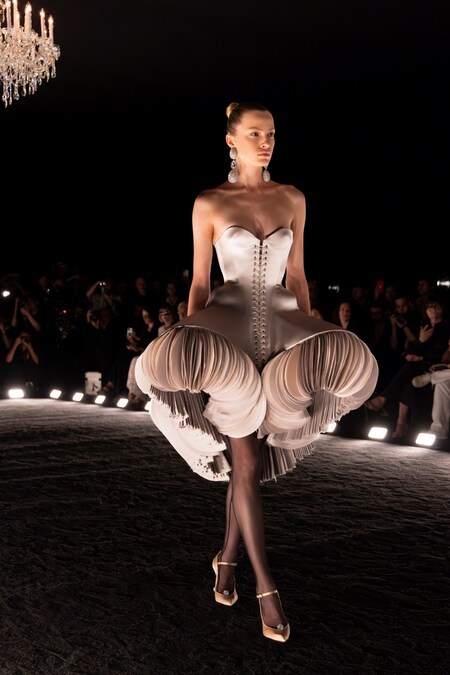
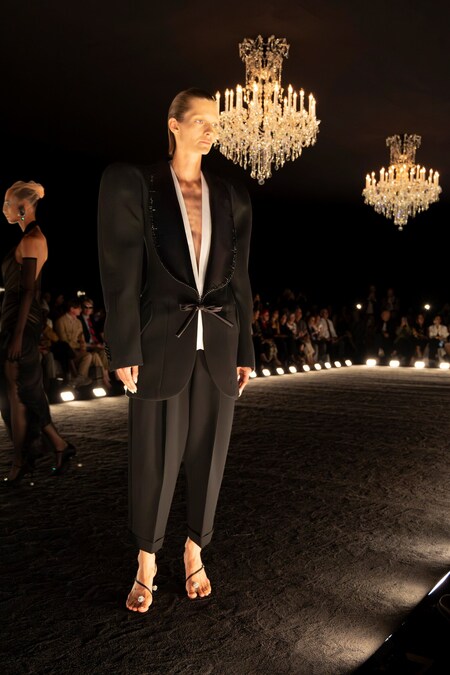
On the left and right, respectively—“Phoenix, ” Figure 10 and Figure 11, Daniel Roseberry, Sciaparelli Haute Couture, Fall/Winter 2024–2025.
… only the form of expediency in which the subject is presented—because we recognize it—can evoke favor… [2, p. 59]
«Phoenix, ” Look 29, Daniel Roseberry, Schiaparelli Couture, Fall/Winter 2024–2025.
Shaped textiles, corset foundations, and hidden boning create a sculptural silhouette [6]. These material techniques and understanding of garment construction do not explain its aesthetic impact because the viewer perceives not the techniques or supports themselves, but the tension between contrasting textures—the tension between a rigid structure and soft drapery, an unexpected rhythm of lines, the sensation of impossible balance [7]. All of this creates a expressive form, allowing the costume to be considered an artistic object.
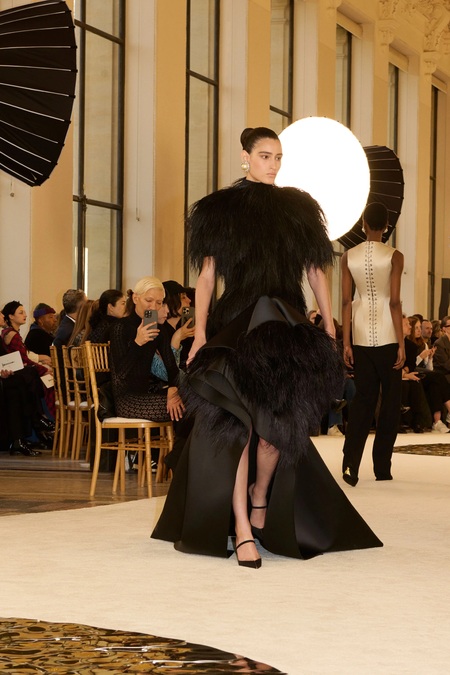
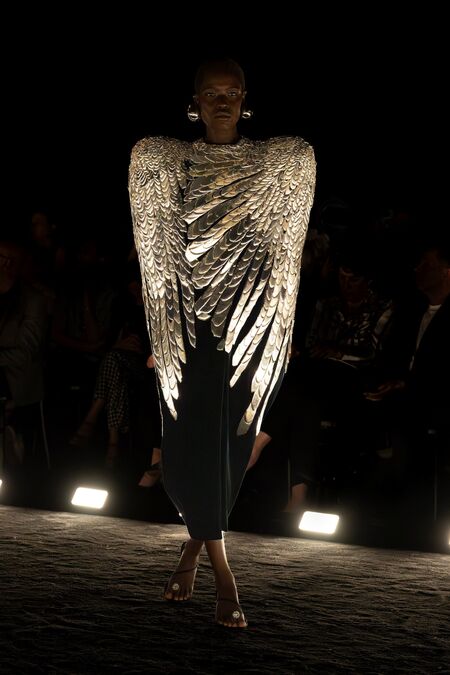
Left — «Icarus, ” Look 22, Daniel Roseberry, Schiaparelli Haute Couture, Spring/Summer 2025. Right — „Phoenix, ” Look 1, Daniel Roseberry, Schiaparelli Haute Couture, Autumn/Winter 2024–2025.
«Phoenix, ” Image 30, Daniel Roseberry, Schiaparelli Haute Couture, Fall/Winter 2024–2025
Imagination and Artifice
In Kant’s aesthetic theory, the aesthetic idea is a conception of imagination that provokes more thought than any single concept can contain [2]. An artistic image cannot be fully reflected by literal meaning; rather, it generates associations and establishes a space for the free work of the imagination [2, 4]. From this perspective, Sciaparelli’s haute couture pieces can be viewed not merely as clothing, but as prompts for contemplation on the real versus the imagined, the artificial versus the natural, and the boundaries of the human body. The aesthetic impact of the costume arises from a multitude of potential meanings that cannot be reduced to a single explanation.
… under an aesthetic idea, I understand such a conception of imagination as one that forces intense thought without being adequate to any specific idea… [2, p. 155]
«Sciaparani,» Image 6, Daniel Roberry, Sciaparelli Couture, Spring–Summer 2024
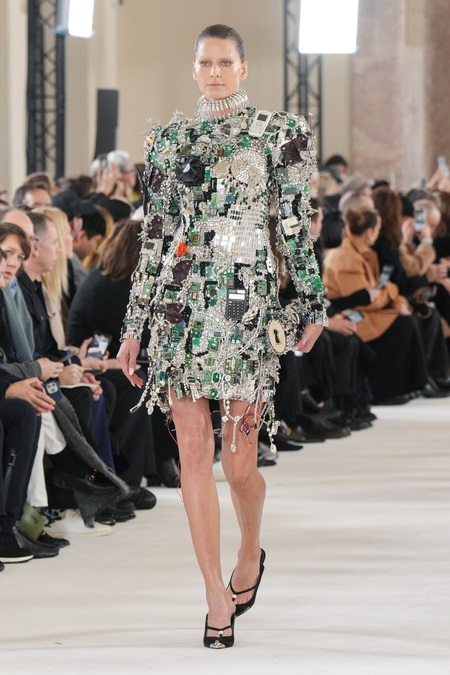
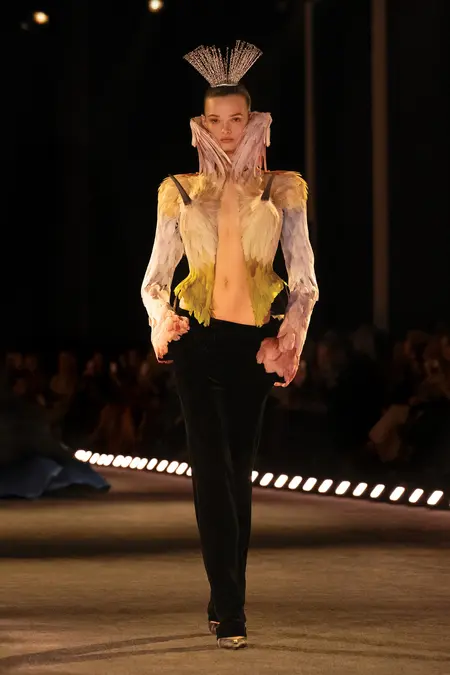
Left— «Sciaparansiane, ” Image 6, Daniel Roseberry, Sciaparelli Haute Couture, Spring/Summer 2024. Right— „Agony and Ecstasy, ” Image 29, Daniel Roseberry, Sciaparelli Haute Couture, Spring/Summer 2026.
Between the real and the artificial
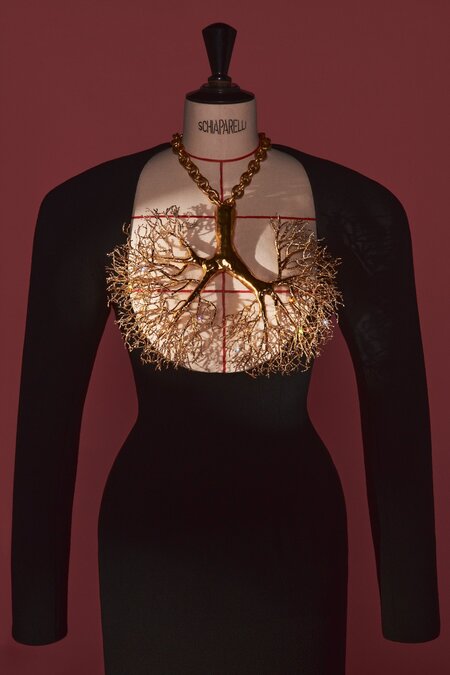
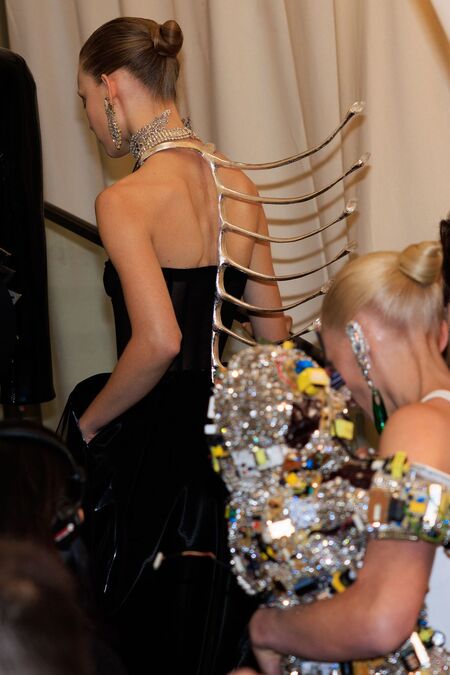
Left — «Matador, ” look 11, Daniel Roberry, Sciaparelli Couture, Fall/Winter 2021–2022. Right — „Sciaparansiane, ” look 5, Daniel Roberry, Sciaparelli Couture, Spring/Summer 2024.